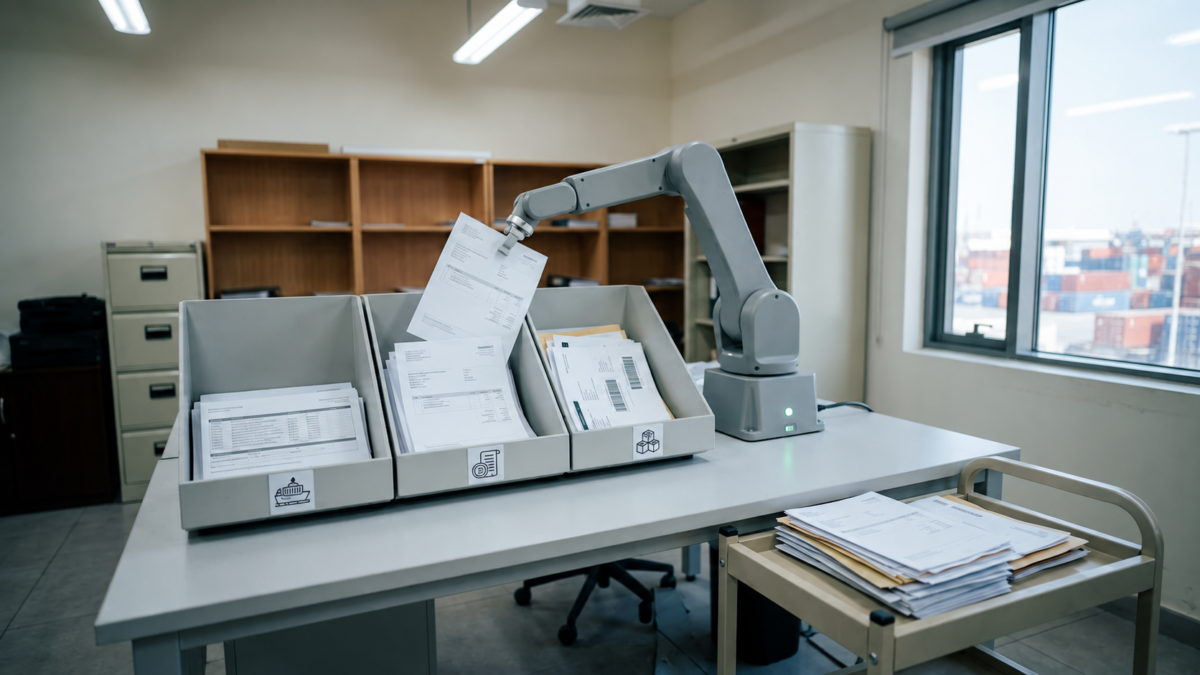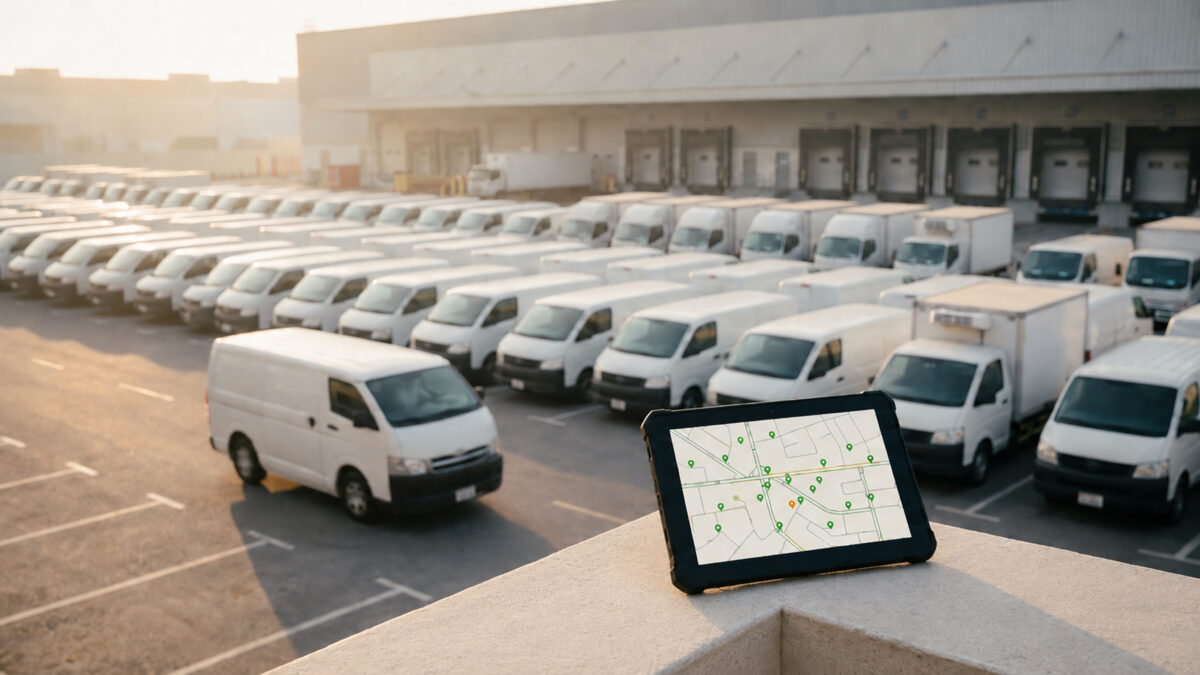
Case Study: A UAE-based FMCG distribution company operating a fleet of more than 130 vehicles across multiple Emirates and supplying over 3,000 retail outlets.
Important note on terminology: The deployed system brought together real-time vehicle telemetry, AI-assisted route optimization, predictive and rule-based workflows, automated alerts, SAP integration, driver applications, and human operational oversight. It was not intended to function as a fully autonomous AI fleet manager. In this article, “agentic AI for fleet management” refers to the next stage of operational automation. The software continuously monitors events, evaluates them using business rules and real-time context, recommends or carries out approved actions, and escalates exceptions to human teams when their judgment is needed.
A fleet may already have GPS tracking and still be managed reactively. Knowing where a vehicle is does not tell a dispatcher which delivery is at risk of missing its time window, whether a route needs to be changed, or whether a refrigeration issue could affect product quality. It also does not indicate when a vehicle should be taken out of service before a breakdown or when an unusual fuel pattern needs to be investigated. GPS shows where vehicles are, but the decisions that keep operations running smoothly require much more than a map.
This is where agentic AI can bring real value across transport, distribution, field service, and last-mile operations. The aim is not to replace dispatchers with a chatbot. Instead, it works as a controlled digital operations layer that continuously monitors approved data, spots exceptions, brings together the information needed to assess them, suggests the appropriate response, and—when authorized by the business—handles routine, low-risk tasks while keeping more important decisions with human teams.
The wider supply-chain industry is moving in this direction. Gartner has identified agentic AI and physical AI as key supply-chain technology trends for 2026, reflecting a shift toward systems that can plan, act, and adapt while still operating within clear safeguards for accountability and explainability. Gartner also expects agentic capabilities in supply-chain software to grow rapidly through 2030. For fleet operators, the takeaway is simple: visibility is only the first step. The next step is turning that visibility into coordinated action.
The core technology needed to support this is already in place. Telematics tracks vehicle locations and key events. ERP systems manage orders and customer commitments, while driver apps capture delivery activity. Routing engines evaluate different delivery options, maintenance records provide service history, and temperature sensors monitor cold-chain conditions. Agentic AI becomes valuable when these systems are connected and work together as a single decision workflow instead of remaining isolated dashboards.
The most valuable fleet use cases are not broad “AI optimization” projects. They focus on recurring operational decisions where small improvements can have a measurable impact. A good way to identify these opportunities is to look at where dispatchers, fleet managers, or branch coordinators repeatedly check different systems, determine whether something is unusual, contact someone for clarification, update records, and keep following up until the issue is resolved.
· Delivery exception monitoring: Monitor active routes, stop progress, traffic, customer windows, and driver status; identify deliveries at risk before they become late; recommend resequencing, reassignment, or customer communication.
· Dynamic route management: Reassess routes when traffic, new orders, cancellations, failed deliveries, vehicle problems, or customer delays change the plan. The agent should work within capacity, time window, product, and driver constraints rather than chasing the shortest distance alone.
· Cold-chain exception handling: Watch temperature telemetry, identify excursions, measure duration, create an event record, alert the responsible team, and preserve evidence for quality review. The system should not automatically decide product disposition where a quality professional is required.
· Predictive maintenance coordination: Combine mileage, engine hours, fault codes, prior service history, and route commitments to surface vehicles approaching maintenance risk and help schedule service at the least disruptive time.
· Fuel and idling anomalies: Compare fuel activity, route distance, idle time, and historical consumption to identify cases worth investigation. The system should flag anomalies rather than accuse a driver of theft without human verification.
· Driver-performance support: Use speeding, braking, acceleration, idle, and route-adherence events to identify coaching opportunities, while accounting for legitimate operational context such as unloading, approved rerouting, and traffic conditions.
· Digital proof of delivery: Capture signature, photo, GPS, and timestamp evidence; link it to the right delivery, update order status, and make proof immediately available to customer service and finance.
· ERP-to-dispatch orchestration: Create delivery tasks from approved ERP orders, handle cancellations or split shipments, send jobs to the route engine, and keep execution status synchronized without duplicate manual entry.
· Customer communication: Draft or send approved ETA-change notifications when service risk crosses defined thresholds. High-value or sensitive customer communication can remain approval-based.
· Exception closure and audit trail: Track who received the alert, what action was recommended, what decision was taken, and whether the issue was resolved. This turns “someone called the driver” into a measurable operating process.
Many fleet digitization projects improve visibility without improving the response. A map can show where every vehicle is. However, the dispatcher still has to monitor the fleet, compare vehicle locations with the delivery plan, identify what is going wrong, contact the driver, coordinate with the branch manager, update the customer, and keep checking for changes. The software has improved visibility, but the actual operational response still depends heavily on people.
An agentic approach changes this process. Instead of expecting someone to constantly monitor every vehicle, the system continuously checks fleet activity against the expected delivery plan and operating conditions. It can identify normal progress, detect meaningful deviations, and bring only the issues that need human judgment to the right person. This follows the same principle used in exception-based management across the supply chain: people should focus on decisions and exceptions, not spend their time acting as the monitoring system.
AWS guidance for resilient supply chain architectures also emphasizes connecting route optimization with real-time traffic data, logistics-provider information, and IoT sensor feeds. This allows routes to be adjusted as conditions change and disruptions occur. That is the kind of architecture fleet operators should aim for: a continuous decision loop that responds to what is happening in real time, rather than relying on a static plan created each morning.
The term “agentic” is often overused. A vehicle tracker is not an AI agent, and a dashboard is not one either. A route optimizer that calculates a route once can be valuable, but that alone does not make it agentic. The key difference is a controlled loop in which the system continuously assesses changing conditions, makes decisions, and takes action within defined limits.
1. Sense — Read approved operational signals: GPS, telemetry, delivery status, temperature, traffic, order changes, maintenance state, messages and system events.
2. Understand context — Relate the event to the relevant route, customer, order, vehicle, driver, branch, product constraints and service commitment.
3. Decide whether it matters — Apply thresholds, business rules, models and historical patterns to distinguish a normal variation from an exception.
4. Generate an action plan — Recommend rerouting, reassignment, customer communication, maintenance scheduling, investigation or another permitted response.
5. Act within guardrails — Execute low-risk approved actions—such as creating an exception ticket, updating status or sending an internal alert—while routing sensitive decisions to a person.
6. Verify the outcome — Check whether the exception was resolved, whether the route recovered, whether the customer was updated, and whether another escalation is required.
7. Preserve evidence — Store the source data, decision, confidence level, human approval, and resulting action so the process can be reviewed later.
This is important because transport operations are full of real-world uncertainty. Road conditions change. Drivers may lose connectivity. Customers can delay unloading. Urgent orders can come in after routes have already been released. Temperature sensors can suddenly spike, and a vehicle may deviate from its planned route for a valid reason. An enterprise system needs to handle these situations without assuming that every signal has a single, obvious meaning.
The safest approach is graduated autonomy. Fleet operators do not have to choose between keeping everything manual and giving AI complete control of the fleet. Different actions can be assigned different levels of authority based on their risk and impact.
· Read-only monitoring: the system identifies delay risk, temperature excursions, maintenance thresholds, or fuel anomalies but does not change operations.
· Recommend-and-confirm: the system proposes a reroute, delivery resequencing, maintenance window, or customer message and waits for dispatcher approval.
· Act with guardrails: the system can automatically create tickets, update internal status, send standard internal alerts, request driver confirmation, or apply low-risk routing adjustments under predefined rules.
· High-risk decisions remain human-controlled: product disposition after a cold-chain excursion, major customer commitments, disciplinary driver decisions, expensive emergency transport, or actions with safety implications should normally require authorized human review.
A production fleet agent should not depend on a single data source. It needs a well-structured architecture where each system continues to handle the work it is designed for. The ERP remains the source for commercial orders, while telematics provides vehicle and location data. The route engine handles optimization, and the driver app captures what happens in the field. The agent then brings these sources together, providing the context needed to identify exceptions, make decisions, and coordinate the right actions.
· ERP / order management: Orders, customer commitments, product requirements, branch data, cancellations, split shipments, and dispatch eligibility.
· Telematics and IoT: GPS position, speed, engine hours, fault codes, ignition, idling, fuel signals, and temperature sensors.
· Routing and geospatial services: Travel-time estimates, distance, traffic context, stop sequencing, and route alternatives.
· Driver application: Assigned work, navigation, confirmations, reason codes, proof of delivery, images, signatures, and offline buffering.
· Fleet and maintenance records: Vehicle class, capacity, service intervals, history, maintenance status, and availability.
· Event-processing layer: Normalize high-frequency telemetry, detect thresholds, suppress duplicates, and maintain the current operational state.
· Decision layer: Rules, optimization, risk models, and agent logic that determine whether an event requires action.
· Action and approval layer: Alerts, task creation, communication, route changes, status updates, and human approval.
· Audit and observability: Evidence showing which source triggered an action, what the system recommended, who approved it, and what happened afterwards.
For refrigerated transport, temperature monitoring is more than an operational convenience. It can also serve as evidence that products were kept within the required conditions during transit. The World Health Organization’s guidance for transporting temperature-sensitive products recommends on-board electronic temperature monitoring and event logging for refrigerated vehicles. While specific compliance requirements vary by product, industry, and jurisdiction, the underlying principle is broadly applicable: an AI system should preserve the original sensor data and should not replace required quality checks or human review.
A practical cold-chain agent should preserve the original temperature event, along with the threshold used, duration, vehicle, route, affected load, acknowledgement time, and resolution. It can speed up detection and coordination, but it should not make a compliance decision when the organization’s quality process requires that decision to be made by a qualified person.
The client was a large FMCG distribution company with branches across Dubai, Abu Dhabi, Sharjah, and other Emirates. Its fleet included refrigerated trucks for temperature-sensitive products, standard delivery vans, and larger vehicles for bulk transfers. The company served more than 3,000 retail outlets, including supermarkets, convenience stores, restaurants, and hotels.
The company already had basic vehicle tracking, but tracking alone had not become operational control. Dispatchers still relied heavily on spreadsheets, phone calls, and WhatsApp to plan routes, understand delays, and coordinate with drivers. The project therefore started as a broader fleet management and delivery operations initiative rather than as a standalone AI experiment.
The client’s name has been kept confidential because its fleet, branch, and operational data are commercially sensitive. The results shared below are based on outcomes reported by the client in this specific operating environment. They are intended as case-study evidence and should not be taken as a guarantee that another fleet would achieve the same results.
· Manual route planning: Routes depended heavily on dispatcher experience and driver habits. This created inconsistent route quality and made it difficult to explain why one branch or vehicle performed better than another.
· Low delivery reliability: The client reported that approximately 30–35% of deliveries were missing the intended time window. That created retailer complaints, operational escalations, and pressure on branch teams.
· Reactive maintenance: Vehicles were commonly serviced after breakdowns or driver-reported issues. Some telemetry existed, but there was no unified workflow converting it into planned maintenance actions.
· Cold-chain evidence gaps: Refrigerated vehicles did not have a consistent workflow for detecting, escalating, and documenting temperature deviations. Reviews often depended on calls, handwritten notes, or fragmented records.
· Fuel-cost uncertainty: Management believed fuel consumption was materially above optimal levels but did not have enough structured data to separate route inefficiency, idling, driver behavior, and possible anomalies.
· Driver performance without context: Speeding, harsh braking, acceleration, and idling were not consistently measured. The client wanted accountability but did not want to deploy a simplistic punitive scoring system.
· Disconnected order-to-delivery flow: The commercial order process lived in SAP, while dispatch execution was managed separately. Without integration, delivery tasks still required avoidable manual coordination.
· Too much coordination through WhatsApp: Routine status questions and route updates consumed dispatcher time because teams did not share one operational view.
aTeam designed a modular fleet management platform instead of replacing the company’s existing systems. SAP continued to handle core order and inventory processes, while the new platform served as the operational layer for delivery planning, vehicle telemetry, driver execution, exception handling, and management reporting.
Eligible orders were automatically converted into delivery tasks. The integration also handled changes such as cancellations, partial shipments, and data-validation errors, helping keep route plans aligned with the commercial source system.
Dispatchers could see vehicle locations, route assignments, delivery progress, stop status, idle time, and active exceptions in one place. The goal was not simply to put more information on a map but to give dispatchers a prioritized view of the issues that needed their attention.
The AI-assisted route engine considered delivery windows, vehicle capacity, branch locations, traffic patterns, product constraints, and stop sequences when building routes. It combined optimization methods, historical travel-time patterns, and operating rules to create practical route recommendations. Dispatchers could still review and override those recommendations when needed.
Routes could be reassessed when delays or new exceptions occurred. This marked a shift toward exception-driven fleet management, where the operating plan could adapt as conditions changed instead of being treated as fixed once vehicles left the branch.
Drivers received delivery tasks and stop details through an Android application. The app supported delivery confirmation and digital proof of delivery, including photos, signatures, timestamps, and GPS data. It also provided offline storage for areas with weak connectivity.
The platform monitored driving patterns such as speeding, braking, acceleration, idling, and route adherence. It also considered the operational context, so activities such as unloading or an approved route change were not automatically flagged as poor driving behavior.
Temperature data from refrigerated vehicles triggered real-time alerts and automatically recorded temperature deviations. This shortened the time between detecting an issue and taking corrective action, allowing operations teams to respond while the shipment was still in transit.
Mileage, engine hours, fault codes, and service intervals were used to flag vehicles that were nearing scheduled maintenance or showing early signs of service risk. The first version combined established maintenance rules with vehicle telemetry, providing practical early warnings without claiming fully autonomous failure prediction.
Fuel fill-ups, route distance, idling time, and vehicle consumption patterns were compared to flag unusual cases for branch review. The system identified potential anomalies, while branch teams reviewed the evidence and handled the investigation.
Leadership and branch teams used a common set of measures covering fleet utilization, delivery reliability, vehicle health, cost per delivery, and driver performance. This provided a consistent view of operational performance and made it easier to measure improvements over time.
The client chose to start with a limited fleet rather than commit all vehicles to an unproven workflow. The initial release covered 20 vehicles and the core operating functions: live tracking, dispatch management, driver app, route planning, proof of delivery, and telemetry ingestion. The MVP was delivered in approximately 14 weeks and validated with real drivers and routes before the solution was expanded to the full fleet.
This phased approach is particularly important when deploying agentic AI. Fleet operations involve connectivity gaps, incomplete telemetry, driver behavior, customer requirements, and branch-specific workarounds that are difficult to uncover through workshops alone. A limited pilot allows the organization to evaluate system performance in real conditions, identify edge cases, refine decision thresholds, and build confidence before expanding the system’s authority.
· Fuel cost: Client-reported fuel cost decreased by approximately 21% after rollout, attributed to better route planning, lower idling, and stronger operating accountability.
· On-time delivery: Client-reported on-time delivery increased from 68% to 94%. Dispatchers could identify at-risk routes earlier rather than discovering delays after customers escalated them.
· Vehicle breakdowns: Breakdown incidents were reported to have decreased by approximately 43% after the predictive-maintenance workflow was adopted across the fleet.
· Dispatcher workload: The client estimated roughly a 60% reduction in dispatcher workload related to manual route planning and task assignment. Dispatchers still made important decisions, but they spent less time building plans from spreadsheets and chat messages.
· Cold-chain incidents: Reported temperature violations decreased from around 15 incidents per month to around 3, an approximately 80% reduction. The improvement was linked to faster alerting, intervention, and better event logging.
· Fleet utilization: Reported fleet utilization increased from about 65% to 85%, giving management a clearer view of underused assets and branch-level capacity.
· Fuel anomaly investigations: During the first month, the client reported confirming three fuel-theft cases after the platform surfaced anomalies and the organization completed its own investigation.
· Operating model: A less quantifiable but important change was that branch heads and dispatchers increasingly used shared operational data instead of reconstructing events through calls and WhatsApp threads.
How to interpret these numbers: These figures reflect results reported by the client in one UAE distribution environment. They are not a guarantee that an AI fleet system will deliver a 21% reduction in fuel use or achieve 94% delivery performance for every operator. Actual results can vary based on route quality, network density, vehicle mix, driver behavior, branch practices, traffic conditions, customer delivery windows, telematics quality, and management adoption.
This distinction matters for credibility. Some parts of the system used AI-assisted or predictive capabilities, while others relied on optimization, event processing, or conventional software engineering. In a production fleet environment, these capabilities work together rather than operating as separate technologies.
· Route generation used data-driven scoring, historical travel-time patterns, optimization heuristics, and business constraints. It was not a general-purpose LLM deciding where trucks should drive.
· Maintenance used available telemetry and service thresholds to prioritize risk. It did not claim to predict every mechanical failure with certainty.
· Fuel monitoring detected abnormal patterns. It did not label a driver guilty of theft without human verification.
· Cold-chain monitoring used sensor events and thresholds to accelerate detection and documentation. Quality or compliance decisions remained with responsible people.
· SAP integration, offline mobile synchronization, proof of delivery, and event ingestion were conventional engineering capabilities that were essential to making the intelligent features operational.
This is also a practical way to evaluate agentic AI vendors. A capable fleet agent is rarely just an LLM. It typically combines deterministic software, optimization, event processing, machine learning, where it adds value; enterprise integrations; human approvals; and clearly defined exception rules. The value comes from how these components work together to support real operational decisions.
The existing platform already provides the data and operational foundation needed for the next stage. The focus now would be on making exception handling more autonomous in carefully selected areas. A modern fleet agent could work across telemetry, routing, and delivery systems to detect issues, assess the situation, and coordinate the appropriate response across multiple steps.
· At-risk delivery agent: A route is projected to miss a customer window. The agent checks remaining stops, vehicle capacity, nearby vehicles, and customer priority; proposes a resequence or transfer, drafts the customer ETA update, and asks the dispatcher to approve the change.
· Cold-chain response agent: A temperature excursion exceeds the configured tolerance. The agent creates an incident, identifies affected delivery tasks, alerts operations and quality, requests driver confirmation, preserves the sensor evidence, and continues monitoring until the event is closed.
· Maintenance scheduling agent: A vehicle approaches a service threshold while carrying a busy route schedule. The agent identifies lower-impact maintenance windows, checks vehicle replacement availability, and prepares a service request for fleet manager approval.
· Fuel investigation agent: An abnormal fuel event is detected. The agent gathers the fill-up record, route distance, idling history, location, and recent vehicle baseline into one investigation packet rather than forcing a manager to collect the evidence manually.
· POD exception agent: A delivery is marked complete, but required signature or photo evidence is missing. The agent asks the driver for the missing proof before the route closes and escalates unresolved cases.
· Customer-status agent: Instead of customer service calling dispatch for every ETA, the agent uses approved live status to answer routine questions and only escalates when the customer commitment is genuinely at risk.
Real-world fleet operations are rarely as predictable as a demo. Cancellations, split orders, traffic disruptions, customer delays, failed deliveries, and connectivity issues are everyday scenarios that the system needs to handle as part of its core workflows.
The first driver app worked well in the office environment but was less practical during deliveries. Real users needed larger touch targets, fewer confirmation steps, and simple workflows that were easy to use in bright sunlight, with gloves, and while moving between deliveries.
Drivers may see monitoring systems as surveillance if they feel the data is being used to find fault. The client took a more positive approach by rewarding safer driving instead of penalizing mistakes. This helped build driver trust and made the monitoring data more useful for focused coaching.
Some UAE routes passed through areas with weak cellular coverage, so telemetry and proof-of-delivery (POD) updates could not always be sent immediately. The system stored these events with timestamps and synced them once the connection was restored, while preventing duplicate entries and keeping the route history intact.
A route optimizer that cannot keep up with actual order changes can create another layer of manual data entry. Integrating it with SAP, including validation and error handling, ensured that order updates reached the routing process correctly. This integration was key to making the system practical for dispatchers and gaining adoption.
Vehicle capacity, delivery eligibility, safety limits, and mandatory business rules should use fixed rules whenever there is a clear answer. Relying on probabilistic reasoning for these decisions can introduce unnecessary uncertainty and lead to inconsistent operational outcomes.
The client was more interested in real-world fleet performance than AI benchmark scores. Fuel costs, on-time deliveries, breakdown frequency, dispatcher workload, temperature incidents, and fleet utilization were the measures that mattered when assessing whether the solution was actually delivering value.
· On-time delivery rate and percentage of deliveries at risk detected before the committed window is missed.
· Average time from exception detection to dispatcher acknowledgement and to final resolution.
· Fuel cost per kilometer, per route, per delivery, or per unit moved, depending on the operating model.
· Idle time, route deviation, and empty-mile indicators where the available data supports them.
· Fleet utilization and vehicle availability.
· Roadside breakdown frequency and planned-versus-emergency maintenance ratio.
· Cold-chain excursion frequency, duration, acknowledgement time, and resolution time.
· Dispatcher time spent on manual planning, status checking, and driver follow-up.
· Percentage of delivery tasks created automatically from ERP without re-entry.
· POD completeness and time from delivery completion to proof availability.
· Agent recommendation acceptance rate and override rate once agentic functions are introduced.
· False-positive exception rate. Too many low-value alerts can destroy trust even if the system technically detects everything.
· FMCG and retail distribution fleets with dense multi-stop routes and strict customer windows.
· Food, pharmaceutical, healthcare, or other temperature-sensitive distribution where cold-chain monitoring is important.
· 3PL and contract-distribution fleets operating across multiple branches or customer accounts.
· Companies already using GPS/telematics but still coordinating exceptions through calls, spreadsheets, and messaging apps.
· Organizations with SAP, Oracle, Microsoft Dynamics, or another ERP that need delivery execution connected to the source order workflow.
· Fleets where fuel, idle time, breakdowns, driver behavior, and asset utilization are major cost drivers.
· Operators that want to introduce AI gradually while retaining dispatcher and fleet-manager control.
A sophisticated fleet agent is not always the right starting point for every company. If the fleet is small, routes are straightforward, order data is unreliable, GPS coverage is limited, or basic digital dispatch is not yet in place, the priority may be to improve the underlying operations before introducing agentic AI. The same applies when delivery windows, vehicle records, or maintenance history are incomplete or inconsistent. Without reliable data and clear operating rules, an AI system will struggle to make dependable decisions.
A practical rollout usually starts with reliable operational data, connected order and fleet systems, and clear visibility into exceptions. Once the route and alert logic has been tested and shown to work, the company can gradually increase automated decision-making. Gartner’s 2026 guidance on supply-chain agents makes a similar point: organizations need connected, contextualized, continuously updated data and clear decision guardrails before they scale autonomous workflows.
Ask what happens after the route is generated. Can the system handle live updates, spot exceptions, take action when needed, and keep the operational records in sync?
A mature vendor should clearly explain which parts of the system rely on rules, optimization, machine learning, or LLM-based reasoning rather than simply labeling everything as “AI.”
Ask how the system records event times, temporarily stores data, removes duplicate entries, and syncs event records when a vehicle goes offline and reconnects later.
The system should be designed to handle real-world constraints such as delivery windows, vehicle capacity and type, refrigerated goods, branch cutoffs, driver shifts, urgent orders, split shipments, and cancellations.
Ask for a practical walkthrough of how orders are created, modified, cancelled, cleared for dispatch, updated, and handled when errors occur—not just a claim that “APIs are available.”
The answer should explain the confidence thresholds, when a human needs to review the case, what source evidence supports the decision, and how the agent safely stops or escalates when it is unsure instead of acting without confirmation.
Cold-chain incidents, driver safety issues, vehicle maintenance, and regulated deliveries should have clear approval rules, defined responsibilities, and limits on what the agent can handle without human oversight.
Ask to review the event history, source data, decision process, approvals, overrides, and the workflow for rolling back or correcting actions when necessary.
The solution should include role-based access, clear data retention rules, branch-level visibility controls, secure integrations, and continuous monitoring.
When an exception system generates too many irrelevant alerts, teams may stop paying attention to them, turning the system into just another dashboard.
A well-planned pilot should use a small group of vehicles, representative routes, baseline KPIs, and a defined comparison period before expanding the rollout.
The client should know how to manage rules, thresholds, route constraints, user permissions, and agent behavior after go-live without depending on the vendor for every update.
Agentic AI in fleet management is a controlled software layer that monitors fleet and delivery events, understands them in context, and recommends or takes approved actions. It can also track exceptions through to resolution. Rather than replacing telematics, routing, ERP, driver, or maintenance systems, it works alongside them to help teams respond faster and manage operations more effectively.
GPS fleet tracking shows where vehicles are and can trigger basic alerts. An AI fleet agent goes further by combining location data with orders, route plans, delivery windows, customer priorities, temperature readings, maintenance needs, and other operational information. It can then determine whether an event needs attention and recommend or take the appropriate next step.
Yes, but the level of automation should depend on the risk involved. Low-risk route changes that follow predefined rules can be automated after validation. High-value, regulated, customer-critical, or complex changes should still require dispatcher approval.
AI and route optimization can help find shorter, more reliable routes, reduce idling, improve vehicle utilization, and flag unusual fuel consumption. The savings will depend on the fleet’s existing operations and baseline performance. In the case study discussed in this article, the client reported a 21% reduction after the broader fleet platform was rolled out, but this result should not be treated as a guaranteed benchmark.
Predictive maintenance can use mileage, engine hours, fault codes, and maintenance history to identify vehicles with a higher risk of failure and prioritize servicing. However, it cannot predict every mechanical failure, especially when sensor coverage or maintenance records are incomplete.
It can continuously monitor temperature data, detect excursions, connect them to the affected vehicle and delivery, alert the responsible team, request confirmation, record the incident, and continue tracking it until resolved. Decisions about product disposition or regulatory requirements should remain with qualified personnel when necessary.
Yes. In the case study, the fleet platform connected with the client’s SAP-based order and inventory workflow, allowing approved orders to create delivery tasks while keeping later changes synchronized across systems.
The goal is usually to reduce repetitive monitoring, planning, status checks, and manual coordination. Dispatchers continue to manage exceptions, trade-offs, customer priorities, and unusual situations. The best systems help dispatchers manage more work efficiently rather than simply replacing them.
A focused pilot can often start within a few weeks once data access and integrations are ready. A full production rollout covering ERP integration, driver apps, telematics, route optimization, and multiple branches requires a larger engineering effort. In this case study, the MVP for 20 vehicles was delivered in about 14 weeks before expanding to the full fleet.
Typical inputs include order details, customer locations and delivery windows, vehicle information and capacity, GPS and telematics data, driver assignments, traffic and route information, temperature sensor data where relevant, maintenance history, fuel records, and delivery status.
Yes, especially for multi-branch distribution, last-mile delivery, cold-chain operations, and fleets that already use ERP and telematics systems. The solution should be designed around the UAE operating conditions, route patterns, connectivity, customer delivery windows, and the organization’s own safety and compliance requirements.
For many fleets, it is better to start with one measurable exception workflow rather than a full autonomous-fleet program. At-risk delivery detection, route planning support, cold-chain alerts, predictive maintenance prioritization, and proof-of-delivery exception management are practical starting points because their results can be measured clearly.
The fleet industry has spent years improving how it tracks and monitors operations. Companies can now track vehicles, capture events through sensors, digitize orders, and use route-planning systems to build efficient plans. The real operational challenge is what happens when that data changes and the business needs to respond.
This is where agentic AI can make a real difference. A useful fleet agent continuously monitors operations, spots changes that need attention, gathers the right context, and recommends or carries out approved actions. When a situation still requires human judgment, it escalates it to the appropriate person. This moves fleet technology beyond simply showing what happened and toward helping teams manage what is happening right now.
The UAE FMCG case study highlights why a strong foundation is so important. The measurable gains did not come from a single AI model. They came from connecting SAP order data, route planning, vehicle telemetry, driver activity, cold-chain alerts, maintenance, fuel monitoring, and shared operational reporting within one system. Once this decision-making foundation is in place, businesses can safely build and introduce agentic workflows on top of it.
For logistics and distribution companies exploring agentic AI, the right starting point is not, “Which AI model should we use?” Instead, ask which fleet exception is taking up the most dispatcher time or creating the biggest service risk today. Start with that issue, establish a baseline, automate the monitoring and coordination, keep the necessary approvals in place, and expand only when the workflow has proven its value.
aTeam Soft Solutions develops custom software and agentic AI solutions for logistics, distribution, and other businesses with complex operational needs. For fleet and delivery teams, our work can cover ERP integration, real-time vehicle data, dispatch systems, driver apps, route planning, exception handling, document processing, shipment tracking, and AI agents with human oversight built into the workflow.
If your operations team still spends considerable time monitoring routes, checking vehicle status, following up on delivery updates, or managing recurring exceptions manually, start with one real workflow that has a measurable impact on cost or service. Map the existing process, set clear exception and approval rules, and test the agent in real operating conditions before gradually increasing its level of autonomy.