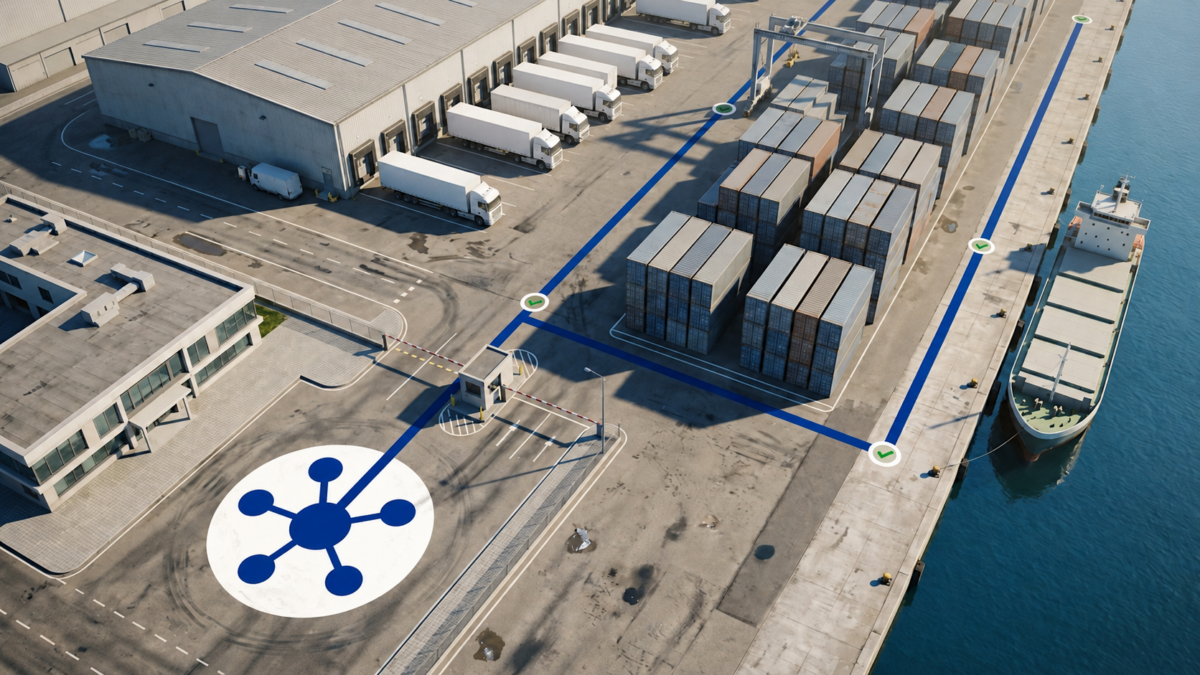
Yes, agentic AI can now coordinate much of a freight forwarder’s workflow, from the first customer inquiry to quotation, booking, documentation, shipment tracking, exception handling, delivery, and billing. However, putting one unrestricted AI agent in charge of the entire operation is not a sensible way to build a production system. A more practical approach is to use multiple specialized agents, each with clearly defined responsibilities, while keeping commercial and compliance decisions under established rules. The TMS or ERP remains the system of record, and employees retain approval authority over decisions that could create significant financial, regulatory, safety, or customer risks.
The reason is straightforward: freight forwarding is not a single task that starts and finishes in one sitting. It is a series of connected operational stages, and each stage depends on information from the ones before it. A customer inquiry leads to a quotation. Once the customer accepts the price, the team arranges the booking and creates the shipment file. Documents arrive at different times, carrier milestones change, and unexpected issues can affect the schedule. Customs requirements and delivery arrangements must also be met. Even after the cargo reaches its destination and proof of delivery is received, work may remain on supplier invoices, shipment accruals, customer billing, and financial reconciliation.
This is where agentic AI can make a practical difference. Instead of handling each request in isolation, agents can retain the relevant shipment context, use authorized tools to complete the next step, monitor incoming updates, and respond when new information becomes available. If a document is missing, a milestone changes, or a request falls outside the approved operating rules, the system can follow a defined recovery process or refer the issue to the appropriate employee.
The goal is not to replace the forwarding platform that already manages shipments. It is to create an execution layer that connects the systems and activities around it. That layer can reduce the manual coordination currently required across email inboxes, TMS screens, carrier portals, shipping documents, spreadsheets, WhatsApp conversations, and customer updates—while keeping operational control, financial accountability, and human judgment where they belong.
The phrase “end-to-end agentic freight forwarding” can describe two quite different approaches. The first focuses on coordination. The AI system tracks shipment details as a job moves from one stage to the next, connects information across systems, and handles routine tasks that would otherwise require repeated manual effort. In 2026, this kind of operational coordination is becoming a realistic option for freight forwarders. The second approach assumes AI can run the entire process independently, making decisions on pricing, routing, customs, compliance, customer communication, and financial settlement. That is a much bigger leap. For most freight forwarding businesses, handing all these decisions to a single AI system without meaningful human oversight is not a practical production goal today.
The freight forwarding industry is increasingly focusing on connecting AI agents across workflows rather than relying on one system to handle everything. C.H. Robinson, for example, has described how it maps its quote-to-cash process and uses AI agents to manage routine tasks at different stages. DHL Global Forwarding is applying agentic AI to high-volume booking activities and enriching shipment data. In September 2026, DHL and Alibaba.com also announced plans to connect quotation, booking, and shipment execution through an agentic experience for cross-border trade.
WiseTech is following a similar path with CargoWise. Its published examples show specialized AI agents supporting document processing, data entry, customs preparation, invoicing, and workflow progression. Human oversight remains part of the process, particularly when information needs to be verified, or a formal submission requires approval.
Current examples: DHL Global Forwarding booking and enrichment; DHL and Alibaba.com agentic logistics collaboration; C.H. Robinson’s Lean AI approach; WiseTech agentic AI workflow model.
For freight forwarders, the aim is to manage the entire shipment process through a connected workflow while giving AI the freedom to handle specific tasks within defined limits. A shipment can progress from inquiry and booking to documentation, tracking, and billing without repeated manual intervention at every step. However, the level of autonomy should depend on the task. Routine activities can be automated, while decisions involving customs compliance, unexpected costs, routing changes, or financial approvals should remain subject to human review where necessary.
Freight forwarding companies may use different terms and follow different procedures, but most international shipments move through a similar series of steps. Each step also affects what happens next, so a delay, missing document, or incorrect detail at one stage can create problems later in the shipment.
· Customer inquiry and shipment requirement capture
· Rate retrieval, cost normalization, pricing, and quotation
· Quote acceptance and booking preparation
· Carrier or co-loader booking and confirmation
· Job creation and shipment-data enrichment in the TMS
· Document collection, classification, extraction, and validation
· Origin operations, pickup, consolidation, and departure readiness
· Customs or trade-compliance preparation where relevant
· Milestone tracking and carrier follow-up
· Exception detection, investigation, recovery, and customer communication
· Destination operations, delivery appointment, and final-mile coordination
· Proof of delivery and shipment closure
· Customer invoicing, carrier/supplier invoice matching, accruals, and reconciliation
· Operational and financial exception closure
Most freight forwarding systems already handle the main stages of a shipment. The real delays often happen in the gaps between them. An email may arrive before the TMS record is complete. A carrier may send a revised ETA while the customer’s delivery deadline remains recorded in another system. An invoice may be ready, but a vendor cost is still missing. When a container is rolled to a later sailing, someone must confirm the change, check the next available departure, assess the commercial impact, notify the customer, and update the shipment record.
An end-to-end agentic AI system can help manage these handoffs while keeping the shipment details connected throughout the process.
It is possible to connect one AI agent to multiple tools, but that does not mean it is the right choice for a live freight forwarding operation. Different tasks involve different information, business rules, risks, and levels of authority. An agent that prepares a freight quotation, for example, should not automatically have the same access as a system that submits customs information or processes supplier payments.
A more practical approach is to divide the work into clear responsibilities. A central orchestration layer keeps track of the shipment, its current status, and the next steps. Other specialized functions handle individual tasks, such as understanding customer inquiries, retrieving freight rates, processing documents, confirming bookings, tracking shipment milestones, investigating exceptions, communicating with customers, preparing customs paperwork, generating invoices, and maintaining audit records.
These functions do not necessarily require separate AI models or standalone software products. A multi-agent architecture is about organizing responsibilities, permissions, and workflows, not simply deploying dozens of independent bots. What matters is that each function has defined responsibilities, appropriate tool access, clear operating rules, relevant context, and specific approval requirements.
Gartner’s 2026 research also points towards a gradual move to more specialized AI agents working together across supply chain processes. Most organizations are still expanding their AI capabilities step by step rather than moving straight to fully autonomous operations. A Gartner survey published in May 2026 reported that 83% of supply chain organizations were applying AI incrementally to individual use cases or gradually expanding it into connected processes. Only 17% were pursuing immediate, large-scale transformation.
An agent must be able to connect every piece of information to the correct shipment, from the initial customer inquiry and quotation to the booking confirmation, bill of lading draft, carrier updates, customs documents, invoices, and customer emails. Keeping these records connected can be difficult when different parties use different reference numbers.
For example, a customer might identify a shipment by its purchase order number, while the carrier uses a booking reference. Ocean freight records may contain a container number or bill of lading number, and airfreight shipments may use a master or house air waybill. The TMS may assign another reference entirely. In some cases, documents arrive before the shipment has even been created in the TMS.
To manage this reliably, the workflow needs a permanent internal ID for each shipment or case, along with a controlled record of the external references linked to it. AI can help identify likely matches across emails, documents, and operational systems. However, when the match is uncertain, the system should flag it for review rather than update shipment records automatically.
A freight forwarding agent must keep track of more than past conversations. It needs to know the current status of every shipment and what still needs to happen. A quotation may be awaiting missing details, rates may have arrived but still need commercial approval, or a customer may have accepted a quote while the booking remains unconfirmed. The same applies to missing documents, customs holds, pending delivery appointments, and invoices that cannot yet be processed.
This allows the system to wait for a carrier’s response and continue handling the same case the next day without losing track of what has already happened. Without persistent workflow state, the system may hold a conversation well, but it cannot reliably manage ongoing freight operations.
An agent should never turn into a second, unofficial TMS. Every important business object needs a clearly defined source of truth. For example, the TMS may own the shipment record, the ERP the posted financial transactions, the carrier its confirmed booking, and the customs authority the declaration status.
The agent can read information from these systems and carry out approved actions across them. It should not quietly replace an authoritative value just because another source seems more convincing. When records conflict, the workflow needs a defined source hierarchy and a clear rule for escalating the discrepancy.
AI is useful for tasks that require interpretation. It can read an unstructured email, find a shipment reference, summarize a carrier’s reply, or identify a likely recovery procedure.
Other decisions should follow explicit, repeatable rules. These include margin floors, credit holds, dangerous-goods restrictions, carrier eligibility, approval limits, tax calculations, duplicate-booking checks, customs-submission authority, payment limits, and customer-specific commercial terms.
A production agent should work within those rules rather than reinterpret them.
To move work forward, the system may need to connect with TMS and carrier APIs, email, WhatsApp Business, document repositories, ERP and CRM interfaces, portals, rate systems, customs platforms, and controlled RPA where an API is unavailable.
Access should depend on the job being performed. A quotation agent may need to read customer and rate information and prepare a draft quote, but it does not need permission to make supplier payments. A document agent may classify and attach files without having authority to submit a customs declaration.
Human-in-the-loop does not mean someone has to watch every action the AI takes. It means the system can recognize when approval is required, send the case to the right person with the supporting evidence, wait for a decision, and continue from the correct point once that decision is made.
This matters for commercial exceptions, unclear customs requirements, dangerous goods, unfamiliar carriers, expensive recovery options, claims, bank-detail changes, unusual customer commitments, and any action that could create a significant legal or financial obligation.
Real forwarding workflows encounter problems. Carrier APIs time out, TMS updates fail, emails arrive more than once, portals change, customers provide incomplete details, documents are misclassified, and two agents may try to handle the same shipment.
The system therefore needs idempotency, retry policies, timeouts, ownership controls or locks, event logs, and an exception queue that operators can see. Failed actions must remain visible. Retrying a step must not create a second booking or send the same customer message again.
A customer sends an email or WhatsApp message asking to move ocean freight from Dubai to Rotterdam. The message includes the origin, destination, cargo description, pallet count, approximate weight, and preferred departure week, but leaves out the Incoterm.
The enquiry agent extracts the available details, identifies the customer account, checks which required fields are missing, and flags the absent commercial term. Rather than preparing a quote with an important gap, it asks the customer for the Incoterm or sends the enquiry to a coordinator if the request needs clarification.
Once the required information is available, the agent creates or updates the opportunity or quotation case. The key design feature is that every later step should remain linked to that same case.
The rate layer retrieves approved contract and spot rates from connected sources. It puts the charges into a consistent format, including origin and destination costs, surcharges, validity dates, transit time, equipment, and service conditions. A deterministic pricing engine then applies customer-specific charges, margin rules, and minimum thresholds.
The agent can compare eligible options and prepare a quotation. If the proposed quote falls below the permitted margin or relies on a non-standard service, the case goes for commercial approval. A person can approve, change, or reject the exception, after which the workflow resumes and sends the approved quote.
The AI is not making up a price. It is coordinating approved rate information and applying established commercial rules.
When the customer accepts the quote, the workflow should move the existing case to the next state rather than launch a disconnected process. It checks that the rate is still valid, confirms whether capacity or the required sailing is available, prepares the booking request, and submits it through an approved carrier connection or forwarding platform.
When the carrier confirms, the booking reference is added to the existing shipment case. If the requested sailing is unavailable, the system looks for alternatives and presents them according to policy. It may handle a routine alternative automatically when the service and cost remain within approved limits. A meaningful change to transit time or cost should go to a person for review.
This is where the existing infrastructure is improving quickly. CargoWise carrier connectivity supports real-time planning, booking, confirmation, and shipment management with connected airlines, reducing the manual handoffs an agent would otherwise have to bridge.
The booking confirmation, customer instructions, and supporting documents now provide the information needed to create or update the operational job. An agent can organize information from emails and attachments, validate it, and write approved fields into the TMS.
DHL Global Forwarding has publicly described an agentic booking and enrichment workflow that handles 2.5 million air and ocean requests each year. Its 2026 investor material says the workflow automates more than 70 data fields, integrates with CargoWise, includes human validation, and delivered a reported 40% productivity gain. The example matters because the capability is part of the forwarding process itself, not a standalone chatbot.
Shipping instructions, commercial invoices, packing lists, certificates, dangerous-goods declarations, bills of lading, customs paperwork, and carrier confirmations tend to arrive at different times.
The document layer identifies each file, links it to the shipment, extracts the required details, checks for missing documents or fields, and compares information across the file. If the packing list says there are 48 cartons while the commercial invoice says 46, the system should not choose one figure simply because its OCR confidence score is higher.
Instead, it should retain both source values, apply the customer’s rules, and send the mismatch to the right person. If information is missing altogether, the agent can request it from the customer or supplier and leave the case open until the requirement is met.
For customs tasks, the system can reuse the shipment and document information already collected rather than making a broker enter the same details again. It can prepare data, flag missing items, compare invoice lines with product master data, find possible classifications, and assemble a draft declaration package.
The limits of its authority must remain clear. WiseTech’s published CargoWise AI workflow example describes AI personas supporting document intake, invoice data, initial customs data checks, classification, invoicing, and workflow coordination. A responsible importer or broker remains involved in verification and submission.
That is the practical meaning of end-to-end orchestration in a regulated process: information moves through the workflow, but accountability remains.
Once the cargo is moving, the agent’s work shifts from preparation to monitoring. It compares planned milestones with actual events, using carrier updates, tracking platforms, EDI/API feeds, driver communications, and terminal events to maintain the shipment’s status.
Confirmed routine milestones can automatically update the TMS and customer visibility. If a milestone is missing or out of date, the system can start a follow-up: check the trusted source, contact the carrier or driver where needed, interpret the response, update the case, and retry or escalate if the gap remains.
In its June 2026 release notes, project44 described autonomous agents that collect missing air and ocean milestones directly from carriers and freight forwarders. The information includes pickup, ETA, proof of delivery, and reasons for delays. This kind of targeted follow-up across company boundaries is a practical fit for an end-to-end forwarding workflow.
Imagine an ocean container is rolled at transshipment. A standard visibility platform may alert an operator. An agentic workflow should also check whether the roll is confirmed, obtain the revised schedule or available alternatives, assess the effect on the customer’s commitment, and determine whether the recovery plan fits the approved policy.
Project44’s Ocean Exceptions Agent follows this general approach. It detects roll risk, checks the issue with carriers, retrieves rescheduling options, and presents the findings in a structured workflow. Human operators retain the final rebooking decision.
Continuity is crucial here. The exception capability should already have the shipment’s customer, quote, margin context, delivery requirement, and earlier communications. It should not have to investigate the delay as though it were an unrelated alert.
After the delay is confirmed, the communication layer can prepare or send an update according to the agreed policy. Routine factual messages may be automated, but new commercial commitments need more care.
For example, the system can report that the carrier’s latest confirmed ETA is 18 October. It should not promise delivery by 19 October unless the forwarding company has authorized that commitment.
Keeping a verified source fact separate from a new business promise is one of the most important safeguards for customer-facing agentic AI.
At destination, the agent can coordinate delivery appointments, follow up on missing proof of delivery, check for outstanding charges or documents, and update the shipment after the physical movement is complete.
Delivery alone should not automatically mark the shipment as financially complete. Operational closure and financial closure may happen at different times.
The same case information can support customer billing and supplier-cost checks. The workflow can compare quoted selling charges with actual shipment events, retrieve or process supplier invoices, match vendor charges against bookings or purchase records, flag duplicates or unexpected accessorials, and prepare invoices or accrual adjustments.
Accounting rules and approval thresholds should remain deterministic rather than being left to a language model. The agent coordinates the supporting evidence and the handling of exceptions.
For that reason, the complete lifecycle is better described as enquiry-to-cash, not simply enquiry-to-delivery. The forwarding job is not finished until operational and financial exceptions have been dealt with.
A substantial amount of coordination can already be automated when the process is well digitized. Suitable tasks include collecting data, handling documents, preparing standard-rate quotes, preparing bookings, updating job records, collecting milestones, sending routine status messages, investigating exceptions, chasing missing documents, coordinating appointments, following up on POD, preparing invoices, and matching low-risk items.
That does not mean every shipment should move through the entire process without a person. Full autonomy becomes harder when the workflow crosses company boundaries, relies on poor-quality external data, or creates significant commitments.
· Generally suitable for higher autonomy: data extraction, normalization, routine status collection, document completeness, standard customer updates, approved TMS updates, repeatable follow-up, and low-risk exception handling.
· Usually better with approval: low-margin quotes, alternative routing with cost impact, rebooking, premium recovery, non-standard commercial terms, customs ambiguity, dangerous goods, claims, and high-value financial adjustments.
· Usually human-led: open-ended negotiation, legal interpretation, sanctions or compliance judgment, disputed claims settlement, unknown-carrier onboarding, material contract deviations, and decisions where accountability cannot be safely delegated.
The right architecture can support all three levels within the same end-to-end workflow.
A forwarder does not control every system involved. Smaller suppliers may respond only by email or WhatsApp. A carrier may provide some events through an API but leave out the exception details an operator needs. Customs portals may offer limited integration options, and a destination agent may update its own system late.
Agentic AI can work across structured systems and less formal communication channels, but it cannot produce authoritative information when none is available.
Automation becomes risky when every source is treated as equally authoritative. A planned ETA in the TMS, a carrier-confirmed ETA, a predicted ETA from project44, the customer’s requested delivery date, and an operator’s note are not interchangeable.
The workflow needs to retain where each value came from and distinguish confirmed facts from predictions, commitments, and inferences.
Freight forwarding depends on cargo, equipment, drivers, terminals, warehouses, aircraft, vessels, ports, customs officers, and customers. A digital agent can coordinate the work between them, but it cannot remove the physical uncertainty of the transport network.
The cheapest option on paper may harm a strategic customer relationship. Paying for premium recovery may be worthwhile if a customer’s production line is at risk. A margin exception might make sense for a valuable annual contract. AI can gather evidence and help assess these choices, but commercial context cannot always be reduced to one universal rule.
Customs, dangerous goods, export controls, sanctions, tax, and financial processes may require authorized individuals or legally accountable entities. An end-to-end workflow should involve those people at the appropriate stage, not attempt to bypass them.
One agent may be sufficient for a small, tightly defined process. Across a broader forwarding lifecycle, specialization is usually easier to control. Quotation, documents, booking, exceptions, customs, and finance can be handled by separate capabilities, each with its own tools and permissions but all working from a shared shipment state.
The orchestration layer determines which capability should act next. This limits the impact of mistakes and makes performance easier to evaluate. For example, a document-classification error can be measured separately from an error in quotation or billing.
This also fits Gartner’s 2026 direction toward collaborative multiagent systems and groups of specialized agents for multi-step supply-chain work. The point is not to maximize the number of agents; it is to give each capability a clear, manageable responsibility.
The TMS becomes more important, not less. It provides the operational backbone, core records, workflow history, financial context, permissions, and integration points that agents rely on.
Replacing a TMS just to introduce agentic AI is rarely the best first step. A more practical approach is to keep the TMS as the authoritative operational platform and let agents work around and through it. Platforms such as CargoWise are adding agentic capabilities to their workflows, while custom agents can also connect to existing TMS, ERP, CRM, WMS, email, and carrier systems.
The next articles in this series look more closely at two related questions: whether agents can work with existing enterprise systems and whether a logistics company needs to replace its TMS.
Document the shipment lifecycle from initial inquiry through financial closure. Identify the systems, documents, queues, handoffs, approvals, waiting periods, and common exceptions. At this stage, the aim is to understand where work gets delayed, not to automate everything immediately.
Connect the relevant data sources and establish shipment identity and workflow state. Let the agent summarize progress, point out missing information, and recommend next steps without taking external action.
Allow the system to draft quotes, booking requests, TMS updates, carrier emails, customer messages, document requests, and invoice actions. Users confirm those actions while the business measures reliability across the process.
Move high-volume, repeatable actions into controlled execution once they prove reliable. Routine follow-ups, data enrichment, status updates, document requests, and other reversible tasks can often proceed with minimal human involvement.
After the workflow demonstrates reliable identity matching, source handling, business-rule enforcement, integrations, and failure recovery, the organization can consider extending autonomy to more consequential steps. Some decisions may need to remain approval-based permanently.
This gradual approach reflects current industry guidance. Gartner has cautioned against monolithic transformations and premature high-risk autonomous use cases. DHL has also described an ROI-led approach focused on high-volume, well-defined processes with strong data quality.
Measure the shipment journey, not just the AI model. Extraction accuracy and model evaluations help diagnose problems, but they do not show whether the overall forwarding operation has improved.
· Enquiry-to-first-quote time
· Quote handling minutes per shipment
· Quote-to-booking conversion time
· Booking processing time and rework
· Manual TMS data-entry minutes
· Job-file completeness at defined milestones
· Number of manual carrier follow-ups per shipment
· Exception detection-to-resolution time
· Percentage of exceptions resolved without operator investigation
· Customer status enquiries per shipment
· On-time milestone and delivery performance
· POD collection time
· Delivery-to-invoice time
· Supplier invoice exception rate
· Revenue leakage or missed-charge rate
· Human touches per shipment
· Escalation rate by workflow stage
· Failed or reversed agent actions
· End-to-end workflow completion rate without unplanned manual intervention
A program can deliver strong results even if people still control one or more stages. Much of the financial benefit comes from removing repeated handoffs, searches, re-entry, and follow-up across the shipment lifecycle.
A forwarder can introduce several impressive AI tools and still end up with a fragmented operation. One agent summarizes emails, another extracts documents, a chatbot answers status questions, and a separate model predicts ETAs. If those tools do not share shipment context and workflow state, employees must still connect the process themselves.
This is where end-to-end orchestration is more essential than the number of AI features. The system needs to know the shipment’s current stage, what must happen next, who has authority, which evidence is missing, and what conditions must be met before the workflow can close.
In August 2026, Gartner published a logistics research note titled ‘Stop Managing Logistics by Function. Start Orchestrating End-to-End Workflows With AI.’ The message is relevant to forwarders: the opportunity is not only to speed up each department, but also to reduce the coordination burden between them.
· How do you maintain one shipment identity across enquiry, quote, booking, documents, tracking, exceptions, and billing?
· Where does persistent workflow state live?
· Which system remains the source of truth at each stage?
· How do you distinguish carrier-confirmed data from predictions and inferred information?
· Which commercial, compliance, and financial rules remain deterministic?
· Can different agent capabilities have different permissions?
· How do you prevent two agents from acting on the same shipment at the same time?
· How are retries made safe and duplicate bookings or messages prevented?
· What happens when the TMS, carrier API, customer email, and tracking platform disagree?
· Which actions require approval and why?
· Can the workflow resume correctly after a human approval or a two-day external delay?
· Can an operator see every action, source, rule, and reason that moved the shipment to its current state?
· How does the system enter safe/manual mode if an integration fails?
· How do you evaluate reliability across the full workflow rather than only model accuracy?
· What part of the workflow has actually run in production, and what is still a roadmap capability?
One agent can be connected to many tools, but separating responsibilities is generally safer in a production environment. A workflow orchestrator can track the shipment’s overall progress while specialized capabilities handle quotation, documents, booking, exceptions, customs, customer communication, and finance.
Routine, low-risk tasks can increasingly be handled with little or no human input. High-impact commercial, regulatory, safety, and financial decisions should still require approval unless the company has tested and explicitly authorized a narrowly defined autonomous process.
No. In most cases, the existing TMS should remain the operational system of record. The agentic layer coordinates work across the TMS and the systems around it. Some modern TMS platforms are also adding agentic capabilities directly to their workflow engines.
Yes, provided the required interfaces are available and access is controlled. Email and WhatsApp can carry unstructured messages, APIs can connect carriers and enterprise systems, and browser automation or RPA can support older portals when needed.
The workflow should register the change, identify which later steps it affects, and recheck rates, capacity, documents, booking details, and commercial approvals as necessary. It should not continue blindly with assumptions from the original quote.
Yes, although the workflow rules, identifiers, data sources, carrier connections, milestones, and document requirements differ by mode. The overall orchestration design can be shared while the mode-specific processes remain separate.
They can, as long as each transport leg is represented clearly and the relevant carrier information, milestones, documents, and handoff rules are available. Multimodal work adds complexity because the system must preserve dependencies between legs and avoid applying information from one mode to another incorrectly.
Completion should be based on defined workflow conditions, not on the model’s own judgment. These might include confirmation of delivery or the final milestone, POD capture where required, complete mandatory documents, closure of operational exceptions, creation of customer billing, matching or accrual of supplier costs, and clearance of any financial holds.
Not as a universal way of operating. Standard shipments with good digital data can reach high levels of automation, but forwarding still involves uncertainty across companies, physical execution, compliance duties, negotiation, and customer-specific judgment. Selective autonomy is realistic; unrestricted autonomy is not the right target.
Persistent workflow state linked to a reliable shipment identity. Without it, the system cannot safely connect events and actions over time. Model quality matters, but state management, identity resolution, business rules, integrations, permissions, and recovery behavior are what make the workflow dependable in practice.
Start with one or two high-volume stages, but design the data and workflow foundations so those stages can connect later. This avoids a risky, all-at-once transformation without leaving each pilot as another disconnected tool.
The focus shifts from routine checks, duplicate data entry, follow-ups, and status updates to resolving exceptions, making commercial decisions, managing customer relationships, maintaining compliance, and improving the rules that guide agent decisions.
Agentic AI can manage tasks across the full freight-forwarding process, but the emphasis should be on working across the workflow, not operating without human involvement. The real value comes from keeping a shipment moving through quotation, booking, documentation, execution, exception handling, delivery, and finance without repeatedly switching between disconnected inboxes and manual handoffs.
A practical approach combines existing business systems with an agentic execution layer. The TMS remains the source of operational records, while APIs and RPA handle authorized actions. Predictive models provide forecasts, and fixed rules protect margins, compliance, and approval processes. Specialized agents interpret the available information and coordinate the next steps. People retain responsibility for decisions where mistakes could have significant commercial or operational consequences.
For freight forwarders, this is a more useful goal than aiming for ‘complete autonomy.’ A shipment can benefit from end-to-end agentic AI even when people remain involved in key decisions. What matters is reducing the need for employees to repeatedly gather the same information, chase updates, and reconnect disconnected parts of the workflow at every handoff.
aTeam Soft Solutions develops custom agentic AI and enterprise automation for logistics, freight forwarding, transportation, trading, and supply chain operations. Our logistics work includes freight quotation, document intelligence, shipment exception handling, customs workflows, supplier ETD monitoring, dispatch, fleet operations, accounts payable, demand planning, and enterprise integrations.
For end-to-end forwarding automation, our preferred approach is to retain existing TMS and enterprise platforms as the authoritative systems, build a shared workflow and context layer around them, and expand agent permissions in stages. Teams keep control while agents handle repetitive coordination between systems.