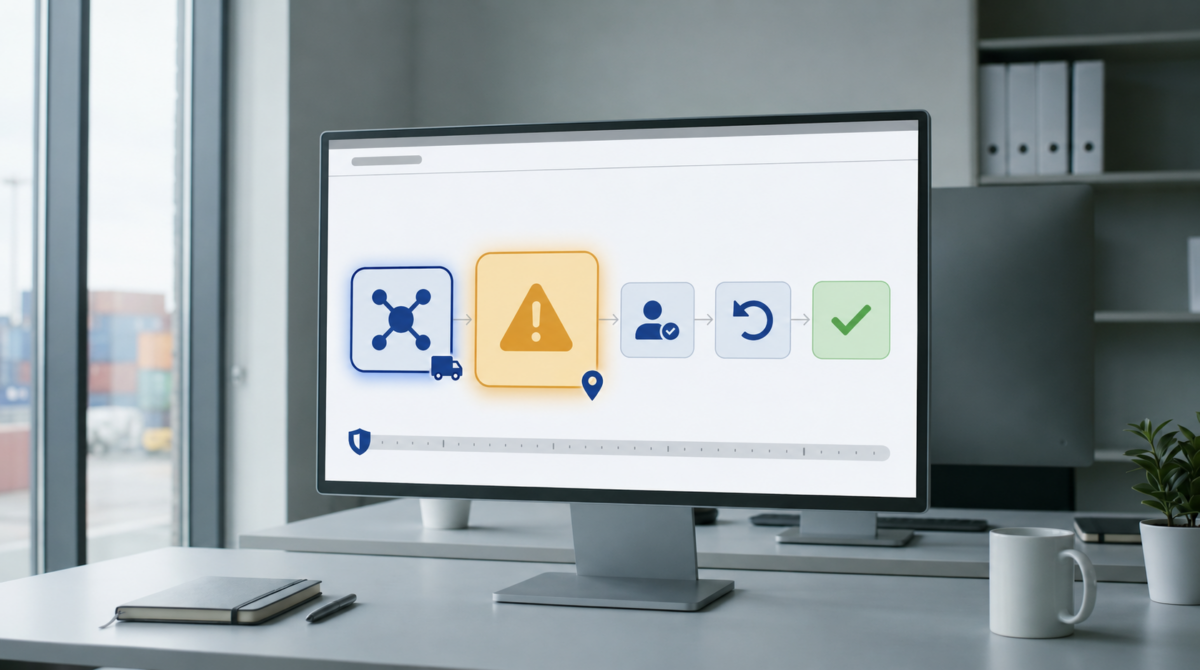
Logistics companies should avoid giving AI agents complete control over decisions that could lead to serious legal, financial, safety, regulatory, contractual, or reputational problems. In these situations, the agent can still handle most of the routine work, including collecting evidence, checking information across systems, identifying unusual cases, preparing recommendations, comparing possible outcomes, drafting communications, and getting actions ready. However, the final decision should remain with a qualified professional who can take responsibility for the outcome.
Simply keeping a person involved at every stage of an automated process is not a practical solution. Requiring employees to approve every routine update or low-risk activity can bring back much of the manual work that automation was intended to eliminate. Human approval should be reserved for situations where a mistake could have serious consequences, an action is difficult to reverse, the available information is unclear, or the decision involves legal or commercial responsibility.
For logistics leaders, the important question is no longer whether AI agents can perform particular tasks. Modern agents can already read shipping documents, compare freight rates, communicate with carriers, update operational systems, prepare bookings, investigate shipment delays, reconcile invoices, and coordinate activities across multiple workflows. The real challenge is deciding how much authority an agent should have and knowing when a decision needs to be handed over to a person.
Most AI demonstrations focus on the tasks an agent can complete. A production deployment needs to answer another equally important question: which actions must the agent stop before taking without human approval?
This distinction matters when moving from a controlled demonstration to everyday logistics operations. An agent may perform well during routine situations but encounter problems when information is incomplete, instructions conflict, or an action carries consequences beyond the immediate workflow.
The aTeam Logistics & Agentic AI Blog Writing Playbook highlights this requirement. It recommends identifying decisions that should remain under human control, including unresolved customs classification, onboarding unfamiliar carriers, large financial commitments, dangerous goods, changes to bank accounts, legal interpretation, and unusual contractual conditions.
These restrictions are not a reason to slow down automation. They allow businesses to automate routine work with greater confidence because the system knows when a case needs attention.
A practical operating model gives agents responsibility for repeatable coordination while keeping people in charge of decisions that could affect the company’s legal position, financial exposure, safety obligations, or commercial relationships.
Before allowing an AI agent to complete a logistics task independently, consider four things:
A routine shipment milestone update is usually straightforward. When a trusted carrier API confirms that a shipment has departed, the agent can update the TMS. The information comes from an approved source, the action is easy to correct, and the update does not normally create a new commercial obligation.
Customs classification involving conflicting product information presents a different situation. An incorrect declaration can lead to penalties, delays, additional costs, or regulatory action. Correcting the problem after submission may not be straightforward, and the importer, customs broker, or authorized professional may remain accountable.
The agent can collect the relevant documents, compare previous entries, identify possible classifications, and explain the differences. It should not make the final decision simply because its model produces a confident answer.
Gartner’s 2026 guidance on human oversight follows a similar approach. Its research recommends placing human supervision according to risk, reversibility, and confidence instead of requiring approval for every automated action. Gartner’s supply-chain guidance also cautions against introducing high-risk autonomous processes before suitable controls, escalation procedures, and audit arrangements are established.
Current research: Gartner – How to Keep Humans in the Loop in Agentic Systems; Gartner – Agent Washing Risks in Supply Chain Planning.
AI can make customs preparation considerably faster. However, allowing an agent to decide a product’s classification without sufficient supporting evidence creates unnecessary regulatory risk.
An agent can review commercial invoices, product descriptions, technical specifications, previous customs entries, product master records, certificates, and broker correspondence. It can suggest possible HS headings, compare classification options, identify missing information, retrieve relevant rulings, and prepare the declaration for review.
The difficulty arises when the available information does not support one clear classification. Two products that appear similar may require different classifications because of their composition, intended function, manufacturing process, or applicable customs interpretation. An agent may select an incorrect code because the product description does not contain the details needed to distinguish between them.
This can have consequences beyond a delayed shipment. U.S. Customs and Border Protection’s informed-compliance guidance explains that importers of record are expected to exercise reasonable care when entering, classifying, and valuing goods. Classification can also affect quotas, restrictions, embargoes, and other import requirements. Responsibility varies across jurisdictions, but the underlying concern remains the same: customs decisions carry formal obligations.
Example regulatory context: U.S. CBP – Classification and reasonable care guidance.
A better approach is to let the agent handle document preparation, research, and initial classification suggestions. Unresolved questions involving product classification, country of origin, valuation, permits, sanctions, or restricted goods should go to the responsible customs professional.
There may be opportunities to increase automation later. For example, an approved product classification supported by a binding ruling and reliable product master data can provide a stronger basis for automating repeat shipments within that product family.
Dangerous-goods operations offer several opportunities for automation, particularly in document checks and shipment screening. However, the final decision about whether an uncertain shipment is safe to transport should not be left entirely to an AI agent.
The agent can examine product records for dangerous-goods indicators, check whether required documents are available, compare declared quantities with packing details, identify missing labels, retrieve handling instructions, and prevent a shipment from progressing when mandatory information is missing.
The concern is allowing the system to decide that a shipment is safe when the available information does not support that conclusion.
Dangerous-goods classification, packing, labeling, documentation, segregation, and acceptance involve direct safety responsibilities. In air cargo, IATA requires consignors to prepare a declaration confirming that dangerous goods have been packed, labeled, and declared in accordance with the Dangerous Goods Regulations.
Reference: IATA – Dangerous Goods Shipper’s Declaration.
The agent should help prevent incomplete or inconsistent information from moving through the shipping process. When classification or acceptance remains uncertain, a trained and authorized professional should make the final decision.
Bringing a new carrier into the logistics network may look like a routine administrative activity. The actual risk becomes clear when the company discovers that the transport provider has invalid insurance, missing operating authority, unsuitable equipment, incomplete security credentials, questionable banking information, or an unacceptable compliance record.
An AI agent can make the onboarding process more efficient by collecting registration documents, extracting company details, checking expiry dates, validating required fields, consulting approved external databases, and identifying differences between company names and payment information.
This removes much of the repetitive work involved in preparing an onboarding file.
However, approving an unfamiliar carrier without proper review can expose the business to fraud, cargo security problems, insurance disputes, sanctions issues, and financial losses. A certificate that appears genuine and a company name that matches an internal record do not necessarily establish that the organization is trustworthy.
The risk increases when the same agent can approve the carrier and authorize a new payment destination. These responsibilities should not be combined without independent controls.
Once the carrier has passed verification and operates under an approved agreement, many routine activities can be automated. The important distinction is that establishing trust with a new transport partner requires stronger evidence and accountable approval than managing an existing approved relationship.
AI agents can handle several accounts payable activities with limited intervention. They can match invoices against purchase orders, identify duplicate bills, compare accessorial charges, check contracted freight rates, and prepare entries for the ERP.
However, a supplier email requesting a different bank account should never be treated as an ordinary invoice update.
A change in payment details can create substantial financial exposure. Fraudsters may impersonate suppliers, intercept legitimate email conversations, or send convincing requests using compromised business accounts. Once a payment reaches the wrong account, recovering the money may be difficult.
The agent should identify the requested change, pause the payment process, retain the existing bank information, collect the relevant evidence, and send the request through the company’s independent verification procedure.
The same precautions should apply to unusually large payments, unexpected refunds, and transactions that fall outside approved financial limits.
There is no need to introduce manual approval for every normal invoice. Routine transactions can continue through automated processing while unusual payment instructions receive additional verification.
AI agents can review contracts and check their clauses against the terms a company has already approved. They can flag indemnity provisions, liability caps, service commitments, payment conditions, detention and demurrage charges, insurance requirements, and operational obligations that fall outside the usual agreement.
This gives the legal and commercial teams a clearer starting point for their review. Instead of reading every clause from scratch, they can see what differs from the standard contract and understand how those changes could affect day-to-day operations.
The risk arises when an agent is allowed to make the final legal or commercial decision. Agreeing to an unusual liability clause, giving up a contractual safeguard, promising a service level the business cannot meet, or interpreting unclear force-majeure wording can expose the company to obligations that extend well beyond a single shipment.
The agent should make contract reviews faster and more focused, not replace the people responsible for approving the terms. Agreements that follow approved standards can move through an automated process. Any unusual clause or material change should be referred to the appropriate legal or commercial owner.
AI agents can support freight procurement by requesting quotations, comparing carrier offers, checking available capacity, calculating total transportation costs, reviewing historical performance, and preparing counteroffers within approved limits.
For straightforward transactions, these capabilities can reduce the time procurement teams spend collecting and comparing rates.
Long-term carrier decisions involve more than finding the lowest quotation. A transport partner may be important because of peak-season capacity, network coverage, service reliability, claims handling, equipment availability, or commitments made to major customers.
A low rate may not be the best commercial decision if the carrier cannot support the company’s operational requirements.
Gartner has identified cross-enterprise negotiation and dynamic cost trade-offs among the high-risk autonomous supply-chain activities that businesses should approach carefully. This is particularly relevant when AI agents are being considered for freight procurement.
A controlled negotiation model gives the agent permission to work within an approved carrier list, lane, service level, pricing range, and margin limit. If the discussion moves toward a strategic carrier award, long-term volume commitment, contract revision, or major change in commercial terms, the responsible procurement manager should take over.
Shipment exception management is a strong candidate for agentic AI because it involves repeated investigation, information gathering, and communication across different systems.
An agent can identify a rolled container, confirm the disruption with the carrier, retrieve alternative sailing schedules, estimate the delay, review customer delivery commitments, compare available routes, and calculate additional transportation costs.
This can remove hours of manual investigation from the operations team’s workload.
However, selecting the recovery option may involve competing commercial priorities. The company may need to balance transportation costs, customer importance, contractual obligations, inventory urgency, and the potential impact on an ongoing business relationship.
For example, moving a delayed shipment to premium air freight may protect a customer’s production schedule but create a substantial additional cost. The agent can calculate the options, but the decision to accept that expense may require management approval.
Project44’s Ocean Exceptions Agent demonstrates a useful division of responsibilities. The agent can identify roll risks, confirm exceptions with carriers, retrieve rescheduling options, and prepare the case for review. Final rebooking and scheduling authority remains with the human analyst.
Current example: Project44 – Ocean Exceptions Agent.
The objective is not to restrict what the agent can investigate. It is to automate the work leading up to the decision while keeping significant commercial commitments under accountable control.
Cargo claims involve a large amount of documentation, making them suitable for AI-assisted investigation. An agent can collect bills of lading, proof of delivery, photographs, survey reports, invoices, customer correspondence, temperature records, tracking information, and insurance documents.
It can also identify missing evidence, arrange the events into a timeline, check relevant contractual deadlines, and prepare an initial estimate of the potential financial exposure.
The final decision is more complicated. Settling a claim may require an assessment of legal liability, insurance coverage, negligence, the cause of the loss, contractual exclusions, and the commercial relationship with the customer.
These decisions cannot always be reached through document extraction or automated comparison.
A better approach is to use the agent for claims preparation and initial assessment. It should organize the information and highlight unresolved issues so that the claims manager, insurer, adjuster, or legal representative can concentrate on the decisions that require professional judgment.
Customer-facing AI agents can handle many routine logistics inquiries. They can provide confirmed delivery estimates, explain that customs clearance is pending, share requested documents, and communicate whether a booking has received carrier confirmation.
However, responding to an unhappy customer should not automatically give an agent permission to offer financial compensation or make a new commercial commitment.
For example, an agent should not independently promise free storage, waive transportation charges, guarantee a delivery date that operations cannot confirm, or agree to compensation outside the customer’s contract.
The difference is between sharing verified information and creating a new obligation for the company.
The agent can prepare a response using the customer’s service agreement, shipment history, approved service levels, and compensation policy. If the proposed response goes beyond those limits, the account manager or operations manager should review it before it is sent.
AI can improve dispatch planning by matching available drivers with suitable vehicles, checking working hours, comparing routes, reviewing equipment availability, and preparing transport assignments.
These tasks can be automated when the operating rules and safety requirements are clearly defined.
The system should never bypass an unresolved safety condition simply to keep a delivery on schedule. Uncertainty involving driver eligibility, vehicle condition, route restrictions, cargo requirements, dangerous goods, weather conditions, or legally permitted driving hours should stop the assignment until the issue is resolved.
This becomes particularly important as agentic AI moves beyond administrative work and begins influencing physical logistics operations.
DHL’s September 2026 Logistics Trend Radar describes the shift from AI-assisted activities toward systems that can plan and take action. It also emphasizes that logistics remains a people-driven industry and that safeguards and human oversight become increasingly important as intelligent systems receive greater operational responsibility.
Current industry view: DHL Logistics Trend Radar 8.0 – AI takes action while people remain central.
The examples above should not be treated as a permanent list of activities that AI agents can never perform independently. The appropriate level of automation depends on the evidence, controls, and operating conditions available to the business.
Consider customs classification. A product that currently requires manual review may become suitable for automated processing after the company obtains an applicable binding ruling and connects the approved classification to reliable product master data.
The same applies to carrier onboarding. If the company integrates trusted registration databases, insurance verification, and independent payment controls, it may be able to automate more of the process for known types of transport providers.
Rebooking decisions can also become more autonomous. For example, a low-value shipment may be moved to an approved alternative sailing automatically when the additional cost remains below a defined limit.
The important point is that greater autonomy should follow a reduction in operational uncertainty. It should not be granted simply because a newer AI model appears more capable.
Gartner’s October 2026 guidance on agent reliability makes a related argument: businesses need to establish reliable operating conditions before increasing the authority given to AI agents. Greater autonomy also increases the potential consequences of unintended actions or misuse.
Current research: Gartner – AI Agent Success Requires Reliability Before Autonomy.
Poorly designed approval processes can create a new problem. If employees must approve every extracted document field, drafted email, milestone update, and routine system change, they will spend much of their time checking the agent instead of managing logistics.
The approval point should be placed immediately before the decision that carries the actual business risk. In customs preparation, the agent can collect documents, check product information, compare previous entries, and prepare the classification details before sending unresolved questions to a customs broker. In shipment exception management, it can investigate the delay, calculate alternative routes, and estimate additional costs before asking a manager to approve an expensive rebooking.
In accounts payable, it can process thousands of standard invoices while sending only unusual payment instructions, changed bank details, or significant discrepancies for review.
People should receive a complete decision summary rather than a long list of unexplained exceptions.
A useful approval package should include:
This gives the reviewer enough information to make a decision without repeating the investigation already completed by the agent.
| Decision type | Typical treatment | Agent’s role | Human role |
| Low-risk, reversible, well-grounded | High autonomy | Execute and verify | Monitor exceptions |
| Low-to-medium risk with clear thresholds | Guarded autonomy | Execute inside policy | Approve threshold breaches |
| High-impact but well-supported | Prepare and recommend | Gather evidence and propose action | Make final decision |
| Ambiguous regulatory, legal, safety or financial decision | Human-controlled | Research, compare, flag uncertainty | Own and authorize decision |
This matrix helps separate the work an agent performs from the authority it receives. The same AI agent can operate at different levels depending on the situation.
For example, it may post a standard supplier invoice automatically but stop when the supplier requests a bank account change. It may resolve a routine shipment exception independently, but request approval before committing the company to expensive emergency transportation.
The level of autonomy should reflect the individual case, not just the name of the workflow.
One common mistake businesses can make when deploying agentic AI is using a single confidence threshold to decide whether an action needs human approval.
A high confidence score does not guarantee that the underlying decision is correct. An agent may be highly confident in an incorrect interpretation because the source information is incomplete or misleading. The acceptable error rate also depends on the task. A small mistake in an internal note may have little impact. An incorrect bank account, dangerous-goods declaration, or customs classification can create a much more serious problem.
Confidence should therefore be considered alongside the potential business impact. Before an action is allowed to proceed independently, the workflow should establish whether the information comes from an authoritative source, whether the applicable rule is clear, whether the action can be reversed, whether another system can verify the result, and whether the decision creates a material obligation.
A model’s confidence is useful information, but it should never be the only condition for granting permission to act.
Logistics operations depend on information from several systems, and those systems do not always agree. A carrier API may report one estimated arrival time, the TMS may display another, a predictive model may suggest a third, and an email from the destination agent may contain a different update.
The AI agent should not silently select the value that looks most reasonable and continue with the workflow. It should retain the source of each update, explain the disagreement, and apply the company’s approved source hierarchy. If the difference affects a significant business decision, the agent should pause and request confirmation.
The same approach is necessary when checking supplier invoices, product descriptions, customs records, payment instructions, and customer contracts.
When conflicting information could change the outcome, the uncertainty needs to be visible to the person making the decision.
A well-designed workflow should record rejected recommendations as useful operational information rather than allowing them to disappear from the process.
The system should capture which recommendation was rejected, the reason for the rejection, the action the reviewer chose instead, and whether the issue came from a missing rule, unreliable source data, a faulty assumption, or a decision that required human judgment.
This feedback can help improve the workflow over time. If reviewers keep rejecting the same recommendation for the same reason, the organization should revisit the relevant policy or adjust the agent’s logic. Repeatedly sending the same unsuitable recommendation for approval only creates more work.
Human oversight delivers greater value when feedback leads to changes in the system, rather than simply correcting one decision after another.
A company should not give an AI agent more authority simply because a pilot has been running for three months. The decision should be based on what the workflow has consistently demonstrated in practice.
Before increasing autonomy, the team should see reliable entity matching, accurate handling of source data, few incorrect actions, appropriate escalation, safe retry and recovery processes, consistent application of business rules, and proper verification after each action. They should also have a clear understanding of the situations in which the workflow can still fail.
For example, if an agent has handled the last 1,000 routine cases correctly but still struggles with unusual situations, the company can allow it to process standard cases automatically while keeping exceptions under human approval. There is no need to apply the same level of autonomy to every situation.
The aim should not be to eliminate as many approvals as possible. The objective is to remove unnecessary checks without exposing the business to unacceptable risk.
Several measures can help logistics leaders understand whether human oversight is positioned correctly:
Consider a review queue where employees approve almost every recommendation without making meaningful changes. This may indicate that the approval threshold is unnecessarily restrictive. On the other hand, if employees frequently discover missing evidence, incorrect assumptions, or serious problems with proposed actions, the agent may be progressing too far without supervision.
The right balance comes from reviewing these results regularly and adjusting the authority assigned to each task.
The logistics industry is moving toward systems that can investigate problems, coordinate work, and take action with less direct involvement from employees. However, the direction of adoption does not suggest that every decision should be delegated to AI.
DHL’s 2026 Logistics Trend Radar describes agentic AI as an important part of the shift from assistance toward planning, coordination, and execution. It also recognizes the continuing importance of people in logistics operations.
Project44’s Ocean Exceptions Agent provides another practical example. It automates much of the investigation involved in shipment disruptions while retaining human authority over rebooking decisions.
Gartner’s supply-chain research similarly encourages businesses to prioritize established use cases, clear operating boundaries, and appropriate human hand-off points instead of rushing into full autonomy.
Gartner also predicts that a growing share of supply-chain disruptions will be resolved without human intervention over the coming years. This does not mean that people will become unnecessary. It points toward a different distribution of responsibility: routine and predictable cases will increasingly be handled by agents, while exceptional, strategic, and high-impact decisions will remain with people.
Related forecast: Gartner – 60% of supply chain disruptions predicted to be resolved without human intervention by 2031.
Before allowing an agent to take an action independently, the process owner should understand the risks and controls involved.
The following questions provide a useful starting point:
If the business cannot answer these questions clearly, the workflow is not ready for unrestricted autonomy, even if the agent performs well during a demonstration.
Product families with approved classifications, reliable master data, and clear supporting rulings may be suitable for high levels of automation. However, when the classification is uncertain or carries significant regulatory consequences, the agent should prepare the evidence and refer the final decision to the responsible customs professional.
They can handle clearly defined situations where alternative routes, carrier conditions, service requirements, and additional cost limits have already been approved. Rebookings involving significant expenses, important customer commitments, unusual routes, or contractual consequences should normally require human authorization.
Only when the business has established reliable verification procedures, and the approval falls within clearly defined rules. Unresolved questions involving insurance, operating authority, sanctions, fraud, safety, or banking information should be reviewed by an accountable employee. The agent can still collect documents and complete much of the verification work.
Routine transactions that meet existing financial controls can be processed with a high level of automation. However, changed bank details, unusual payment requests, large financial differences, and transactions outside approved limits should trigger independent verification and human authorization.
AI agents can help identify potentially hazardous goods and restricted products, check shipment documents, validate information, and retrieve relevant handling requirements. Decisions involving uncertain classification, declarations, shipment acceptance, and other safety-critical responsibilities should remain with trained and authorized personnel.
Yes, within clearly approved limits. An agent can negotiate when the carrier list, transport lane, price range, margin requirements, and service conditions are already established. Strategic negotiations, long-term capacity agreements, and major commercial commitments should remain under human control.
If employees approve almost every routine recommendation without making changes, the workflow may require more human intervention than necessary. Approval should focus on cases involving meaningful risk, incomplete evidence, difficult-to-reverse actions, or decisions that require business accountability.
No. An approval process is useful only when the reviewer receives reliable evidence, understands the relevant business context, and has enough information to assess the recommendation. Poorly designed approval screens can create unnecessary fatigue and encourage people to approve actions without properly examining them.
No. A confidence score indicates how certain the model appears to be, not whether the consequences of an incorrect action are acceptable. Decisions involving legal responsibility, financial exposure, safety, or contractual commitments may still require human authorization even when the agent reports high confidence.
Human-in-the-loop oversight means the workflow pauses and waits for a person to approve a specific action before it proceeds. Human-on-the-loop oversight allows the agent to operate within approved limits while employees monitor performance, review results, and intervene when necessary. Logistics companies can use both approaches depending on the risk involved.
Yes. This is often more practical than assigning one autonomy level to an entire process. Routine, low-risk cases can be completed automatically, while unusual instructions, high-value shipments, conflicting records, and decisions outside approved policies can be sent for human review.
They can reduce the benefits when approval is required for every small activity. A well-designed system handles most of the preparation, investigation, and routine execution automatically. Employees only become involved when a decision requires their authority. This allows businesses to reduce manual coordination without removing necessary controls.
The logistics activities that should not be fully automated are not necessarily beyond the technical capabilities of AI. Many can already be handled by modern agents. The reason to retain human authority is that an incorrect decision may create serious consequences, the action may be difficult to reverse, the supporting evidence may be unclear, or the business may have responsibilities that cannot simply be delegated to software.
This applies to unresolved customs classification, dangerous-goods decisions, first-time carrier approval, changes to bank details, large financial commitments, unusual contractual terms, strategic freight negotiations, expensive shipment recovery, disputed claims, customer compensation outside approved policies, and dispatch decisions involving unresolved safety conditions.
The agent should handle as much of the preparation as it can. It should collect the relevant information, check records across systems, apply established rules, compare available options, prepare the proposed action, and explain why the case needs human review. Employees should not have to repeat work the agent can perform reliably. Their time is better spent assessing the risks, resolving difficult cases, and making decisions that the business cannot safely delegate.
For logistics businesses, the real measure of agentic AI maturity is not how much work can be handed over to an AI system. It is how much work can be delegated safely while keeping the right decisions in the right hands.
aTeam Soft Solutions develops custom agentic AI systems and enterprise automation for logistics, freight forwarding, transportation, trading, distribution, and supply chain businesses. Our logistics work covers freight quotation, document intelligence, shipment exception management, supplier ETD monitoring, customs preparation, dispatch coordination, fleet operations, accounts payable, demand planning, and integrations with TMS, ERP, WMS, CRM, email, WhatsApp, carrier platforms, APIs, and legacy applications.
We follow a graduated trust approach when introducing AI agents into business operations. Systems begin by observing production workflows and preparing information. Once reliability and controls are established, they can take on approved low-risk activities. Greater authority is introduced only when source quality, policy enforcement, execution reliability, and recovery procedures have been tested. Decisions with significant legal, financial, regulatory, or safety consequences remain with accountable people. This allows businesses to gain the benefits of automation without losing control over the decisions that matter most.