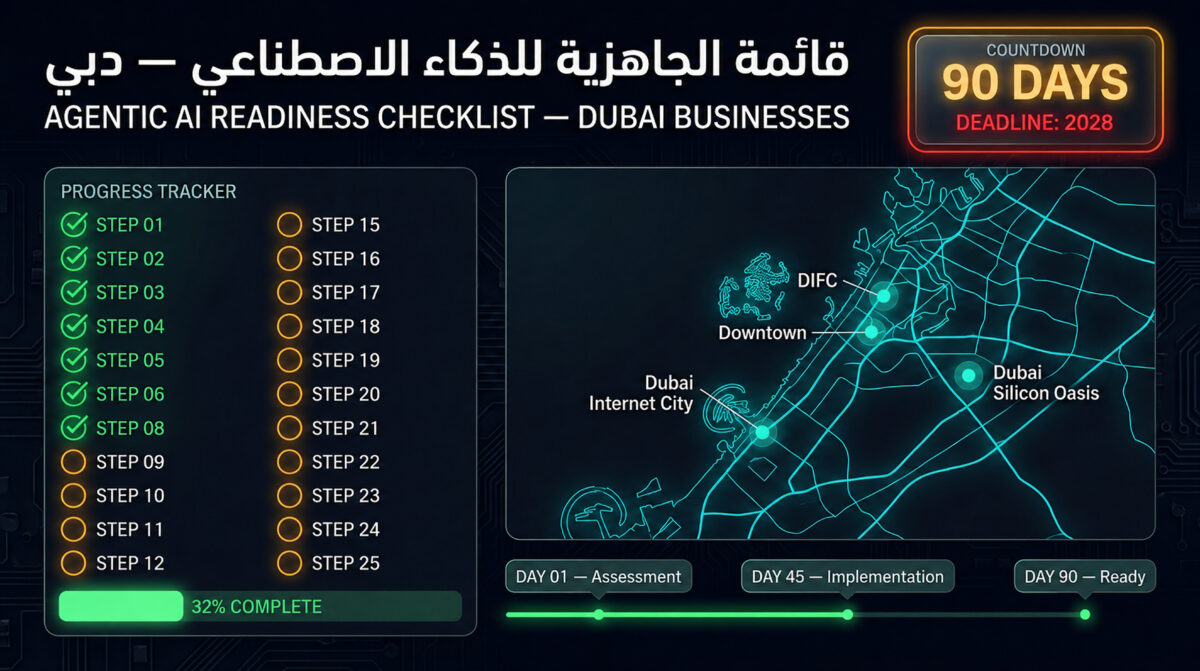
Many Dubai-based companies generally do not require another AI awareness session. They require an agentic AI readiness checklist that Dubai companies can really use to transition from conversation to deployment.
That’s the real challenge after Sheikh Hamdan’s agentic AI initiative for the private sector in May 2026.
The initiative provides a two-year guidance period for Dubai firms. Yet, the companies that have to wait until 2028 to get ready will already be behind. Agentic AI adoption is not something you turn on in the last quarter. It involves process mapping, data readiness, budget approval, staff alignment, vendor selection, compliance review, pilot testing, and operating discipline.
This checklist converts the Dubai agentic AI mandate into a 90-day implementation plan.
At aTeam Soft Solutions, we have witnessed the same pattern in UAE and Saudi AI agent projects. Organizations move more quickly when they stop asking, “How do we apply AI?” and start asking, “Which workflow should we build, test, and scale first?”
The aim of this checklist is straightforward: to enable your business to identify a single valuable AI agent pilot in 90 days, demonstrate whether it works, and form the basis for broader adoption before 2028.
This agentic AI readiness checklist that the Dubai companies can adopt is divided into four phases: Assess, Plan, Pilot, and Scale.
The 90-day format is feasible.
Weeks 1 to 3 are reserved for evaluation. You define your AI champion, manual processes, data sources, infrastructure gaps, compliance requirements, current costs, staff readiness, and vendor options.
Weeks 4 to 6 are for planning. You pick your initial pilot process, establish success criteria, develop a business case, select an implementation partner, determine data governance, and prepare staff communication.
Weeks 7 to 10 are for pilot execution. You begin the proof of concept, verify outputs, gather staff feedback, transition to assisted workflows, calculate ROI, and make a decision on go/no-go.
Weeks 11 to 13 and going forward are to scale. You roll out the full agent, train employees on the new workflow, set up monitoring, document outcomes, and choose the next three processes to automate.
Each step consists of four things: what you need to do, who is responsible, when it is expected to occur, and what the output is.
Do not consider this theoretical knowledge.
Print it out. Put it into an Excel spreadsheet. Assign owners. Rate your progress. Review it every week.
The companies that succeed in agentic AI are not going to be the ones that talk about A.I. the most often. They will be the ones who move fastest to adapt their operations.
The evaluation phase avoids costly errors later on.
The reality is that a lot of AI projects fail as companies select the wrong process, underestimate their data challenges, ignore compliance, or assume employees will automatically embrace the change.
The initial three weeks will provide a clear indication of how your business is doing.
Every Dubai-based business preparing for agentic AI requires a single internal owner.
This person cannot be a junior IT coordinator. The AI champion must be senior enough to talk with department heads, examine underlying assumptions, manage vendors, and get leadership attention.
In most organizations, the right person is the Operations Director, COO, Head of Digital Transformation, Finance Controller, or Business Unit Head.
The AI champion participates in training at the Dubai Chamber, manages internal preparedness efforts, assesses vendors, and is the first pilot sponsor.
In the absence of an AI champion, accountability is spread among departments. When responsibility is distributed, nothing happens.
Designated owner: CEO or Managing Director.
Schedule: Week 1.
Expected Outcome: Named AI champion with executive initiative.
Walk through every department and make a list of the manual processes that are repetitive.
Begin with finance, HR, operations, procurement, customer service, compliance, sales, logistics, and administration.
For each process, record how many people it involves, how many hours per day they spend on it, how frequently the task occurs, what systems they use, how many mistakes happen, and how much those mistakes cost.
Good candidates involve invoice processing, handling of customer inquiries, document collection, order status updates, insurance approvals, HR onboarding, purchase order matching, contract data extraction, collection of compliance evidence, and sales lead qualification.
Do not just trust the managers. Talk to the workers about doing the work.
In a single UAE finance workflow we examined, leadership believed invoice processing was done primarily within the ERP. The real work itself was emails, WhatsApp pictures, scanned PDFs, supplier portals, Excel trackers, and manual reminders for approval.
That discovery changed the whole design of the AI agent.
Accountable owner: AI champion with department heads.
Schedule: Week 1 to Week 2.
Outcome: Process inventory spreadsheet with priority scoring.
Determine where the data resides for each high-priority process.
Your information may be within the ERP systems, CRM tools, email inboxes, WhatsApp groups, shared folders, scanned documents, government portals, supplier portals, Excel files, or paper records.
Also, determine the right format.
Structured data is easier to work with. PDFs, images, handwritten notes, unstructured email communications, and chats in multiple languages require additional processing and preparation.
Identify whether each source system is associated with an API. Without an API, the implementation partner might need secure connectors, access to a database, screen-based automation, document intake, or a human review process.
This step is important since the AI agents will not finish tasks if they’re not able to get the right information.
Accountable owner: IT manager and department process owners.
Schedule: Week 2.
Result: Data landscape map.
Agentic AI deployment requires the technical foundations.
Identify your existing cloud environment, hosting model, API availability, data storage capacity, cybersecurity setup, identity and access management, network stability, and monitoring tools.
Inquire if your systems are on AWS, Azure, Google Cloud, private cloud, local servers, or vendor-hosted platforms.
Also, check whether the company already uses Microsoft 365, Google Workspace, SAP, Oracle, Odoo, Salesforce, Zoho, HubSpot, a custom ERP, or an industry-specific platform.
The infrastructure audit determines if your initial AI agent can be deployed more quickly or if foundational work is required.
A company with well-documented APIs and secure cloud systems could be ready for a 4-6-week proof-of-concept initiative.
A business relying on outdated systems, absent APIs, fragmented data, and unclear access controls may require 8 to 12 weeks before the first production-ready AI agent is functioning properly.
Assigned owner: IT manager or Technology head.
Schedule: Week 2.
Result: Infrastructure readiness report.
Regulatory compliance should be verified before AI systems are allowed to access business data.
Dubai-based companies could be required to consider UAE PDPL, DIFC, or ADGM data rules, DHA healthcare requirements, financial services regulations, MOHRE rules, tax documentation, Dubai Municipality requirements, industry-specific audit standards, and client contractual agreements.
The key question is not just “Can AI get to this data?”
A better question is, “If AI can access this data, where should it be processed, who can see the output, and what kind of audit trail is needed?”
Access control should be strict over patient data in healthcare.
In finance, KYC documents and transaction data must be treated with the utmost care.
For HR, employee records need to be protected.
Explainability and record retention are important for legal and compliance workflows.
Designated owner: Compliance lead, legal advisor, IT security, and AI champion.
Schedule: Week 2 to Week 3.
Outcome: Regulatory compliance checklist as per the industry.
Before you develop an AI agent, calculate the cost of the existing process.
Estimate the annual staff cost, error cost, delay cost, and opportunity cost for your top three candidate workflows.
A basic calculation formula works well.
Annual staff cost = monthly manual hours × loaded hourly staff cost × 12.
Annual error cost = number of errors per year × average cost per error.
Opportunity cost = lost revenue or delayed cash flow caused by slow processing.
For example, if your finance team spends 300 hours a month on invoice processing at a loaded cost of $18 an hour, the annual labor cost is around $64,800.
If mistakes and rework cost an additional $25,000 a year, the total quantifiable cost is nearly $90,000.
That allows a financial foundation for your AI pilot.
Accountable owner: Finance controller and AI champion.
Timeline: Week 3.
Output: Cost Baseline Assessment
If employees are ready, the AI pilot will be adopted; if not, there will be quite a bit of resistance.
Inquire with the employees about their experiences with AI. See who is excited and nervous, who has tried AI tools, who knows the process well now, and who might be a strong internal champion.
Do not neglect fear.
A lot of employees hear the “AI agent” and think of “job replacement.”
Your message must be that the AI agent is a system that takes away repetitive work instead of a tool that takes away people.
In a single Dubai property support workflow, the support team became more open to AI after they saw the agent handle repetitive tenant questions while humans retained control of complaints, legal matters, payment disputes, and delicate situations.
Designated owner: HR lead and department managers.
Timeline: Week 3.
Result: Staff preparedness survey results.
Know what’s realistic before you choose a vendor.
Evaluate the case studies, implementation schedules, pricing ranges, technical capabilities, and industry experience.
Check for specific numbers.
A good case study tells what workflow was automated, what systems were involved, how long it took to deploy, what accuracy was achieved, what human review remained, and which business outcome was measured.
aTeam Soft Solutions has published case studies in areas such as AI workflow automation, enterprise software, healthcare, logistics, finance, and customer operations. Refer to case studies such as these to understand what actual deployment looks like beyond demo videos.
Designated owner: AI champion with procurement or leadership.
Timeline: Week 3.
Result: Vendor shortlist of 3 to 5 companies.
Planning turns assessment into action.
This is where you pick the first process, define what success looks like, prepare the budget, select a partner, set the rules for the data, and communicate with staff.
The aim is not to build everything.
The aim is to build the right thing first.
Choose a single process using a prioritization matrix.
The first pilot shall be high volume, high manual effort, measurable, and recoverable if errors occur.
Don’t start with the highest-risk process in the company.
Good first pilots are invoice data extraction, customer inquiry handling, document intake, employee onboarding paperwork, purchase order matching, lead qualification, and regular report preparation.
Bad first pilots are final legal approval, clinical judgments, high-value payment release, credit approval, and sensitive disciplinary actions.
Those are the areas that may benefit from AI later on, yet they need stronger governance and a more cautious rollout.
Designated owner: AI champion and leadership team.
Timeline: Week 4.
Outcome: Chosen pilot process with justification.
Before developing or building anything, define what success is.
Success can’t be “the AI works.”
Success must be measurable.
Examples are 85% extraction accuracy in validation mode, 50% reduction in manual review time, 30% reduction in processing cost, 40% faster customer response, 20% fewer errors, or 70% of general inquiries resolved without human involvement.
Different workflows require different success metrics.
Accuracy and exception handling are important for a finance AI agent.
Resolution rate and escalation quality matter for a customer support agent.
Extraction accuracy and processing time matter for a document processing agent.
For a sales qualification agent, lead-to-meeting conversions are important.
Designated owner: AI champion, department head, finance controller, and implementation partner.
Timeline: Week 4.
Result: POC success criteria.
The business case should link pilot investment to measurable return.
A targeted proof of concept usually costs between $15,000 and $40,000 and will take 4 to 6 weeks.
A full production deployment typically costs between $40,000 and $120,000 based on integrations, languages, compliance, document complexity, and user volume.
Give the leadership team four things: how much money they need to invest, how much they expect to save each month, how long it will take to get that investment back, and how to reduce the risk.
The best business cases are built around current cost benchmarks from step 6.
Responsible owner: CFO or finance controller with an AI champion.
Schedule: Week 4 to Week 5.
Outcome: Business case and pilot budget approval.
Select a partner that is capable of building, integrating, testing, deploying, and maintaining the AI agent.
Do not make a decision based on a demo.
Assess case studies, phased approaches, Arabic and English proficiency, UAE regulatory knowledge, system integration experience, security practices, transparent pricing, and post-deployment support.
aTeam Soft Solutions generally recommends a readiness-first selection process, as the wrong partner can turn a good AI idea into a failed internal project.
Responsible owners: AI champion, CTO, IT lead, procurement, and business owner.
Timeline: Week 5.
Outcome: Signed pilot agreement or selection of an implementation partner
Set the rules before the AI agent touches data.
What data can it view?
Where will that information be stored?
Will the production information leave your environment?
Will the partner execute well with secured information?
Who can see the results?
Which actions require human intervention for approval?
Where will logs be stored?
Where will personal information be kept safe?
This becomes particularly important when working with offshore or India-based engineering teams.
A secure delivery model can ensure sensitive data stays within the client’s UAE cloud or approved environment while external engineers develop connectors, logic, testing, and deployment with controlled access.
Responsible owner: IT security, compliance, legal, and implementation partner.
Timeline: Week 5 to Week 6.
Outcome: AI Data governance framework.
Do not surprise an AI pilot with employees.
The aim is to state clearly the purpose.
The message shouldn’t be, “We’re going to use AI to cut headcount.”
The better message is “We are testing AI to work on repetitive work so teams can work on exceptions, customers, decisions, and higher-value work.”
Explain to staff what process is being tested, what the AI agent will do, what will still need human approval, how feedback will be collected, and how performance will be measured.
Clear communication planning reduces fear and builds cooperation.
Responsible owner: HR, department head, and AI champion.
Timeline: Week 6.
Outcome: Internal communication plan.
The pilot phase tests whether your intended workflow is ready for agentic AI.
A good pilot is tight, deliberate, and in control.
This should not be presented as an end-to-end company overhaul.
It should answer a single question: Can an AI agent manage this process better, faster, or cheaper than the existing workflow while keeping the risk under control?
Begin with a well-defined project scope.
Specify the workflow, systems, sample data, success metrics, timeline, roles, review cycle, and escalation rules.
The initiative must include the business owner, AI champion, IT lead, compliance contact, end users, and the implementation partner.
The pilot should get weekly review points.
Responsible owner: AI champion and implementation partner.
Timeline: Week 7.
Output: POC launch document.
During observation mode, the AI agent performs the task in parallel with humans, who continue the current process.
The AI can extract invoice data, classify tickets, prepare responses, check documents, or suggest actions, but it does not act on its own.
Your team tests AI output against human output.
This is the safest way to measure accuracy without taking risks with operations.
In a Saudi healthcare workflow, observation mode was used to highlight payer-specific exceptions before the AI agent was able to prepare structured pre-authorization submissions. That early testing reduced the risk in deployment.
Responsible owner: Implementation partner and department reviewers.
Timeline: Week 7 to Week 8.
Output: Daily or weekly accuracy report.
The people looking at the AI output will see things that indicate the missed dashboards
Ask the AI what it gets right, what it gets wrong, which documents are problematic, which cases require escalation, and where the workflow is slower than expected.
The agent can be improved directly by staff feedback.
This is how trust is built, too.
When employees see their feedback influencing the system, they tend to be more supportive of adoption.
Responsible owner: Department manager and AI champion.
Timeline: Week 8.
Outcome: Staff feedback log and backlog of improvements.
When observation mode accuracy reaches the agreed threshold, switch to assisted mode.
In assisted mode, the AI agent makes suggestions for actions, and humans accept the suggestions.
For example, the AI agent may prepare an invoice entry, but finance approves it before it is posted.
It may compose a customer response, but support signs off before sending.
It can prepare a claim submission, but staff must approve it before the portal submission.
Assisted mode is where the business starts seeing time savings while keeping humans in control.
Responsible owner: Business process owner and implementation partner.
Timeline: Week 8 to Week 9.
Outcome: Assisted with the live workflow for selected users.
Evaluate pilot performance relative to the baseline from Step 6.
Calculate the time saved, error reduction, throughput, response speed, backlog reduction, and user satisfaction.
Do not depend only on positive feedback.
Utilize the numbers.
If the pilot reduces manual effort by 40 percent, capture that.
Document if the AI agent resolves 60% of routine questions.
Document it if it takes 12 minutes to process an invoice, and reduce that to 3 minutes per invoice.
The argument for numbers is made by scale.
Responsible owner: Finance controller, AI champion, and department head.
Timeline: Week 9 to Week 10.
Result: Pilot ROI report.
Decide at the end of the pilot what happens next.
There are three possibilities.
Plan full deployment if the pilot is successful.
If the pilot is partially successful, iterate on the workflow, improve data quality, adjust the scope, or extend the pilot.
Find out why the pilot fails. The reason could be bad data, a wrong process choice, poor integration, unclear approvals, staff resistance, or unrealistic expectations.
Not every failed pilot is a waste. It can tell the company what needs to be fixed before scaling.
Responsible owner: Leadership team and AI champion.
Timeline: End of Week 10.
Output: Go/no-go decision document.
Scale should occur only after the pilot demonstrates value.
The biggest mistake is to grow too fast before monitoring, staff training, and governance are in place.
Scaling is moving from a controlled test to a stable working workflow.
Full deployment generally means moving from assisted mode to controlled action.
The AI agent can now perform low-risk tasks on its own and refer cases where it’s uncertain or sensitive to humans.
The deployment will include role-based access, monitoring dashboards, exception queues, audit logs, fallback workflows, and support processes.
Responsible owner: Implementation partner, IT, and business owner.
Timeline: Week 11.
Output: AI agent for production launched.
The training should be about how jobs change.
Employees need to understand what the AI agent now does, what they still approve, how to handle exceptions, how to fix mistakes, and how to report issues.
Do not train the employees on buttons and screens only.
Teach them the decision boundaries.
Responsible owner: Department manager, HR, and implementation partner.
Timeline: Week 11 to Week 12.
Outcome: Employee workflow training completed.
AI agents require constant observation.
Configure accuracy tracking, error logging, escalation reports, processing volume, time savings, user feedback, and frequent review meetings.
Business procedures are subject to change. Documents are updated. Portals are subject to change. Consumer behavior shifts. Rules are subject to change.
An unmonitored AI agent will eventually deteriorate.
Responsible owner: AI champion, IT, and implementation partner.
Timeline: Week 12.
Outcome: Monitoring dashboard and maintenance plan.
If the pilot yielded quantifiable results, record them internally.
Display the baseline, the pilot result, the ROI, staff feedback, and the upcoming opportunity.
This is important, as successful AI adoption requires internal momentum.
A well-documented win boosts leadership confidence and reduces resistance in the subsequent department.
Responsible owner: AI champion and leadership team.
Timeline: Week 12 to Week 13.
Outcome: Internal case study and leadership summary.
Go back to Step 2 of the process inventory.
Select the next three candidates for automation based on value, readiness, risk, and stakeholder support.
Do not select only from the same department.
One workflow for finance, one for customers, one for operations, and one for compliance could all be included in a solid 12-month plan.
As a result, adoption is balanced throughout the company.
Responsible owner: AI champion and executive sponsor.
Timeline: Week 13 and beyond.
Outcome: Next-process roadmap.
Utilize this scoring system to measure your readiness.
A score is assigned to each of the 25 steps.
0 indicates that it hasn’t begun.
2 means ongoing.
4 means finished.
There is a maximum score of 100.
| Score range | Readiness level | What it means |
| 0-25 | Just starting | You are still at the awareness level and need a basic assessment. |
| 26-50 | Building awareness | You understand the need but have not prepared enough for a pilot. |
| 51-75 | Actively preparing | You have owners, process data, and planning in motion. |
| 76-100 | Ready to deploy | You are ready for pilot execution or production scaling. |
Before beginning a paid pilot, a Dubai-based business should aim for a score of at least 60.
A score of less than 40 typically indicates that the business needs to conduct discovery work before implementation.
The company has a good chance of transitioning from pilot to production in less than a quarter if the score is higher than 75.
Select the first AI agent using this framework.
| Candidate process | Volume | Manual effort | Error cost | Data readiness | Risk level | First-pilot suitability |
| Invoice extraction and matching | High | High | Medium | Medium | Medium | Strong |
| Customer inquiry handling | High | High | Low to medium | Medium | Medium | Strong |
| Employee onboarding paperwork | Medium | Medium | Low | Medium | Low | Strong |
| Insurance pre-authorisation preparation | High | High | High | Medium | High | Moderate |
| Contract review | Medium | Medium | High | Low to medium | High | Moderate |
| Final payment release | Low | Low | Very high | High | Very high | Weak |
| Clinical decision support | Medium | Medium | Very high | Medium | Very high | Weak |
The best initial AI agent should provide real value without putting the company at unacceptable risk.
That’s why aTeam Soft Solutions frequently advises beginning with document-driven, high-volume, reviewable workflows before shifting to sensitive decision automation.
The goal of the UAE finance team was to lessen the workload associated with supplier invoices. PDFs, scans, emails, and WhatsApp photos were all part of the process. The AI agent prepared ERP entries for review after extracting invoice data, comparing it with purchase orders, and highlighting discrepancies. Reducing repetitive reading and typing, rather than eliminating finance oversight, was the primary benefit.
A Dubai real estate company had to manage a lot of multilingual tenant communications. The AI agent raised sensitive cases, generated support tickets, and responded to standard inquiries. After adjustments, it addressed 73% of recurring questions without the need for human intervention, leaving staff to handle complaints, legal matters, and payment disputes.
A Saudi healthcare provider required quicker preparation for insurance pre-authorization. Multiple payer portals, various document requirements, and manual follow-up were all part of the workflow. The AI agent drafted submissions, verified for missing information, and facilitated portal processes, reducing the usual preparation of cases from lengthy manual processes to a formal 15-minute workflow.
These illustrations highlight the importance of preparedness.
The process design, data access, human review model, and operational discipline surrounding the AI agent determine its strength.
Assigning an AI champion, recording current manual workflows, mapping your data sources, verifying system integration readiness, evaluating compliance requirements, analyzing existing expenses, and choosing a single pilot process with quantifiable ROI are the first steps.
An agentic AI readiness assessment determines whether the company has the data access, system infrastructure, governance, staff preparedness, budget, implementation support, and process clarity required to deploy AI agents safely.
The majority of Dubai companies require four to six weeks to get ready for a targeted proof of concept for an AI agent. It may take eight to twelve weeks before production deployment is feasible for companies with unstructured data, legacy systems, or workflows that heavily rely on compliance.
You need data sources that are accessible, clear permissions, secure storage, API or connector options, document intake, audit logs, and defined rules for where data is processed. The exact setup will be based on whether your data resides in ERPs, CRMs, emails, WhatsApp, portals, PDFs, or even spreadsheets.
The first step is not to simply buy an AI tool. First, you have to identify if the company has repetitive manual work that can be improved with an AI agent safely. Start by creating a process inventory and readiness scoring.
A focused pilot will normally cost between $15,000 and $40,000 and will take around 4 to 6 weeks. Costs for a complete production deployment typically range from $40,000 to $120,000, depending on systems, integrations, languages, compliance, and the complexity of workflows.
Readiness should be owned by the senior AI champion. This could be the COO, Operations Director, Digital Transformation Head, Finance Controller, CTO, or business unit leader. The owner needs to have enough authority to coordinate with various departments and push the pilot forward.
The agentic AI readiness checklist that companies in Dubai require is not a shopping list for technology.
It is like an operating checklist.
Sheikh Hamdan’s initiative has provided a clear indication for the private sector. That gives Dubai companies two years to learn, prepare, test, and scale AI agents ahead of 2028.
The companies that begin now will learn faster.
They will know what processes are ready, what data gaps need to be fixed, what teams need support, what vendors can deliver, and what AI agents generate measurable ROI.
Those companies that wait will need to do the same work, but under greater pressure.
aTeam Soft Solutions assists Dubai businesses through this readiness journey via workflow discovery, AI agent design, system integration, pilot deployment, and long-term support.
Begin with a single process at a time.
Rate your readiness.
Conduct the pilot.
Follow the result.
Then expand with proper oversight.