The strongest case for adopting agentic AI in Dubai’s real estate sector is not about futuristic property searches or AI-generated listing descriptions. The real value comes from solving the everyday operational challenges that property management companies deal with every day.
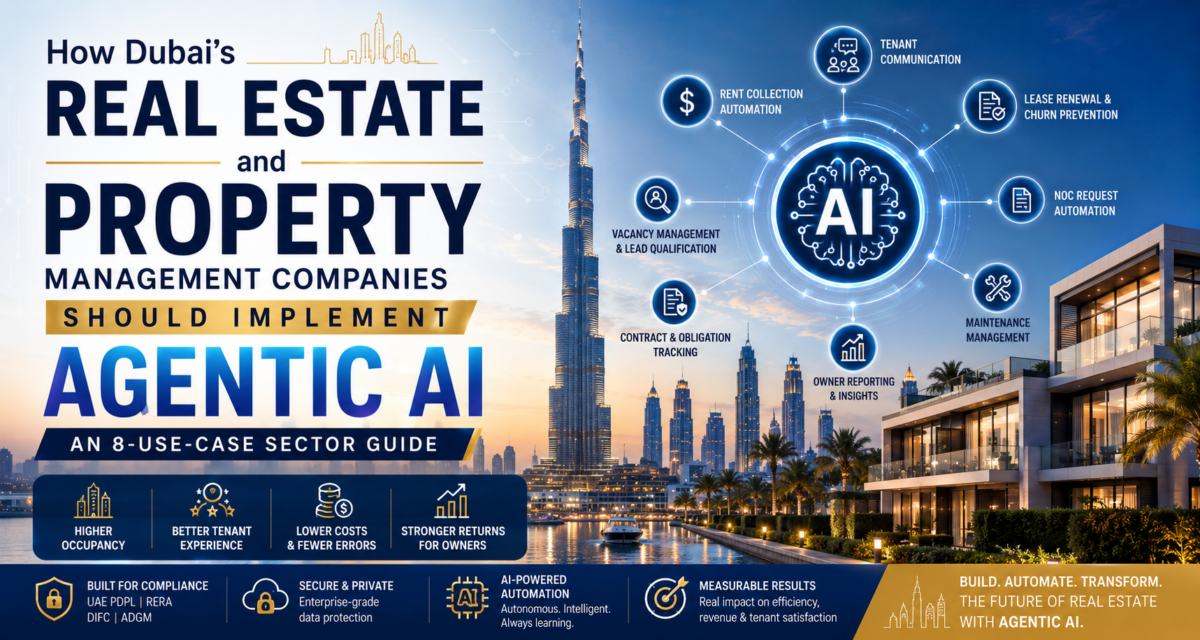
Common property management workflows include responding to tenant questions, managing lease renewals, processing NOC requests, handling maintenance tickets, following up on late payments, addressing vacancy queries, tracking contract obligations, and preparing owner reports.
These challenges have a major impact on day-to-day operations.
A Dubai property management firm that owns a few thousand units may conduct tens of thousands of tenant transactions a month. So a lot of those interactions are repetitive, multilingual, time-sensitive, and across WhatsApp, phone calls, emails, portals, spreadsheets, and property management systems.
That’s precisely the sort of situation where agentic AI could generate quantifiable value.
A chatbot can respond to a simple tenant query. An AI agent can review the tenant’s lease, confirm payment status, verify the unit, produce the correct document, file a maintenance ticket, send it to the appropriate vendor, monitor SLA, inform the tenant, and escalate the matter if it becomes sensitive.
That is the difference that truly matters.
After Sheikh Hamdan’s initiative on agentic AI in the private sector, Dubai real estate firms should not consider AI as a branding element. They should see it as an operating system upgrade. The companies to react most quickly are not going to be the ones adding AI language on their websites. They will be those reducing response times, protecting lease renewals, boosting collection rates, and offering owners cleaner reporting.
At aTeam Soft Solutions, we believe property management is among the most obvious use cases for agentic AI adoption for Dubai businesses, given that the workflows are high-volume, document-rich, multilingual, and quantifiable. The return on investment (ROI) is also easier to demonstrate than in many other industries because time saved, renewals preserved, vacancy days reduced, and collection rates enhanced can all be directly measured.
This guide discusses eight real estate and property management use cases where Dubai organizations should look at agentic AI, with details on current manual pain points, AI agent design, anticipated ROI, regulatory considerations, and practical first moves.
A lot of real estate firms initially consider AI a sales tool.
They envision AI-generated descriptions of properties, virtual buyer assistants, AI-powered virtual staging, or more intelligent property search. They’re useful, but they don’t always make the best first use case.
The larger opportunity is typically within property operations.
Property management is just repetitive workflows that need context. A tenant applies for an NOC. An assistant needs to verify if the lease is active, if the payments are clear, what type of NOC is asked for, which template should be used, if it requires the manager’s approval, and how to send the final PDF.
A tenant reports an AC problem. The coordinator needs to read and understand the message, know the property, categorize the type of issue, verify if it’s covered by warranty or is maintenance responsibility, raise a ticket, assign the appropriate vendor, monitor response time, notify the tenant, and escalate if the SLA is missed.
A lease is up for renewal. A team needs to identify the tenant, examine history, analyze payment behavior, assess risk for customer attrition, formulate an offer, send follow-up messages, respond to objections, and update the system.
These are not just conversations. They are about workflow processes.
That is why agentic AI is better suited to property management than a normal chatbot.
The AI agent can read messages, recognize intent, fetch tenant records, execute business rules, generate documents, create tasks, modify systems, and escalate exceptions to human operators.
For real estate firms in Dubai, this is significant as tenant expectations have evolved. Tenants want rapid WhatsApp replies, transparent communication, digital paperwork, and immediate acknowledgement of issues. Owners want better occupancy, faster collections, fewer complaints, and comprehensive monthly reports.
Manual teams can deal with this to some extent. But as portfolios expand, that old model becomes costly and unreliable.
Agentic AI does not eliminate the need for property managers. Instead, it eliminates the repetitive coordination burden that stops property managers from concentrating on exceptions, relationships, disputes, owner strategy, and the quality of service.
The handling of tenant inquiries is usually the most well-known agentic AI real estate Dubai use case because the pain is visible in the eyes every day.
A property management company might get tenant inquiries via WhatsApp, calls, emails, website contact forms, or even in person. The questions are usually repetitive, but they still need context. A tenant can inquire about rent payments, maintenance status, renewal timeline, parking availability, move-in regulations, deposit reimbursement, Ejari, NOC formalities, service charges, community regulations, or document submission.
In Dubai, this communication is seldom English-only. A real portfolio might have tenants who speak English, Arabic, Hindi, Urdu, Malayalam, Russian, Chinese, or who send mixed-language messages. The support staff has to understand the message, identify the tenant, look the record up, respond accurately, and escalate when the question is sensitive.
In one single-property workflow based on this pattern, the volume got to over 15,000 tenant interactions a month in five languages. About 12 coordinators were devoting much of their time to responding to identical categories of queries. The issue was not that the team was inefficient. The real challenge was the sheer volume of repetitive work they had to manage every day.
An AI tenant communication agent addresses this by acting as the primary layer of interaction. This is connected to tenant records, lease information, payment status, maintenance ticket history, knowledge-base articles, and escalation policies. When a tenant messages over WhatsApp, the agent recognizes the tenant, comprehends the request, grabs the right context, replies to routine questions, and escalates complicated or sensitive matters to the team.
The anticipated ROI will be from the labor savings, faster response times, and fewer tickets that are left open. In the above case pattern, the 73% AI solution rate on standard inquiries can considerably reduce the burden on coordinators. For a team that dedicates the equivalent of several full-time employees to repetitive communications, labor savings can exceed AED 350,000 annually, with the exact figure depending on salary structure and portfolio size.
From both a regulatory and operational perspective, an AI agent shouldn’t handle every tenant query on its own. Matters involving legal disputes, rent increase objections, eviction concerns, payment disagreements, formal complaints, or other sensitive issues should always be passed to human staff. The agent should also maintain a clear record of every interaction, including the questions asked, the responses provided, the information source used, and the reason a case was escalated.
The appropriate case study reference for this use case is the tenant communication AI agent, where routine inquiries were handled while sensitive matters passed to human agents.
Lease renewals are one of the most valuable processes in property management because even a small increase in renewal rates can have a meaningful impact on revenue.
Many property management companies still manage lease renewals using generic emails, manual phone calls, spreadsheet reminders, and delayed follow-ups. In many cases, the same renewal message is sent to every tenant, with little or no personalization. The challenge is that this approach overlooks important details such as the tenant’s payment history, past complaints, unit type, changes in market rental rates, and the likelihood of renewing the lease.
If renewal emails are opened by only 12% of tenants and the overall lease renewal rate is just 68%, the company may be missing valuable opportunities to retain tenants and protect recurring revenue.
An AI lease renewal agent transforms the renewal process from generic follow-ups into personalized, data-driven engagement. It analyzes tenant history, payment patterns, previous complaints, maintenance records, lease expiry dates, rent adjustment eligibility, owner-approved negotiation limits, and, where available, comparable rental data. Using these insights, the agent creates personalized renewal messages and delivers them through the tenant’s preferred channel, such as WhatsApp, email, or a mobile app notification.
The agent can reach out at the right time with renewal reminders, answer common questions, explain the documents required for renewal, schedule calls with the leasing team, and negotiate within predefined guidelines. For example, if the company has approved a small discount, a flexible payment option, or a renewal incentive for eligible tenants, the AI agent can present those offers based on the rules it has been given. However, it should never create new offers or make legally binding commitments without human approval.
One of the most valuable capabilities is identifying tenants who may not renew their lease. An AI agent can spot these risks as early as six months before the lease expires by analyzing patterns such as repeated maintenance complaints, late rent payments, negative sentiment in emails or messages, slow issue resolution, sensitivity to rent increases, and limited engagement with renewal communications.
The return on investment (ROI) can be high. A secured income could be material if the renewal rate is increased from 68% to 89%. In the instructed case pattern, the secured annual worth is AED 4.2 million. This value does not come solely from automation. It results from earlier engagement, better personalization, fewer missed follow-ups, and more rapid escalation of high-risk tenants.
Consideration of RERA is essential. Renewal communication and rent change advice should be in accordance with Dubai tenancy Law and legal processes approved by the company. The AI agent must never make definitive statements about rent increases, lease termination notices, or tenant rights unless those answers are approved and source-controlled. Human oversight should continue for disputes, appeals, and anything involving legal interpretation.
The tenant agent case study is applicable for this use case, as the identical tenant communication layer can be extended for renewal prediction and renewal workflow automation.
Production of NOC is among the top initial pilots for Dubai property management companies.
It’s high volume, low risk relative to legal or payment decisions; it’s easy to track; and it’s enough to frustrate tenants that a small amount of improvement in speed can bring meaningful experience uplift.
Hundreds of NOC requests are processed by many property management teams on a monthly basis. Tenants can apply for NOCs for DEWA, Etisalat, du, visa processing, admission to school, permission to move, fit-out, or other administrative needs. Each application could take 15-20 minutes manually, as the coordinator has to verify tenant identity, unit information, lease status, payment status, requested purpose, correct template, whether approval is needed, and delivery of the final PDF.
If the company processes 300 or more NOC requests in a month, the workload is substantial. Even more to the point, tenants frequently want these documents fast. A minor delay can cause frustration even when the document itself is routine.
An AI NOC generation agent can handle most of this workflow. The tenant raises the NOC request via WhatsApp, the portal, email, or mobile app. The agent authenticates the tenant, retrieves the lease record, verifies payment status, validates the requested type of NOC, retrieves the appropriate template, fills the document, routes it for digital approval if necessary, creates a PDF, and sends it back to the tenant.
The agent needs to manage partial requests. If the tenant omits the NOC type, the agent raises a clarifying question. If payment is late, the agent explains the outstanding requirement and routes the case if necessary. The agent escalates if the lease has expired. If the request is unusual or requires special handling, human review is enabled.
The expected time saving is obvious. A manual request that takes 15 minutes can be reduced to about 5 minutes or less when the AI agent does all the preparation and humans only approve exceptions. Over hundreds of requests per month, this leads to a direct saving in staff time and better tenant satisfaction.
The regulatory concern is that NOCs are official documents. The AI agent should produce them only from predefined templates. It should not modify legal texts at will. It should keep a document history showing request time, the tenant information verified, the template used, the approver, the date of issue, and the PDF delivered.
That is the reason why NOC generation is the suggested first pilot for a lot of property management companies. It is simpler to scope than lease negotiation, safer than payment enforcement, and more quantifiable than broad customer service enhancement.
Maintenance is where tenants experience the true quality of property management.
Tenants may overlook a delayed response to a general inquiry, but they’re far less likely to be patient when dealing with maintenance issues. Problems such as an air conditioning failure during the summer, a water leak damaging the ceiling, electrical faults that raise safety concerns, or plumbing issues that disrupt daily life require fast and effective action.
A lot of property management teams still get maintenance requests via phone calls, WhatsApp messages, emails, and building security notes. The request might be logged into a shared spreadsheet or sent manually to a specific maintenance coordinator. Photos may reside in WhatsApp. Vendor updates might come by call. SLA monitoring might be uneven. Tenants might receive no response for 48 to 72 hours.
This results in complaints even when the maintenance team is busy.
The problem is not just repair time. It is about communication, classification, prioritization, and monitoring.
An AI maintenance request agent can capture the tenant’s message and photo evidence, recognize the unit, categorize the issue type, assess urgency, generate a ticket, assign it to the right maintenance team or vendor, monitor SLA, and provide notification at every stage. In the case where the tenant sends a photo of leakage, the agent is able to categorize it as plumbing or water damage and prioritize it over a non-critical issue. If the tenant says the AC is not cooling, the agent can gather some basic information before escalating it to HVAC support.
The agent is not a substitute for technical diagnosis. It should coordinate the intake and scheduling layer.
The ROI arises from quicker response time, fewer missed requests, fewer escalations, and better vendor accountability. In the case pattern discussed, response times improved significantly, moving from 48 hours to around 4 hours once maintenance requests were automatically classified, assigned, and tracked. That level of improvement has an effect on both tenant satisfaction and the likelihood of renewal.
The key regulatory and business implication is ensuring that the AI agent must never provide unsafe technical recommendations. It could gather, categorize, allocate, refresh, and escalate information. It must also send safety-related matters, recurring complaints, water leaks, electrical problems, fire safety issues, and high-priority cases to human operators without delay.
The property management case study is the appropriate reference here because maintenance management is linked to an operational workflow, rather than just conversation.
Rent collection is one of the most practical and financially impactful use cases for agentic AI in property management.
Many property companies still handle monthly invoicing, payment reminders, bounced cheque tracking, overdue collections, and escalation processes manually. A coordinator or finance team often has to send payment reminders, verify transaction statuses, contact tenants with pending dues, update spreadsheets, and notify management when outstanding payments become a concern.
It may be repetitive work, but it requires careful handling.
The quality of communication matters. The right timing can influence outcomes. A tenant’s payment history provides important context, and every escalation must follow the correct process. Any legal action must also be handled according to approved procedures.
When a property portfolio already achieves an 88% on-time collection rate, even a small improvement of a few percentage points can have a meaningful impact. It can improve cash flow, reduce outstanding payments, and lower the workload for finance teams.
An AI rent collection agent can automate the entire payment follow-up process. It can create invoices, send them through WhatsApp or email with payment links, remind tenants before the due date, and schedule follow-ups after 3, 7, and 14 days. If payments remain overdue, it can automatically escalate cases to finance or legal teams after 30 days based on company policies. The agent can also personalize each interaction by considering tenant history, payment patterns, lease details, and previous communication, helping property teams maintain a consistent and professional approach.
The agent can also reduce the need for uncomfortable manual follow-ups. Instead of staff spending time calling every tenant, the AI agent can manage routine reminders automatically. This allows property teams to focus on more complex cases, such as serious arrears, disputes, and payment plan discussions.
The ROI of an AI rent collection agent can be measured by improvements in collection rates and operational efficiency. If on-time collections increase from 88% to 97%, the company can improve cash flow, reduce overdue payments, and decrease the workload on finance teams. The overall financial benefit will depend on factors such as portfolio size, average rent value, payment schedules, and the company’s historical arrears patterns.
From a regulatory perspective, the AI agent must communicate responsibly. It should not use threatening language, provide inaccurate information about legal consequences, or trigger incorrect escalations. All reminder messages should follow pre-approved communication guidelines. Any legal escalation should be based on clearly defined rules and reviewed by a human team. The system should also keep complete records of reminders, tenant responses, payment updates, and escalation history for transparency and compliance.
This workflow requires careful handling because it involves PDPL-sensitive information, including tenant identities, contact details, and payment data. Security measures such as proper access controls and data minimization should be considered from the beginning to protect personal and financial information.
Vacancy management is often viewed as a marketing challenge, but it is ultimately a revenue issue
When a property stays vacant for 45 days, the financial impact is immediate. Owners lose rental income, property managers come under pressure, and leasing teams often shift into a reactive mode to fill the vacancy quickly. Managing vacancies manually requires teams to handle multiple tasks, including publishing listings on property portals, responding to inquiries, confirming availability, screening prospects, arranging viewings, following up with leads, and updating property status across different systems.
The biggest delays often occur during the inquiry stage.
A potential tenant may discover a property through platforms such as Bayut, Property Finder, social media, or the company website. They typically ask questions about rental price, location, availability, move-in dates, payment options, viewing times, or property features. If the response is delayed by 24 to 48 hours, the prospect may lose interest and choose another available property instead.
An AI vacancy and lead qualification agent can significantly reduce response delays during the leasing process. It can automatically list vacant units on supported portals, generate listing drafts using approved property information, and respond to inquiries instantly. The agent can also qualify prospects based on criteria such as budget, preferred move-in date, family size, location requirements, payment preferences, and viewing availability. In addition, it can schedule viewings, send reminders, update CRM records, and follow up with prospects after property visits.
This use case is not only about responding faster to inquiries
It is about shortening vacancy periods.
Reducing vacancy duration can create a significant revenue impact. For example, if the average vacancy period decreases from 45 days to 18 days, property companies can recover rental income much faster. The actual value depends on factors such as average rent, the number of vacant units, and current market demand. In high-demand areas, faster lead response can directly improve conversion rates because potential tenants often contact multiple property providers at the same time.
The AI agent should also safeguard the quality of the listings. It must not invent amenities, misstate prices, or guarantee availability that may have changed. It should not interfere with the property records that are pre-approved and should escalate any uncertain questions to the leasing staff.
The compliance aspects involve advertising accuracy, broker/licensing rules, and DLD/RERA-related expectations concerning the truthfulness of the information related to the property. Any automated listing workflows should rely on validated property information, confirmed unit availability, and approved marketing content.
This use case is well suited as a second or third AI pilot, following initiatives such as NOC or tenant inquiry automation. It provides a clear link between AI implementation and business outcomes by directly supporting revenue growth.
Property management involves numerous responsibilities, and some important obligations can easily be overlooked without proper tracking.
Property teams must manage a wide range of ongoing obligations, including lease terms, renewal deadlines, rent increase notice periods, insurance certificates, vendor contract renewals, maintenance schedules, fit-out requirements, owner reporting commitments, deposit refund timelines, community regulations, service agreements, warranty conditions, and approval processes.
Many property companies still manage these obligations through Excel sheets or by relying on individual team members to remember important deadlines
This approach may work with a small portfolio, but it becomes increasingly difficult to manage as the number of properties and responsibilities grows.
Missing a renewal deadline, allowing an insurance certificate to expire, overlooking a maintenance obligation, or delaying owner communication can lead to disputes, financial impact, compliance issues, and damage to the company’s reputation.
An AI agent for contracts and obligations monitoring reads leases, management agreements, vendor contracts, insurance certificates, and other similar documents. It pulls out obligations, dates, responsible parties, notice requirements, renewal provisions, payment terms, escalation measures, and required actions. A structured obligation calendar is then generated, and proactive alerts are sent before deadlines
The benefit is not about time-saving. It is risk mitigation.
For example, if a lease requires advance notice before a specific date, the AI agent can alert the property manager well ahead of the deadline. If a vendor agreement requires an updated insurance certificate before work can continue, the agent can identify the expiry date and send reminders. Similarly, if an owner agreement requires monthly reports by a fixed date, the system can create tasks, send alerts, and track completion.
This workflow requires strong controls because contracts often contain complex legal terms, exceptions, and conditions that require careful interpretation.
The AI agent must not be the ultimate legal authority. It needs to extract, summarize, flag, and give references to sources. High-risk obligations and any unclear contract interpretation should be reviewed by human employees or legal teams.
The ROI can be quantified by fewer missed deadlines, reduced disputes, less time spent on manual contract review, and improved compliance monitoring.
The contract agent case study is the applicable benchmark for this use case. It demonstrates how AI can transform lengthy documents into structured obligation management, but only with human review for legal sensitivity.
Owner reporting is a monotonous yet high-visibility workflow process.
Property owners and investors expect simple monthly reports that cover income, expenses, occupancy, maintenance costs, outstanding issues, arrears, tenant movement, and portfolio performance. For building owners or institutional investors, the quality of reporting matters to trust.
Most property management teams generate these reports manually. They extract the information from their property management systems, accounting software, maintenance logs, spreadsheets, and even email notifications. Then they format the report, include commentary, make charts, and send it to owners.
For a single building, this can mean two to three days a month.
Over multiple buildings, the burden of reporting becomes immense.
An AI owner reporting agent can fetch information from property management systems, accounting software, maintenance tickets, rent collection logs, vacancy status, and prior reports. It can automatically produce branded monthly reports, explain significant changes, highlight exceptions, summarize maintenance concerns, present occupancy, alert to arrears, and deliver reports on schedule.
This use case is worthwhile as it enhances owner communications without requiring additional admin resources.
The AI agent can also generate different report formats for different types of owners. A simple summary might be enough for a small landlord. A portfolio owner may wish to receive a breakdown of expenses by category. An institutional investor might want to see trends in occupancy, arrears aging, categories of maintenance, and variance at the unit level.
Accuracy is essential for maintaining compliance and trust. Financial figures should always be pulled directly from validated source systems rather than generated or estimated by AI. While the AI agent can prepare summaries, highlight key insights, and draft report commentary, all financial data should come from verified records. Reports should also go through an appropriate review process before they are shared, particularly when they are prepared for high-value property owners or key clients.
This use case is typically better suited as a later AI pilot because it depends on clean, reliable data from multiple systems. Once tenant, maintenance, rent, and occupancy information is well structured, owner reporting becomes a practical and high-value opportunity for automation.
| Use case | Current pain | AI agent solution | Expected result | First-pilot fit |
| Tenant inquiries | 15,000+ monthly interactions across languages | WhatsApp AI agent with tenant record access | 73% routine resolution | Strong |
| Lease renewals | Generic emails and low response | Personalised renewal agent with churn prediction | 68% to 89% renewal rate | Strong but needs controls |
| NOC generation | 300+ monthly requests, 15-20 minutes each | AI verifies lease/payment and generates PDF | 15 minutes to 5 minutes | Best first pilot |
| Maintenance requests | Phone/WhatsApp/spreadsheet handling | AI classifies, assigns, tracks SLA | 48 hours to 4 hours response | Strong |
| Rent collection | Manual reminders and follow-ups | AI invoices, reminds, escalates | 88% to 97% collection | Strong with compliance controls |
| Vacancy marketing | Slow inquiry response | AI qualifies leads and schedules viewings | 45 days to 18 days vacancy | Strong revenue use case |
| Contract tracking | Obligations tracked in Excel | AI extracts and monitors obligations | Fewer missed deadlines | Medium-high complexity |
| Owner reporting | Manual monthly report preparation | AI pulls data and generates reports | 2-3 days to automated drafts | Good after data cleanup |
This table highlights why property management is well suited for agentic AI.
These are real operational workflows with clear business value. They are repetitive, easy to measure, and have a direct impact on tenant experience, owner confidence, and revenue performance.
Agentic AI real estate Dubai deployments should be designed with compliance from the start, rather than being addressed later.
Dubai’s real estate sector operates within a well-regulated framework that includes the Dubai Land Department, RERA-related processes, Ejari tenancy registration, rental regulations, real estate licensing, and dispute resolution procedures. AI agents can help streamline these workflows, but they should support human decision-making rather than make legal decisions on their own.
The first principle is to ensure AI uses approved templates for all formal documents and communications. Whether it’s an NOC, a lease renewal notice, a payment reminder, an owner report, or any lease-related communication, the content should be based on pre-approved wording rather than generated from scratch. AI can personalize the message by filling in property details, dates, names, and other structured information, but the legal and policy language should remain consistent and under organizational control.
The second principle is to keep a clear audit trail for every AI-powered action. Property management companies should be able to trace each step of the process, including the tenant’s request, the records the AI accessed, the template it used, the document it generated, who reviewed or approved it, and when it was sent. This ensures greater transparency, accountability, and compliance across the workflow.
The third principle is to escalate sensitive matters to the right people. Issues such as rent disputes, eviction-related requests, legal notices, rent increase objections, security deposit disputes, tenant complaints, and regulatory queries should always be reviewed by trained staff
The fourth principle is to protect tenant data at every stage. Information such as tenant names, phone numbers, Emirates ID details, passport copies, visa documents, payment records, lease agreements, and family information may all be considered personal data. AI agents should only access the information they need to complete a task, with role-based permissions, secure storage, data minimization, and appropriate processing controls in place to safeguard sensitive information.
The fifth principle is to treat AI recommendations as guidance, not legal advice. If an AI agent identifies a potential lease renewal issue or flags a rent-related concern, the recommendation should always be reviewed by a qualified member of the team before any action is taken.
The practical reality is straightforward: agentic AI can make property management faster, more efficient, and more consistent, but the company remains responsible for every decision and action taken.
For most Dubai property management companies, NOC generation is an ideal first use case for an agentic AI pilot.
Tenant inquiry handling is another strong use case because of the high volume of requests. Lease renewal automation can help protect revenue, AI-assisted rent collection can improve cash flow, and maintenance automation can enhance the tenant experience with faster, more consistent service.
For an initial pilot, NOC generation is often the most practical and well-balanced choice.
NOC generation is a strong first pilot because it offers the right mix of value and simplicity. The process is frequent enough to make a measurable difference, structured enough to automate with confidence, and far less risky than lease negotiations or legal communications. It also provides clear performance metrics, can be tested in shadow mode before full deployment, and delivers faster, more visible service improvements for tenants.
A well-planned NOC pilot can typically be completed within 4 to 6 weeks.
The pilot should focus on a clearly defined scope. This typically includes the five most common NOC types, tenant identity verification, lease and payment status checks, generation of documents using approved templates, digital approval workflows, PDF delivery, and comprehensive audit logging.
Success should be measured using clearly defined metrics.
The goal should be to reduce the average processing time from 15–20 minutes to around 5 minutes.
The pilot should aim to automate the preparation of at least 80% of standard NOC requests.
Low-confidence or unusual requests should be routed to the appropriate staff for review.
The overall tenant experience should improve.
Staff should spend less time on routine, repetitive tasks.
If the pilot is successful, the company can gradually expand AI to other workflows, such as tenant inquiry handling, maintenance request management, and lease renewal automation.
This phased approach helps build trust.
This approach allows the company to achieve a practical AI win before taking on more complex and sensitive processes.
A property management company should avoid starting with a large-scale AI transformation program.
The process should begin with workflow analysis.
During the first two weeks, the focus should be on identifying the highest-volume tenant and owner workflows. Review monthly request volumes, staff effort, response delays, complaint levels, and the number of systems involved in each process. Key areas to analyse include NOC requests, maintenance tickets, tenant inquiries, lease renewal follow-ups, rent reminders, and owner reporting.
During weeks three and four, the focus should be on mapping the data environment. Identify where tenant records are stored, how lease information is managed, how payment status is verified, where maintenance tickets are tracked, how WhatsApp conversations are handled, what APIs are available, and which documents support each workflow.
During weeks five and six, the company should select the first AI pilot. For many property management companies, NOC generation is likely to be the strongest starting point because it is structured and repeatable. However, businesses handling a very high volume of tenant communications may find tenant inquiry handling to be an equally suitable option.
During weeks seven to ten, the company should run the proof of concept using real operational data. The POC should include actual tenant requests, approved templates, payment status checks, and existing approval workflows. Start with a parallel testing phase, allowing staff to compare AI-generated outputs with the existing manual process before making changes to live operations.
During weeks eleven to thirteen, move into a controlled deployment phase. The AI agent can begin preparing standard documents and responses, while human teams continue to review and approve the outputs. Increase automation gradually only after the system has demonstrated consistent accuracy and earned user trust.
After completing the first pilot, document the results and measure the impact. Capture key outcomes such as time saved, request volumes processed, escalation accuracy, tenant feedback, staff feedback, and estimated annual savings. Use these results as an internal case study to demonstrate value and secure investment for the next AI use case.
aTeam Soft Solutions helps Dubai real estate and property management companies adopt agentic AI by focusing on practical, high-value workflows.
We are an India-based AI and software development company with a team of 120+ engineers. Our capabilities are backed by ISO 9001:2015 and ISO/IEC 27001:2022 certifications, a 4.9/5 Clutch rating from 90+ verified reviews, and more than 20 published case studies demonstrating our experience delivering technology solutions.
Our focus is on building AI agents that integrate with real business systems and workflows, rather than creating standalone demos.
For property management companies, the company helps identify and map critical operational workflows, including tenant communications, NOC processes, lease renewals, maintenance requests, payment follow-ups, vacancy marketing, contract obligations, and owner reporting requirements.
We then design the AI agent around the company’s existing processes, systems, and operational requirements.
This includes integrating with WhatsApp workflows, property management systems, CRM platforms, accounting software, document templates, escalation rules, dashboards, audit logs, and human review processes.
aTeam Soft Solutions does not recommend giving AI full autonomy from day one. For real estate workflows, we typically start with a human-in-the-loop approach, especially for documents, payment communications, renewal offers, and sensitive tenant-related matters.
The goal is not to replace property managers but to help them work more efficiently.
The goal is to eliminate repetitive coordination tasks so property managers can focus more on building owner relationships, improving tenant experiences, resolving disputes, managing vendor performance, and growing their portfolios.
Agentic AI can help Dubai property management companies streamline a wide range of operations, including tenant inquiries, NOC requests, maintenance ticket routing, lease renewal follow-ups, rent reminders, vacancy lead qualification, contract tracking, and owner reporting. The biggest value comes from reducing repetitive coordination, improving response times, and allowing property teams to focus more on complex issues and relationship-building.
For most Dubai property management companies, NOC generation is one of the strongest starting points for an AI automation pilot. It involves high volumes of repetitive requests, follows a structured process, carries lower risk than legal or payment-related decisions, and offers clear ways to measure results. It also creates a noticeable improvement in service for tenants. For companies managing a large volume of tenant communications, inquiry handling can be another strong first use case.
A focused AI proof of concept for a single property management workflow typically costs between $15,000 and $40,000 and can be completed in around 4 to 6 weeks. A full production deployment usually ranges from $40,000 to $120,000, depending on factors such as system integrations, WhatsApp workflows, document templates, dashboards, data quality, and compliance requirements.
Yes, AI agents can support multilingual tenant communication when they are properly designed, trained, and tested. Dubai’s property sector involves a diverse tenant base, with conversations often taking place in English, Arabic, Hindi, Urdu, Malayalam, Russian, Chinese, and mixed languages. To deliver reliable results, AI agents should be tested using real tenant interactions and configured to escalate sensitive matters to human staff when required.
Agentic AI can support RERA-aware property management workflows, but responsibility for compliance remains with the company. AI agents should operate within approved processes by using authorized templates, maintaining audit trails, escalating legal or dispute-related matters, protecting tenant information, and avoiding independent legal decisions without human oversight.
Yes, AI agents can automate the generation of standard NOCs when the workflow is properly designed and controlled. The agent can verify tenant details, lease status, payment information, NOC type, and the correct approved template before sending the document for approval and delivering the final PDF. However, unusual, complex, or sensitive cases should still be reviewed by human staff.
Yes, AI can help reduce vacancy periods by responding quickly to tenant inquiries, qualifying potential leads, scheduling property viewings, following up with prospects, and keeping listings accurate and updated. The results depend on factors such as market demand, data quality, integration with property portals, and how effectively leasing teams follow up on qualified leads.
The right agentic AI strategy for Dubai real estate is to start with focused automation rather than trying to automate everything immediately.
The better approach is to begin with a single operational workflow where the company can demonstrate measurable value quickly.
For a lot of property management companies, NOC generation is the most practical first workflow to automate.
For other companies, the best starting point may be tenant inquiry handling, maintenance request routing, lease renewal automation, or rent collection follow-ups.
The ideal first use case should involve a high volume of activity, clear measurement criteria, manageable risk, and a direct connection to business outcomes.
Sheikh Hamdan’s agentic AI initiative has created a two-year opportunity for Dubai’s private sector to accelerate AI adoption. Real estate and property management companies can use this period to move beyond manual coordination and build more efficient, AI-assisted operations.
The opportunity goes beyond reducing costs.
It is about delivering faster tenant service, improving owner reporting, strengthening lease renewals, maintaining better compliance records, and creating more consistent portfolio operations.
aTeam Soft Solutions helps Dubai property companies design, build, and deploy agentic AI solutions that are aligned with real business workflows, existing systems, and actual tenant experiences.
Start with a single high-value process.
Demonstrate measurable results.
Then extend the approach across the business.