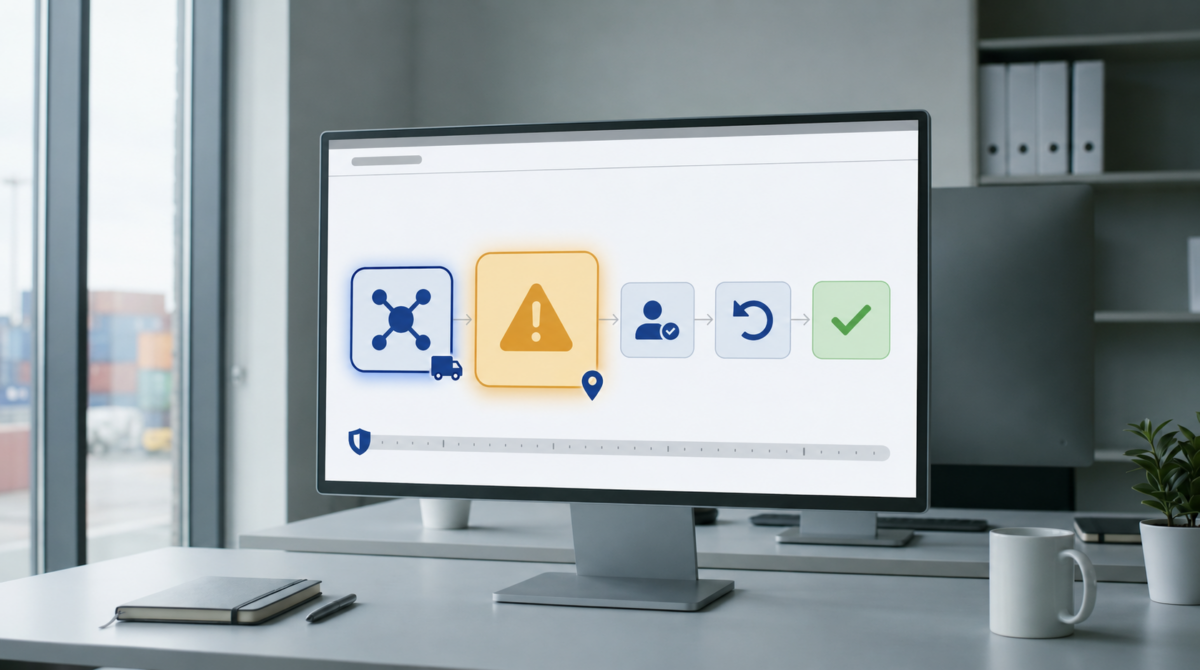
When a logistics AI agent makes a mistake, simply retrying the task is not enough. The system must identify what went wrong, prevent the error from affecting other operations, retain the relevant evidence, and restore the correct business state. If necessary, the case should be escalated to a human operator. The team must also identify the cause, strengthen the relevant control, and test the workflow again before allowing the agent to operate autonomously. The goal is not to eliminate every possible mistake. It is to ensure that failures are detected early, contained, corrected, and used to improve the system.
This is particularly important in logistics because an AI-agent error can have consequences beyond an incorrect response. An agent might update the wrong shipment, send an inaccurate freight rate, create a duplicate booking, use an outdated document, or close an exception before the carrier has confirmed that the issue is resolved. It may also complete an update in one system while a related action fails in another, leaving the shipment or order in an inconsistent state. These situations can be difficult to detect because part of the workflow may appear successful even when the actual operational status is incorrect.
The important question is not whether an AI agent can make mistakes. It will. What matters is whether the system around it can detect an error quickly, prevent it from spreading, restore the correct operational state, and stop the same type of failure from happening again at scale.
Preventing errors is an important part of enterprise AI development, but it cannot guarantee that an AI agent will always work as expected. Logistics operations involve constantly changing conditions, making it difficult to anticipate every situation before deployment. API failures, conflicting data, revised documents, changing customer instructions, and unexpected carrier responses can all affect how an agent performs.
A more reliable approach is to prepare the system to handle problems when they occur. This means having clear recovery procedures, monitoring mechanisms, and safeguards that prevent one failure from disrupting other operations.
Gartner’s October 2026 guidance on agent reliability reinforces this approach. It highlights the importance of mitigation and recovery alongside failure prevention. It also recommends circuit breakers, quick rollback mechanisms, continuous monitoring, and clearly assigned ownership as AI agents are given greater autonomy.
Current research: Gartner – AI Agent Success Requires Reliability Before Autonomy; Gartner – Proportional governance and rollback for autonomous agents.
This has an important implication for system design: every logistics AI agent must have a clearly defined response when something goes wrong. If a carrier API becomes unavailable, two documents contain conflicting information, a system rejects an update, the agent cannot make a reliable decision, or an operational threshold is exceeded, the workflow must know what to do next. Depending on the situation, it may retry the operation, pause the process, switch to a safer mode, request human approval, or escalate the case to an operator.
An AI agent designed only to handle normal operating conditions is not ready for production. It must also be able to recognize failures and respond without putting other business operations at risk.
A reliable incident-handling process can be divided into eight stages: detection, containment, evidence preservation, recovery, communication, diagnosis, correction, and validation.
These stages may overlap in a real incident. However, each has a distinct purpose, and together they give logistics teams a practical way to manage failures without losing control of ongoing operations.
A failure cannot be contained if the system mistakenly assumes that the task has been completed successfully. Detecting errors therefore requires more than checking the AI agent’s own response. The workflow must also verify the actual results in the connected business systems.
For example, when an agent reports that a carrier booking has been created, the system should confirm that a valid booking reference is available. If it claims to have updated a shipment status in the TMS, the corresponding record must be checked. If it reports that a customer notification has been sent, the system should verify the outbound message. Likewise, an invoice should only be considered posted when the ERP confirms that the transaction has reached the expected status.
Anthropic’s 2026 guidance on agent evaluation highlights the difference between an agent’s execution history and the actual outcome. A convincing activity log does not necessarily mean the task was completed correctly. Businesses need independent checks to confirm the final state, particularly because errors across multiple tool calls can accumulate and affect subsequent operations.
For logistics companies, successful execution should be determined by verified changes in business systems, not simply by what the AI agent reports.
Evaluation reference: Anthropic – Demystifying evals for AI agents.
Once a significant failure is identified, the system should prevent the same error from affecting other operations. It should be able to stop the affected workflow, disable a particular tool, restrict updates to a connected system, or move certain cases back to human approval. If failures exceed a defined threshold, a circuit breaker can automatically suspend the affected operation.
The response should match the severity and scope of the problem. For example, if a document-classification rule is producing incorrect results, there may be no need to shut down the entire AI platform. Instead, the affected document-processing workflow should be paused until the issue is corrected.
This is especially important in logistics because AI agents can process tasks much faster than human operators. A person might repeat an error a few times before someone notices. An autonomous agent running inside a high-volume workflow could repeat the same mistake hundreds of times before the problem is identified.
Before making changes to a failed workflow, the system should preserve the information needed to understand what happened. This includes the source data, document and message versions, retrieved information, model and prompt versions, tool calls, input parameters, system responses, approval records, and the resulting business state.
Without this information, engineering teams may identify the wrong cause. What appears to be a reasoning error could actually be caused by outdated source data. A duplicate booking might result from poorly designed retry logic rather than an incorrect model decision. A shipment-matching error could originate from identity resolution, while an incorrect customer communication might be caused by an inaccurate CRM field.
These problems require different solutions.
Maintaining a complete audit trail is therefore not just about compliance or record-keeping. It gives engineering and operations teams the evidence they need to identify the actual cause and prevent similar failures.
When an error occurs, the immediate priority should be to restore the affected shipment, order, invoice, or customer workflow to its correct operational state. Identifying the root cause is important, but it should not delay actions needed to limit business disruption.
Some actions can be reversed directly. An incorrect internal status can be corrected, a draft quotation can be withdrawn, and an incorrectly created internal task can be cancelled. A TMS field may also be restored to its previous value.
Other actions require a compensating transaction because the original action cannot simply be undone.
For example, if an AI agent creates an incorrect carrier booking, the system may need to cancel it while retaining the original transaction history. If an incorrect quotation has already been sent to a customer, the company may need to issue a corrected version. A posted invoice may require a reversal entry through the finance system. If a carrier or another external partner has already received an instruction, the company may need to send a clear cancellation or correction.
This distinction between rollback and compensation is important in enterprise systems. Not every business action has an undo option, particularly once it has affected an external party.
Not every AI-agent error requires the same level of attention. The escalation process should depend on the potential business impact, the affected system, and the risk involved.
For example, an incorrectly classified internal email that is automatically corrected may only need to be recorded in the incident log. A duplicate carrier booking may require attention from the operations team. An incorrect customer-facing freight rate could involve both sales and finance. A customs or dangerous-goods documentation error may require compliance involvement, while an incorrect payment instruction could trigger a formal incident-response process.
The agent should classify the incident according to its severity and business impact before escalating it.
The person receiving the alert should be able to understand what happened, which systems or transactions were affected, what steps have already been taken to contain the problem, what remains unresolved, and whether further approval is required.
This gives the operations team enough information to respond without having to investigate the entire execution history from the beginning.
Simply recording that an AI agent made a mistake does not help the engineering team prevent it from happening again. Every incident should be classified according to the underlying failure.
The investigation should establish whether the problem came from incorrect source data, a wrong shipment or customer match, an outdated document, faulty model reasoning, a missing business rule, an incorrect tool parameter, an API failure, duplicate retry execution, a missed escalation, or inadequate monitoring.
Each of these problems requires a different correction.
Changing the prompt will not fix an idempotency issue. Using a more capable model will not resolve a conflict between two systems of record. Adding more human approvals will not solve an API integration that silently fails to save updates.
The engineering team must identify the layer responsible for the failure before deciding what needs to change.
Once the cause is understood, the next step is to strengthen the specific control that allowed the failure to occur. Correcting an individual shipment or transaction is not enough if the same weakness remains in the wider workflow.
For example, if the agent selected the wrong shipment, the team should improve identity-matching rules and confidence thresholds. If it used an outdated document, the workflow needs stronger document-version controls and clear rules for determining which revision takes precedence.
If the agent generated a value without reliable supporting evidence, the system should require approved source data before allowing the action. If an expensive carrier rebooking happened without review, the approval rules should be tightened. If a retry created a duplicate transaction, the integration should use idempotency controls and more reliable retry handling.
The objective is to correct the underlying weakness rather than repeatedly fixing individual cases. A successful correction should reduce the likelihood of the same failure occurring across other shipments, customers, and operational workflows.
A workflow should not automatically return to full production authority simply because an engineer has changed the code, prompt, or business rule.
The failure should first be added to the regression test suite. The team should also test similar scenarios to confirm that the correction works beyond the original incident. If the problem involved a particular customer, document type, carrier response, or system integration, the evaluation should include representative variations of those cases.
Anthropic recommends maintaining regression evaluations to ensure that improvements do not introduce new problems or break capabilities that previously worked reliably.
Once the workflow passes the required checks, its previous level of autonomy can be restored gradually. Depending on the severity of the incident, the agent may initially operate in recommendation-only mode or prepare actions for human approval while the team monitors actual production activity.
Full autonomy should return only when the team has sufficient evidence that the failure has been addressed and the relevant controls are working as expected.
An effective production framework classifies errors based on their severity and impact on logistics operations.
| Failure type | Example | Immediate response | Typical autonomy response |
| Low-impact recoverable | Wrong internal category or non-material status | Correct automatically and log | Continue with monitoring |
| Operationally material | Wrong shipment field or duplicate task | Pause affected action, restore state, review cause | Temporary approval mode |
| Commercially material | Incorrect rate, premium rebooking or customer commitment | Contain, notify owner, reverse or compensate | Human approval until revalidated |
| Regulatory or safety critical | Customs, dangerous goods or sanctions error | Stop workflow, escalate formally, preserve evidence | Manual control until remediation is proven |
| Financial or security critical | Wrong payment destination or sensitive data exposure | Incident response, lock affected capability, investigate scope | Disable affected autonomous permissions |
The table provides a starting point rather than a complete incident classification system. Each company can adapt the categories to its own operations, but the important point is to change the agent’s permissions and behavior according to the potential consequences of a mistake.
Understanding individual failure scenarios makes it easier to see why recovery controls need to be part of the original system design. The following examples show how an error can occur, what the immediate response should look like, and which technical or operational controls can prevent a repeat.
Imagine that a carrier sends an email referring to booking ABC123. The AI agent matches the reference to a shipment with a similar identifier and updates the ETA on the wrong TMS record.
The first line of defence should have been a reliable identity check. Once the incorrect update is discovered, the system should stop further changes through that uncertain matching path.
The operations team should restore the original ETA on the affected shipment and update the correct record only after its identity has been confirmed. The original carrier email and the agent’s matching decision should also remain available for investigation.
The underlying problem may have nothing to do with the language model. The company might discover that different branches reuse booking references or that one application truncates identifiers during data transfer.
In that situation, the lasting solution is better identity resolution across connected systems, not simply rewriting the agent’s prompt.
A freight quotation agent may produce a well-presented quotation using a carrier tariff that is no longer valid. The problem can easily go unnoticed because the quotation looks complete and commercially reasonable.
The system should check the rate’s validity before the quotation reaches the customer. If an incorrect rate has already been sent, the affected tariff should be removed from further use, the commercial owner should be informed, and a corrected quotation should be prepared.
The CRM or quotation record should also be updated to reflect the correction, with the original rate source retained for investigation.
The team then needs to establish why the expired rate was accepted. Was its validity date missing? Did the rate API return outdated information? Did the agent mistake an old spreadsheet for a current negotiated tariff?
The lasting correction belongs in the rate-source validation and commercial policy layers.
Duplicate bookings are a good example of why agent reliability depends on more than model performance. The language model may make the correct decision, but a weakness in transaction handling can still produce an incorrect result.
Consider a workflow in which the agent submits a carrier booking request. The API times out before returning a confirmation. The system assumes the request failed and sends it again. However, the carrier has already processed the first request, so the second submission creates a duplicate.
Telling the agent to be more careful will not solve this problem.
The booking operation needs idempotency controls or a reconciliation step before another request is submitted. The system should check the carrier platform for an existing transaction using a unique client reference before attempting another booking.
Microsoft’s Azure architecture guidance for agent orchestration addresses similar problems in distributed systems. It recommends timeouts, controlled retries, graceful degradation, output validation, circuit breakers, and checkpointing to manage issues such as message loss, partial failures, and cascading errors.
Architecture reference: Microsoft Azure Architecture Center – AI Agent Orchestration Patterns.
An exception-management agent notices that a shipment has missed a milestone and contacts the carrier. The carrier replies that the shipment is expected to depart shortly.
The agent interprets the response as confirmation and closes the exception.
The problem is that an expected event is not the same as a confirmed event. The carrier has provided an update, but the shipment has not necessarily departed.
The case should remain open until the required completion evidence is available. That might be a carrier-confirmed departure event, a trusted tracking update, or another predefined milestone.
The workflow needs a clear definition of what counts as resolution. A carrier response alone should not automatically mean that the exception has been resolved.
False completion deserves particular attention during testing because the agent’s conversation may look entirely successful even though the operational problem remains open.
Suppose a document-processing agent extracts information from an original commercial invoice. The customer later sends a revised invoice containing different quantities, but the agent continues working with the earlier version.
The first step is to establish which downstream actions used the outdated document. The team should identify the correct governing revision, repeat the affected validations, and review any TMS, customs, or billing records that may need correction.
The longer-term solution is a document-version precedence model.
The system must distinguish between original files, revised documents, replacements, superseded versions, and unresolved conflicts. An agent should not be allowed to treat every uploaded file as equally authoritative.
This is why document intelligence requires more than accurate OCR. A system may extract every field correctly and still make the wrong decision if it cannot determine which document version should govern the transaction.
A customer asks whether a delivery can be guaranteed by Friday. The carrier’s latest estimated arrival time suggests Friday delivery is possible, but it hasn’t been confirmed. Despite this uncertainty, the AI agent tells the customer that the shipment will arrive on Friday.
The problem is not simply an incorrect AI response. The agent has turned an estimated delivery date into a firm business commitment without the necessary confirmation or approval.
Resolving the issue may require sending the customer a clarification, correcting the earlier communication, and involving the account owner. To prevent similar incidents, the system must clearly distinguish between confirmed information, predicted outcomes, and commitments made on behalf of the business.
The agent can share a carrier-confirmed ETA or an estimated delivery window. However, any statement that guarantees delivery should follow the company’s customer-commitment policy and require approval where necessary.
A production logistics agent should not have only two operating choices: complete autonomy or a complete shutdown.
There are situations where a workflow can continue safely with fewer permissions.
For example, if one carrier API becomes unavailable, the system may switch to manual carrier follow-up for that carrier while continuing normal operations with other carriers. If document-matching confidence falls for a particular customer, the affected cases can move back to human approval. If a model update creates an unusual increase in escalations, the team may pause only the affected action category.
This approach is known as graceful degradation. It allows the business to keep unaffected operations running while limiting the impact of a failing component.
AWS guidance for production agents follows a similar layered approach. It covers output validation, business rules, human approval gates, circuit breakers, observability, rollback, and fallback to a more restricted or human-managed workflow when the primary agent cannot continue safely.
Production-control reference: AWS – Is your AI Agent ready for prime time?
Software teams often rely on rollback mechanisms to reverse incorrect actions. However, logistics operations frequently involve external parties and connected business systems, where simply undoing an action may not restore the original situation. In such cases, the workflow needs a compensating action to correct the problem.
For example, if an AI agent sends a booking request to a carrier, the error may need to be corrected by cancelling the booking. An incorrect customs submission may require an amendment. A customer who receives inaccurate information may need a correction message. An incorrect ERP posting may require a reversal transaction, while a warehouse task may need a new instruction rather than simply deleting the original one.
These recovery procedures should be defined before an AI agent is given permission to perform such actions autonomously. For every important operation, the implementation team should establish two things: what needs to happen if the action goes wrong, and who has the authority to carry out the correction.
This ensures that the agent does not simply stop after detecting an error. It has a defined recovery path that helps restore operational accuracy while keeping the necessary approvals and accountability in place.
A production incident does not necessarily mean that the entire AI agent must lose all its permissions.
If an issue affects one carrier integration, one document category, or one stage of a workflow, the company may be able to restrict autonomy only in that area. Other processes can continue operating under their existing controls.
Gartner’s May 2026 governance guidance supports this proportional approach. Different levels of agent autonomy involve different trust boundaries, so governance should reflect the level of authority being granted. The same principle should apply after an incident. If one capability has become unreliable, restrict that capability until it has been corrected and tested. Avoid unnecessarily disabling unrelated automation that continues to operate safely.
When an operator corrects an AI agent, the system should record more than the corrected value. It should also capture the reason behind the change.
Was the source inaccurate? Was an important rule missing? Did the customer have an exception that was never documented? Did the agent close the case too quickly? Or did the operator make a commercial decision based on their own judgment that should not become a standard rule?
The final distinction is especially important. A human override does not always mean the agent made a mistake. Some decisions require professional judgment and are meant to remain discretionary. The system must be able to distinguish between an actual agent failure and a valid exception made by an accountable person.
A clear incident classification helps teams identify the actual source of a failure instead of assuming that every problem requires changes to the AI model.
Context failures happen when the agent cannot access the information it needs or retrieves incorrect information. Identity failures occur when it selects the wrong shipment, order, customer, or other business record. Reasoning failures arise when the model misinterprets evidence that is otherwise correct. Policy failures happen when business rules or deterministic controls are missing or incorrectly configured. Tool failures involve unexpected behavior from APIs, RPA actions, or system integrations. Transaction failures occur when an action is only partly completed or gets executed more than once. Oversight failures happen when the system fails to escalate an issue or gives reviewers too little information to make a sound decision.
This classification also helps prevent unnecessary model tuning. For example, retraining or changing a model will not fix an incorrect shipment record, a failed API call, or a missing approval rule.
Gartner’s September 2026 research on context failures is relevant to this issue. It highlights how production agent failures can originate in poorly managed context rather than in the underlying model or agent framework. This is particularly important in logistics, where the information an agent needs is spread across shipment records, transport documents, carrier updates, emails, TMS platforms, and customer-specific instructions.
Current research: Gartner – Diagnosing and Fixing Context Failures in AI Agents.
Once an incident has been resolved, the exact conditions that caused it should be added to the regression test suite so the same problem can be detected before it reaches production again.
For example, if an agent processes an outdated invoice version, the test suite should include a scenario with multiple revisions. If a booking retry results in a duplicate, the test environment should recreate the timeout that triggered the second attempt. If the agent fails to escalate a high-value shipment recovery, similar cases around the escalation threshold should be added to the test suite.
This gives the organization a practical way to improve agent reliability over time. Rather than treating production incidents as one-off problems, teams use each failure to expand test coverage and reduce the chance of the same issue happening again.
Anthropic’s evaluation guidance distinguishes between capability tests and regression tests. Capability tests measure what an agent can do, while regression tests check whether previously reliable behavior remains consistent as models, prompts, tools, and orchestration logic are updated.
For low-risk workflows, organizations can set an acceptable error budget based on the potential business impact of a failure.
This does not mean accepting serious mistakes. It means separating minor, recoverable issues from failures that could cause financial, legal, operational, or safety consequences.
For example, an internal classification task may allow occasional errors that an operator can easily correct. However, actions involving bank account details, customs declarations, dangerous goods, or strategic pricing commitments require much stricter controls. These decisions should not be left to autonomous execution without appropriate validation or human approval.
This approach provides a more realistic way to measure reliability. Instead of relying on one overall accuracy score, organizations can set different error limits and control requirements for each workflow based on the risks involved.
An observe-only agent may provide incorrect recommendations, but it cannot directly change a shipment or trigger an operational action. An advisory agent can influence a human decision. An agent that acts with approval can execute changes after a person reviews them. A fully autonomous agent, however, can carry out actions at scale without someone checking every individual case.
Incident response must become more rigorous as an agent gains authority. Workflows with greater autonomy need faster failure detection, stricter transaction controls, clear audit trails, effective circuit breakers, defined rollback or corrective actions, and designated people responsible for handling incidents.
The key principle is that greater autonomy must be supported by proven reliability. An agent should earn permission to take on more responsibility through consistent performance, not receive it simply because its underlying model appears capable.
An effective incident report should explain the business consequences of a failure, not just the technical details.
Management should be able to establish:
The report should also distinguish between a model error, an integration issue, poor master data, an incomplete business rule, and a problem originating in a source system.
Simply blaming AI does not explain what happened. Management needs to know which part of the operating process failed and what is being done to prevent another incident.
Recovery procedures should be tested before an AI agent enters production. Teams should not have to design them for the first time while handling a live incident.
Testing should deliberately reproduce failures such as carrier API timeouts, duplicate messages, outdated documents, conflicting ETAs, rejected TMS updates, missing customer records, permission errors, low-confidence matches, revised invoices, and tool failures. The goal is to verify that the agent stops safely, preserves the current transaction state, escalates the issue to the right person, and resumes correctly once the problem is resolved.
Microsoft’s guidance on agent orchestration highlights several practices that support reliable recovery: making errors visible rather than hiding them, validating outputs before they reach downstream systems, implementing retries and graceful degradation, using circuit breakers, and saving workflow state through checkpoints so interrupted processes can resume safely.
These practices are not unique to AI. They come from established distributed-systems engineering and are equally important when building reliable agentic workflows.
A logistics buyer should evaluate a vendor not only on how well its AI agent performs when everything works but also on how it handles mistakes and unexpected failures.
The key questions include:
A vendor with a credible production architecture should be able to answer each question with specific controls, recovery procedures, and real operational examples. General assurances about AI accuracy are not enough to demonstrate that an agent can operate safely in a live logistics environment.
Yes. The failure may originate from incorrect identity matching, outdated data, incomplete business rules, API errors, duplicate retries, permission problems, or an action being marked complete without successful execution. It does not necessarily mean the language model itself made the mistake.
Isolate the affected workflow to prevent the error from repeating through automated execution. Next, retain the evidence needed for investigation and correct the affected business records before restarting the process.
Yes, in some situations. An incorrect internal status or an unsubmitted draft can often be corrected automatically. However, actions involving carriers, customers, financial systems, or external authorities may require a compensating transaction. For example, the company may need to cancel a booking, reverse an invoice posting, or send a correction to a customer.
No. The response should reflect the seriousness and scope of the problem. If an issue is limited to one integration or action category, the company may only need to pause that part of the workflow and require human approval. Unaffected processes can continue operating under their existing controls.
A circuit breaker automatically stops or restricts execution when a predefined failure condition is reached. This could include repeated API errors, an unusual number of duplicate actions, excessive escalations, or unexpected transaction volumes. It helps prevent a localized problem from spreading across a larger operation.
Prevent duplicate bookings and system updates by designing actions to be idempotent, using unique transaction references, checking the current system state before retrying, and reconciling records after timeouts. The AI model should never assume that an unsuccessful response means the action was not completed. The connected system must confirm the actual transaction status before another attempt is made.
The workflow should first assess the business impact and notify the relevant account or operations owner when necessary. It should then issue the appropriate correction, retain the original message and supporting evidence for audit purposes, and address the underlying policy or source-control weakness that caused the error.
Reinstate the correct document revision, trace all downstream actions that relied on the outdated version, and correct the affected records. Then strengthen the revision-priority rules so the agent can consistently identify the latest approved version instead of treating every revision as equally valid.
Every significant failure should be added to the evaluation process as evidence for improving the system. However, human overrides should not be classified as AI model errors. Before updating the evaluation suite, the team should identify the nature of the issue. Was it caused by inaccurate data, an incorrect policy, faulty reasoning, identity mismatch, execution failure, or a human decision that required professional judgement? This distinction helps teams address genuine system weaknesses without turning every discretionary decision into a model failure.
The underlying cause should first be identified and corrected. The original failure and similar scenarios should then pass regression testing. The revised workflow should also demonstrate stable behavior under the corrected controls. For higher-risk operations, it may be sensible to restore autonomy gradually while keeping human approval in place.
Rollback takes a system back to an earlier state. Compensation uses a new action to correct or offset something that has already happened. For example, restoring an internal shipment field may be a rollback, while canceling a carrier booking or reversing a posted invoice is a compensating action. External logistics transactions frequently require compensation because the original event cannot simply be erased.
Responsibility remains with the organization and its designated process owners. Using an autonomous agent does not transfer accountability for commercial decisions, shipment operations, financial transactions, regulatory requirements, or safety outcomes. Companies need clear ownership before allowing agents to perform business-critical actions.
The workflow can capture and organize incident data to support continuous improvement, but it should not modify its own behavior without proper oversight. Any changes to business rules, prompts, models, permissions, or connected tools must be tested, reviewed, and approved before being introduced into production.
When a logistics AI agent makes a mistake, the right response is neither to panic, retry blindly, nor permanently switch back to manual operations. The system should contain the failure, restore the correct operational state, preserve the audit trail, identify the actual cause, strengthen the relevant control, and verify the fix before restoring autonomy.
Failure recovery should be built into the agent’s architecture from the beginning. The workflow must have defined responses for conflicting data, failed integrations, transaction timeouts, low-confidence decisions, and breached business thresholds. These situations should not require teams to invent recovery procedures during a live incident.
The most reliable logistics agents will not necessarily be those that never make mistakes. They will be the ones that keep errors within acceptable limits, detect problems quickly, recover safely, explain what went wrong, and use every incident to reduce the likelihood of the same failure happening again.
aTeam Soft Solutions develops custom agentic AI solutions and enterprise automation for logistics, freight forwarding, transportation, trading, distribution, and supply chain businesses. Our solutions cover freight quotation, document intelligence, shipment exception management, supplier ETD monitoring, customs preparation, dispatch operations, fleet management, accounts payable, and demand planning. They also connect with existing business systems, including TMS, ERP, WMS, CRM, email, WhatsApp, carrier platforms, APIs, and legacy applications.
Recovery is built into the way we design and deploy production workflows. Agents follow clear data-source priorities and defined business rules, with approval limits, audit trails, action verification, controlled retries, exception handling, and safe fallback procedures. Every significant production mistake is investigated, classified, and added to the regression test suite. Autonomy is expanded only after the corrective changes have been tested and verified.