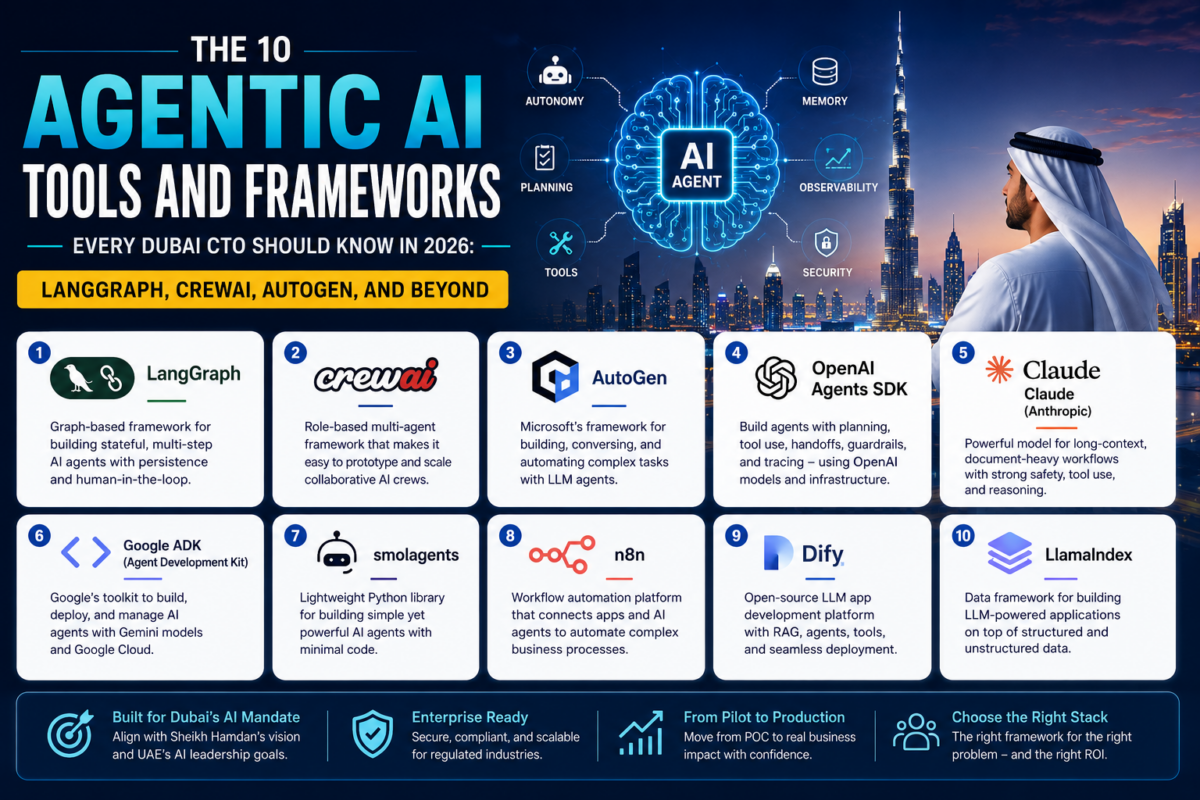
The agentic AI tools and frameworks landscape in 2026 has become increasingly competitive and fast-moving, making careful evaluation a challenge for enterprise technology teams.
For CTOs, agentic AI development in Dubai presents a real challenge.
Following Sheikh Hamdan’s private-sector agentic AI initiative, the conversation has shifted from whether Dubai companies should understand AI agents to which tools and frameworks are capable of supporting production-ready deployments in real business environments.
The market now offers a wide range of options, including LangGraph, CrewAI, AutoGen, the OpenAI Agents SDK, Claude tool use, Google ADK, Smolagents, n8n, Dify, OpenAgents, MCP, and A2A. Alongside these are agent platforms, low-code AI builders, model-specific SDKs, open-source frameworks, and cloud-native platforms, giving businesses more choices than ever before.
Most Dubai companies do not need to assess every tool or framework available.
They need to know which frameworks are worth considering, where each one fits best, and the trade-offs involved in using them in production.
This article is written for CTOs, technology leaders, digital transformation executives, and founders who need practical guidance. It is not a hype-driven list, a GitHub popularity ranking, or another generic roundup of the “latest tools.”
At aTeam Soft Solutions, we have helped organizations across the UAE and Saudi Arabia move AI agents from pilot projects into production. Along the way, we have used several of these frameworks, evaluated many more, and dismissed a few that were not suitable for enterprise production due to operational limitations or higher implementation risk.
The conclusion is clear.
The best framework is not necessarily the one getting the most attention online.
The best framework is the one that aligns with your workflows, integrates with your existing systems, matches your team’s expertise, supports your governance requirements, fits your model strategy, and can be managed reliably in production.
For many enterprise deployments, LangGraph paired with Claude or another capable foundation model is often the approach we recommend.
For rapid proof-of-concept projects, CrewAI is often the faster option.
For AI-powered workflow automation, n8n can be a practical choice.
For visual prototyping, Dify is a practical choice.
For document-intensive tasks that require long-context reasoning, Claude is often a strong choice.
For enterprises that rely heavily on Google Cloud, Google ADK and the Gemini Agent Platform are well worth considering.
As multi-agent systems continue to evolve, support for MCP and A2A is likely to become increasingly important over the next two years.
This guide explores the 10 agentic AI tools and frameworks Dubai CTOs should know about in 2026.
The agentic AI tools and frameworks market in 2026 appears more mature than it really is.
There are many frameworks available, but not every option is ready for every use case.
Some frameworks are excellent for demos.
Others are better suited for research.
Some work best for internal prototypes.
Some are built for production enterprise workflows.
Others are better viewed as workflow automation platforms with AI capabilities.
Some are model-focused SDKs rather than complete orchestration frameworks.
Some are protocol layers that allow agents to connect with tools and communicate with one another.
A Dubai CTO should not evaluate these tools based only on popularity.
The important considerations are different.
Can the framework reliably handle long-running workflows?
Can it provide human oversight before the AI performs critical actions?
Can it recover when a workflow step fails?
Can it capture what the agent observed, decided, and executed?
Can it support reliable audit trails?
Can it support multiple model providers?
Can it connect with the enterprise systems?
Can it effectively handle both Arabic and English workflows through the underlying model?
Can the team maintain it after deployment?
Can another vendor step in and manage the system if required?
This is important because agentic AI is not the same as building a chatbot.
A chatbot can often operate as a straightforward request-response application.
A production AI agent can operate for minutes, hours, or even days. It may pause for human approval, retrieve documents, call APIs, update records, trigger notifications, manage exceptions, and continue from a saved state. It may need to provide auditors with a clear record of what happened, pause when confidence is low, and safely retry failed steps without disrupting the workflow.
That is where the framework choice is important.
But this is also why the choice of framework should not be overstated.
A strong implementation partner can build reliable AI agents across multiple frameworks. A weak team can struggle even with the most advanced framework available.
The framework is an important part of the foundation.
The architecture, testing approach, process design, governance, and maintenance model determine whether the agent succeeds in production.
LangGraph is a graph-based orchestration framework from the LangChain ecosystem. It represents AI agent workflows as connected graphs, where each node handles a specific step, and each edge controls how the workflow moves between steps.
This is important as enterprise workflows often look like graphs.
An invoice agent may begin by receiving a document, classifying it, extracting key fields, verifying supplier details, matching it against a purchase order, validating totals, and deciding whether the invoice should move to human review or ERP preparation. If an exception occurs, the workflow can branch into a different path. If a human approves the invoice, the process continues; if it is rejected, the workflow moves into correction.
LangGraph is well suited for this type of workflow.
Its biggest strength is the level of control it provides.
The graph structure gives engineers precise control over how the agent workflow operates. It simplifies state management, supports long-running processes, and allows human-in-the-loop checkpoints when approval is required. With persistence capabilities, workflows can save their progress and resume from the correct point later. LangGraph also integrates with LangSmith for tracing, debugging, evaluation, and ongoing monitoring.
For Dubai companies, this matters because many agentic AI use cases are focused on operational workflows rather than simple conversations.
Finance workflows, claims processing, compliance tasks, procurement operations, customs documentation, and tenant communications all require structured execution and clear controls. These processes cannot operate like open-ended conversations.
LangGraph is not the simplest framework for beginners. It requires engineers to understand concepts such as graph-based orchestration, state management, nodes, edges, retries, and persistence. For basic prototypes, it may introduce more complexity than necessary.
For production enterprise deployments, however, that structure becomes a major advantage.
At aTeam Soft Solutions, we often choose LangGraph for complex enterprise agents because it provides the control needed for phased autonomy. The same workflow can support different maturity stages, from observation mode and assisted operation to controlled actions and full production monitoring. Each stage can be represented within the graph with clearly defined entry and exit conditions.
We use this approach for finance, compliance, documentation, and operational agents where human oversight, traceability, and auditability are critical.
A ZATCA compliance support agent is a good example of where graph-based workflows are valuable. The agent must validate information, check regulatory requirements, identify exceptions, and determine the right next step. Customs documentation agents follow a similar pattern, where each document type, validation step, and exception scenario can be structured clearly.
LangGraph is best suited for production enterprise deployments, complex multi-step workflows, audit-sensitive processes, human oversight workflows, and agents that need to continue across multiple stages over time.
For a Dubai CTO, the key question is whether the team has the engineering maturity required to use it effectively.
If the answer is yes, LangGraph is one of the strongest options to consider in 2026.
CrewAI is a role-based framework designed for building multi-agent systems.
The concept is straightforward. Agents are created like members of a team, with each one assigned a specific role, goal, and responsibility. A workflow can then be designed around a group of agents collaborating to complete tasks.
That is where developers like CrewAI.
It feels natural to understand and work with.
A recruitment workflow might include separate agents for resume screening, skills matching, and candidate communication.
A finance workflow might include separate agents for invoice processing, purchase order matching, and exception review.
A market research workflow might include separate agents for research, analysis, and report generation.
This role-based structure makes CrewAI well-suited for rapid prototyping.
A team can describe a workflow using familiar business roles and quickly translate it into an agent-based structure. This approach is often easier for non-ML engineers to understand compared with graph-based orchestration. It works especially well when the workflow naturally involves multiple specialists working together.
CrewAI has grown beyond simple experimentation. It now offers stronger support for structured flows, production workflows, and enterprise use cases compared with earlier versions. For companies that want to move quickly from an idea to a working proof of concept, it can be a practical option.
The limitation is that a role-based approach can become challenging for workflows that require precise state management and detailed control over execution.
In many enterprise processes, workflows do not operate like a team of people with separate roles. They function more like controlled pipelines with validations, decision branches, approvals, retries, and system-driven actions. In these scenarios, LangGraph may provide a stronger structural approach.
CrewAI can still support production deployments, but the architecture needs to be designed carefully. If teams rely only on agents communicating with each other without clear state management, workflow controls, and business rules, the system can become difficult to monitor, troubleshoot, and maintain.
At aTeam Soft Solutions, we primarily use CrewAI for proof-of-concept projects and workflows where the team-based approach makes sense. It is especially useful when clients need to validate an idea quickly, and the process can be divided into clear specialist roles.
For example, a recruitment automation pilot can be a good fit for CrewAI because tasks like screening, matching, and candidate communication naturally align with different roles. A research or proposal drafting assistant can also work well because each agent’s responsibility can be clearly defined.
However, for financial transaction processing, compliance validation, claims processing, customs documentation, and other workflows that require strong audit trails, we typically prefer LangGraph or a more controlled workflow architecture.
CrewAI is best suited for rapid pilots, role-based workflows, internal prototypes, and teams that want to move quickly without complex workflow management.
For Dubai CTOs, CrewAI is valuable because it can reduce the time needed to turn a business concept into a working proof of concept.
AutoGen emerged as one of the early widely adopted frameworks for developing multi-agent AI applications.
It introduced many developers to the concept of AI agents collaborating through structured conversations. One agent may generate a response, another may review or challenge it, another may execute code, and another may validate the result. The workflow continues through agent interactions until the task is completed.
This conversation-based design is useful for certain scenarios.
It can support multi-agent discussions, research workflows, coding tasks, document reviews, and scenarios where multiple perspectives help improve the outcome.
However, AutoGen’s position in the market has changed over time.
Microsoft’s AutoGen repository now indicates that AutoGen is in maintenance mode. This means it will not receive new features or major enhancements and will continue under community management. Microsoft has also provided migration guidance for teams moving toward the broader Microsoft Agent Framework.
AG2, which evolved from the AutoGen-style multi-agent collaboration approach, continues as an open-source framework for building agent-based systems. It supports multi-agent collaboration, tool integration, human review workflows, and structured conversation patterns.
For Dubai CTOs, the key point is not that AutoGen has no value. The consideration is that AutoGen should not automatically be the default choice for new enterprise production projects without a careful evaluation.
A framework in maintenance mode can still be functional and useful. However, CTOs need to consider whether the ecosystem, available support, future roadmap, and long-term maintainability align with enterprise requirements.
The deeper limitation is related to the underlying architecture.
Conversation-based agent systems can become inefficient for structured business process automation. A claims preparation workflow does not need agents continuously discussing possible outcomes. It needs defined steps, validation rules, confidence thresholds, human review points, and reliable system updates.
In other words, enterprise operations often require controlled execution rather than continuous multi-agent conversation.
At aTeam Soft Solutions, we have evaluated AutoGen-style approaches for different use cases, but we rarely select them for production business process automation. They can be valuable for research-oriented tasks, document quality review, and internal analysis workflows where feedback and multiple perspectives improve results. However, they are less suitable for processes that require predictable execution, detailed logs, and strong integration with enterprise systems.
A Dubai CTO should consider AutoGen or AG2 when the use case genuinely benefits from multi-agent collaboration, discussion, or research-oriented workflows.
For operational workflows involving invoice processing, tenant support, customs documentation, compliance monitoring, and insurance submissions, a structured and controlled approach is often more suitable.
The OpenAI Agents SDK provides developers with a structured approach to building AI agents that can plan tasks, use tools, transfer work between agents, apply guardrails, support tracing, and implement multi-agent workflows.
For companies already relying heavily on OpenAI models, the SDK is an attractive option because it fits closely within the OpenAI ecosystem and provides clear building blocks for agent development.
The handoff model is one of its key strengths.
A primary agent can delegate tasks to specialized agents based on the type of request. For example, a customer support agent can route billing questions to a Billing Specialist agent, technical issues to a Technical Support agent, and contract-related queries to a Legal Escalation agent.
This approach aligns well with service-based workflows.
The built-in tracing capabilities are also valuable. Agent systems can be difficult to troubleshoot when teams cannot see how decisions were made during execution. Tracing provides visibility into model interactions, tool usage, agent handoffs, guardrails, and decision paths. This helps teams during both development and production monitoring.
Compared with more complex orchestration frameworks, the SDK provides a simpler approach that can help teams develop faster and remain aligned with OpenAI models.
However, the key consideration is strategic dependence on the platform.
If a company becomes too dependent on a single model ecosystem, it may face challenges later around pricing, performance, regional deployment, Arabic language support, or data governance requirements. While some OpenAI SDK capabilities are more flexible across models than many assume, the strongest overall experience still comes from staying within the OpenAI ecosystem.
For Dubai companies managing sensitive data or multilingual workflows, this consideration is important.
A CTO should evaluate whether the system can support future model changes, whether it can use models like Claude for long-context document tasks, whether local or open-source models can be used for sensitive data, and whether the architecture keeps business logic separate from model provider dependencies.
At aTeam Soft Solutions, we use OpenAI’s agent tooling when clients are already invested in the OpenAI ecosystem or when the use case benefits from its models and built-in capabilities. However, for complex enterprise systems, we often prefer a more model-agnostic orchestration layer such as LangGraph, allowing different models like OpenAI, Claude, or other providers to be selected based on the specific task requirements.
The OpenAI Agents SDK is best suited for teams already invested in the OpenAI ecosystem, service-oriented workflows with clear handoffs, rapid agent development, and use cases where OpenAI models are well suited to the task.
For a Dubai CTO, it is a strong option, but model flexibility should be part of the evaluation.
Claude is more than a language model. It now provides a strong foundation for agentic workflows with capabilities such as tool use, long-context processing, computer use, and advanced document reasoning.
For many enterprise applications, especially those centered on large volumes of documents, Claude is often among the strongest model choices.
This is important for Dubai companies because many real-world AI agent applications involve processing, reviewing, and managing documents.
Supplier invoices.
Contracts.
Insurance documents.
Healthcare policies.
Arabic-English forms.
Lease agreements.
Compliance documents.
Customs paperwork.
Procurement emails.
Claims attachments.
A model that can process long-context information and reason accurately across multiple documents can deliver real business value.
Claude’s tool use capabilities allow developers to give the model access to specific functions and external tools. The model can request a tool, receive the result, incorporate that information into its reasoning, and continue the workflow. Its computer use capabilities and advanced tool use patterns also demonstrate the direction of modern agentic workflows, although production deployments still require strong security controls and appropriate human oversight.
The main advantage of Claude is safety and document understanding.
Claude is often a strong choice for regulated, legal, healthcare, and financial workflows, as well as other use cases that require long-context reasoning. It can process large documents, maintain context across complex information, and generate more careful, consistent outputs than many lighter models.
While Claude provides advanced tool use capabilities, it is not intended to serve as a full workflow orchestration framework by itself.
Claude still needs to be part of a broader application architecture. Production systems require state management, retry mechanisms, monitoring, human review, dashboards, audit logs, and business rule validation. Claude can provide the reasoning layer, but it should not be treated as the entire system.
At aTeam Soft Solutions, we often use Claude as the model layer within a LangGraph architecture. This combines Claude’s document reasoning capabilities with LangGraph’s production-ready orchestration. Claude is responsible for understanding and reasoning over documents, while LangGraph manages workflow state, execution flow, human review checkpoints, and overall process control.
For example, in contract review, invoice processing, compliance monitoring, and claims preparation, Claude is a strong fit because these workflows often involve long, complex, or unstructured documents. However, the business process still requires guardrails, validation rules, and human oversight around the model.
Claude is best suited for document-intensive agents, safety-sensitive workflows, long-context tasks, regulated use cases, and Arabic-English document workflows where high-quality reasoning is critical.
For Dubai CTOs, Claude is a strong option to evaluate, especially for workflows where document processing is central to the business.
Google’s Agent Development Kit (ADK) helps developers build multi-agent applications that run within the Google Cloud and Gemini ecosystem
Google’s Gemini Enterprise Agent Platform helps organizations build, deploy, and manage AI agents across the enterprise. It is best suited for companies that already use Google Cloud, BigQuery, Vertex AI, Gemini models, or other Google technologies, making it easier to integrate AI agents into their existing infrastructure and workflows.
ADK is built around a hierarchical agent architecture. A central agent can assign work to specialized sub-agents, which can then pass tasks to other agents as needed. This approach reflects how many enterprises already operate, with a central coordinator directing work to teams that handle specific functions.
Google is also closely involved with the A2A (Agent-to-Agent) protocol, which enables AI agents to communicate across different systems and vendors. As enterprise AI continues to evolve, this capability will become increasingly important. Instead of relying on a single agent within one organization, businesses are likely to use multiple agents that collaborate across departments, customers, suppliers, partners, and technology platforms.
For businesses in Dubai, this future matters.
A logistics company, for example, may have its shipment agent talk to a supplier production agent, a customs documentation agent, a warehouse agent, and a customer notification agent.
A healthcare organization might require its claims agents, scheduling agents, pharmacy agents, and patient communication agents to collaborate.
A realty firm may want its tenant agents, maintenance vendor agents, payment agents, and CRM agents to safely share context.
A2A-style interoperability is nascent, but CTOs should keep an eye on it.
The enterprise cloud integration is the strength of the Google ADK and Gemini Agent Platform. For organizations that are already on Google Cloud, the platform can offer identity, logging, monitoring, scaling, and governance services that are difficult to duplicate quickly.
The constraint is ecosystem fit.
ADK is designed for Google Cloud and Gemini. It could work with other tools and models, but your best experience is going to be on Google’s stack. For companies using Azure, AWS, Salesforce, SAP, or their own infrastructures, the compatibility needs to be tested.
At aTeam Soft Solutions, we are keeping a close eye on Google ADK in particular for multi-agent interoperability and Google Cloud-heavy clients. It works well if the enterprise already has Google Cloud infrastructure and wants to create agents within that governance environment.
For CTOs in Dubai, Google ADK matters most if your business is either already aligned with Google Cloud or looking out to the horizon for agent-to-agent interoperability.
Hugging Face Smolagents is a lightweight building block to build agents easily, and particularly code agents.
Its philosophy is unlike that of many other bulkier frameworks.
Rather than having to define multiple layers of orchestration, Smolagents aims to be simple. The agent is able to write and run Python code to complete the task. This gives it flexibility for data analysis, research workflows, and cases where predefined tools are too restrictive.
Code-based agents can be highly effective because code offers the flexibility to express complex logic and workflows.
If a task requires data manipulation, calculations, file parsing, API calls, or custom analysis, then Python can do it. The agent is now able to generate the code required for the task rather than being limited to predefined function calls.
This is especially helpful for data science teams.
For example, a company that wants an agent to process CSV exports, create summaries, run transformations, create charts, or test hypotheses on data sets. Smolagents are well-suited for these tasks, as the agent can go through code.
The restriction is security.
Letting an AI agent write and run code has its risks. The agent may execute unsafe commands, access unauthorized files, consume resources, leak data, or behave unpredictably if its execution is not isolated.
Deterministic tool calls tend to be safer than open code execution for production business processes, though.
A finance AI agent that processes invoices should not be allowed to arbitrarily write code in production. A healthcare workflow also should not be allowed to execute arbitrary code on patient data. A regulatory workflow must be very tightly regulated.
At aTeam Soft Solutions, we utilize Smolagents-style approaches primarily for our research workflows, internal data analysis and transformation tasks, as well as controlled sub-systems within larger systems. This can be helpful when the agent has to produce analysis code or process data in a flexible way.
However, we don’t suggest it for customer-facing, regulated, or high-risk production workflows unless the execution environment is very heavily isolated and controlled.
Smolagents is ideal for data science teams, research tasks, internal analytics, adaptable data transformation, and internal automation for low-risk workflows
For a CTO in Dubai, the key consideration is whether code execution is a benefit or a potential risk for the use case.
n8n is a workflow automation platform and has gradually introduced AI capabilities, enabling businesses to build more intelligent and automated workflows.
It is not really an AI agent framework like LangGraph or CrewAI is. It is best viewed as a visual automation platform that brings together AI components, LLM interactions, RAG workflows, API integrations, database operations, and a wide range of connected services in a single workflow.
That is how it can be useful in AI-assisted workflows
Various companies already have basic automation requirements that do not need custom agent development. They have to integrate forms, CRMs, emails, databases, spreadsheets, ticketing tools, WhatsApp tools, and internal systems.
n8n can assist in creating these workflows visually.
For small and medium-sized enterprises (SMEs) and mid-market firms in Dubai, this may be a useful stepping stone between no-code automation and full agentic AI.
For example, a business can employ n8n to sense when a document is uploaded, route it to an AI extraction step, save the output, inform finance, and generate a review task. The AI portion manages the interpretation. n8n manages the workflow movement.
Self-hosting is even more important. For companies that are concerned about data control, self-hosted n8n can be deployed in a managed environment. This is not the same as a complete enterprise AI platform, yet it can offer more control than just cloud-based automation tools.
The limit is the depth of reasoning.
n8n is great for workflows, triggers, integrations, and visual automation. However, for complex workflows that require multi-step reasoning, long-running state management, advanced human oversight, and deeper model coordination, LangGraph or a custom agent architecture is often the stronger choice.
At aTeam Soft Solutions, we recommend n8n for clients looking to quickly introduce AI capabilities into their existing automation workflows. It works particularly well for internal operations, automated notifications, straightforward document processes, and early-stage automation initiatives.
n8n is not usually the first choice for building complex enterprise agents, but it can be a valuable component within a broader AI architecture.
It is best suited for AI-powered workflow automation, low-code internal tools, simple agent-based processes, and organizations that want to experiment with automation without requiring extensive engineering resources.
For Dubai CTOs, n8n is worth evaluating when the primary goal is connecting systems and streamlining workflows rather than handling complex reasoning or decision-making.
Dify is an open-source LLM application platform that provides visual tools for creating AI workflows, RAG pipelines, agent applications, prompt management, model integrations, and monitoring capabilities.
It appeals to a broad base since it reduces the friction of creating AI applications.
Teams are able to prototype more quickly without having to build every component from the ground up. They can visually configure RAG workflows, connect models, build chat interfaces, create agent flows, and manage prompts.
Dify is useful for internal tools and quick concept validation.
A company in Dubai that wants to experiment with an internal policy assistant, a knowledge-base search tool, a straightforward document Q&A agent, or a prototype support assistant may be able to advance rapidly using Dify.
The built-in RAG pipeline feature is extremely valuable. A lot of companies want AI tools that answer from internal documents. Dify offers a more straightforward path than building a retrieval system manually from the ground up.
The main limitation is that it has a ceiling when workflows become more complex.
Visual builders are useful until the process is too specialized. Once the enterprise requires custom state management, complex branching, unusual system integration, elaborate audit trails, sophisticated approval flows, and production-specific governance, visual platforms start to feel limiting.
Dify is a solid choice for prototypes and internal applications, but CTOs should exercise caution in adopting it as the basis for complex, production workflows without considering the implications on scalability, governance, and maintainability.
At aTeam Soft Solutions, we leverage Dify primarily for internal tools, client presentations, rapid prototyping, and early validation. It gives clients the possibility to see what is possible before they commit to a full custom build.
For production systems, we usually rebuild the mature version in a more controlled framework like LangGraph, based on the workflow.
Dify is suitable for fast prototyping, internal AI applications, RAG-based knowledge tools, and teams lacking deep ML engineering expertise.
Dify is a practical tool for Dubai CTOs to quickly test out ideas, but it should not be presumed that it will automatically be the final architecture for regulated or high-value workflows.
OpenAgents represents an important shift in the agent framework landscape by focusing on interoperability and enabling different AI agents to work together more effectively.
The agentic AI of the future will not be a single agent doing everything.
The future will be driven by connected networks of agents.
A supplier can possess an agent. A buyer can have an agent. A logistics provider can have an agent. A bank is likely to have an agent. A government portal could expose agent-consumable services. Internally, finance, HR, procurement, sales, and operations might each have their own agents.
All those agents will need to safely communicate.
That is where MCP and A2A-type protocols come into play.
MCP, which was first brought by Anthropic, is an open standard to connect AI applications to tools, data sources, and systems. This addresses the problem of having to build custom integrations with each tool for every AI application.
A2A, originally introduced by Google and now part of wider agent interoperability work, is intended to allow agents to communicate, share data, and coordinate activity across system and vendor boundaries.
OpenAgents is an interesting part, as it is focused on this protocol-first future, with support for agent interoperability patterns.
This is still in the early stages.
A Dubai CTO should not adopt an emerging interoperability-focused framework as the default foundation for a critical production workflow without extensive testing and validation.
However, CTOs should understand the direction the market is moving toward.
As Dubai’s private sector continues adopting agentic AI across thousands of businesses, AI agents will increasingly move beyond isolated workflows. Procurement agents may communicate with supplier agents, real estate agents may coordinate with maintenance and service providers, logistics agents may exchange updates with customs systems, and healthcare agents may interact with payer platforms.
Interoperability is going to be a strategic concern.
The advantage of OpenAgents-style thinking is future readiness.
The constraint is maturity.
The ecosystem is still immature. Documentation, community support, enterprise case studies, security models, and production patterns are still evolving.
At aTeam Soft Solutions, we do not advise beginning most enterprise deployments on the youngest interoperability-first framework. However, we do suggest designing agent architectures for MCP and A2A. A company doesn’t have to implement every protocol on day one, but it should stay away from closed architectures that prevent future interoperability.
OpenAgents and protocol-first frameworks are the best option for organizations with plans to support multi-vendor agent ecosystems, agent marketplaces, cross-company workflows, and future agent-to-agent collaboration.
For Dubai CTOs, the message is simple: develop today’s agents in a manner that will not hinder tomorrow’s interoperability.
The table below provides a practical comparison of the 10 frameworks and tools from a CTO decision-making perspective.
| Framework | Architecture | Learning curve | Production readiness | Model lock-in | Arabic support | Best for |
| LangGraph | Directed graph | High | Very high | None | Via model | Enterprise production |
| CrewAI | Role-based crews | Low | High | None | Via model | Rapid prototyping and team-style agents |
| AutoGen / AG2 | Conversation-based | Medium | Medium | None | Via model | Multi-agent deliberation |
| OpenAI Agents SDK | Handoffs, tools, tracing | Low-medium | High | Strong OpenAI fit | Via model | OpenAI ecosystem agents |
| Claude tool use | Tool-use chain | Low-medium | High with orchestration | Claude-focused | Strong through Claude | Document-heavy and safety-sensitive work |
| Google ADK | Hierarchical agents | Medium | Medium-high | Gemini/Google preferred | Via model | Google Cloud teams |
| Smolagents | Code execution | Medium | Medium | None | Via model | Data science and code agents |
| n8n | Visual workflow | Very low | High for workflow automation | None | Via model | AI-augmented workflows |
| Dify | Visual builder and RAG | Very low | Medium | None | Via model | Rapid prototyping and internal tools |
| OpenAgents / protocol-first | Interoperability layer | High | Emerging | None | Via model | MCP/A2A future readiness |
This table is not to be taken as a fixed ranking.
LangGraph is better suited for controlled enterprise workflows.
CrewAI is better suited for rapid prototyping and proof-of-concept development.
Claude is well suited for long-context document analysis and reasoning-heavy workflows.
n8n is a stronger choice for automating workflows.
Dify is a stronger choice for quickly prototyping internal AI applications.
OpenAgents-style frameworks are better positioned for future interoperability between AI agents, systems, and platforms.
The appropriate framework depends on the task.
For the majority of enterprise agentic AI deployments in Dubai, the company, aTeam Soft Solutions, suggests LangGraph as the orchestration layer with Claude, OpenAI, Gemini, or any other model chosen based on the task.
LangGraph provides the control necessary for human-in-the-loop review, branching, persistence, monitoring, and production workflows. Claude is generally good for document-based workflows. OpenAI might be better for some tool-use or service workflows. Gemini might be attractive for customers who are heavily invested in Google Cloud. Choose the model based on the task, not the brand.
For rapid proofs-of-concept, CrewAI can be a strong option because it helps teams quickly build and demonstrate working AI agent workflows. This makes it useful for businesses that want to test whether a process delivers enough value before investing in a full production implementation.
For simple AI-powered workflows, n8n is often the easiest entry point. It allows teams to connect systems, automate actions, integrate AI models, and improve internal operations without the need for extensive custom engineering.
For internal knowledge applications and early-stage prototypes, Dify can help teams quickly experiment with RAG workflows and AI agent concepts before moving toward more advanced implementations.
For future-ready enterprise architecture, CTOs should closely monitor developments such as MCP and A2A. Companies do not need to implement full agent-to-agent communication immediately, but they should avoid creating closed systems that limit future integration and scalability.
The most important takeaway is that the choice of framework matters less than the discipline behind its implementation.
A strong technology partner can build reliable AI agents using different frameworks, depending on the business requirements and workflow complexity.
A weak implementation partner can still deliver poor results, even when using advanced platforms like LangGraph, Claude, or OpenAI.
The success of an AI agent depends more on the quality of process discovery, data design, system integration, testing, human-in-the-loop workflows, monitoring, and ongoing maintenance than on the framework brand itself.
Apply this framework before deciding on the technical stack.
| Business situation | Recommended option | Why |
| Complex enterprise workflow | LangGraph | Strong orchestration, persistence, human review |
| Fast pilot or POC | CrewAI | Quick to build and explain |
| OpenAI-first company | OpenAI Agents SDK | Strong fit with OpenAI models and tracing |
| Document-heavy workflow | Claude with LangGraph | Strong document reasoning plus controlled orchestration |
| Google Cloud enterprise | Google ADK / Gemini Agent Platform | Better fit with Google infrastructure |
| Data science workflow | Smolagents | Useful for code-based analysis |
| Simple internal automation | n8n | Visual workflow and integrations |
| Internal RAG prototype | Dify | Fast visual knowledge app development |
| Multi-vendor future architecture | MCP/A2A-aware design | Avoids closed agent systems |
| Regulated workflow | LangGraph + strict controls | Audit, review, confidence thresholds |
This is how production decisions should be made, according to this framework.
Never select a framework because the developers are excited about it.
Select it because it fits well with the workflow and is maintainable.
aTeam Soft Solutions helps Dubai businesses identify the right agentic AI approach and build architectures that align with their workflows, goals, and operational requirements.
We are an India-based AI and software development company with a team of 120+ engineers, ISO 9001:2015 and ISO/IEC 27001:2022 certifications, a 4.9/5 Clutch rating with 90+ verified reviews, and more than 20 published case studies.
Our role is not to recommend a single framework for every client.
Our role is to first understand the client’s workflow and then choose an architecture that delivers the right balance of speed, control, cost, security, and long-term maintainability.
For finance and compliance workflows, the company often chooses LangGraph because these processes require clear audit trails, better control, and human oversight before important decisions are made.
For document-focused AI agents, the company often uses Claude as the underlying model because strong long-context reasoning and accurate document understanding are critical for these workflows.
For quick proofs-of-concept, we may choose CrewAI or Dify based on the project requirements, complexity, and expected outcome.
For AI-powered workflow automation, n8n can be a useful option, especially when connecting different tools, systems, and business processes.
For future multi-agent interoperation, we design with MCP and A2A orientation.
The aim is not to create a system that looks good in a demo.
The aim is to build an AI agent that makes it through production.
This means the framework must align with how Dubai businesses actually operate, supporting bilingual documents, existing legacy systems, compliance requirements, ERP connections, human approval workflows, audit tracking, and the confidence business users need to rely on the system.
aTeam Soft Solutions has the necessary implementation expertise to make those decisions the right way.
No one AI agent framework fits every business need. LangGraph is a strong option for production-level enterprise workflows because it provides better control, workflow orchestration, persistence, and human approval capabilities. CrewAI works well for quickly testing multi-agent ideas, while Claude is well suited for document-heavy processes that require strong reasoning. For simpler AI-powered workflows and early prototypes, tools like n8n and Dify can be effective choices.
Use LangGraph for complex workflows, workflows that maintain state, are audit-heavy, or require human review and controlled execution. Use CrewAI if you want a quick proof of concept, or your workflow fits naturally into a team of role-based agents. For enterprise production, LangGraph is typically the safer default. For quicker validation, CrewAI is typically faster.
Depending on the task, you can choose from OpenAI, Claude, Gemini, or open source models, or a combination of them. Claude tends to be good for long-context and document-heavy workflows. OpenAI is a strong option for tool-based workflows and service-oriented applications. The best production architecture is to avoid unnecessary model lock-in as much as possible.
The company typically uses LangGraph for complex enterprise AI agent orchestration, combined with Claude or OpenAI models based on the specific workflow requirements. For faster proofs-of-concept, we may use CrewAI, while n8n is useful for AI-powered workflow automation and Dify works well for internal prototypes or RAG demonstrations. The final framework selection depends on the client’s business processes, existing systems, data environment, and risk considerations.
Most AI agent frameworks do not provide Arabic support on their own. Arabic capabilities usually depend on the underlying AI model, OCR technology, document processing pipeline, and how thoroughly the system is tested. A framework like LangGraph can manage and coordinate Arabic-based workflows, but the actual accuracy depends on factors such as model performance, prompt quality, OCR accuracy, validation processes, and testing with real business scenarios.
LangGraph is a graph-based orchestration framework designed to provide greater control over workflow state, decision paths, persistence, and human approval steps. CrewAI follows a role-based multi-agent approach, where different AI agents collaborate by taking on specific responsibilities. LangGraph is generally better suited for complex, production-level workflows, while CrewAI is often a simpler choice for rapid prototypes and task-based agent collaboration.
Using multiple frameworks is possible, but it requires a well-planned architecture and clear standards. A company might use LangGraph for production-grade workflows, CrewAI for rapid POCs, n8n for internal workflow automation, and Dify for prototypes. The critical part is ensuring all solutions follow consistent standards for logging, data access, security, monitoring, and governance.
The agentic AI tools and frameworks market is expected to change rapidly in 2026.
New frameworks will continue to emerge.
Existing frameworks will continue to mature and improve.
Protocols such as MCP and A2A are expected to become increasingly important.
Model capabilities will keep improving as the technology evolves.
Pricing models will continue to evolve.
However, the underlying principle will remain the same.
Choose the framework that best fits your workflow and business requirements.
Dubai companies should avoid choosing AI tools based solely on their popularity in developer forums. Instead, they should focus on technologies that meet their production needs, integrate with existing systems, and support the long-term goals of the business.
If your workflow requires controlled execution, choose a framework that supports state management, workflow persistence, and human review throughout the process.
If the workflow calls for a rapid pilot, choose a framework that helps you build and validate the solution quickly.
If the workflow relies on numerous documents, select a model and architecture with good document reasoning capabilities.
If the workflow involves simple automation, avoid overengineering the solution.
If the company expects to adopt multi-agent systems in the future, design the architecture with interoperability in mind to support easier integration, scalability, and long-term flexibility.
Sheikh Hamdan’s agentic AI initiative has created greater urgency for AI adoption across Dubai’s private sector. However, faster adoption should still be supported by careful technical planning and the right architectural decisions.
aTeam Soft Solutions helps Dubai businesses select, design, and implement the right agentic AI architecture, guiding them from framework selection through to production deployment.
Choosing the right framework alone does not guarantee success.
However, choosing the wrong framework can make success much harder to achieve.