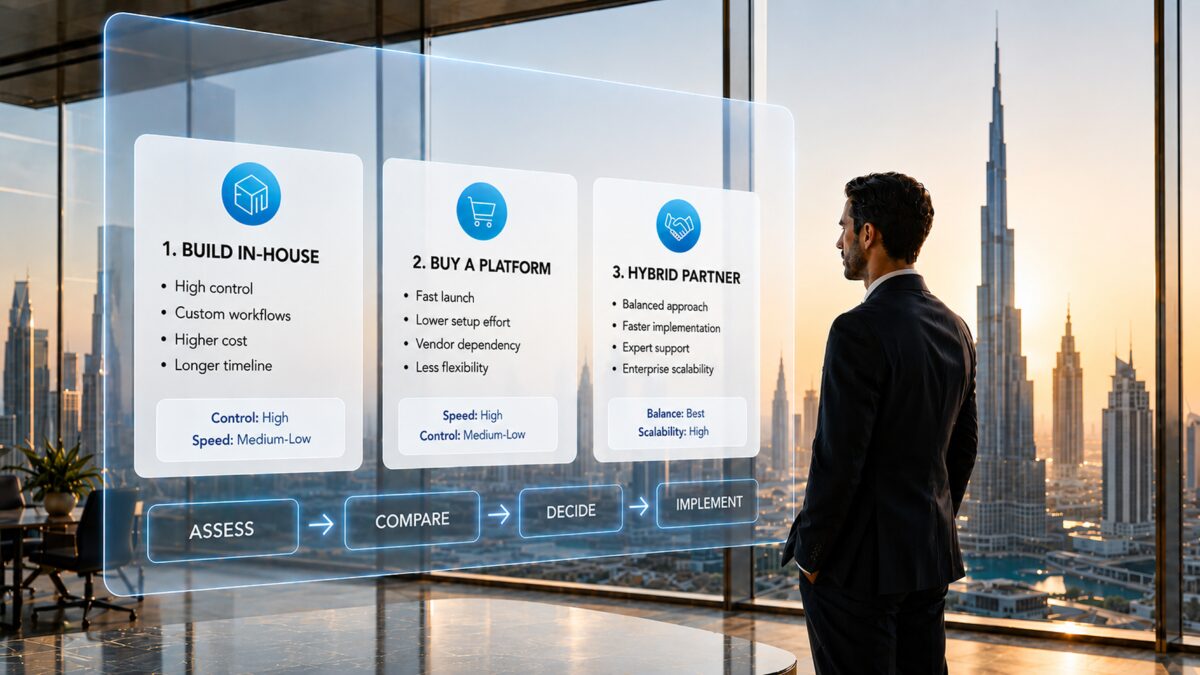
The build vs. buy decision for AI agents is one of the most important choices Dubai companies will face following Sheikh Hamdan’s private-sector agentic AI initiative.
The question is no longer whether businesses in Dubai should prepare for AI agents. That direction has already been set. The real question is how your company should introduce AI agents into its operations.
There are three options.
Build custom AI agents designed around your business processes.
Buy a platform that comes with pre-built agents.
A hybrid approach is another option, where simpler workflows run on a platform while more complex workflows are built specifically for your business.
All three paths can deliver good results when they match the needs of the business.
All three can also produce poor results if they are chosen for the wrong reasons.
A Dubai company that relies on a platform for a highly customized workflow involving Arabic content and legacy systems may reach its limits within a few months. On the other hand, a company that builds a custom solution for a simple FAQ or appointment booking process may spend more than necessary. A company that combines platform-based and custom solutions without a clear integration plan may end up with two systems that do not work well together.
That is why this decision should be based on a clear framework.
At aTeam Soft Solutions, we do not start by asking whether a business should build or buy. We begin by understanding how the workflow operates. The right choice depends on the process itself, the quality of the data, the systems involved, the level of risk, language requirements, and the degree of control the business wants over the solution.
If the workflow is standard, low risk, and already supported by an established platform, buying a solution may be the quickest and most practical option.
If the process is complex, unique to the business, supports multiple languages, involves regulatory requirements, or depends on close integration with internal systems, a custom-built solution is often the better long-term choice.
If the business has a combination of simple and complex workflows, a hybrid approach may be the most practical choice.
This article examines all three approaches and provides a practical framework to help Dubai companies choose between custom AI agent development, AI agent platforms, and a hybrid approach.
Any discussion about building or buying agentic AI in Dubai should begin with one simple truth: agentic AI is not a single product category.
Some AI agents are lightweight assistants built into CRM systems.
Some are platform-based agents designed to handle common customer service or sales tasks.
Some are custom-built solutions that process documents, apply business rules, integrate with ERP systems, update records, handle exceptions, and maintain audit trails.
These solutions serve very different business needs.
Following Sheikh Hamdan’s announcement, many Dubai businesses have felt increasing pressure to adopt AI agents. That sense of urgency is understandable. However, choosing the wrong approach can lead to six to twelve months of delays and between $50,000 and $200,000 in unnecessary costs, including vendor changes, rework, and employee dissatisfaction.
A platform can help you launch faster, but it may not support every part of your business process.
A custom-built solution can be tailored to your business needs, but it usually requires a larger upfront investment and more involved implementation effort.
A hybrid approach can offer the best balance, but it works well only when the overall architecture is planned carefully.
The decision should be based on business needs instead of what seems more modern.
It should be based on what best fits the business.
If you want to automate common tasks such as answering customer FAQs, booking appointments, capturing leads, or handling routine support requests, a platform may be sufficient.
If your business needs to automate supplier invoice processing across PDFs, scanned documents, WhatsApp images, purchase orders, VAT records, and ERP approval workflows, a standard platform may not meet all of your requirements.
If your business operates in sectors such as real estate, healthcare, logistics, finance, or government services across Dubai and Saudi Arabia, you may need a combination of both approaches.
This is why aTeam Soft Solutions recommends that companies evaluate and categorize their workflows before choosing the right implementation approach.
Do not choose a platform only because it promises a faster launch.
Do not choose a custom build simply because it appears more advanced.
Choose the approach that best fits the workflow.
Building a custom solution means working with an experienced implementation partner to design and develop AI agents that fit your company’s processes, data, systems, business rules, compliance requirements, and operating model.
For complex, high-value, or business-specific workflows, aTeam Soft Solutions recommends a custom approach.
A custom AI agent is designed around your business processes, not generic features. It is designed around your processes, systems, business rules, and the way your teams work.
The discovery phase begins by understanding the existing process. Who performs the task today? Which systems are involved? What data is needed? Which documents are processed? What exceptions occur? Which decisions require human approval? What defines a successful outcome? What should happen if the AI agent cannot determine the correct outcome?
Only then does it make sense to design the solution architecture.
The implementation process typically follows a structured process: discovery, solution architecture, phased development, proof of concept, human review and validation, production deployment, monitoring, and ongoing maintenance.
The biggest advantage of a custom build is that it is designed to fit the way your business operates.
A custom AI agent can be designed to work with your ERP, CRM, business portals, document formats, approval workflows, Arabic-English processes, security requirements, and reporting needs.
It can run in your preferred cloud environment.
It works with your existing data.
It can integrate with systems such as SAP, Oracle, Odoo, Microsoft Dynamics, Salesforce, custom ERP platforms, and legacy applications.
It can also generate audit trails that support your compliance requirements.
Ownership remains with your company.
That ownership is important.
If the AI agent becomes part of your day-to-day operations, your company should not depend entirely on a single vendor to manage it. You should have a clear understanding of where the code is stored, who owns the repository, how data is processed, which model providers are used, and how another team can maintain the solution if needed.
The primary disadvantage of a custom build is the greater upfront investment required.
A production-ready custom AI agent typically costs between $40,000 and $120,000, depending on factors such as system integrations, document complexity, Arabic language support, compliance requirements, dashboards, and monitoring capabilities.
Implementation typically takes between 8 and 20 weeks.
This takes longer than deploying a pre-built platform.
The additional time is spent tailoring the agent to fit your business requirements.
A custom build is usually the right choice for processes that are unique, complex, high-volume, multilingual, compliance-sensitive, or connected across multiple systems.
For example, a UAE finance workflow that handles supplier invoices received through PDFs, scanned documents, emails, and WhatsApp images is a strong candidate for a custom build. The agent needs to extract invoice details, match them with purchase orders, identify duplicate invoices, verify VAT details, flag discrepancies, and prepare ERP entries for finance review.
A Dubai real estate workflow that manages multilingual tenant communication across lease records, payment updates, maintenance requests, renewal processes, and escalation rules may also require a custom solution.
A Saudi healthcare workflow that manages insurance pre-authorization submissions across multiple payer portals is often not suitable for a generic platform. It requires workflow-specific rules, document validation, portal integration, and human review.
These workflows require more than basic “installation and configuration.”
They are business process automation challenges.
That is where a custom solution justifies the investment.
Buying a platform means subscribing to an existing product that provides pre-built or configurable AI agents for common business needs.
The platform may include pre-built AI agents for customer service, sales, recruitment, support, knowledge management, property management, and CRM-based workflows.
The main advantage is speed.
A platform agent can often be configured and deployed within days or weeks instead of months.
The upfront cost is usually lower because you are using an existing platform instead of building a solution from the ground up. Depending on the platform, pricing may include subscription fees, setup charges, usage-based fees, or user-based licensing costs.
For standard workflows, this can be the right choice.
A company that needs a customer service solution for common questions may not require custom development. A sales team looking to qualify leads within an existing CRM may be able to use a platform-based AI solution. Similarly, a small business that wants an AI assistant to answer website questions, qualify prospects, or schedule meetings can often get value quickly from an existing platform.
The market already offers several established options.
Beam AI focuses on AI agents and automation solutions for business workflows, including areas such as property management and process automation.
Salesforce Agentforce is built around autonomous agents within the Salesforce ecosystem. For companies already using Salesforce extensively, this can be an attractive option because the platform can connect closely with existing CRM data, processes, and workflows.
HubSpot Breeze provides AI agents across marketing, sales, and customer service functions. For SMEs already using HubSpot, this can simplify implementation and reduce the effort required to get started.
Freshworks Freddy AI Agent focuses on customer service workflows and can connect with backend systems to support tasks such as order updates, refunds, and verification processes.
Teammates.ai focuses on AI-powered assistants for customer service, sales, and recruitment, with Arabic and multilingual capabilities included in its offering.
These platforms are valuable because they reduce the need to build a solution from the ground up.
The main limitation is the level of customization available.
A platform works best when your business processes align with the way the platform is designed to operate.
The first 80% of a standard workflow can be easy to handle.
The final 20% is often where complexity appears.
That final 20% is where your business processes, rules, and requirements become unique.
For example, a platform may handle common customer support questions effectively, but challenges can arise when responses depend on custom lease rules, Arabic document attachments, payment history, maintenance SLA requirements, and legal escalation processes.
A platform may handle standard sales qualification effectively, but it can become challenging when lead scoring depends on unique industry signals, custom quoting rules, regional pricing requirements, or CRM data that is incomplete or inconsistent.
A platform may handle basic property management tasks, but it may not integrate deeply with your existing property systems, accounting software, WhatsApp workflows, or document approval processes.
Ownership is another area that businesses need to consider.
In most platform-based models, the vendor owns the platform, core workflow capabilities, infrastructure, and product roadmap. Your business can configure the system to support its needs, but it does not own the underlying technology.
This model may be acceptable for common business processes.
It may be a risk for core workflows where your business relies on the agent every day.
Subscription cost is another factor to consider.
A platform may appear more affordable in the first month. However, if subscription costs increase based on users, usage volume, number of agents, or advanced features, the total cost over two years may become comparable to or even exceed the cost of a custom solution.
That does not mean platforms are the wrong choice.
It means the total cost should be evaluated over two years rather than looking only at the initial setup cost.
Buying a platform is usually the right choice for standard, low-complexity workflows that require fast deployment and do not need extensive customization, code ownership, Arabic document processing, or complex legacy system integration that are not major requirements.
The hybrid approach uses platforms where they are a good fit and custom development for processes that require deeper business control.
For many Dubai companies, this is likely to be the most practical approach.
A business may use a ready-made platform for customer FAQs and lead qualification while developing custom software for invoice processing, claims preparation, customs documentation, compliance workflows, or Arabic document extraction.
This approach delivers faster implementation where speed is important and greater control where the business needs it most.
For example, a real estate company may use a ready-made chatbot or customer service platform to respond to basic questions about office hours, service request procedures, community rules, and general FAQs. For more complex operations, it may develop custom software for lease renewal automation, tenant payment follow-up, NOC generation, maintenance SLA tracking, and Arabic-English document processing.
A healthcare group may use a ready-made platform for general patient inquiries and appointment reminders. For more specialised and higher-risk workflows, it may develop custom software for insurance pre-authorization, claims document verification, pharmacy reporting, or nurse scheduling.
A logistics company may use no-code tools or a ready-made platform for shipment notifications. For more complex operations, it may develop custom software for customs documentation, flagging shipments at risk of demurrage charges, supplier ETD updates, and exception handling across multiple portals.
A hybrid approach works well because not every workflow requires the same level of investment.
Its main limitation is the added complexity of managing the overall system architecture.
Without a clear integration strategy, using multiple platforms alongside custom systems can lead to disconnected systems. One system may store data in a platform, another may keep logs in a custom dashboard, a third may use a separate knowledge base, while another updates the CRM. As a result, the company may not have a single, consolidated view of how its automated processes are running.
This can lead to challenges in monitoring, governance, data privacy, and maintenance.
A hybrid approach should follow a clear strategy.
It should be a deliberate business decision.
A hybrid approach requires a clear system architecture. The company should define which systems serve as the source of truth, how data moves between platforms and custom applications, where logs are stored, how human review is handled, how identities and access permissions are managed, and how compliance is monitored.
This is where an experienced implementation partner adds value.
aTeam Soft Solutions often recommends a hybrid approach for businesses that have both standard and complex workflows. Ready-made platforms handle routine tasks, while custom development supports processes that require deeper integration or provide a competitive advantage.
The table below compares the three approaches based on the key factors Dubai businesses should evaluate before investing.
| Factor | Build Custom | Buy Platform | Hybrid |
| Upfront cost | $40K-$120K | $0-$5K setup | $20K-$80K |
| Monthly cost | $1K-$5K maintenance | $1K-$10K subscription | $2K-$8K combined |
| Time to first agent | 8-20 weeks | 1-4 weeks | 2-10 weeks |
| Customisation | Unlimited | Limited | Mixed |
| Arabic document processing | Full, if designed | Basic or unavailable | Full on custom workflows |
| Legacy system integration | Any system, if engineered | Usually API-only | Custom where needed |
| Ownership | The client owns the code. | The vendor owns the platform. | Mixed |
| Vendor lock-in risk | Low | High | Medium |
| Regulatory compliance | Fully customisable | Limited to vendor controls | Customisable on custom agents |
| Scalability | Build more agents | Add subscriptions | Flexible |
| Two-year total cost for 3 agents | $150K-$400K | $72K-$360K | $100K-$350K |
The table demonstrates that the best choice depends on the workflow and business needs.
A ready-made platform is often the quickest and most affordable choice for simple, well-defined workflows.
Custom development may require a higher upfront investment. However, for complex workflows, it can be more cost-effective over time by avoiding platform limitations, repeated rework, and ongoing subscription costs.
A hybrid approach offers the best balance when it is planned and managed effectively.
The most important factor in the comparison is ownership.
When an AI agent supports a workflow that is strategic, sensitive, or core to business operations, ownership becomes a key consideration. For standard support workflows, it may be less important.
A Dubai company should not apply the same decision criteria to every business requirement.
The decision should be based on the specific requirements of each workflow.
The first question to consider is how unique the business process is.
If the process is standard, a ready-made platform may be the right choice.
Standard business processes often include customer FAQs, appointment booking, basic lead qualification, support ticket management, simple internal knowledge searches, and everyday CRM workflows.
These processes are common across many businesses, allowing platform providers to offer proven templates based on well-established workflow patterns.
If the process is unique, custom development becomes a stronger option.
Unique business processes include multi-format invoice processing, insurance claims across multiple payer portals, Arabic-English document extraction, customs documentation, ZATCA compliance monitoring, complex lease renewal workflows, supplier ETD tracking, and industry-specific approval processes.
The more a process depends on your business rules, documents, existing systems, country-specific compliance requirements, and staff expertise, the less likely a ready-made platform will meet your needs.
A useful way to evaluate the process is to explain the workflow in five sentences.
If most businesses in your industry would describe the process in a similar way, a ready-made platform may be a good fit.
If your explanation involves several phrases such as “except when,” “only for this category,” “unless the supplier is,” “depending on the emirate,” “for Arabic documents,” “if the customer has this contract type,” or “because our ERP works differently,” a custom development should be considered.
In one Dubai finance workflow, the client initially considered invoice processing a standard process. However, a detailed review showed that invoices arrived through multiple channels, including email, WhatsApp images, supplier portals, scanned PDFs, and branch-level uploads. Approval rules varied based on supplier type, purchase order status, value thresholds, and VAT treatment. It was no longer a simple standard workflow; it required a customized solution.
The more exceptions a process involves, the more cautious you should be when choosing a ready-made platform.
The second question is whether the AI agent needs to handle Arabic documents or bilingual workflows.
This is particularly important in Dubai.
Many platforms can support Arabic conversations to some extent, but that does not mean they can process Arabic documents effectively.
Arabic document processing is more complex than Arabic chat
These documents may contain right-to-left formatting, stamps, handwritten annotations, mixed number formats, bilingual tables, scanned copies, unclear images, government terms, legal language, and Arabic-English text combinations.
A platform may handle a simple Arabic customer message entered as text.
However, it may still struggle with scanned Arabic invoices, bilingual lease documents, handwritten notes, or government forms.
This is particularly important for industries such as real estate, healthcare, finance, logistics, HR, legal services, and government-related operations.
If the AI agent only needs to handle basic Arabic customer conversations, a ready-made platform may be sufficient.
If the AI agent needs to extract data from Arabic and English documents, custom development is often the safer choice.
Custom development allows the implementation team to test real documents, improve document recognition, define extraction rules, set validation checks, establish review thresholds, and route uncertain cases for human verification.
In aTeam Soft Solutions’ experience, Arabic and bilingual document handling should be evaluated at an early stage. Businesses should not assume that a platform’s Arabic support claims will cover their specific document requirements.
The best way to evaluate this is simple.
Provide the vendor with 50 real Arabic-English documents from your business for testing.
Not ideal samples.
Actual business documents.
If the system processes the documents accurately and provides clear reasons for cases that need review, a platform may be enough. Otherwise, custom development may be required
The third question is about system integration
AI agents are effective when they can access the right data and perform the required actions.
If your workflow relies on a single modern SaaS platform with well-structured APIs, a ready-made solution may be easy to implement.
If your workflow involves multiple systems, custom development becomes more important.
A lot of Dubai companies operate with a mix of different technologies. A company may use SAP for finance, Zoho for CRM, WhatsApp for customer communication, Excel for daily operations, a custom vendor portal, and an older reporting system. Another business may use Odoo with extensive customization, shared document folders, Microsoft Teams for approvals, and government portals for submissions.
A ready-made platform may integrate well within its own ecosystem
Salesforce Agentforce is a strong option for companies already using the Salesforce ecosystem.
HubSpot Breeze is an attractive option for companies already using the HubSpot ecosystem.
Freshworks Freddy is well suited for companies already using Freshworks support systems.
However, if the workflow depends on data from multiple disconnected systems, a platform may not provide the required level of integration without custom development.
Legacy systems create another challenge.
If a system does not have an API, integration may require database-level connections, secure file exchanges, automated workflows, or custom-built connectors.
Platforms usually work best with API-based integration.
Custom development can support more complex integration requirements, although it usually involves higher costs and longer timelines.
The practical approach is this:
If the workflow depends on one or no systems with a reliable API connection, a ready-made platform may be a good fit.
If the workflow involves multiple systems, legacy software, government portals, or custom databases, custom development should be seriously considered.
Integration is often where platform projects face their biggest challenges.
The demo works smoothly because it uses data already available within the platform. Real-world implementation becomes more challenging when business data is spread across different systems.
The fourth consideration is ownership.
Some businesses simply need the solution to work effectively
For low-risk, standard workflows, this may be completely acceptable
If the AI agent handles FAQs or qualifies basic website leads, vendor ownership may not be a critical consideration.
However, if the solution handles finance records, healthcare claims, legal documents, customer contracts, lease renewals, supplier invoices, KYC records, or operational exceptions, ownership becomes a much more important consideration.
Several factors should be evaluated before selecting a platform.
Who owns and manages the workflow setup?
Who owns and manages the prompts?
Who owns and manages the logs?
Can the data be moved to another system if required?
Can the AI decisions be tracked and reviewed?
Can the system be deployed in your cloud infrastructure?
What happens to the solution if you discontinue the subscription?
Can another vendor take over maintenance of the workflow?
Can the agent be migrated to a different technology provider?
What happens if the platform changes its pricing model?
These are practical questions that businesses need to consider.
Agentic AI systems may become part of your core operating infrastructure. Once employees rely on them, switching to another solution becomes more difficult.
Custom development provides greater control because the client can own the code, architecture, integration logic, and deployment environment.
This does not mean every business needs complete ownership of every agent.
It means ownership should be aligned with business risk.
For routine workflows that are not business-critical, platform-based solutions may be sufficient.
For critical workflows, maintaining client ownership is often the safer approach.
At aTeam Soft Solutions, our custom AI agents are typically designed so clients retain ownership of the code repository and deployment environment. This helps reduce vendor lock-in and gives businesses greater long-term control.
The fifth consideration is budget and timeline.
If the business needs a solution within two weeks and has a budget below $15,000, a ready-made platform is usually the most practical option.
A custom production agent cannot usually be designed, integrated, tested, and deployed within two weeks unless the scope is extremely limited.
If the company has a budget of $40,000 or more and can commit 8 to 16 weeks, custom development becomes a realistic option.
This does not mean custom development is always slower from a business perspective.
A platform can be deployed quickly but may take months to overcome limitations and adapt to business requirements.
A custom solution may require more time upfront but can align with the process from the beginning.
The better question is not only, “How quickly can we go live?”
The real question is “How quickly can we achieve reliable business value?”
For straightforward customer support processes, a platform may provide faster time to value.
For complex document workflows, custom development may deliver business value faster because it avoids months of adapting a platform to a process it was not designed to support.
The budget should also be evaluated over two years.
A platform with a low initial setup cost may involve ongoing fees that increase with usage, users, features, or the number of workflows.
A custom-built solution requires a higher upfront investment but reduces long-term dependency on subscription fees.
The hybrid approach offers a middle ground.
A CFO should evaluate the total cost of ownership rather than focusing only on the initial invoice.
Custom development is the better choice when the workflow is unique to your business.
It works well when Arabic document processing is a critical requirement.
It is the better choice when the workflow requires integration across multiple systems.
It is the better choice when compliance requirements and audit trails are critical.
It becomes more suitable when the company needs long-term ownership and control of the solution.
It is the better choice when the AI agent becomes part of core business operations.
A platform is the better choice when the workflow is standard and well-defined.
It is the right approach when speed of delivery takes priority over full customization.
It is the better choice when the process fits well within the vendor’s ecosystem.
It is the better option when the company has a limited budget for the initial experiment.
It works best when the business wants to test adoption before making a larger investment.
A hybrid approach is the better choice when the company has both simple and complex workflows.
It is the better choice when customer-facing tasks can be managed by a platform, while back-office processes require custom agents.
It executes well when the company wants faster implementation without losing control over critical workflows.
It works well when a multi-year AI roadmap requires flexibility.
The most successful Dubai companies will likely combine platform, custom, and hybrid approaches over time.
They may use platforms for standard business functions.
They may build custom agent solutions for workflows that create a competitive advantage.
They may connect both approaches through governance and monitoring processes.
This is a more mature approach than trying to apply a single model across the entire company.
A Dubai-based trading company needed invoice processing across PDFs, scanned documents, WhatsApp images, purchase orders, supplier records, VAT details, and ERP approvals. This was not a suitable platform-first use case because the workflow depended on document variations and finance-specific rules. A custom solution was the better approach. The AI agent extracted invoice details, verified purchase order matches, identified discrepancies, and prepared ERP entries for human review.
A small service company needed a website lead qualification assistant to respond to basic questions, collect contact details, understand customer interest, and schedule meetings. This did not require a custom solution. A ready-made platform or CRM-based tool could handle most of the requirements quickly and affordably.
A Dubai property management company had two different requirements. It needed a simple solution to answer tenant FAQs quickly, but it also required deeper automation for lease renewal reminders, NOC generation, maintenance request routing, payment follow-ups, and escalation handling. A hybrid approach was the right fit. A standard conversational tool could manage basic questions, while custom solutions handled lease, payment, maintenance, and document-related workflows.
A Saudi healthcare operator needed insurance pre-authorization support involving payer rules, clinical documents, missing-field checks, and portal-specific submission preparation. This required a custom solution because the workflow was highly sensitive and depended on specific healthcare requirements that a standard platform could not easily support.
These examples show why the right approach depends on the workflow.
A company should not make a build-versus-buy decision at the company level first.
The decision should be made based on each individual process.
Many Dubai businesses compare build and platform options based only on upfront costs.
That alone is not enough.
A platform may appear inexpensive initially, but monthly costs can grow to $5,000 to $10,000 when additional usage, users, features, integrations, and capabilities are added.
A custom solution may require an $80,000 upfront investment but involve only $2,000 to $5,000 per month in ongoing maintenance costs.
Over two years, the total costs may be closer than many businesses expect.
For example, a platform solution costing $8,000 per month amounts to $192,000 over two years, excluding setup costs, internal effort, and custom integrations.
A custom agent costing $90,000 to build, plus $4,000 per month for maintenance, results in a two-year cost of $186,000.
At that point, the decision is no longer based on cost alone.
It becomes a question of fit, control, risk, and scalability.
A platform may still be the better choice if the workflow is standard and the vendor can manage the requirements effectively.
Custom development may be more suitable when the workflow is critical, complex, or directly linked to business strategy.
This is why CFOs should evaluate the two-year total cost of ownership before approving either approach.
The lowest first-month cost is not always the most cost-effective business decision.
Ownership is often overlooked at the beginning because businesses are focused on speed and quick results.
But ownership becomes more important once the AI agent proves successful and becomes part of daily operations.
If the system works well, the business starts relying on it.
That is when vendor dependency becomes a real concern.
If the vendor controls the platform, code, workflow logic, data model, logs, and integrations, the company may have limited control over the solution. If pricing changes or new requirements cannot be supported, the business may have fewer options moving forward.
Custom development can provide more control, but businesses need the right contractual terms to protect that control.
The company should own the code or have clearly defined access rights.
The company should retain ownership of its data.
The company should have clear information about where and how the system is deployed.
The company should have complete documentation for the system.
The company should be able to maintain the system or transfer it to another provider if required.
Hybrid models require careful planning because ownership is shared. The platform provider controls its part, the custom partner handles its development work, and the client must know who owns and manages each component.
At aTeam Soft Solutions, we prioritize ownership clarity from the start. For custom solutions, clients should not find after launch that critical workflow logic is locked within a vendor environment they cannot control.
Use this framework before approving any budget.
| Question | If your answer is standard/simple | If your answer is complex/custom |
| How unique is your process? | Platform | Custom build |
| Do you need Arabic document processing? | The platform may work for simple Arabic chat | Custom build for Arabic documents |
| How many systems need integration? | Platform if 0-1 clean API | Custom if 2+ systems or legacy tools |
| How important is ownership? | The platform may be fine | A custom build is safer |
| What is your budget and timeline? | The platform is under $15K and urgent | Custom if $40K+ and 8-16 weeks available |
This framework is focused on practical decision-making.
It does not assume that one approach is always better than the others.
The right decision should be based on the specific workflow.
If a company answers “complex” or “custom” for three or more questions, it should strongly consider a custom-built solution.
If a company answers “standard” or “simple” for most questions, a platform may be the right starting point.
If the answers are mixed, a hybrid approach may be the best fit.
aTeam Soft Solutions helps Dubai businesses evaluate build, buy, or hybrid options before committing a budget.
We are an India-based AI and software development company with 120+ engineers, ISO 9001:2015 and ISO/IEC 27001:2022 certifications, a 4.9/5 Clutch rating with 90+ verified reviews, and more than 20 published case studies.
Our work focuses on practical AI agent implementation for businesses across the UAE and Saudi Arabia.
We do not suggest custom development as the right choice for every business process.
That would not be the right approach.
If a platform can solve the problem faster and at a lower cost, the business should consider that option. However, if the workflow involves Arabic documents, legacy systems, compliance requirements, custom business rules, high-volume back-office operations, or ownership needs, a custom agent may deliver greater long-term benefits.
The company supports clients throughout the AI agent implementation process, from process discovery and architecture design to data mapping, system integration, dashboard development, human-in-the-loop workflows, testing, deployment, and ongoing maintenance.
The focus should not be on winning the build-versus-buy debate but on choosing the right approach.
The goal is to help the company choose the approach that delivers real business results with the lowest risk.
For Dubai businesses responding to the agentic AI initiative, this decision matters today. The wrong approach can waste time and resources, while the right approach can deliver the first measurable AI success before market expectations increase.
Buy a platform when the workflow is standard, low risk, and fits the platform’s existing capabilities. Build a custom solution when the workflow is complex, unique, requires extensive Arabic language support, has strict compliance requirements, or must integrate with multiple business systems. For many Dubai companies, the right approach will be a combination of both.
A custom solution typically costs $40,000 to $120,000 to develop, with ongoing maintenance costs of $1,000 to $5,000 per month. A software platform may have lower implementation costs, but subscription fees can range from $1,000 to $10,000 per month, depending on transaction volume, number of users, available features, and workflow requirements. When comparing the two options, consider the total cost over two years, rather than focusing only on the initial investment.
Yes, but the transition can be challenging if the platform controls your workflow rules, data structure, activity logs, integrations, and configuration. Before purchasing a platform, confirm that your data can be exported, understand what happens if you decide to cancel, and verify that your workflows can be recreated or integrated with a custom solution in the future.
For basic Arabic customer interactions, some platforms may be sufficient. However, for Arabic document handling, bilingual data extraction, right-to-left layouts, scanned forms, mixed Arabic-English communication, and compliance-related workflows, a custom solution is often the better choice because it can be designed, tested, and refined using your organization’s actual documents and business processes.
Consider five questions: How unique is the process? Do you need Arabic document support? How many business systems need to be integrated? How important is owning the solution? What budget and timeline do you have? If the process is standard and needs to be implemented quickly, choose a platform. If the process is complex and strategically important, build a custom solution. If your business has both types of processes, use a combination of a platform and a custom solution.
A combination of a platform and a custom solution is often the most practical approach for mid-market and enterprise businesses in Dubai. A platform can manage standard tasks such as answering frequently asked questions or qualifying leads, while custom AI agents can support more complex business processes such as invoice processing, lease renewals, claims preparation, customs documentation, and compliance monitoring.
The greatest risk is platform lock-in. If the platform cannot support your custom workflows, Arabic documents, legacy system integrations, or compliance requirements, you may need to replace it or build a custom solution later. This can increase costs, delay implementation, and reduce confidence within the organization.
The build-versus-buy AI agent decisions in Dubai should not be made based on boardroom slogans or industry trends.
Instead, the decision should be made on a process-by-process basis.
Some workflows are well suited to ready-made platforms.
Some workflows require a custom solution.
Some workflows require a combination of both approaches.
The Dubai agentic AI strategy has created urgency, but companies should not let that pressure lead them to choose the wrong delivery approach.
A platform is the most suitable when the workflow is well-defined, low risk, and can be deployed quickly.
Custom development is best suited for workflows that are complex, specific to your business, requires extensive Arabic-language support, depends on multiple integrations, involves regulatory requirements, or is strategically important.
A combined approach is the right choice when businesses want faster deployment for simple workflows while maintaining control over critical processes.
aTeam Soft Solutions supports Dubai companies in evaluating this decision carefully and building custom agentic AI systems when standard platforms are not enough.
The real question is not, “Should we build or buy?”
The key question is “Which approach will make this workflow work reliably within our business?”
Answer that correctly, and your first AI agent has a much better chance of reaching production, gaining trust, and delivering measurable returns or ROI before 2028.