If you are trying to build an agentic AI team that Dubai companies can realistically utilize, don’t start by hiring a room full of AI researchers.
That will be the first mistake many companies make after Sheikh Hamdan’s private-sector agentic AI directive.
The directive isn’t saying that every Dubai company should be an AI research lab. It is encouraging companies to use AI agents that boost productivity, reduce manual work, and enable the private sector to move faster before the 2028 window turns into real pressure.
That requires implementers.
Not just PhDs.
Not just strategy consultants.
Not just chatbot vendors.
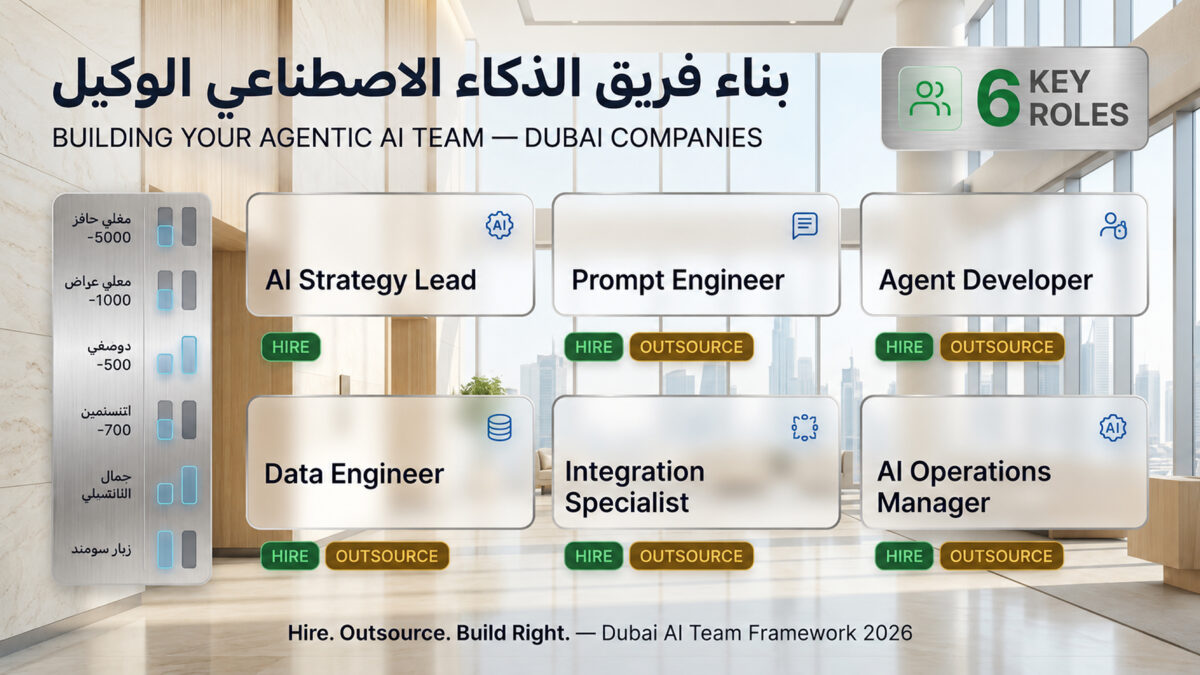
A practical agentic AI in the Dubai team requires six particular roles. Two of these should almost always be internal. Four roles can sometimes be outsourced, especially in the case of smaller and medium-sized companies.
At aTeam Soft Solutions, we have witnessed this very clearly across the UAE and Saudi AI agent deployments. The companies that move fastest never overbuild their internal teams. They select a single strong internal owner, hire experienced AI engineers, conduct a single focused pilot, and then decide what to bring on board permanently.
In this article, we explain the six roles you need, when to hire versus outsource for each role, what the team should look like by company size, and what each role costs in Dubai versus a dedicated team model based in India.
Many Dubai businesses hear “agentic AI” and immediately think they need to hire an AI department.
That typically means a Chief AI Officer, machine learning researchers, data scientists, AI architects, prompt engineers, cloud engineers, QA engineers, and internal project managers.
For many companies, that is too much too soon.
Your first aim is not to release AI research.
Your first objective is to automate a single high-impact business process safely.
That process could be processing invoices, handling customer inquiries, insurance pre-authorization, employee onboarding, communication for lease renewal, shipment documentation, or reporting related to compliance.
To accomplish that, you require six roles:
AI Champion or AI Product Owner.
Data Engineer.
AI/ML Developer.
Frontend or Dashboard Developer.
QA and Testing Specialist.
Change Management Lead.
The key point to note is that none of the six roles need to be full-time internal employees.
The AI Champion needs to be internal, as this is the person who owns the business outcome.
The Change Management Lead also needs to be an internal person, as the staff has more trust in internal leaders than they do outside consultants.
The rest of the roles are usually able to be outsourced, at least for the first one to three AI agents.
That’s the pragmatic approach with many Dubai companies.
You don’t need to create a permanent AI team until you have one working AI agent in production.
You require a small, focused deployment team that can shift from process selection to proof of concept to production.
Sheikh Hamdan’s directive generates a sense of urgency, but it does not want to overhire. It demands execution with focus.
An effective agentic AI team does not build around job titles.
It is built based on duties.
Each of the roles listed below addresses a particular challenge in the AI adoption journey. When one role is absent, the project tends to stagnate or quietly fail.
The AI Champion is the in-house owner of AI adoption.
This is the most important position on the whole team.
The AI Champion should own the AI roadmap, decide which processes to automate first, define success metrics, manage stakeholders, attend Dubai Chamber training, and translate business needs into technical requirements.
This person doesn’t have to be an expert AI engineer.
They have to understand the business.
They need to know where manual work is happening, which teams are overloaded, which processes are creating errors, which workflows are impacting customers, and which automation projects can deliver measurable ROI.
For most of Dubai’s companies, the right AI Champion is the COO, Operations Director, Head of Digital Transformation, Finance Controller, CTO, or senior business unit leader.
AI Champion is a role that cannot be outsourced.
An external partner can consult, build, test, and deploy. However, an outsider cannot own internal priorities, negotiate between departments, manage political resistance, or decide which trade-offs are acceptable.
The AI Champion must also have authority.
If the individual doesn’t have the authority to make decisions, the project will come to a halt. All requests to access data or to change processes, rules of approval, or staff concerns will get stuck in meetings.
For the first AI agent, the AI Champion may have to commit 50% to 70% of their time to the project.
Once the initial few agents are deployed, the commitment could be reduced to 20% to 30%.
In many firms, this should not be a new hire to begin with. Reassign a senior manager who already knows the business.
If you are considering hiring a full-time AI Product Owner in Dubai, anticipate a monthly salary range of between AED 25,000 and AED 40,000 for an individual with significant business, technology, and transformation expertise.
In a UAE finance automation project, the AI Champion was the finance transformation lead. That made the project go faster since they knew the invoice workflow, ERP rules, approval hierarchy, supplier issues, and CFO expectations. In the absence of that internal owner, the AI team would have dedicated weeks to trying to understand decisions that the finance lead could have explained in one meeting.
The Data Engineer is responsible for enabling the AI agent for use in the real business environment.
This position audits the data landscape, develops data pipelines, cleans and structures data, develops API connectors, and ensures data quality between existing systems and the AI agent.
The majority of AI agent projects decelerate because the data is not where leadership thinks it is.
A company could say, “All invoices are in SAP.”
Then, discovery shows that invoices also come via email, WhatsApp, supplier portals, scanned PDFs, and even in shared folders.
The customer support team might say, “All customer history is in the CRM.”
Then discovery reveals that the critical conversations take place on WhatsApp, call notes, spreadsheets, and personal inboxes.
The Data Engineer turns that unstructured data into usable input.
A strong Data Engineer should have three to five years of experience in Python, SQL, APIs, ETL pipelines, cloud services, and data modeling. Experience with AWS, Azure, or Google Cloud is a must for Dubai companies creating secure, scalable AI agents.
You should bring on a Data Engineer internally if you have a plan to build three or more AI agents and have continuous work related to data infrastructure.
You can outsource the role if you are creating your first one or two AI agents or if the data work is project-driven.
The hiring cost for a mid-level Data Engineer in Dubai is usually around AED 15,000 to AED 25,000 monthly.
A company such as aTeam Soft Solutions, a Data Engineer based in India for Dubai AI projects, usually costs $2,500 to $4,500 per month, based on experience and complexity of the project.
In a Dubai real estate AI support project, the Data Engineer needed to join tenant records, maintenance ticket history, lease renewal dates, payment status, and content from a multilingual knowledge base. The AI agent could not answer tenant questions with any degree of reliability until those data sources were aligned and cleaned.
That is why data engineering isn’t optional.
The AI agent is just as useful as the data it has access to.
The AI/ML Developer implements the intelligence layer of the agent.
This individual designs the agent architecture, integrates LLM APIs, develops retrieval-augmented generation pipelines, configures prompts, implements tool calling, develops confidence scoring, designs escalation logic, and assists the agent in reasoning on multi-step workflows.
For agentic AI, this role differs from traditional software development.
A normal backend developer creates deterministic logic.
An AI/ML Developer is responsible for building workflows based on probabilistic reasoning, model behavior, confidence thresholds, human review, and guardrails.
An ideal AI/ML Developer would have three to seven years of experience in Python, LLM APIs, agent frameworks like LangGraph or CrewAI, vector databases, RAG pipelines, prompt design, API integration, and production deployment.
For Dubai companies, having experience in Arabic NLP is a major benefit.
Many real-world workflows often include Arabic invoices, supplier emails in two languages, documents in English and Arabic, right-to-left interfaces, and communication with customers in several languages.
For the majority of companies, it is reasonable to outsource the role.
Senior AI developers in Dubai can cost between AED 35,000 and AED 55,000 on a monthly basis. Employing them also takes time, and the local talent pool remains limited compared to India.
At aTeam Soft Solutions, a professional AI/ML Developer working on Dubai agentic AI projects usually costs $3,500 to $6,500 per month.
The difference in the talent pool is what matters.
India possesses one of the largest technology workforces in the world, and this workforce continuously generates large numbers of software developers yearly. For Dubai companies, this is a practical benefit: you can get experienced engineering talent without incurring the full cost and hiring lag of building locally from scratch.
Only hire AI developers on a local level if you are building a permanent AI capability team with 5+ agents for ongoing development and long-term internal ownership.
For the first few agents, outsourced AI engineering is typically faster and less expensive.
Within a Saudi healthcare workflow, the AI/ML Developer had to build an agent that generated insurance pre-authorization submissions for a variety of payer requirements. The agent had to read documents, identify missing information, apply payer-specific rules, generate portal-ready data, and escalate ambiguous cases. That was not just a chatbot project. It required production AI engineering.
The Frontend or Dashboard Developer is responsible for building the human-facing layer of the AI agent.
This includes dashboards for human-in-the-loop review, monitoring screens, exception queues, reporting dashboards, approval interfaces, admin panels, and customer-facing agent interfaces where applicable.
This role counts as AI adoption, which depends heavily on usability.
If staff can’t easily review AI output, fix the mistakes, approve actions, or understand why a case was escalated, they will lose trust in the system.
A good dashboard is one that the AI agent feels it is managing.
A poor-quality dashboard is one where the AI agent feels like a risk.
The perfect profile is a React.js or frontend developer with experience in responsive design, data visualization, dashboard workflows, API integration, and role-based access control.
For many Dubai-based companies, this role should be outsourced.
Frontend development for an AI agent is normally project-driven. You require very robust development during the building phase, and then a bit lighter maintenance after going live.
With aTeam Soft Solutions, a Frontend or Dashboard Developer usually costs between $2,500 and $4,000 per month.
In a single invoice processing agent, the dashboard was the place where finance users would review extracted fields, purchase order matches, confidence scores, duplicate alerts, and exception reasons. The AI was not simply pushing entries into the ERP. It showed finance users what it found and why a particular item required approval.
That dashboard supported the finance team in trusting the agent.
The output was generated by the AI model.
The dashboard led to adoption.
The QA Specialist checks if the AI agent functions reliably in real business situations.
This role is commonly undervalued.
AI Quality Assurance differs from conventional software Quality Assurance.
A conventional QA engineer verifies if a button functions, if a form submits, if a page loads, or if an API returns the anticipated response.
An AI QA engineer tests if the agent extracts the correct VAT amount from an Arabic invoice 98% of the time, if it escalates low-confidence cases correctly, if it handles poor-quality scans, if it misreads dates, if it applies business rules, and if it doesn’t perform unsafe actions.
The outputs of agentic AI are uncertain.
That means testing needs to measure patterns, accuracy, edge cases, regression, and confidence thresholds.
A good QA Specialist for AI agents needs to know about test case design, benchmark datasets, accuracy measurement, regression testing, validation of business rules, Arabic language testing, if necessary, and monitoring production.
This role can normally be outsourced.
At aTeam Soft Solutions, an AI QA Specialist usually costs between $1,500 and $3,000 per month, based on scope and seniority.
The Quality assurance role for the AI agent is even more critical when it deals with documents, customer correspondence, compliance audits, or financial processes.
For example, in a tenant communication agent, QA should verify if the AI properly handles routine maintenance requests, if it escalates legal disputes, if it avoids giving incorrect payment promises, if it comprehends bilingual messages, and if it generates tickets under the appropriate category.
Without proper QA, an AI agent may perform well in a demonstration but perform poorly in production.
The Change Management Lead enables the organization to actually employ the AI agent.
This position is in-house and cannot be completely outsourced.
External consultants can assist with communication materials, training schedules, and the rollout format. But trust has to be from within the company.
Staff should hear from their own leaders that the AI agent is being brought in to take away repetitive work, rather than to penalize teams or silently replace all of their human workforce.
The Change Management Lead outlines the rationale for the company to introduce AI agents, what will change, what won’t change, how staff feedback will be obtained, and how mistakes will be managed.
This person could be an HR manager, operations manager, department head, team lead, or transformation manager.
The role needs more credibility than technical skill.
In the course of implementation, the Change Management Lead may devote 20% to 30% of their time to supporting the rollout. After roll-out, the time commitment is decreased.
In a Dubai support automation project, initial resistance from staff was intense because support agents felt the AI would replace them. The Change Management Lead rebranded the project as repetitive workload reduction. Complaints, escalations, payment disputes, and complex cases would still be dealt with by the staff. Routine questions and ticket creation would be handled by the AI agent.
That message changed everything for adoption.
The team was no longer viewing the AI agent as a threat and began seeing it as a filter that conserved their time.
Change management is never soft work.
It is one of the key factors that cause AI agents to succeed or fail.
The appropriate agentic AI team will vary based on company size, process complexity, and long-term aspirations.
A company of 30 people shouldn’t have the same structure as a company with 3,000 employees.
The objective is to develop sufficient capability for execution without generating unnecessary overhead.
Small businesses need to outsource nearly everything besides the AI Champion.
A small company does not have to employ a full-time team of AI developers, data engineers, QA testers, and dashboard developers for a single AI agent.
The practical framework is straightforward.
The AI Champion comes from within the organization. This might be the founder, operations manager, or senior business lead.
The external team consists of an AI Developer, a Data Engineer, a QA Specialist, and a Project Manager from a partner such as aTeam Soft Solutions.
The Change Management Lead can also be the AI Champion or any other internal manager.
Typical format:
| Role | Internal or external | Time commitment |
| AI Champion | Internal | 50% during the first pilot |
| AI/ML Developer | External | Full-time or part-time |
| Data Engineer | External | Part-time or full-time during setup |
| QA Specialist | External | Part-time during testing |
| Project Manager | External | Part-time |
| Change Management Lead | Internal | 20% during rollout |
External team costs are typically between $12,000 and $18,000 monthly.
The initial agent generally requires three to six months from discovery to stable deployment, based on access to systems and quality of data.
For an SMB, the aim should be a single useful agent that saves quantifiable time.
Do not build an AI department.
Make one working result.
Mid-market companies normally require a hybrid model.
They are sufficiently complex in terms of operations to justify some internal competence, but not enough reason to hire an entire AI team immediately.
The AI Champion should already be internal and might be a dedicated position.
The Data Engineer position can also be recruited internally if the company intends to have multiple agents. This person is able to maintain data pipelines, support reporting, and coordinate with outsourced AI developers.
The development of AI can be outsourced to speed up the process and ensure cost control.
QA may be outsourced.
Change management should be kept internal through HR, operations, or transformation leadership.
Typical layout:
| Role | Internal or external | Recommendation |
| AI Champion | Internal | Dedicated or 50% allocation |
| Data Engineer | Internal | Hire if building 3+ agents |
| AI/ML Developer | External | Outsource for build speed |
| Frontend Developer | External | Outsource |
| QA Specialist | External | Outsource |
| Change Management Lead | Internal | HR or operations leader |
Typical internal cost may range from AED 40,000 to AED 60,000 per month.
Typical cost for external development could be $15,000 to $25,000 per month during the active development phases.
This structure provides the company with internal ownership but without forcing it to bring on every specialised skill too soon.
For a lot of Dubai medium-market companies, this is the right balance.
Enterprises require an internal core team and external partners.
With this size, adopting an AI agent is not a one-time project. It turns into an operating capability.
An organization should have an internal AI team of three to five individuals.
That team may consist of an AI Product Owner, two Data Engineers, one AI Developer, and one QA Lead.
The enterprise should still employ external partners such as aTeam Soft Solutions for surge capacity, specialised skills, Arabic NLP, computer vision, legacy integration, and new agent development.
The internal team retains governance, long-term architecture, business alignment, and existing agents.
The external team assists in building faster.
Typical corporate structure:
| Role | Internal or external | Purpose |
| AI Product Owner | Internal | Owns the roadmap and business alignment |
| Data Engineers | Internal | Maintain pipelines and data quality |
| AI Developer | Internal | Maintains core systems |
| QA Lead | Internal | Owns testing standards |
| External AI team | External | Builds new agents and specialised workflows |
| Change programme | Internal | Drives adoption across departments |
Internal cost is typically between AED 150,000 and AED 250,000 per month.
External development phases might incur an additional $20,000 to $40,000 per month, based on the number of agents, integrations, and expert skills required.
Enterprises also need to formalize AI governance, approval processes, model monitoring, and employee training.
At the enterprise level, agentic AI is not just about development.
It is an operation under change.
Dubai companies are faced with a practical cost decision.
Should they recruit AI talent locally, outsource to India, or adopt a hybrid model?
The answer will depend on how many agents you need to create, how much internal control you want, and how fast you want to go.
For the first one to three AI agents, outsourcing tends to provide better speed and cost control.
Typical cost ranges for 2026 are presented in the table below.
| Role | Dubai salary range | India via aTeam | Estimated savings |
| Senior AI/ML Developer | AED 35,000-55,000/month | $3,500-$6,500/month | 60-70% |
| Mid-Level Data Engineer | AED 15,000-25,000/month | $2,500-$4,500/month | 55-65% |
| Mid-Level Frontend Developer | AED 12,000-20,000/month | $2,500-$4,000/month | 50-60% |
| Mid-Level QA Specialist | AED 10,000-18,000/month | $1,500-$3,000/month | 60-70% |
| Project Manager | AED 18,000-30,000/month | $2,500-$4,000/month | 55-65% |
These Dubai salary ranges are estimates of base salaries. They do not involve costs of visas, benefits, recruitment fees, the time required to onboard, costs of office space, devices, management overhead, or the expense of replacing the hire if it doesn’t work out.
The monthly cost for India-based aTeam Soft Solutions covers management overhead, payroll, benefits, office setup, hardware, and delivery support.
That is why the savings are significant.
The cost difference is not due to the skill being lower.
It exists because India has a much bigger pool of technology talent and a much lower cost base.
Kerala also provides a solid engineering benefit to aTeam Soft Solutions, as the state has a robust education system, a higher literacy rate, and a long track record of developing technology talent for the international markets.
For Dubai-based companies, this offers a practical model: maintain ownership and business direction internally while utilizing India-based engineering teams to build more quickly and cost-effectively.
The dedicated team model allows companies in Dubai to have the experience of hiring their own staff without the need for direct employment.
You are the one who interviews and chooses the team members.
They work only on your project.
They coincide with the Gulf working hours, as India is nearly in the UAE time zone.
They participate in daily standups, weekly demos, project planning sessions, and review meetings.
Communication can be possible via Slack, Microsoft Teams, Jira, ClickUp, email, or through the project management system preferred by the client.
The company manages payroll, benefits, office setup, hardware, delivery management, and team continuity.
You are responsible for priorities, product direction, workflow decisions, project goals, and company approvals.
This model executes well for agentic AI as the requirements evolve in the course of discovery and experimentation.
You might begin with invoice extraction and later realize the true value is in matching purchase orders.
You may begin with a response to customer inquiries and later identify the major issue as ticket routing.
You could start by checking insurance documents and then find out that the greatest bottleneck is handling payer-specific exceptions.
A focused team provides the flexibility to adjust without having to renegotiate for each minor variation.
Minimum engagement typically begins at three months with at least two team members.
The team can be scaled up or down on a monthly basis according to the workload.
For example, an initial AI agent might start with an AI Developer and a Data Engineer. During the dashboard build, a Frontend Developer joins. During testing, QA effort intensifies. After release, the team is reduced to maintenance and optimization.
That kind of flexibility is hard to realize with local full-time employment alone.
The first mistake is employing a Chief AI Officer before launching a single AI agent.
A title does not make capability.
If the organization has no pilot, no process inventory, no data map, and no implementation partner, a senior AI title can be costly signaling rather than effective execution.
The second error is that of attempting to turn already existing developers into AI engineers too rapidly.
Strong developers can develop AI engineering, but production agentic AI requires expertise in LLM behavior, RAG, tool use, orchestration, confidence scoring, human review, and model evaluation.
That learning curve can last from six to twelve months.
Dubai’s 2028 window makes that risky if you want to make progress now.
The third mistake is employing people based on their PhD credentials rather than their deployment experience.
Research skills are useful; however, many Dubai businesses require production builders. They want someone who can connect with ERP systems, process unstructured PDFs, handle API failures, test edge cases, and deploy dashboards that staff will use.
The fourth pitfall is not designating an internal AI Champion.
This is the top reason why AI projects lose momentum. The vendor is constantly requesting decisions, data, access, feedback, and approvals. No one has the answer internally.
The fifth pitfall is delegating change management.
Employees have more faith in their own managers than in external consultants.
A partner can assist with rollout, but the message has to come from internal leaders.
If the employees feel that AI is something that is being forced on them from outside, they will quietly resist it.
Before you build your AI team, use this framework.
| Situation | Recommended model | Why |
| First AI agent | Outsource technical roles | Faster, lower risk, lower upfront hiring burden |
| One simple workflow | Outsource almost everything except AI Champion | No need for a permanent team |
| 3+ agents planned | Hybrid model | Internal data ownership plus external build speed |
| 5+ agents planned | Internal core team plus external partner | Long-term capability needed |
| Heavy compliance workflows | Hybrid or enterprise model | Internal governance with specialist support |
| Arabic document-heavy workflows | Outsource to a partner with Arabic NLP experience | Specialist skill matters |
| Legacy system-heavy workflows | Outsource to an experienced integration team | Internal teams may lack agent integration experience |
| AI as a core product | Hire internally | AI capability becomes part of the company’s IP |
The simplest rule is this:
Take internal ownership of the company’s direction.
Specialized engineering should be outsourced until the demand for AI work warrants full-time employment.
A practical agentic AI team requires six positions: AI Champion or AI Product Owner, Data Engineer, AI/ML Developer, Frontend or Dashboard Developer, QA and Testing Specialist, and Change Management Lead. The AI Champion and Change Management Lead will ideally be internal. The technical roles can frequently be outsourced for the initial few AI agents.
The majority of Dubai companies should outsource their AI developers to India for their first one to three AI agents. When you intend to develop a permanent internal AI capability with five or more agents, local hiring makes sense. Outsourcing provides quicker access to skilled AI talent at 50% to 70% less by reducing costs.
A small Dubai company may begin with a single internal AI Champion and an outsourced team costing between $12,000 and $18,000 per month. A medium-sized market company can spend between AED 40,000 and AED 60,000 per month internally, with an additional $15,000 to $25,000 per month externally. Enterprises might spend between AED 150,000 and AED 250,000 per month on an internal core team plus external development support.
Yes, you can outsource AI agent development, data engineering, frontend development, QA, project management, and maintenance. However, you do not outsource the AI Champion role or change management ownership. Those have to remain internal as they depend on business context, authority, trust, and relationships with staff.
For the first AI agent, a lot of companies seem to want a single internal AI Champion and a 3-4-person external team. A typical external team comprises an AI Developer, Data Engineer, QA Specialist, and Project Manager. More complex projects might also require a Frontend Developer, DevOps Engineer, or compliance specialist.
Many Dubai companies do not require a Chief AI Officer at the start. They want an internal AI Champion who can run the first pilot. A Chief AI Officer might be appropriate at a later stage for large enterprises with diverse AI initiatives, governance requirements, and long-term internal AI competence.
Hybrid is the best model for the majority of Dubai companies. Retain AI ownership, process selection, change management, and internal governance. Contract the AI development, data engineering, dashboard development, and QA to an experienced partner until the company has a sufficient AI workflow to support full-time internal staff.
Start with the tasks that must be completed to create an agentic AI team that Dubai companies can rely on.
You require an internal AI Champion who is in charge of the roadmap.
You need a Data Engineer who can make your data useful.
You want an AI/ML Developer who can build the agent.
You want a Dashboard Developer who can make the system useful for the employees.
You require a QA specialist capable of testing accuracy in real-world situations.
You need a Change Management Lead who can guide people to adopt the new workflow.
That’s the team.
It’s not a full-scale AI department.
It’s not a lab for research.
It is not a committee with a lot of titles.
Sheikh Hamdan’s vision provides a two-year window for Dubai’s private sector to progress towards agentic AI adoption. The companies that do well are not going to be the ones that employ the most people. It will be those who construct the right balance of internal ownership and external execution.
aTeam Soft Solutions supports Dubai-based companies in forming that combination via focused AI teams, agentic AI developers, data engineers, QA specialists, and implementation support from India, with a solid overlap of Gulf time zones.
Begin with a single AI Champion.
Choose a single business process.
Bring in the appropriate technical team.
Deploy a single helpful AI agent.
Next, scale.