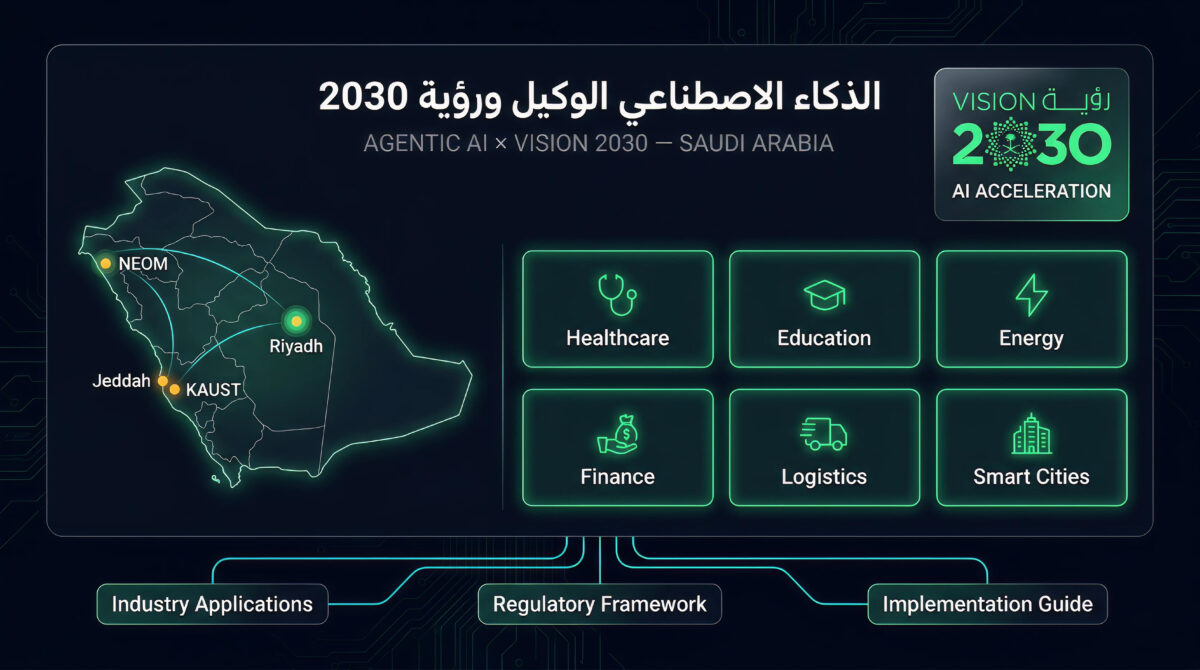
Agentic AI adoption in Saudi Arabia’s Vision 2030 is no longer a discussion of the future. It’s already appearing in invoice compliance, hospital claims, procurement portals, customs paperwork, HR onboarding, supplier follow-up, retail forecasting, and government-facing workflow processes in the Kingdom.
Saudi Arabia is among the most explicit national AI mandates in the world. PwC estimates AI has the potential to add over US$135.2 billion to the economy of Saudi Arabia by 2030, corresponding to 12.4% of the GDP. According to SDAIA, data and AI support the realization of 66 out of 96 direct and indirect objectives of the Saudi Vision 2030.
That’s the national opportunity.
The commercial opportunity is much more defined.
A leading Saudi healthcare group requires agents who are aware of the NPHIES claims process. A multi-entity trading group requires an AI compliance monitor for ZATCA Phase 2. A distributor working with government hospitals wants an agent to read procurement portal orders and normalize unit-of-measurement discrepancies. A construction company seeks an AI solution to monitor MOMRA/Balady permits, suppliers’ documents, contracts, and project approvals.
This guide describes the agentic AI Saudi Arabia Vision 2030 projects, which are already feasible; which regulations are relevant; what the Saudi-specific hurdles need to be addressed; and how companies can transition from AI POC to production securely.
The aspirations of Saudi Arabia in terms of AI are not just confined to technology firms. It is related to diversifying the national economy, modernizing the government, transforming healthcare, expanding logistics, building smart cities and financial services, and improving industrial productivity.
Vision 2030 is the holistic plan. Its focus is on diversifying the Saudi economy, developing the non-oil sector, enhancing public services, and boosting national competitiveness.
AI would be among the practical instruments to support that aspiration.
The National Strategy for Data and AI of SDAIA expresses a vision to make Saudi Arabia a global hub “where the best of Data & AI is made reality” and to be ranked among the top 15 countries in the AI segment.
The signals of investment are also big as well. Reuters cited that Saudi Arabia had filed plans for a US$40 billion investment push into AI, citing a New York Times report, with the potential fund expected to assist AI-based startups, chip companies, and data centers. Reuters additionally indicated that PIF leadership framed Saudi Arabia as a potential AI hub on account of energy resources, capacity to fund, and political will.
But the needs of a national ambition do not necessarily provide deliverables for enterprise AI outcomes.
A Saudi business does not gain from AI because the Kingdom has a strategy. It benefits when AI cuts down on manual labor, enhances compliance, reduces cycle time, finds errors, and enables better decisions within actual business workflows.
That’s where agentic AI gets important.
Agentic AI is AI that can comprehend an objective, determine the next action, leverage tools, perform tasks, and escalate exceptions.
A chatbot replies to the questions.
An AI agent does not function.
For example, a chatbot is able to explain ZATCA Phase 2. An AI agent is able to validate invoices before submission, detect potential reasons for rejection, send high-risk invoices to the finance department, and update this data in a compliance dashboard that spans multiple Saudi entities.
A chatbot can provide an explanation of what documents are required for insurance pre-authorization. An AI agent can also read the clinical notes, prepare the pre-authorization file, identify missing documents, predict the risk of rejection, and forward exceptions to the revenue-cycle team.
That distinction is essential for Vision 2030.
The AI revolution in Saudi Arabia is about more than just models. It’s about the operating systems of business productivity.
Saudi AI implementations could be designed around local regulation, data governance, sector rules, and platform-related workflows.
This section is a practical summary, rather than legal advice.
SDAIA lies at the core of Saudi Arabia’s data and AI priorities. SDAIA claims that data and AI are enablers of Vision 2030 and align with 66 of its 96 direct and indirect goals of the vision.
Under the SDAIA, the National Data Management Office seeks to develop the Kingdom’s capabilities by recommending data regulations and facilitating efficient data governance.
For AI agents, this means data governance is not an after-launch add-on.
A production AI agent should specify what data it comprehends, where the data is stored, who can access it, how decisions are logged, and how private information is protected.
The Personal Data Protection Law of Saudi Arabia protects the personal data of individuals, specifies rights, and imposes obligations on controllers that handle personal data.
AI agents may also process personal information.
A healthcare claims agent can handle patient information. An HR onboarding agent can handle the processing of employee proof of identity. A KYC agent could process an identity and financial documents. A tenant or customer-service agent may handle contact information, complaints, documents, and payment information
For Saudi businesses, the design of an AI agent must involve data minimization, role-based access, audit logs, retention controls, and explicit human accountability.
Saudi Arabia has particular concerns with respect to the transfer of personal data outside the Kingdom. The regulation of SDAIA on the transfer of personal data outside the Kingdom outlines the necessary safeguards and the need for the transfer or disclosure of personal data to an entity outside of Saudi Arabia.
This is crucial for cloud AI implementations.
A Saudi Arabian company should not expect to be able to do all of its AI processing outside the Kingdom. Sensitive workflow processes may require infrastructure hosted in Saudi Arabia, deployment in a private cloud, data masking, or the use of a model that does not expose personal data to external systems.
Phase 2 of ZATCA requires the integration with the ZATCA systems for the relevant taxpayers. ZATCA’s implementation page mentions that Phase 2 has been rolled out in stages since January 1, 2023, and that taxpayers were notified at least six months before their integration date.
AI agents don’t replace ZATCA integration tools.
They were sitting around them.
A ZATCA AI agent can verify invoices before submission, estimate the risk of rejection, identify common patterns of errors, track several entities, and even help maintain supplier invoice quality for input VAT examination.
Related article: AI Agents and ZATCA Compliance
NPHIES is Saudi Arabia’s national healthcare and insurance exchange platform. The Council of Health Insurance refers to NPHIES resources as an implementation guide containing information exchange flow, use cases, data models, API specifications, and sample messages.
For healthcare AI agents, NPHIES is important, as the claims, approvals, clinical data exchange, and payer-provider workflows require structured integration.
A healthcare AI agent is not supposed to be just a document reader. It should be aware of payer workflow, claim status, missing documentation, and requirements for human review.
CBAHI is the recognized official agency to apply for the accreditation certificate for health facilities functioning in the public or private sectors in Saudi Arabia. CBAHI is responsible for defining the standards of healthcare quality and patient safety to be used in assessing the compliance of facilities.
AI agents within a hospital environment should assist with documentation, compliance evidence, patient safety workflows, and audit readiness.
A hospital should never implement AI in a manner that diminishes responsibility. The safe design is to employ AI for preparation, review, documentation, and exception handling, with humans retaining clinical and compliance responsibility.
The SFDA is responsible for monitoring food, drugs, medical devices, cosmetics, pesticides, and feeds. The SFDA states that its mission is to protect society, through regulations and controls, to attain safety in these fields.
For AI agents operating in the pharmaceuticals, medical devices, food, and healthcare supply chains, SFDA-related workflows may involve the review of documentation, assistance with registering products, tracking of expiry, validation of supplier documentation, and monitoring of recalls, quality records, and audit preparation.
Saudi Arabia’s Balady platform offers e-services at the municipal level, such as electronic submission of permits and use of information services.
Construction companies, contractors, developers, retail operators, restaurants, and facility managers all deal with municipal approvals, permits, licenses, and inspections.
AI agents may be able to track permit documents, highlight missing requirements, make submission checklists, and track approval status. Human teams, however, need to continue to manage and submit the final regulatory filings and the strategic decisions.
The Ministry of Justice in Saudi Arabia mentions that Najiz centers contribute to the quality of service, specialization in services, quick service delivery, and customer happiness. The Ministry also provides a listing of e-services connected to Najiz, such as power of attorney services, inheritance calculation, verification services, and a few more in the category of judicial services.
Legal AI agents in Saudi Arabia could assist with contract obligation monitoring, litigation document management, power-of-attorney record verification, legal intake prioritizing, and deadline tracking.
The agent is intended to assist legal teams. It is not a substitute for legal judgment.
Saudi labor workflows are strictly organized. Saudi Labor Law provides that a non-Saudi shall not be allowed to work in the kingdom unless that non-Saudi has obtained a work permit from the Ministry. Qiwa also mentions that all non-Saudi workers in Saudi Arabia must have a permit to work on the right side of the law.
HR AI agents can assist with managing document collection, work permit monitoring, contract reminders, renewal notifications, employee onboarding, and compliance dashboards.
But the decisions about employment and legal compliance should stay with human HR and legal oversight.
The most powerful applications of AI automation in Saudi Arabia are not general-purpose. Rather, they are industry-specific workflows related to compliance, portals, documents, approvals, and a large number of transactions.
Saudi healthcare AI agents are helpful in insurance pre-authorization, NPHIES claims preparation, clinical document verification, missing-document detection, appointment coordination, medical coding assistance, and revenue cycle workflow processes.
The greatest benefit is lowering the administrative delay.
A healthcare pre-authorization agent can scan clinical notes, determine required documents, prepare payer-ready files, and send uncertain cases to human examiners.
Related aTeam case study: Healthcare Claims Pre-Authorization Agent
Saudi finance teams require more information than just the submission of an invoice.
They want invoice quality monitoring, rejection prediction, multi-entity compliance dashboards, supplier invoice checks, and audit-ready evidence.
An AI ZATCA compliance agent can monitor over 50,000 invoices monthly, detect rejection patterns, and alert on high-risk invoices before submission.
Related aTeam case study: ZATCA Compliance Monitor Agent
Saudi companies that do business in the public sector procurement are frequently exposed to the portals, order downloads, CSV files, Excel sheets, product mismatches, and unit-of-measurement variations.
An AI agent for portals can track government procurement portals, parse order data, normalize units, match purchase orders, and identify fulfillment issues.
Related aTeam case study: Saudi Public Hospital Order Extraction Agent
Saudi logistics workflow processes include the shipping documents, supplier messages, freight quotes, customs details, delivery commitments, and warehouse coordination.
AI agents can parse shipment information, compare supplier ETDs, track purchase orders, categorize document risk, and alert teams before delays escalate.
Related aTeam case study: Supplier ETD Tracking Agent
Retail and wholesale businesses located in Saudi Arabia are faced with stockouts, overstock, supplier delays, invoice mismatches, product data-related problems, and operating from multiple branches.
An AI retail agent can forecast demand, alert to stock risks, compare sales velocity, suggest retrieval, and spot abnormal store-level performance.
Related aTeam case study: Retail Demand Forecasting Agent
Workflow processes in construction and real estate cover the permits, contracts, progress reports, subcontractor documents, project approvals, tenant communications, lease renewals, maintenance tickets, and payment reminders.
An AI agent can be used to track contract obligations, track permit-specific documents, categorize tenant requests, and notify teams of risk to approvals or renewals.
Related aTeam case study: Contract Obligation Tracking Agent
The growth of tourism and hospitality in Saudi Arabia leads to a need for revenue maximization, automation of guest assistance, summarization of reviews, monitoring of booking channels, and coordination of operations.
A hotel revenue agent can observe occupancy, pace of booking, competitor prices, seasonality, and event demand. It can suggest price actions while revenue managers remain in control.
Related aTeam case study: AI-Powered Hotel Revenue Optimization
Recruitment screening, onboarding, work permits, contracts, renewals, employee files, reporting related to Saudization, and internal support requests are all handled by the Saudi HR teams.
An HR AI agent can review resumes, gather documents, monitor permits, respond to employee inquiries, and escalate compliance-sensitive matters.
Related aTeam case study: HR Recruitment Screening Agent
Legal teams can utilize the AI agents in areas such as contract assessment, obligation extraction, litigation document management, renewal monitoring, deadline reminders, and risk signaling.
The biggest use case is not just simple summarization.
The biggest use case is translating legal text into operational obligations that teams can monitor.
Related aTeam case study: Commercial Contract Obligation Agent
Saudi insurers, brokers, finance companies, and finance teams within corporates can deploy AI agents for claim classification, document validation, KYC support, AML screening, policy comparison, and case routing.
The safest approach is to have AI-assisted evidence preparation with human approval of the final compliance or claim decisions.
Related aTeam case study: Insurance Claims Automation Agent
The Saudi AI projects have particular challenges that the generic AI vendors seem to underestimate.
Companies in Saudi Arabia work in Arabic and English, and Arabic is not a single uniform set of patterns in data.
Documents can use Modern Standard Arabic. WhatsApp messages can use the Saudi dialect. The names of the products can be transliterated. Formal Arabic may be used in legal and governmental documents. Supplier communications may blend Arabic and English within the same message.
An AI agent needs to be evaluated on Saudi Arabian data, not just on generic Arabic examples.
Workflows in Saudi Arabia are usually on both the Gregorian and Hijri dates.
HR documents, legal records, government processes, and some business communications may also refer to dates in Hijri. A system that interprets dates can lead to major errors in renewals, deadlines, permits, contracts, and compliance monitoring.
AI agents for Saudi companies should normalize Hijri and Gregorian dates with utmost care.
Saudi financial processes might include the Shariah-compliant products, Islamic financing structures, profit-rate calculations, contract terms, and approval rules.
A generic financial AI agent might not realize the distinction between conventional and Islamic finance structures.
Human examination is crucial for Shariah-sensitive or compliance-sensitive cases.
Companies in Saudi Arabian culture value relationships, trust, authority, and context.
An AI execution that ignores internal approval hierarchies will fail even if the model works in a technical sense.
For example, a finance agent might require approval routing by entity, branch, value threshold, department, and seniority. A procurement agent might be required to respect supplier relationships and escalation etiquette. A customer support agent might require Arabic tone control for sensitive complaints.
Saudi AI projects may involve data that ought to stay within the borders of the Kingdom or within the infrastructure controlled by the client.
This applies particularly to healthcare, government-associated processes, HR files, finance, legal, and personal information.
AI architecture needs to support the infrastructure hosted in Saudi Arabia, private cloud, and on-premise solutions, and must provide the necessary access control and audit logs, if applicable.
Data categorization, data sharing, privacy, access, and governance need to be taken into account from the beginning.
An AI agent that cannot demonstrate what it read, what decisions it made, what it modified, or who signed off on it will struggle in Saudi enterprise environments.
aTeam Soft Solutions develops the Saudi AI agents based on the realities of local workflow rather than generic automation assumptions.
In the case of Arabic and English processes, the company utilizes the actual sample documents, translation quality check interfaces, confidence scoring, and human-in-the-loop escalation.
The system is field-by-field tested.
An invoice agent, for example, is rejected as it “reads Arabic.” It is only approved if the invoice number, VAT number, buyer name, date, amount, line items, and tax details reach agreed-upon accuracy thresholds
For Saudi workflows, handling dates is treated as a business rule, rather than a formatting issue.
AI agents normalize Hijri and Gregorian dates, retain the source date, and mark uncertain conversions for human evaluation.
This is relevant for employee permits, contract renewals, legal deadlines, document expiry, and healthcare eligibility inquiries.
The company would not suggest complete autonomy for high-risk Saudi workflows from day one.
For ZATCA, NPHIES, HRSD, legal, financial, or healthcare processes, the AI agent watches first, then recommends, and finally takes action with guardrails.
This reduces the risk of operational errors and builds trust.
Related guide: The 4-Phase Framework for Implementation of AI Agents in Enterprise
For Saudi deployments that are sensitive in nature, the system can be implemented within the client’s own cloud environments, private infrastructure, or using regional hosting models.
Access controls, logging, separation of environments, and data minimization are integrated in the architecture.
This is particularly crucial for healthcare, HR, finance, and legal workflows.
aTeam Soft Solutions has released case studies in Saudi and Gulf processes, such as ZATCA compliance, Saudi public hospital procurement automation, supplier ETD monitoring, healthcare claims, AP automation, tracking of contract obligations, HR automation, and logistics processes.
The objective is not to push AI as a generic tool.
The objective is to resolve business workflow processes where Saudi firms already waste time, money, and control.
AI agents should not transition from demo to complete autonomy in a single leap.
The most secure pattern for a Saudi business is graduated trust.
The AI agent comprehends the actual data and extracts structured information.
Humans evaluate each output.
The aim is to predict the accuracy before the agent has power or authority.
Example: A ZATCA agent reviews the invoices and forecasts the risk of rejection, but does not auto-correct or submit the modifications yet.
Action is proposed by the AI agent.
Humans accept or decline suggestions.
Example: A supplier ETD agent recommends suppliers that require follow-up; however, the messages are approved by the procurement team.
The AI agent performs routine low-risk activities when confidence in the outcome is high.
Humans manage the exceptions.
Example: An AP agent automatically processes invoices under a threshold where the PO, GRN, VAT, and supplier information are matched, but escalates invoices that are of high value or have mismatched data.
The AI agent manages the standard workflow activities from start to finish.
Humans monitor the dashboards, evaluate exceptions, and implement audits on a monthly basis.
Example: A compliance monitor executes runs continuously but maintains logs of every decision, correction, and escalation.
Complete methodology: The 4-Phase Framework for Implementing AI Agents in Enterprise
The cost of Agentic AI will depend on the complexity of the workflow, the number of systems, document variations, security needs, and the level of autonomy involved.
A basic POC might begin at almost $15,000.
A specialized production AI agent can cost $40,000 to $120,000.
A complex enterprise rollout including several organizations, ERP integrations, Arabic data, audit logs, dashboards, and compliance workflows could cost $120,000 to $300,000+.
| Project type | Saudi example | Typical range |
| POC | One invoice or document workflow | $15K-$30K |
| Focused AI agent | Supplier tracking, AP matching, HR onboarding | $40K-$120K |
| Compliance AI agent | ZATCA, NPHIES, KYC, legal, SFDA workflow | $80K-$180K |
| Enterprise multi-entity agent | Group-wide ZATCA or healthcare workflow | $120K-$300K+ |
| Ongoing support | Monitoring, model evaluation, changes, support | Monthly retainer |
The more useful cost question is not “How much does AI cost?”
The more relevant cost question is “How much does this manual process cost each month?”
A rejection workflow in ZATCA can cost finance time, delayed invoicing, and exposure to compliance. A healthcare pre-authorization workflow process could result in a delay in revenue. A supplier reminder workflow might delay fulfillment. A legal obligation workflow might result in missed deadlines.
AI is more justifiable when the manual expense is quantifiable.
The appropriate AI partner for Saudi Arabia requires more than just knowledge of the model.
It requires the Saudi workflow process knowledge.
| Question | Why it matters |
| Has the partner deployed production AI agents? | Demos are easier than live operations. |
| Does the partner understand Saudi regulations? | ZATCA, NPHIES, PDPL, HRSD, SFDA, and CBAHI affect real workflows. |
| Can the partner handle Arabic and English data? | Saudi business workflows are bilingual. |
| Can the system support Saudi data residency requirements? | Sensitive data may need local or client-controlled hosting. |
| Does the partner design human-in-the-loop controls? | High-risk workflows need staged autonomy. |
| Can the partner integrate with ERP, CRM, portals, email, and WhatsApp? | AI agents must work inside existing systems. |
| Does the partner provide post-launch monitoring? | AI accuracy must be monitored after go-live. |
aTeam Soft Solutions is an India-based AI and software development company with 120+ engineers, having ISO 9001:2015 and ISO/IEC 27001:2022 certifications, a 4.9/5 Clutch rating with 90+ verified reviews, and 2025 Clutch Global Champion awards recognition.
The company develops enterprise AI agents for Saudi and UAE companies’ businesses in finance, healthcare, logistics, HR, real estate, legal, hospitality, manufacturing, and compliance workflow processes.
The key strength is not just the AI engineering.
The key strength is creating AI agents that comprehend business processes, can be integrated with current systems, assist human approvals, and generate audit trails.
AI agents substitute for repetitive tasks instead of responsible people.
They are best at reading, verifying, classifying, comparing, routing, and following up. They are less capable of final responsibility, handling keen relationships, delicate compromise, rendering legal determination judgment, and making strategic decisions.
In Saudi Arabia deployments, the finest model is human-driven AI.
The agent prepares and manages the routine tasks. Humans manage the exceptions, approvals, relationships, and accountability.
Medium-sized Saudi firms could benefit from AI agents if they have continuous manual workflow processes to execute.
A busy 200-employee company with a finance team, supplier team, HR team, or customer support team might have a more compelling AI use case than a big company without clear process ownership.
The correct place to start is one painful process, not just the company size.
AI can manage Arabic better than previous automation tools, but it needs to undergo proper testing.
Saudi Arabian messages, formal Arabic documents, dual-language invoices, and mixed-language communications from the supplier should be tested with real samples.
The right method is to evaluate the Arabic accuracy and escalate the doubtful cases.
Uncontrolled AI is not safe for regulated processes.
Controlled AI agents with human approval, audit logs, confidence thresholds, access control, and phased executions may be safe and helpful.
In the context of regulated processes, the AI needs to prepare, validate, identify a flag, and suggest before being allowed to operate autonomously.
Delay could be justified for high-risk autonomous decision-making.
But numerous use cases for AI agents are low-risk or human-reviewed.
A company can begin with document extraction, compliance tracking, workflow recommendations, exception dashboards, and actions approved by humans before progressing to autonomy.
The safest initial step is not just full automation.
Visibility is the safest first step
A Saudi Arabian enterprise should not begin with a tool.
It should begin with a workflow.
Select a workflow process that the people could spend time reading, checking, copying, chasing, approving, or correcting.
Good candidates involve the following:
Utilize this formula:
Monthly process cost = manual hours per day × staff hourly cost × working days per month
Then incorporate the cost of error, cost of delay, exposure to compliance, revenue leakage, and impact on customers.
For example, a 5% rejection rate by ZATCA for 50,000 invoices means 2,500 exceptions per month.
That’s a problem of finance operations, rather than just a technical problem.
List all the sources involved.
This could be SAP, Odoo, ERPNext, Oracle, Microsoft Dynamics, custom ERP, email, WhatsApp, portals, PDFs, spreadsheets, HR systems, NPHIES, ZATCA tools, or supplier dashboards.
The quality of an AI agent is a function of having the right contextual information.
Determine what actions can be automated and what needs to remain human-posted.
For example:
The workshop is expected to determine:
A 4-week POC is supposed to validate a single workflow on actual or representative information.
Relevant metrics for POC involve the accuracy of extraction, the rate at which suggestions are accepted, the amount of time saved per case, exception rate, feedback from reviewers, and the reliability of the confidence score.
If the POC proves successful, transition to phased implementations.
If it fails, the company still gains knowledge about whether the process, data, or mode of automation needs to be altered.
This page serves as the Saudi pillar guide for aTeam Soft Solutions’ agentic AI content library.
| Question | Recommended article |
| Should we use AI agents, RPA, or traditional automation? | Agentic AI vs. RPA vs. Traditional Automation |
| How do we move from POC to production safely? | The 4-Phase Framework for Deploying AI Agents |
| How can AI help ZATCA compliance? | AI Agents and ZATCA Compliance |
| Should Gulf companies choose Indian AI development partners? | Why Middle Eastern Companies Are Choosing Indian AI Development Partners |
| What UAE and Saudi workflows should be automated first? | 15 Business Processes Every Dubai Company Should Automate with AI Agents |
| What is the broader UAE agentic AI model? | The Complete Guide to Agentic AI for Business in the UAE |
The promise of agentic AI in Saudi Arabia’s Vision 2030 is not that every organization is going to have a chatbot.
The promise is that Saudi enterprises can eliminate thousands of hours of manual labor across finance, healthcare, logistics, HR, legal, procurement, retail, hospitality, and compliance processes.
Saudi Arabia possesses a national AI roadmap, regulatory framework, and investment ambition. Nowadays, companies require practical execution.
Start with a single workflow.
Calculate the manual cost.
Make a map of the exceptions.
Review the regulatory needs.
Perform a targeted POC.
Rollout in phases.
Keep decisions that involve high risk under the control of humans.
aTeam Soft Solutions enables Saudi businesses to develop AI agents that integrate with the current systems, cater to local compliance requirements, operate in both Arabic and English workflows, and transition securely from POC to production.
The right first question isn’t “How do we leverage AI?”
The more relevant question is: “Which process is diminishing Vision 2030-scale growth, as our team is still manually doing it?”
That’s the process where the first AI agent should start.
Agentic AI is AI that can interpret a goal, determine the next step, utilize business tools, execute workflow activities, and escalate exceptions.
Traditional AI typically executes a single task function, such as extraction, prediction, or classification. An AI agent, on the other hand, integrates these capabilities into a business workflow.
In the context of Saudi business, this means an AI agent might verify the ZATCA invoices, generate NPHIES claim documents, follow supplier ETDs, check work permit documents, or even classify customer queries.
Yes, agentic AI in Saudi Arabia is production-ready when deployed with phased controls, human review, audit logs, access permissions, and regulatory safeguards standards.
There is no safe option allowing an AI agent to have full control on day one for finance, healthcare, legal, HR, or compliance workflows.
The safer strategy is to begin with observation, transition to suggestions, then actions under control, and finally autonomy for standard low-risk situations.
The Saudi Arabian industries that exploit agentic AI the most comprise healthcare, finance, logistics, retail, construction, real estate, hospitality, legal, insurance, HR, and government-related procurement.
These industries also have document-intensive workflow processes, regulatory compliance needs, communication in both Arabic and English, portal-driven processes, and high levels of manual work.
Agentic AI is most useful in situations where people are already engaged in reading, verifying, comparing, approving, and following up.
A straightforward POC can typically be completed in about 4 weeks.
A specialized production AI agent could take 8 to 12 weeks. A workflow of medium complexity may require 14 to 20 weeks. A complex regulated workflow process, such as ZATCA, NPHIES, HRSD, SFDA, legal, or multi-entity ERP integrations, can take 20 to 32 weeks.
The schedule is influenced by the quality of the data, depth of integration, level of enforcement rules, Arabic needs, and the risk of compliance.
Yes, AI agents can operate on content in Arabic and Saudi dialects; however, the system needs to be evaluated with actual Saudi data.
Formal documents in Arabic, Saudi dialect WhatsApp messages, billing documents, bilingual invoices, and supplier communication in a mixed language should be treated as special cases.
An effective Saudi AI implementation employs field-level accuracy testing, confidence scores, translation quality checks, and human intervention on uncertain outputs.
A dedicated AI agent POC could begin at approximately $15,000. A production AI agent for a single business workflow might cost from $40,000 to $120,000. A large-scale enterprise implementation involving multiple systems, Arabic workflows, audit logs, and compliance controls can cost $120,000 to $300,000 or even more.
The most accurate way to estimate cost is to determine the current monthly cost of manual labor, errors, delays, and the risk of noncompliance.
Saudi organizations must take into account data governance of SDAIA and NDMO, the Personal Data Protection Law, rules on data transfer, requirements of ZATCA in e-invoicing, requirements of NPHIES in healthcare claims and data exchanges, expectations of CBAHI accreditation for hospitals, requirements of SFDA for regulated products, labor workflows of HRSD, and industry-specific regulations.
The most secure AI agent deployments involve human-in-the-loop evaluation, access controls, data minimization, audit logs, and well-defined final decision ownership.