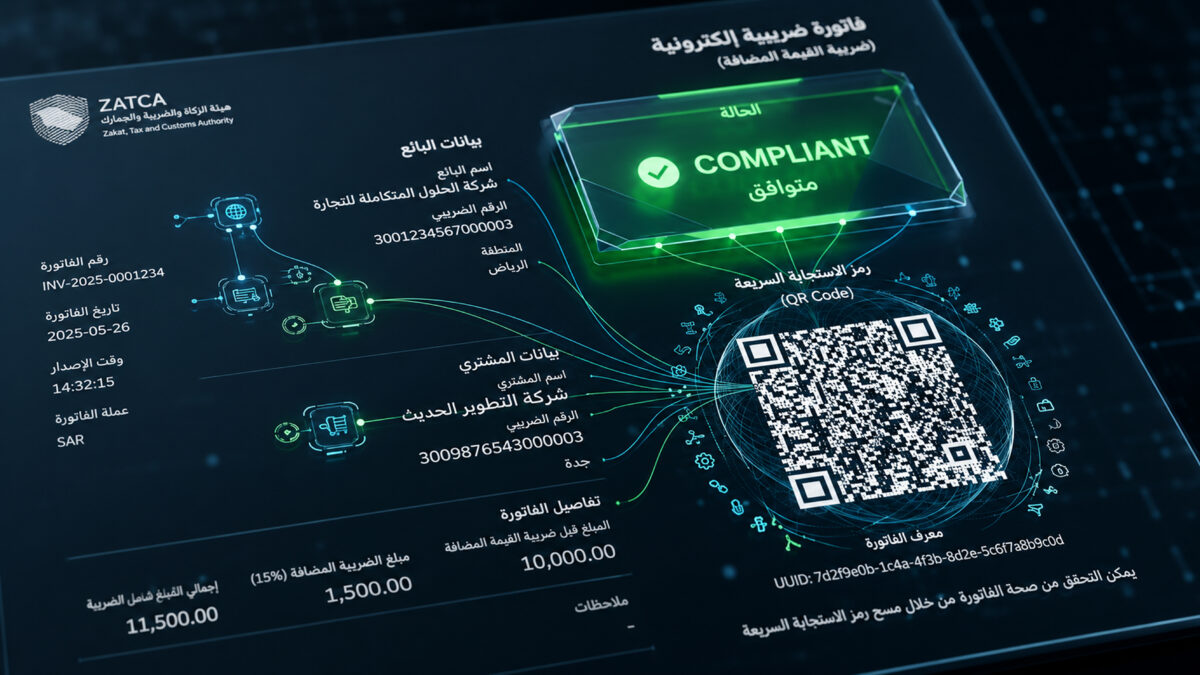
Compliance with ZATCA using AI is not about just integrating your ERP with Fatoora anymore and hoping the invoices go through. For Saudi Arabian businesses in 2026, the real challenge is scale: thousands of invoices, multiple entities, different ERPs, supplier invoices, Arabic and English data, evolving rules, and rejection patterns that the finance teams spot only after the damage is done.
The ZATCA e-invoicing program has already reached its second phase, the integration phase, which obliges taxpayers in notified waves to integrate e-invoicing solutions with ZATCA’s system and issue e-invoices in that format. The ZATCA official launch page says that Phase 2 has been implemented from January 1, 2023, in waves, and the taxpayers are to be notified at least 6 months before the date of integration.
ZATCA Phase 2 is no longer an experimental compliance project in 2026. It is a live functioning requirement for a wide range of VAT-registered companies in Saudi Arabia. The Wave 24 announcement of ZATCA comprises those taxpayers whose VAT-subject turnover has been more than SAR 375,000 in any of the years 2022, 2023, or 2024, and the integration is needed not later than June 30, 2026.
Automation changes that role.
Simple tools for ZATCA integration help to submit invoices. AI agents for ZATCA compliance mitigate the risk of rejection, identify risk patterns, monitor the quality of compliance, and safeguard claims for input VAT before they become penalties, delays, or audit findings.
aTeam Soft Solutions had developed AI compliance agents for Saudi businesses where the volume of invoices, the complexity of entities, and the risk of rejection rendered simple integration inadequate. In this article, we explain where AI agents fit, what they can automate, where they should always be reviewed by humans, and how businesses in Saudi Arabia can begin safely.
The initial phase of e-invoicing implementation was focused mostly on digitization.
Businesses couldn’t continue with handwritten invoices or invoices created using basic word-editing or spreadsheet software tools. They were required to produce and retain compliant e-invoices, including mandatory fields. The ZATCA e-invoicing page defines e-invoicing as a formal electronic process of exchanging and processing invoices, credit notes, and debit notes between a buyer and a seller, which can be facilitated through an integrated electronic solution.
However, the second wave of this problem is different.
ZATCA requires Phase 2 to be integrated. The electronic solution should be linked to the ZATCA systems, and the e-invoices should be produced in the specified format. ZATCA’s standard “What is e-invoicing?” page indicates that Phase 2 began on 1 January 2023 in waves and necessitates integration with ZATCA systems.
For a company that generates 200 invoices monthly, this may be manageable with a standard e-invoicing tool.
For an enterprise group issuing 50,000,000 invoices in a month across different companies, stores, branches, ERPs, POS systems, and business lines, that becomes a problem of compliance operations.
The challenge is not just whether the invoice is allowed to be sent.
The challenge is whether to submit the invoice.
A ZATCA-compliant invoice may be rejected due to missing information, wrong fields mapping, rounding differences, misclassification, inconsistent application of VAT, invalid buyer information, rejected XML structure, or mistakes specific to the system.
The penalty risk is real, although it should have been described precisely. ZATCA has also mentioned that non-issuance of e-invoices shall have a fine of SR 5,000, while the deletion or modification of e-invoices after issuance shall have a fine of SR 10,000; other violations, such as the absence of a QR code, the absence of the buyer’s VAT number where applicable, or non-reporting to ZATCA of any malfunction, may lead to a warning followed by an escalation depending on recurrence.
A lot of firms internally simplify this as “SAR 5,000+ exposure for each invoice that is non-compliant,” but the actual official methodology is a bit more defined. The fine is based on the type of violation, how repetitive it is, and if it’s a non-issuance, whether there is missing data, a system malfunction, or a post-issuance modification.
The larger operations gap is this: Almost all ZATCA integration tools are about submission tools.
They link the ERP or POS with Fatoora. They validate the technical format. They submitted the invoices. They get the clearances or reporting replies.
But they don’t always help the finance teams answer the more complex questions of compliance:
Is it likely to get this invoice rejected?
Which entity is generating the most errors?
What department is still sending invoices with incomplete buyer details?
For which product group is the VAT classification problematic over and over again?
Which supplier bills may put the deduction of input VAT at risk?
What change to the ERP’s mapping caused rejection rates to increase last week?
That is why AI ZATCA compliance is helpful.
A classic tool for integration with ZATCA is required.
An AI agent for compliance does not replace the need for Fatoora integration. It resides on top of the integration layer and enhances the quality of compliance before, during, and after submission.
ZATCA’s implementation resolution requires that e-invoices be produced either in XML or PDF/A-3 with embedded XML on due dates, and it also addresses other requirements, including cryptographic stamps, clearance, reporting, recordkeeping, and connection with ZATCA systems.
That being said, companies still require a compliant e-invoicing infrastructure.
The AI agent addresses another issue: operational compliance intelligence.
Conventional tools for ZATCA usually concentrate on technical submission.
They produce the necessary invoice format, communicate with Fatoora, handle clearance or reporting procedures, fulfill QR code-related requirements, maintain standard XML formats, and log submission status.
This is a vital task.
But these systems are generally not built to think across invoice history, supplier invoices, multi-entity performance, business-specific patterns of errors, and tax risk signals.
A regular integration tool might tell you that an invoice was rejected.
An AI compliance agent needs to tell you why the invoice will likely be rejected before you submit it.
A ZATCA compliance AI agent is capable of checking invoices for validation before submission, estimating the risk of rejection, identifying recurring error patterns, suggesting amendments, tracking compliance across entities, and identifying changes that impact invoice quality.
The agent is also capable of examining supplier invoices in order to safeguard input VAT deductions. Implementation resolution of the ZATCA states that, for utilizing input tax deduction, e-invoices and notes shall be cleared by or reported to the Authority as per the Integration Phase requirements from the effective date.
That means supplier invoices need to be of good quality.
If your customers expect you to provide them with compliant output invoices, then your finance team should also be interested in whether supplier invoices are sufficiently compliant to allow them to make claims for input VAT.
| Capability | Basic ZATCA integration tool | AI ZATCA compliance agent |
| Submits invoices to Fatoora | Yes | Uses existing integration layer |
| Generates XML or PDF/A-3 invoice format | Yes | Validates and monitors quality |
| Checks technical fields | Yes | Yes, plus business context |
| Predicts likely rejection before submission | Usually limited | Yes |
| Detects recurring rejection patterns | Limited | Yes |
| Monitors multiple entities in one dashboard | Sometimes | Yes |
| Auto-corrects known low-risk errors | Limited | Yes, with guardrails |
| Explains why a rejection happened | Limited | Yes |
| Tracks supplier invoice compliance | Learns from the finance team’s corrections | Yes |
| Learns from finance team corrections | Usually not | Yes |
| Flags’ rule-change impact | Limited | Learns from the finance team corrections |
The bottom line is simple.
ZATCA integration delivers the invoice to the authority.
AI ZATCA compliance helps raise the quality of what you submit.
An effective AI agent should not be built as a generic “tax assistant.”
It needs to be engineered for specific workflows with quantifiable patterns of failure.
In aTeam Soft Solutions’ ZATCA compliance agent case study, the client was a large Saudi group running over 50,000 invoices monthly through several business units. The initial rejection rate was around 5%, causing rework, invoicing delays, pressure on the finance team, and uncertainty about compliance. After implementation, the bounce rate was down to 0.15%.
Case report: ZATCA Compliance Monitor Agent
Pre-submission validation is the top priority in the AI ZATCA compliance process.
The objective is to spot errors before they turn into rejections.
Today, a significant number of finance teams find out about invoice problems post-submission. But at that point, the invoice has already been sent down a rejection path. Someone has to go in and investigate, fix, resubmit, and internally reconcile the problem.
An AI agent disrupts this sequence of events.
The agent reviews the invoices before submission to ZATCA. It validates the mandatory fields, buyer details, VAT treatment, invoice type, credit note reference, rounding, line-item consistency, branch-level patterns, and ERP-specific mapping errors.
The agent is able to score each invoice with a risk of rejection.
A low-risk invoice is able to go via normal submission. A medium-risk invoice may be automatically corrected if the problem is known and considered safe. A high-risk invoice may be held for finance evaluation.
In the aTeam Soft Solutions case study, pre-submission validation caught the majority of repetitive rejection patterns prior to submission layer on invoices. The client transitioned from reactive correction to preventive compliance.
A practical measure from the deployment was the decrease in the invoice rejection rate from 5% to 0.15%.
For a business that handles 50,000 invoices a month, that’s a big difference. A 5% rejection rate means 2,500 invoices have to be investigated. A rejection rate of 0.15% means that 75 invoices need attention only.
It’s not just a compliance enhancement but also a relief to finance operations.
Businesses with multiple entities have a different challenge.
A software company may be using SAP. Another might be using Odoo. A third might be using a custom ERP. Retail branches might use POS systems. A service department can generate invoices from a different billing tool.
The ZATCA obligation is applied to all aspects of the organization, but the visibility of errors is usually fragmented.
The chief of finance for a whole group may not learn which entity is generating the most risk until reporting at the end of the month. By then, the source of the problem may have already been applied to thousands of invoices.
An AI compliance agent provides a common compliance layer across entities.
It can track rejection rates, warning patterns, omitted fields, branch-specific issues, differences between types of customers, patterns across types of products, and even mapping specific problems related to ERP.
The customer service can respond to inquiries like
Which entity is leading in rejection rate this week?
Which is the branch without a buyer’s VAT number?
Which ERP causes rounding errors?
What type of invoice generates the most corrections?
What business line is threatened if ZATCA regulations change?
In the aTeam Soft Solutions case study, the multi-entity dashboard provided leadership with a unified view of the compliance health of the group. Finance teams were able to view entity-level risk without waiting for manual reports.
This workflow is important for ZATCA compliance-related issues, not just for a technical issue. It’s an issue of operating control.
A company can’t manage what it can’t see.
Not all ZATCA compliance errors require human review.
Certain problems are recurring and low-risk and can be easily corrected when the correction rule is obvious.
Examples are rounding differences, missing optional-but-required-by-policy fields, known mapping gaps, invalid internal classification labels, formatting issues, or missing branch codes that can be derived from source data.
An AI agent can identify these patterns and make corrections that are safe before submission.
The key phrase is “safe corrections.”
The agent shouldn’t quietly make tax decisions heavy with judgment. It should not amend VAT treatment, alter invoice value, or reclassify a complex transaction without the consent of a human.
However, it can fix some foreseeable technical and mapping issues, as the business rule is clear to do so.
For example, if a branch identifier is sent regularly by one POS in a non-standardized field, the agent can map it correctly. If a particular rounding format problem is known to be generated by one ERP, the agent can normalize it with agreed-upon rules. If a credit note is missing a reference that is in the ERP record, the agent can populate the reference or raise it for review.
In the aTeam Soft Solutions rollout, auto-correction was only after error patterns were confirmed over time. That prevented the usual mistake of letting AI have too much power too early on.
The workflow operated under a phased approach: detect, suggest, confirm, and then auto-correct if low-risk known patterns.
ZATCA compliance is a moving target.
Technical specifications, timeline of waves, field expectations, and guidance on implementation may change. Official ZATCA materials indicate that Phase 2 will be gradually rolled out in waves, and taxpayers will receive a notification at least six months before the date on which they are integrated.
The operational problem is not just knowing that a rule changed.
The actual problem is knowing what the rule change touches inside your organization.
A ZATCA rule change can affect a single type of invoice, a single customer segment, a single entity, a single ERP field, a single POS integration, or a single supplier category at a time.
An AI agent can track official changes, compare them against pre-existing invoice logic, and produce an impact report for finance, IT, and tax teams.
For example, the agent is able to identify that a new field expectation applies to simplified invoices from retail branches but not to b2b tax invoices from the services entity.
The agent also has the ability to produce a test checklist for IT teams. It can determine sample invoices, expected changes of fields, impacted systems, and regression tests needed before the rollout.
This is a useful workflow because a lot of the compliance breakage occurs in the change windows.
The company thinks that the integration is stable. Then it is a rule update, ERP change, product mapping update, or POS configuration change that creates a new rejection pattern.
An AI compliance agent can take that blind spot and decrease it.
ZATCA compliance is more than just about the invoices you issue.
It also impacts the security of claiming input VAT on supplier invoices.
Resolution for the implementation of ZATCA stated that, to claim the input tax deduction, electronic invoices and notes must be cleared by or reported to the Authority as per Integration Phase requirements from the date of applicability.
That makes a real financial logistics problem.
Your AP team might be getting supplier invoices that look fine to the human but have compliance vulnerabilities. There might be missing buyer data, wrong VAT information, wrong format, supplier data that doesn’t match, or references that are incomplete on the invoice.
If the AP team processes those invoices without scrutiny, it’s that much more difficult to defend the input VAT deduction on an audit.
A supplier invoice compliance agent reviews invoices from suppliers before payment or input VAT recovery.
It verifies the supplier’s VAT number, invoice layout, buyer information, tax amounts, customs/reporting information, if available; risk of duplication, and consistency with purchase orders.
The agent can send suspicious invoices back to the supplier for correction before payment.
This is particularly helpful for Saudi groups that have hundreds of suppliers. Manual accounts payable teams don’t have the time to take a deep dive into every supplier invoice. An AI agent can rank the invoices that have the highest potential of creating input VAT risk.
In the aTeam Soft Solutions ZATCA case study, after the output invoice rejection process became stable, supplier-side validations were introduced. That sequencing was intentional. The client initially mitigated the risk of outbound rejection and then grew the agent to guard against the quality of input VAT.
The client was a Saudi conglomerate with several VAT-registered entities and more than 50,000 invoices processed on a monthly basis.
The company already possessed ZATCA integration.
That’s the key.
The issue was not the absence of integration. The problem was that compliance quality issues were not prevented by the integration.
Before the AI agent, the rate of rejection was approximately 5%. That was approximately 2,500 invoices a month that had to be reworked, researched, fixed, or resubmitted.
The patterns of denials were not at random.
Some were due to missing fields. Some were from differences in ERP mapping. A few were due to branch-specific configuration errors. Some were due to issues with classifying invoices. Some resulted from rounding errors. Some appear in particular transaction types only.
Instead of preventing the rejection, after the rejection, time was being spent by the finance team.
The company has developed an AI compliance monitor on top of the existing ZATCA integration layer.
The agent performed five actions.
Firstly, it verified invoices before submission.
Second, it assessed the risk of rejection based on historical data of rejection patterns.
Third, it detected error trends at the entity and branch levels.
Fourth, it proposed corrections related to known recurring problems.
Fifth, it diverted unclear cases to finance reviewers with an explanation.
The agent was not permitted to autonomously modify the high-risk tax treatment.
That control was important.
The rollout employed a human-in-the-loop process for sensitive cases. The agent was allowed to autocorrect low-risk known patterns, but tax-sensitive matters were referred to finance for review.
During the deployment time, the rejection rates decreased from 5% to 0.15%.
At 50,000 invoices a month, that brought down the monthly rejected invoices from around 2,500 to around 75.
The outcome was not just fewer rejections. The finance team obtained visibility into the source of errors. Leadership was able to identify at the entity, branch, system, or even invoice type level where compliance risk was being generated.
This is what is supposed to be automated ZATCA compliance in practice.
It should not just send invoices.
It should minimize the risk of rejection, explain patterns of failure, and allow finance teams to intervene before mistakes reach ZATCA.
Saudi businesses won’t need to have a full AI compliance agent on day one.
A small business with a single accounting system, a low volume of invoices, and minimal rejection issues may only need a robust ZATCA-compliant e-invoicing tool.
Larger companies with multiple entities, high volume, repeated rejections, risk of supplier invoices, or complex ERP system architecture may want to look into an AI compliance layer.
| Business situation | Suggested method |
| Low invoice volume and one ERP | Standard ZATCA integration tool |
| High invoice volume and repeated rejections | AI pre-submission validation agent |
| Multiple entities and systems | AI multi-entity compliance monitor |
| Frequent correction and resubmission | AI rejection prediction and error-pattern agent |
| Supplier invoice input VAT risk | AI supplier invoice compliance verification |
| Regulated or high-value invoices | AI agent with human-in-the-loop approval |
| Complex SAP, Odoo, and custom ERP environment | AI compliance layer integrated across systems |
The decision should be taken based on the volume of invoices, rejection rate, rework hours, compliance risk, and complexity of ERP.
It’s best to start by getting an accurate measurement of the current rejection rate.
The safest way to begin is not with full autonomy.
The safest way is to start with monitoring and validation.
Begin with a quality review of invoices for 90 days.
Track total submitted invoices, rejected invoices, warning patterns, correction reasons, time for resubmission, and differences by entity level.
The most useful figure was not the rejection rate, but the cost of rejection.
To calculate how much the finance department spends in hours correcting invoices, how many invoices are lagging, and how much risk lies in the repetition of noncompliance patterns.
List the systems that generate invoice data.
This can be SAP, Odoo, Oracle, Microsoft Dynamics, ERPNext, custom ERP, POS systems, e-commerce platforms, billing tools, or even manual upload processes.
Many ZATCA problems originate upstream.
If a POS system transmits incomplete data, the ZATCA integration layer might reveal the problem only upon submission. The AI agent should track the upstream source, not the final invoice file alone.
A pilot is appropriate when the rejection issue is observed, but the root causes are unknown.
A full deployment is appropriate if the organization already knows that invoice rejection, multi-entity monitoring, or supplier invoice compliance is an ongoing operational issue.
The company usually suggests a phased deployment for AI ZATCA compliance:
This method does provide finance teams with control before autonomy increases.
A focused pilot for monitoring ZATCA rejections can typically be developed in 6 to 10 weeks if the data is available and the invoice flow is well-defined.
An AI compliance agent for multiple entities across SAP, Odoo, POS, and custom ERP systems might take around 12 to 20 weeks, and this really depends on the complexity of the integrations, the volume of invoices, and the workflows for reviewing them.
A supplier invoice compliance module can be built on top after the outbound invoice process matures.
A narrow AI ZATCA compliance pilot could begin at the price of a specialized AI automation engagement.
A full multi-entity implementation is more expensive, as it requires system integrations, dashboards, audit logs, rule libraries, exception workflows, access control, and monitoring.
The appropriate cost standard is the cost of denial.
When a business is adjusting thousands of invoices monthly, the hidden cost will be higher than the software budget. When a business experiences only a handful of rejections, a full AI agent may not be justified just yet.
aTeam Soft Solutions makes this decision honestly for the Saudi businesses. Sometimes the correct answer is simply a better ZATCA Integration setup. Sometimes the correct solution is an AI compliance agent. And sometimes it is a phased approach beginning with monitoring before automation.
The ultimate goal of AI in ZATCA compliance is not to develop a chatbot that responds to tax inquiries.
The true value is a compliance agent that checks the quality of invoices prior to submission, estimates the risk of rejection, explains error patterns, defends the supplier’s invoice quality, and provides the finance teams with visibility across the entities.
Basic ZATCA integration is required for the taxpayers who have been notified. ZATCA Phase 2 also involves integration with ZATCA’s systems to produce e-invoices in the specified format.
But integration by itself does not guarantee low rates of rejection.
In 2026, Saudi enterprises should transition from “Are we able to submit invoices?” to “Are we able to prevent compliance problems before they materialize?”
That is the purpose of an AI agent.
For large-scale Saudi companies, a 5% rejection rate is not a minor technical matter. It can translate into thousands of exceptions every month, delayed invoices, an overworked finance team, and repeated compliance exposure concerns.
aTeam Soft Solutions develops AI agents that layer on top of existing ERP and ZATCA integration layers to identify risk, minimize rejections, and generate audit-ready compliance workflows.
The best place to begin is straightforward: measure your past 90 days of ZATCA rejections, categorize them by reason, and quantify the monthly cost of remediation.
If the number is hurtful, AI isn’t the initial step.
Visibility is there.
Once you know where the compliance leakage is occurring, AI becomes useful.
Yes. AI agents could assist with ZATCA Phase 2 compliance by invoice validation pre-submission, identifying risk of rejection, handling multiple entities, detecting patterns of recurring errors, and forwarding high-risk situations to finance reviewers.
An AI agent is not a substitute for the required ZATCA integration layer. It enhances the invoice quality around that layer.
The benefit for large volumes of Saudi businesses is mainly fewer rejections and better visibility on compliance.
The price varies according to the volume of invoices, the number of entities, ERP systems, integrations, dashboards, workflows for approvals, and the requirements of supplier invoices.
A focused AI ZATCA compliance pilot can be feasible for one entity or one invoice flow. A full multi-entity compliance tracks costs more as it requires integrations with SAP, Odoo, POS, custom ERP systems, and finance review workflows.
The better question is how much the current invoice rejection is costing you monthly in terms of staff time, delays, rework, and exposure to compliance.
Invoices are submitted to Fatoora through a ZATCA integration tool, which also helps in complying with the technical requirements of e-invoicing.
An AI compliance agent reviews the quality of invoices before submission, forecasts potential rejections, suggests corrections, identifies patterns across entities, and assists finance teams in mitigating repeated compliance problems.
The submission layer is the integration tool.
The agent in the AI space is the compliance intelligence layer.
If historical invoice and rejection data are available, a focused AI agent can begin detecting rejection patterns within the first couple of weeks.
Effective rejection reduction seems to manifest after the agent has observed a sufficient number of real invoices, has learned patterns of recurring errors, and has gone through the finance evaluation.
For many companies, a realistic pilot timeline is 6 to 10 weeks. A larger multi-entity rollout could be in the range of 12 to 20 weeks.
Certainly, yes, an AI ZATCA compliance officer can be integrated with SAP, Odoo, ERPNext, Microsoft Dynamics, Oracle, POS systems, and custom ERP systems, provided that invoice data, submission responses, and error logs are available.
The agent is able to run on top of multiple systems and still provide a unified compliance view.
For complex environments, the most critical job is to map the source of invoice data, the points at which it changes, and where rejection responses are held.