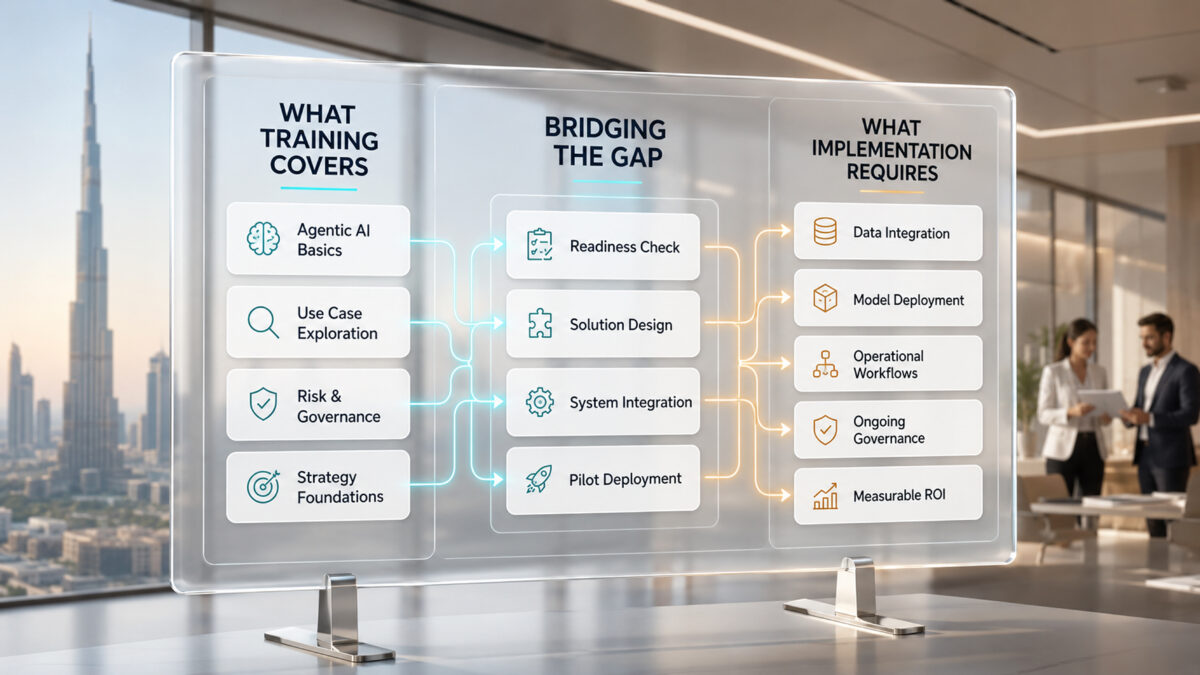
The Dubai Chamber’s agentic AI training will help most business leaders understand what agentic AI actually is. However, training alone won’t prepare your company to roll out AI agents within areas such as finance, operations, customer service, procurement, healthcare, logistics, or compliance workflows.
This is the gap many Dubai companies need to understand now: awareness is not implementation.
On May 4, 2026, Sheikh Hamdan bin Mohammed bin Rashid Al Maktoum unveiled a two-year strategy to guide the transition of Dubai’s private sector towards agentic AI. One of the most important aspects of the initiative is the specialised learning journey provided to all business councils that are connected with the Dubai Chamber of Commerce and Industry.
It’s a serious step.
That means the development of agentic AI education should not be limited to technology companies. It will extend to real estate groups, trading companies, healthcare operators, logistics firms, financial services businesses, hospitality brands, construction companies, retailers, family offices, and professional services firms.
However, that is the truthful point.
The Dubai Chamber’s training can help leadership teams understand what agentic AI can do. But it will not build the first agent, integrate it with ERP, clean operational data, redesign approvals, or prove ROI inside a live process.
At aTeam Soft Solutions, we have observed this disparity very clearly while carrying out AI implementation work within the UAE and Saudi Arabia. The companies that succeed with agentic AI are not the ones that go to the most training sessions. They are the companies that take training and turn it into a well-chosen pilot and then turn that pilot into production.
This article elaborates on what the Dubai Chamber’s agentic AI training will probably include, what it will not include, and how your company can close the execution gap before 2028.
The Dubai Chamber’s AI training comes as part of a broader two-year transition program to transform the private sector.
According to the official statement, the learning journeys will include all business councils associated with the Dubai Chamber of Commerce and Industry. That is a relevant detail that matters as Dubai’s business councils cater to diverse markets, industries, and trade relationships. The program is not just designed for the CTOs or AI founders. It is intended to shift the broader private sector in the direction of agentic AI adoption.
It is anticipated that the format will include a combination of workshops, seminars, executive sessions, case study presentations, vendor demonstrations, and structured learning paths.
Large government-based business programs usually tend to divide their audiences by responsibility. Executive teams have to know the strategy, risk, investment, and competitive pressure. Operations managers must know about the workflow choices and change management. IT teams must know integration, data access, security, and system architecture. Finance teams must understand ROI, cost models, and governance.
The Dubai Chamber’s AI training will also probably follow a similar pattern, although the exact curriculum and delivery providers may differ in each council and sector.
A lot of the companies still confuse chatbots, automation, RPA, generative AI, and agentic AI.
Therefore, the first layer of training will likely describe what agentic AI is.
Agentic AI systems are those that can plan, decide, and execute multi-step business processes with minimal human intervention. A chatbot responds to a query. A workflow is completed by an AI agent.
For example, a chatbot can inform a finance executive how to handle an invoice.
An AI agent can interpret the invoice, extract the supplier details, compare it with the purchase order, check tax fields, identify mismatches, prepare a draft of the ERP entry, and route exceptions to the finance team.
That distinction is important as Dubai’s private-sector shift is not just about adding more chat widgets to websites. It is all about shifting routine business work to autonomous or semi-autonomous workflows.
The Dubai Chamber’s AI training is expected to demonstrate how AI agents can serve a variety of business functions.
In customer service, AI agents can respond to inquiries, open tickets, identify order status, collect documents, and escalate unresolved cases.
In finance, AI agents can handle the invoices, reconcile payments, identify missing documents, and prepare reports.
In HR, AI agents can process the onboarding documentation paperwork, respond to employee policy questions, and track leave documentation.
In logistics, AI agents can track the shipment status, prepare customs documents, send customer updates, and identify delays.
In healthcare, AI agents can assist with insurance pre-authorization, patient communication, nurse rostering, pharmacy reporting, and claims documentation.
In real estate, AI agents can handle tenant inquiries, maintenance requests, renewal reminders, payment follow-ups, and the collection of documents.
This awareness is helpful because most companies still consider AI to be a marketing tool. Agentic AI is more useful when embedded inside operating processes.
Many companies in Dubai will not develop agentic AI entirely internally in-house.
They will require implementation partners, AI development companies, platform vendors, consultants, or internal-external hybrid teams.
The Dubai Chamber’s AI training might enable companies to know exactly what to observe in a vendor. These could be case studies, technical capability, industry knowledge, security practices, pricing transparency, and the ability to support deployment beyond demos.
Having said that, training for vendor evaluation is just a beginning.
The real question is whether the partner can model your workflow, integrate with your systems, process your data, establish the appropriate guardrails, and remain engaged post-deployment.
The Dubai Chamber’s AI training could be useful if the companies attend it with the right expectations.
It should help leaders to know the direction of Dubai’s economy, the meaning of agentic AI, and the opportunities within their own operations.
However, it is not to be considered as a replacement for execution.
Strategic awareness is the primary benefit.
The majority of the board members, founders, CEOs, COOs, CFOs, and department heads still do not have a well-formed mental model for agentic AI.
They might have used ChatGPT. They might have encountered AI design tools. They might have tested a chatbot on their website. But they may not have witnessed an AI agent operating across documents, systems, approvals, and human review processes.
Dubai Chamber’s agentic AI training may help leaders realize why the mandate of Sheikh Hamdan is relevant to business productivity, cost of operation, customer experience, and competitiveness of the market.
That awareness is crucial because AI adoption fails when its leaders view it as nothing more than an IT project.
Agentic AI is not merely a technical choice. It’s an operating model choice.
If leadership are aware of that, they can move faster as a company.
The secondary benefit is the identification of an opportunity.
A good training program should assist the managers in looking at their own departments and asking better questions.
Which workflow processes are repetitive?
Which tasks rely on reading documents?
Which teams have too much time devoted to copying data between systems?
Which customer questions repeat on a daily basis?
Which approvals are held up due to a lack of information?
Which kind of mistakes generate rework, fines, or customer frustration?
These questions are more helpful than asking, “Where can we apply AI?”
Top opportunities for AI agents usually tend to sit within dull workflows. Invoice processing. Document verification, Customer follow-up. Compliance evidence gathering. Matching purchase orders. Scheduling appointments. Submitting insurance. New hire orientation for employees. Qualifications for sales.
At aTeam Soft Solutions, we frequently discover that the more robust first AI agent is not the one the CEO initially mentions. It is typically hidden in the operations team, where the employees spend hours daily doing repetitive tasks that no one has really quantified.
The third advantage is the vendor evaluation.
Dubai-based companies will have to compete in a highly competitive AI market. There will be a lot of vendors who use the same words: agentic AI, autonomous workflows, enterprise AI, AI automation, and AI transformation.
The Dubai Chamber’s agentic AI training will enable companies to distinguish between genuine implementation partners and AI tool sellers at the surface level.
A robust AI partner ought to be able to describe the phases of deployment, data access, human review, exception handling, audit logs, fallback rules, security, and maintenance.
A poor vendor will only be able to show a finished demo.
That makes a difference.
A demo can work really well with well-formed sample data.
A production AI agent has to deal with unstructured PDFs, incomplete emails, Arabic-English documents, legacy systems, impatient customers, staff resistance, compliance requirements, and edge cases that happen each week.
The Dubai Chamber’s AI training will be helpful. However, there are five areas where training will not be sufficient.
These five gaps will determine if your company shifts from AI interest to AI execution.
Training will inform you that AI agents require the information.
It won’t inform you that your data is likely to be scattered in 15 systems, shared drives, email inboxes, WhatsApp groups, Excel sheets, scanned PDFs, and legacy software.
This is the initial execution problem.
AI agents don’t execute well when they can’t access the information required to complete the task.
A customer support AI agent must have access to the customer records, order details, payment status, policy documents, ticket details, and escalation processes.
A finance AI agent requires access to supplier master data, purchase orders, invoice templates, tax fields, approval rules, ERP access, and exception classifications.
A healthcare AI agent must have access to patient data rules, insurance documentation, appointment records, clinical boundaries, payer needs, and audit trails.
The training session can cover this on a higher level. But it can’t chart your real data landscape.
In a single UAE implementation, a client required an AI agent to automate the processing of supplier invoices. The finance team thought all the invoices were stored in the ERP system. During discovery, we learned that 40% of invoices came in via email, 25% came via WhatsApp images, 20% were uploaded to a supplier portal, and the rest were provided as scanned PDFs by internal teams.
The technical issue was not simply one of choosing an AI model.
The actual issue was with the intake data.
Before the agent could handle the invoices, we had to design a common intake layer, document classification rules, duplicate detection, purchase order matching, and exception handling.
That is what makes the data architecture readiness more important than most leaders expect.
An organization might be enthusiastic about the Dubai Chamber’s agentic AI training and still be three months away from implementation, as its data is not ready.
Many AI demonstrations utilize English.
Dubai-based companies do not operate only in English.
Invoices might be in Arabic and English. Supplier messages might be a combination of Arabic, English, Hindi, Malayalam, Urdu, and Chinese. Customer conversations might shift between English and Arabic in the same chat. Government submissions might need the Arabic fields. Internal staff might utilize English systems even though Arabic documents are used.
This makes the execution more difficult.
Arabic OCR is not simply just English OCR, but in a different font. Arabic documents have a right-to-left format, different layout patterns, mixed numerals, stamps, handwritten notes, and quality issues due to scanning.
Bilingual interactions also develop code-switching. A customer might write a single sentence in English and the next one in Arabic. A supplier might send an invoice in English, although they add payment instructions in Arabic. A tenant might submit a maintenance request in Hindi yet attach an Arabic municipality document.
Training is able to explain that multilingual ability is important.
Real document testing is required for implementation.
In a single Dubai real estate AI assistant project, the initial demo worked fine with well-formed English FAQs. However, in production, the agent was required to know the tenant questions in English, Arabic, and South Asian languages. It also had to know when to respond, when to create a ticket, when to escalate to legal, and when to skip giving a final determination.
The agent ultimately managed to resolve 73% of routine inquiries without human participation, but that was only after we developed language-specific processing, escalation types, and confidence thresholds.
That’s the distinction between a demo and a deployment.
If your business caters to actual customers of Dubai’s location, bilingual and multilingual processing needs to be part of the design from day one.
Training will address compliance matters.
Compliance shall be demonstrated in execution.
That is a big difference.
Companies in Dubai are subject to varying regulatory expectations based on sector, jurisdiction, and the types of data. UAE PDPL, DIFC, and ADGM data regulations, DHA expectations, financial services regulations, insurance requirements, tax documentation, employment records, and cross-border data management handling can all influence how an AI agent is constructed.
The training might be able to explain that personal information needs to be safeguarded.
However, an execution team needs to be able to determine which fields are personal data, where they are stored, who can access them, if the data leaves the UAE, if the cloud processing is acceptable, if logs require sensitive data protection, if human approvals are needed, and how long records should be retained.
This is particularly important when working with an India-based deployment partner such as aTeam Soft Solutions.
Cross-border supply can be efficient and cost-effective, but it should be well designed carefully. Sensitive information might have to remain in the client’s cloud in the UAE, in a private environment, or in an infrastructure that was approved. Developers can work with protected data. Production access can be limited. Logs might need to be anonymized. AI outputs may require human approval before action.
This is not just the documentation.
It impacts the architecture.
For an AI agent in healthcare, the patient data cannot be treated like normal customer support information.
For an AI agent in a financial services environment, transaction details, KYC documents, and risk decisions will need stronger access control.
For an AI agent in legal or HR, the system must be able to maintain auditability, as the decisions may be challenged later.
At aTeam Soft Solutions, we sometimes separate AI reasoning, system access, and data storage into different layers so clients can determine where sensitive information resides. That design decision is more important than the model name.
All companies think their systems are normal.
They’re not.
A Dubai company might use SAP for finance, Salesforce for sales, Zoho for support, a custom portal for vendors, and Excel for reporting.
Another might use Odoo with heavy customization, WhatsApp for customer communication, Google Sheets for operations, and a local accounting tool.
A family business might have 20 years of operational knowledge stored in old desktop software, email folders, and employees’ heads.
Training cannot be specific to this level.
The implementation of Agentic AI will be based on integration.
An AI agent needs to have the ability to read from the right systems, write to the right systems, execute the right workflows, and honor permissions.
If APIs are available, integration is more straightforward.
If APIs are not available, the team might require the connectors, database access, robotic browser automation, secure email processing, document pipelines, or human approval queues.
In a single Saudi healthcare implementation, the client requested an AI agent to cut down on insurance pre-authorisation delays. The problem was that different payer portals had different forms, different required documentation, and displayed different status messages. The agent was to prepare submissions, verify missing documents, go through portal steps, and escalate exceptions to staff.
The outcome reduced a workflow process that frequently took around 48 hours of manual follow-up to a structured 15-minute submission process.
That outcome does not arise from the training.
It evolved from studying the portals, mapping the process, creating controlled automation, testing exceptions, and including humans in the process where payer rules were ambiguous.
Legacy integration is where a lot of AI projects lose momentum.
That’s also where experienced partners for implementation truly add real value.
The human dimension of agentic AI is frequently underestimated.
Employees could resist AI agents since they are concerned about their job loss.
Managers can mistrust AI outputs as they do not see the reasoning.
Finance controllers might require audit trails.
Legal teams may be concerned about liability.
Operations staff may be concerned that exceptions will increase, rather than decrease.
IT teams may be concerned about access, security, and support burden.
All of these are valid concerns.
Agentic AI modifies the flow of work through an organization. Because the people impacted by that change aren’t engaged early, they will slow adoption at a later stage.
Based on our experience, change management can represent 40% of the effort to implement.
The best method is not to reveal that AI would “replace manual work.”
The ideal approach is to demonstrate to the staff how the AI agent eliminates repetitive work and provides them more time for judgment, customer dealing, managing exceptions, and making decisions of higher value.
That’s why we frequently launch AI agents in validation mode.
In validation mode, the AI agent executes the task in parallel while humans continue their normal process. The company’s business compares the results, measures accuracy, and builds trust.
Then the system switches to assisted mode. The AI agent does the preparation work, although humans approve before any action is taken.
Only then can the agent perform controlled operations on low-risk tasks.
This gradual approach diminishes fear.
It also makes it easier to spot errors before the system scales up.
The Dubai Chamber’s agentic AI training might explain why staff adoption is important. However, it won’t reside with your finance team, operations team, or customer support team when they initially start by making use of the AI agent.
That is the execution work.
The businesses that will gain the most out of Dubai Chamber’s agentic AI training are the ones that consider it as the starting point.
Training must result in a practical plan for readiness.
The following table shows how to close the five common gaps.
| Implementation gap | What to do after training | Who should be involved | Typical timeline | Typical cost range |
| Data architecture readiness | Audit systems, data sources, APIs, documents, and access rules | COO, IT manager, department head, implementation partner | 1-3 weeks | $3,000-$10,000 |
| Arabic and bilingual processing | Test real Arabic-English documents, chats, forms, and OCR samples | Operations, customer service, compliance, and the AI team | 1-2 weeks | $2,000-$8,000 |
| Regulatory compliance | Define data boundaries, access controls, logs, retention, and approval rules | Legal, compliance, IT security, business owner | 2-4 weeks | $5,000-$20,000 |
| Legacy system integration | Map APIs, databases, portals, email flows, and screen automation needs | IT, system owners, implementation partners | 2-6 weeks | $10,000-$50,000 |
| Staff adoption | Run shadow mode, assisted mode, training sessions, and feedback loops | Department managers, end users, HR, AI champion | 4-8 weeks | $5,000-$25,000 |
**Book a 45-minute Agentic AI Readiness Call**
The above ranges are realistic estimates. Actual cost is based on the complexity of the workflows, the number of systems, security needs, quality of data, and the level of autonomy expected.
At aTeam Soft Solutions, we typically advise a phased track post-training.
The initial phase is discovery for readiness. This represents one or two high-value workflows and investigates whether the business has the data, access, and approval hierarchy required.
The secondary phase is pilot design. This sets the scope, success metric, points for human review, exception handling, integration path, and schedule.
The third phase is the proof of concept. A targeted pilot typically lasts from 4 to 6 weeks and costs between $15,000 and $40,000.
The fourth phase is the production rollout. A full deployment typically costs between $40,000 and $120,000, based on the number of integrations, users, languages, compliance requirements, and workflow complexity.
And the fifth phase is the enhancement. AI agents require supervision, assessment, feedback, and updates as business processes evolve.
A business should not leap from training directly to a big transformation program.
The more secure approach is a single controlled pilot with a measurable ROI.
The Dubai Chamber’s agentic AI training is set to target companies of various sizes. Each kind of company has a different next step that it needs to take.
Small businesses do not require a big AI steering committee.
They just want a single helpful AI agent that saves time fast.
Good initial use cases cover customer service inquiries, quotation preparation, appointment booking, invoice reminders, document collection, lead qualification, and basic reporting.
An SMB shouldn’t have to spend half a year creating an AI strategy document.
It should determine a single manual workflow, select a trusted implementation partner, execute a small pilot, and measure time saved.
For small businesses, an end-to-end solution provider is typically more advantageous than trying to establish their own AI team.
Mid-size market companies have sufficient complexity to require the structure.
They can have multiple departments, multiple systems, regional operations, compliance issues, and additional personnel impacted by change.
The best model is an execution implementation partner with an additional internal AI champion.
The AI champion doesn’t want to be the CTO. In most businesses, the best champion for AI is the COO, operations manager, finance controller, customer service head, or transformation lead.
This individual knows the workflow headaches and can coordinate with leadership, IT, department users, and the execution team.
Mid-size market firms should target a single pilot in 90 days and two to three scaled processes over 12 months.
Enterprise firms require more than pilots.
They require governance.
This encompasses AI usage policies, data access controls, security audits, risk categorizations, vendor management, approval workflows, audit logs, and evaluation of models.
Companies shouldn’t let every department purchase AI tools independently and without supervision.
That leads to information risk, duplicated costs, inconsistent results, and compliance issues.
A large enterprise needs to establish an internal AI governance framework but still relies on implementation partners for specific workflows.
At the enterprise level, aTeam Soft Solutions generally collaborates with internal technology, operations, compliance, and business teams. The intention is not to replace internal capability. The aim is to bring the speed of implementation, depth of engineering, and experience from similar workflows.
The Dubai Chamber’s agentic AI training would be more beneficial if your company made the necessary preparations before attending.
Don’t just send only the IT staff.
Send the person who knows the workflow headaches.
For a lot of the companies, that might be the operations manager, finance controller, head of customer support, HR manager, compliance lead, or business unit head.
Before attending, identify your top five repetitive workflows. Estimate volume per month, staff hours, error rate, cost of delay, and the systems involved.
Bring the actual questions.
Inquire about how the AI agents deal with unstructured documents.
Inquire about how the human approvals are processed.
Inquire about how the workflows are supported in Arabic and English.
Ask what occurs if the AI agent is unsure.
Inquire about the generation of audit logs.
Inquire how the ROI is measured.
Inquire with vendors for particular case studies with numbers, timelines, and failure points.
Never take a demo as evidence of ability to produce.
A demo demonstrates what can be done in a controlled environment. A case study shows what made it through real-world operations.
Also, consider your implementation budget plans during the training.
If the training allows you to recognize a compelling use case but the company doesn’t have the budget to run a pilot, the momentum will be lost.
A realistic initial AI agent pilot budget is $15,000 to $40,000.
A realistic production release budget is $40,000 to $120,000.
The precise number will be based on integration, language, compliance, and workflow complexity.
The fastest-moving companies will attend training with a pilot mindset.
They won’t ask, “What is agentic AI?”
They will say, “Which process do we automate first, and what do we have to demonstrate ROI in 90 days?”
Utilize this evaluation report in advance, before or after the agentic AI training in the Dubai Chamber Region.
| Readiness area | Low readiness | Medium readiness | High readiness |
| Process clarity | Workflows are undocumented and depend on individual staff knowledge | Main workflows are understood but not fully mapped | Workflows are documented with clear steps and owners |
| Data availability | Data is scattered across email, WhatsApp, Excel, and paper | Some data is structured, but key inputs are unstructured | Data is accessible through systems, APIs, or controlled repositories |
| System integration | Legacy systems have no API and limited access | Some systems have APIs; others need custom connectors | Core systems support secure integration |
| Language complexity | Arabic-English documents and chats are common but untested | Some bilingual samples are available | Real multilingual samples are collected and ready for testing |
| Compliance clarity | Data rules are unclear | Legal and IT have basic policies | Data access, retention, audit, and approval rules are defined |
| Staff readiness | Teams fear AI and expect job loss | Managers are open but cautious | Teams understand AI as support for repetitive work |
| Budget readiness | No budget assigned | Budget is possible after the business case | Pilot budget approved or planned |
A company does not need perfect readiness to start.
But it needs honest readiness.
If your company’s rates are low in most areas, start by identifying processes and mapping data flows.
If your company’s rates are medium, start with a single controlled pilot.
If your company’s rates are high, start with a pilot implementation and prepare a 12-month agentic AI roadmap.
The company enables the Dubai businesses to transition from agentic AI awareness to production implementation.
We are an India-based AI and software development company with 120+ engineers, ISO 9001:2015 and ISO/IEC 27001:2022 certified, a 4.9/5 Clutch rating with 90+ verified reviews, and 20+ published case studies.
Our focus is on serving practical agentic AI systems for companies based in the UAE and Saudi Arabian markets.
We do not begin with a model.
We begin with the workflow process.
That matters because the majority of AI execution failures are not due to weak models. Instead, they are a result of poor process choice, non-standardized data, undefined approval processes, poor integration, and insufficient staff adoption.
aTeam Soft Solutions usually serves the clients in five areas: the discovery of workflows, the design of AI agents, system integration, controlled pilot deployment, and long-term enhancement.
In a single UAE finance workflow, we helped build an AI agent that handled supplier invoices received as PDFs, scans, emails, and even WhatsApp images. The agent extracted data, cross-checked it with purchase orders, and generated ERP entries for review.
In a single Dubai property process, we helped develop a multilingual tenant support AI agent that handled routine inquiries, generated tickets, and escalated sensitive cases. After production optimization, 73% of repetitive queries were resolved by the system without human intervention.
In a single Saudi healthcare workflow, we assisted with automated insurance pre-authorisation preparation and portal submission support. The workflow process shifted from extended manual follow-up cycles to a structured 15-minute submission process for routine cases.
These are not theoretical illustrations.
They demonstrate what takes place when training completes and execution starts.
The Dubai Chamber, with its agentic AI training, would likely include what agentic AI is, how it relates to business functions, how organizations can spot AI automation opportunities, and how leaders can consider strategy, vendors, and adoption. The official statement confirms specialised training pathways for all business councils linked with the Dubai Chamber of Commerce and Industry.
No. The Dubai Chamber AI training can be able to build awareness and assist companies in identifying opportunities, yet the deployment requires workflow analysis, data readiness, system integration, compliance planning, bilingual testing, design of human review, and staff adoption.
The best attendees are not just the IT staff alone. Companies should bring the operations managers, finance controllers, customer support heads, HR managers, compliance leads, and business unit leaders who are familiar with where repetitive work, delays, and mistakes take place.
Get ready by listing your top five workflows that repeat regularly, estimating the volume per month and manual hours, identifying systems involved, gathering samples of documents, and making note of where errors or delays cost you money. This allows you to turn training into a real-world pilot.
You require a selected pilot process, access to relevant information, integration with the existing systems, well-defined approval guidelines, compliance controls, staff onboarding, monitoring, and an execution partner that can build and maintain the AI agent.
A targeted pilot project normally costs between $15,000 and $40,000 and will take around 4 to 6 weeks. A complete production deployment normally costs between $40,000 and $120,000, based on the complexity of the workflow, integrations, languages, compliance, and user volume.
That’s right. Small businesses can take advantage if they take the training to identify a single practical workflow for automation, such as customer inquiries, quote preparation, invoice reminders, appointment booking, or document collection. Small businesses would do well to avoid complicated AI strategies and start with a single helpful agent.
The Dubai Chamber’s agentic AI training will enable Dubai-based firms to comprehend the market direction after Sheikh Hamdan’s private-sector AI initiative.
However, implementation is not understanding.
A company can go to all the training sessions and still never deploy a single useful AI agent.
Beneficiary businesses will be those that use training as a prompt to act. They will choose a single manual process, verify data readiness, pick a pilot, allocate a budget, bring in the appropriate personnel, and engage with an implementation partner that is capable of moving from workshop discussion to production workflow.
The Dubai agentic AI initiative provides private-sector firms with two years.
That window should not be used only to learn.
It needs to be spent on building.
aTeam Soft Solutions is eager to assist Dubai businesses in closing the gap between the Dubai Chamber’s agentic AI training and actual agentic AI implementation, with actionable systems built on the existing workflows, existing software, bilingual operations, and quantifiable ROI.
We’ll help you identify one workflow suitable for a 4–6 week pilot, assess data/integration readiness, and estimate the ROI before you commit to development.