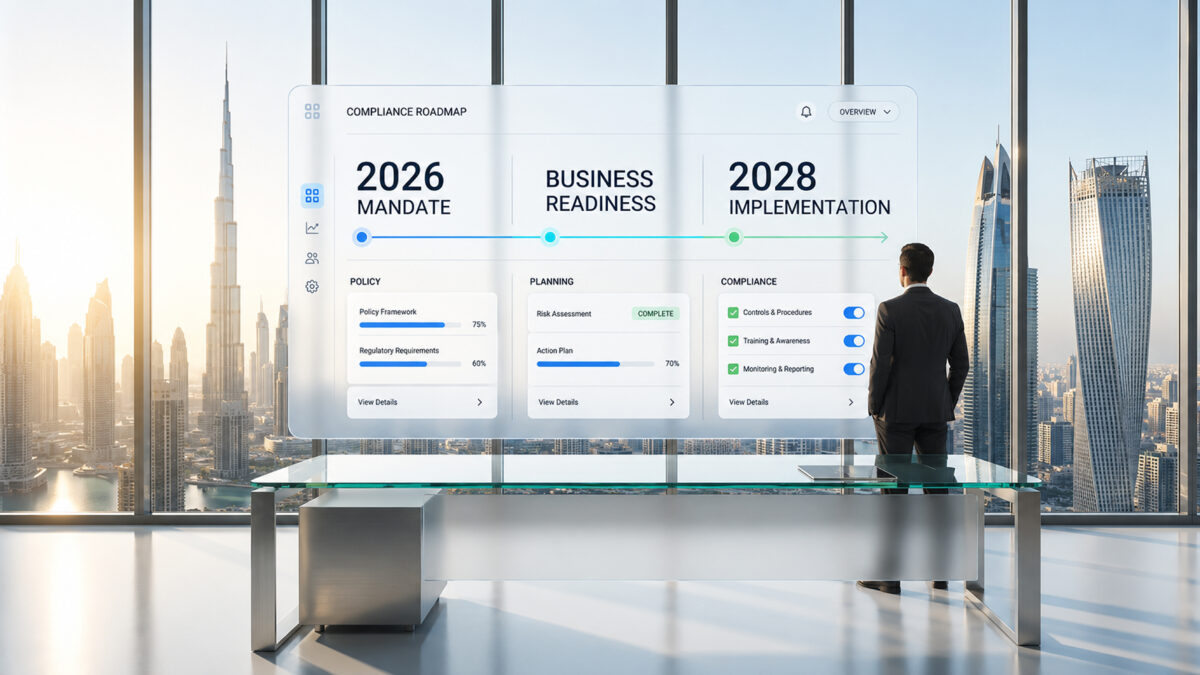
If you’re doing business in Dubai, the Dubai agentic AI mandate 2026 isn’t just something to read and admire and then file under “future technology.” It’s a two-year operating cue from the top of Dubai’s government: private-sector businesses can anticipate beginning to move from AI awareness to AI adoption.
On 4 May 2026, Sheikh Hamdan bin Mohammed bin Rashid Al Maktoum launched a two-year initiative to transform Dubai’s private sector towards agentic AI. The program comprises training tracks via Dubai Chamber business councils, accelerators for agentic AI companies, and sector-specific investment funds to assist AI-focused enterprises.
This is important as it comes after the directive from the UAE Cabinet in April 2026 to shift 50% of federal government services, sectors, and operations toward autonomous AI agents within two years.
That mix alters the practical implications of AI for companies in Dubai.
It’s no longer just a boardroom trend. It will become part of how government, regulated industries, supply chains, customers, and competitors will do business in 2028.
At aTeam Soft Solutions, we have already witnessed this transition in actual execution work in the UAE and Saudi Arabia. The companies that are getting the outcomes aren’t the ones buying the most AI tools. Instead, they are the ones picking a single painful process, building the right AI agent for it, connecting it into their existing systems, and maintaining the humans in control, where the risk is high.
The Dubai Agentic AI Mandate 2026 poses the same question to every company:
What aspect of your business should have an AI agent managing it before your competitors discover it first?
The Dubai mandate for agentic AI 2026 was announced on May 4th, 2026, by Sheikh Hamdan bin Mohammed bin Rashid Al Maktoum, Crown Prince of Dubai, Deputy Prime Minister and Minister of Defense of the UAE, and Chairman of the Executive Council of Dubai.
The announcement included a two-year transformation plan to transition Dubai’s private sector to agentic AI, which was defined as autonomous and self-directed artificial intelligence.
The program stands on three practical pillars.
To begin with, all business councils under the Dubai Chamber of Commerce will have specialized development programs. This means the discussion will not stay within technology circles. Retail, logistics, real estate, healthcare, hospitality, finance, construction, manufacturing, and professional services will all be brought into the conversation via their business councils.
Secondly, the Dubai Chamber has been directed to set up incubators for agentic AI firms. That is an important matter, as the adoption will require local solution builders, rather than only global platforms. Dubai companies will require AI agents that can read Arabic and English documents, UAE workflows, local compliance procedures, WhatsApp-based communication, free zone operations, and mainland licensing realities, and that’s how the regional firms really do business.
Thirdly, the dedicated capital funds will assist the transition to AI-powered businesses. This will likely speed up early adoption, in particular by startups and mid-market firms that can move more quickly than big enterprises.
Sheikh Hamdan said the goal is to enable companies to embrace technologies that enhance productivity, increase business volumes, and reorient the city’s economy around agentic AI adoption.
That quote is significant, as it puts the initiative right in perspective. Dubai is not telling firms to “experiment with AI.” Dubai is encouraging firms to integrate AI into their productivity, revenue, operating models, and cost structure.
The timing is also important.
In April 2026, the UAE Cabinet announced a plan to roll out agentic AI to cover 50% of the federal government sectors and services within the next two years. And if government services become more agent-driven, private-sector companies that deal with government systems will need to adapt.
A logistics company that fills out customs documents by hand will be competing against companies whose AI agents automatically prepare, validate, and submit documentation.
A healthcare service provider that still processes the approvals and claims via manual follow-up will be compared with providers by making use of AI agents to prepare pre-authorization packets, verify the missing documents, and monitor the tracking of payer responses.
A real estate group that still relies on call center agents to respond to the same tenant questions will compete with operators, with whom the AI agents resolve multilingual requests instantly through WhatsApp, web chat, and email.
That’s why the Dubai agentic AI mandate 2026 alters the operating baseline.
The initial wave of AI adoption was not just about tools. The next wave is to have work getting done without waiting for a human to click every single button.
Agentic AI implies that AI systems can plan, decide, and complete multi-step operational business tasks with limited human input.
A normal chatbot responds to a question.
An AI agent completes a workflow process.
That is the difference that many corporate leaders require to understand.
If a customer inquires, “What are the documents I need for my claim?” a chatbot could reply. In case of documents uploaded by a customer, an AI agent can read them, check what is missing, extract necessary data, update the CRM, notify the client, route the case to the appropriate team, and establish an audit trail.
Agentic AI isn’t just an enhanced, smarter chat interface. It’s a digital worker built around a business process.
It also differs from conventional RPA.
RPA adheres to static scripts. It clicks on button A, copies value B, pastes it into field C, and the same process is repeated. This function executes well when the systems are stable. It breaks down when a portal changes its layout, a field name changes, a pop-up appears, or an uploaded document just doesn’t follow the right accepted format.
Agentic AI operates more like a trained employee performing a job. It can interpret intent, read documents, understand context, decide on actions within guardrails, and inquire for human review when confidence is low.
This is not to mean that the agentic AI is magic. It could go wrong if the process is badly designed, if data is unstructured, if permissions are not clearly defined, or if the company expects full autonomy from the first day.
A well-designed AI agent is constructed with boundaries.
A practical agentic AI system consists of five components: data access, reasoning, action execution, guardrails, and monitoring. If any of the five are missing, the company simply does not have a production AI agent. It has a demo.
Here are three examples from aTeam Soft Solutions’ implementation work in the UAE and Saudi Arabia.
A trading company in Dubai has employees who can process thousands of supplier bills each month. Documents came in as PDFs, scanned copies, and WhatsApp images. The AI agent was intended to read the invoice, match it with purchase orders, detect mismatches, generate entries for SAP, and flag exceptions for finance examination. The outcome was not just complete financial automation. The outcome was a controlled flow of work where employees stopped performing repetitive reading and typing.
A real estate company in the UAE was getting over 15,000 tenant inquiries per month in multiple languages. A lot of queries were repetitive: payment status, maintenance requests, renewal dates, document needs, parking access, move-in procedures, and community rules. The AI agent processed and handled the initial layer of response, resolved 73% of inquiries without human assistance, and escalated sensitive or unresolved matters to the appropriate team.
A Saudi Arabia-based healthcare services company provider had a team of people working across and accessing several insurance and payer portals for pre-authorization requests. It was a slow process, as each portal had distinct forms, document needs, and status flows. The AI agent drafted the claim packets, verified missing information, navigated to the payer portals, and compressed a process that frequently took two days of manual back-and-forth into a 15-minute structured submission workflow.
These are illustrated examples that show the practical implications of agentic AI.
It’s not about replacing each employee. It is about eliminating the repetitive load from people who are currently stuck between documents, portals, emails, spreadsheets, and follow-ups.
The Dubai agentic AI mandate 2026 impacts each private-sector enterprise operating across Dubai, but not all of the businesses will use agentic AI in the same manner.
A small company doesn’t require a complex enterprise AI platform. It may require a single AI agent to manage the customer inquiries, quotations, appointment booking, invoice reminders, or document collection.
A mid-size market company might require AI agents in finance, HR, customer support, compliance, procurement, or operations.
An enterprise could require a full agentic AI roadmap, with governance, system integration, security reviews, data policies, change management, and phased execution across departments.
The schedule of the timeline is very short.
In 2026, the initial wave is training, awareness, and early planning via the Dubai Chamber business councils. At this time, companies should educate themselves on agentic AI, audit internal operations, and determine where a first pilot could deliver tangible value.
By Q3 and Q4 of 2026, early adopters will transition to execution. This is where the practical gaps will seem to appear. Companies will discover if their data is usable, if their systems have APIs, if approvals are clear, if Arabic documents are structured enough, and if their teams are ready to rely on trusted AI-supported workflow processes.
Adoption will be more obvious in 2027. Specialized funds, incubators, vendor ecosystems, and competitive pressure will drive agentic AI from innovation teams to operating departments.
By 2028, non-starters among businesses need not necessarily expect a direct penalty. It’s not currently a fine-based regulation like tax compliance is. The threat is competition. Businesses that lag will be competing against those with quicker reaction times, cheaper routine processing costs, more robust reporting, and a superior customer experience.
The industries that will probably shift the fastest are those perhaps adjacent to government systems already or that have a very high level of operational complexity.
Government contractors will be under pressure as the UAE government itself is moving to AI-based services.
Healthcare providers would experience the pressure as the approvals, claims, patient communication, staffing, and compliance rely on quick, accurate workflow processes.
Finance, insurance, and real estate companies will transition as they process high volumes of document review, customer requests, KYC, payments, collections, renewals, and compliance checks.
Logistics and trade companies will shift as Dubai’s economy still relies on documentation, customs, shipment visibility, warehouse operations, and quick exception handling.
Retail and hospitality will shift as the customer service volume, multilingual communication, inventory, staffing, and loyalty workflows can be enhanced more rapidly with AI agents.
The key takeaway is as simple: Adoption is not going to wait for a perfect roadmap plan.
The companies that begin with a single useful agent in 2026 will have a superior operating base by the year 2028 than the firms that are still discussing strategy.
The development programs of the Dubai Chamber will be helpful. Companies’ business leaders want a common language for agentic AI before they will be in a position to make good investment decisions.
Training can equip leaders to understand what AI agents are capable of, where agentic AI fits into business strategy, what risks to observe, what platforms are out there, and how other firms are considering adoption.
It can also give companies exposure to AI vendors, incubator-driven startups, funding sources, and industry-specific use case applications.
But training will not execute or implement agentic AI within your company.
Training won’t plug an AI agent into your SAP, Oracle, Microsoft Dynamics, Odoo, Salesforce, custom ERP, or legacy database.
Training won’t clean your customer information.
Training won’t redesign your approval workflow process.
Training won’t develop Arabic OCR for your scanned documents.
Training won’t set up audit logs, permission layers, fallback rules, human review queues, or logic for escalation.
Training won’t reside with your operations team, and you will comprehend why a single invoice requires three approvals and, in another case, goes directly to payment.
That’s the gap that most of the enterprises are underestimating.
Understanding what agentic AI can actually do is the first 10%.
The remaining 90% is about execution.
At aTeam Soft Solutions, the execution process usually begins with process mapping rather than model selection. We want to learn who performs the task today, which systems they use, which documents they have, what decisions they make, what exceptions take place, what errors cost money, and where human approval is required.
It’s only then that the technical architecture comes into play.
For example, in a Dubai finance process, the client was initially convinced that they wanted a chatbot for vendor queries. After process mapping, the core issue was not vendor communication. The problem was that invoices came in different formats, purchase order matching was a manual process, and exception handling was conducted via email threads. The right AI agent was an invoice intake and validation agent, instead of a chatbot.
In a different UAE property process, the client needed to “automate tenant support.” And that was too broad. We divide the requests into categories: payment questions, maintenance tickets, document requests, renewal queries, complaints, and legal escalations. In the first phase, only three categories were allowed to be secure for very high automation. The rest had to be reviewed by a human.
That’s how real agentic AI work should be done.
Begin with a small view. Evaluate the outcomes. Expand if the business relies on the system.
The Dubai agentic AI mandate 2026 provides a two-year guideline for companies, but the first 90 days are what really count.
A firm that dedicates the next 60 days to nothing but attending webinars will end the quarter being aware but not having an operating edge.
A company that spends the next 90 days selecting a single process, evaluating data readiness, approving a pilot, and then choosing an implementation partner will make 2027 a real learning experience.
Walk through each department and make a list of processes for which employees are regularly spending over 2 hours on repetitive work.
Search for document reading, data copying, follow-up emails, WhatsApp coordination, compliance checks, invoice validation, claim preparation, report generation, appointment scheduling, customer inquiry handling, onboarding paperwork, and deadline monitoring.
Don’t begin with the most exciting-sounding process. Begin with the process that consumes the most time.
A simple scoring system executes well:
| Process | Monthly volume | Manual hours/month | Error rate | Cost of error | AI suitability |
| Supplier invoice intake | 3,000 invoices | 280 hours | 4% | Medium | High |
| Customer inquiry response | 12,000 inquiries | 450 hours | 6% | Low to medium | High |
| Contract review | 200 contracts | 160 hours | 2% | High | Medium |
| Payroll approval | 1 cycle/month | 40 hours | 1% | High | Low to medium |
| Board reporting | 1 report/month | 60 hours | 3% | Medium | Medium |
The best initial AI agent is generally one that is high-volume, repetitive, measurable, and can be recovered if something goes wrong.
AI agents require the data, system access, and process clarity.
Most of the Dubai firms identify that their data is not in a single, clean system. It is spread in emails, WhatsApp, Excel sheets, PDFs, scanned documents, CRMs, ERPs, and personal folders.
That doesn’t mean that the AI agents can’t execute well.
It means the design should be based on reality.
Inquire the Ask five questions.
Where does the process begin?
Where is the data stored?
What systems need to be updated?
What documents should the AI agent require to read?
At what confidence threshold is needed for the agent to act without human review?
If your systems have APIs, your initial AI agent may be feasible in four to six weeks.
If your systems don’t have APIs and the agent has to operate via screens, portals, PDFs, and email inboxes, the initial phase could take around 8 to 12 weeks.
If your data is contradictory, duplicated, or misslabeled, then you might require a data cleanup phase before production rollout.
This is not just a malfunction. It’s part of preparedness.
Don’t just automate everything at first.
Choose a single process.
The first pilot should be significant enough to matter but not so risky that a single mistake can take down the business.
Good first pilots are invoice processing, customer inquiry handling, document data extraction, employee onboarding paperwork, insurance pre-authorization preparation, purchase order matching, and the collection of evidence to demonstrate compliance and qualification of sales leads.
Poor first pilots cover the final legal approval, final medical diagnosis, final credit decisions, release of a high-value payment, and any such procedure for which the organization cannot afford to make mistakes.
Those workflows could still benefit from AI in the future. But they require more robust controls, more testing, and more human oversight.
At aTeam Soft Solutions, we usually suggest a four-stage pilot system model.
Stage one is the shadow mode. The AI agent executes the task, but humans still run their usual workflows. We compare the results.
Stage two is the assisted mode. The AI agent does the preparation work, and humans approve before taking action.
Stage three is the active control. The AI agent then finalizes the low-risk activities and escalates the exceptions.
Stage four is full-scale rollout. The AI agent manages the larger volumes with supervision, reporting, and ongoing enhancement.
This phased model decreases the fear among teams as everyone involved witnesses the system functioning before responsibility is transferred.
A realistic agentic AI pilot in Dubai usually costs about $15,000 and $40,000, and it lasts 4 to 6 weeks.
A full rollout normally costs between $40,000 and $120,000, based on the number of systems, languages, documents, workflows, approvals, and security needs.
Enterprise programs can scale even more when multiple departments, private cloud deployments, regulatory controls, and custom integrations are factored in.
Budget approval gets easier when you stop selling AI and begin selling process economics.
Utilize a simple formula.
Monthly savings = hours saved per month × hourly staff cost + errors prevented per month × cost per error.
If a process saves 300 staff hours each month and the average staff cost is $18 per hour, then the time saving is $5,400 per month.
If the same process stops 20 mistakes each month and each error costs $150 to fix, that’s an additional $3,000 a month.
The total quantifiable monthly savings are $8,400.
A $35,000 pilot that demonstrates this process can pay back in less than a year.
That’s the level of clarity that the CFOs need to see.
Don’t select only a training provider.
Don’t select only a strategy consultant.
Don’t select only a tool reseller.
Select a deployment partner that can develop, integrate, test, deploy, and support the AI agent.
The partner should be able to present the published case studies with specific metrics, rather than vague claims about AI.
The partner must be familiar with UAE workflows, processing Arabic and English documents, integrating with the enterprise systems, designing for human review, and security needs.
The partner has to be comfortable saying no to the process that is not ready for automation.
At aTeam Soft Solutions, we adopt a readiness-first methodology, as a failed AI agent generally fails before development starts. The incorrect process, bad data, unclear approvals, bad exception handling, and unrealistic expectations of autonomy are the true causes of struggling projects.
The first agentic AI project should not be decided by the most prominent division or the most remarkable demo.
It should be selected based on business value and risk of implementation.
| Process type | Best for the first pilot? | Why | Human oversight needed |
| High-volume document extraction | Yes | Easy to measure time saved and accuracy | Medium |
| Customer inquiry handling | Yes | Fast impact on response time and support load | Medium |
| Invoice matching and validation | Yes | Strong finance ROI and clear exception rules | Medium to high |
| Sales lead qualification | Yes | Clear funnel metrics and recoverable errors | Medium |
| Regulatory reporting | Maybe | Valuable, but mistakes can be costly | High |
| Insurance or claim submission | Maybe | High value, but payer rules vary | High |
| Legal contract approval | Not first | Risk is high and context matters | Very high |
| Clinical decision-making | Not first | Requires strict medical governance | Very high |
| Payment release | Not first | Fraud and approval risk are high | Very high |
This framework is intentionally conservative.
The adoption of agentic AI should not start with the most crucial decision in the company. It needs to start where the business can safely learn, demonstrate ROI, and build trust.
The Dubai-based agentic AI mandate 2026 is not yet a regulation with direct penalties for private firms that delay.
The risk is not just a fine.
The risk is to lag behind the market operating standard.
Dubai’s government services will be more AI-driven by 2028. Companies that deal with government agencies, licensing authorities, regulators, customs, healthcare platforms, financial systems, and public-sector buyers will require quicker, cleaner, more digital ways of operating.
Government contractors that are unable to efficiently work with AI-enabled government systems could lose ground to those that can.
Rivals that integrate AI agents into ordinary workflows can operate with 50% to 70% less human effort in selected workflow processes.
AI-native startups emerging from incubators won’t have the same operational burden as established organizations. They will be built around AI agents from the beginning.
That’s the actual risk.
An established business can have a brand, relationships, customers, and knowledge about the market. But if its internal processes are slow, manual, and costly, a smaller competitor that is AI-native can go after the same market with better response times and a lower cost of doing business.
Within 2 to 3 years, the lack of AI agents in high-volume processes might feel like not having a proper website in 2010.
Possible, yes.
Realistic, no.
aTeam Soft Solutions is an AI and software development company based in India with more than 120 engineers, ISO 9001:2015 and ISO/IEC 27001:2022 certifications, a 4.9/5 rating on Clutch, 90+ verified customer reviews, and 20+ published case studies.
Our role in Dubai’s agentic AI transition is the delivery.
We’re not just in the business of trying to sell generic AI excitement.
We work with companies to select the appropriate workflow, design the AI agent, connect it with the existing systems, test it under controlled conditions, and roll out it with human supervision.
Our experience in serving the UAE and Saudi companies’ market has revealed a single consistent trend: the companies that succeed with agentic AI do not begin by inquiring, “Which model should we use?”
They begin by inquiring, “Which business process is costing the most of our time, money, and customer loyalty trust?”
That is the right place to start.
Dubai’s agentic AI mandate is a two-year program launched to shift Dubai’s private sector towards agentic AI. It aims to assist companies in adopting AI-based systems that can carry out business functions, handle workflows, and support decision-making with minimal human involvement.
Agentic AI in Dubai planning was announced by Sheikh Hamdan on 4 May 2026. The initiative offers training programs via Dubai Chamber business councils, accelerators for agentic AI firms, and focused funds helping AI-driven companies.
The initiative is more accurately described as a competition and economic mandate rather than a penalty-based regulation at this point. Dubai is clearly indicating that private-sector companies should shift towards agentic AI adoption within the next two-year timeframe.
The program operates for two years from the announcement in May 2026, which brings the practical adoption window up to 2028. Companies can’t wait until 2028 to begin, as getting readiness, pilot selection, integration, testing, and adoption within a team can take months.
A focused agentic AI proof of concept generally costs between $15,000 and $40,000, and it takes 4 to 6 weeks. A full production rollout can often cost between $40,000 and $120,000, based on systems, complexity of workflows, integrations, types of documents, languages, and security needs.
The initial step is to conduct a review of manual processes between the departments. Look for repeatable processes where employees are spending more than two hours per day reading documents, copying data, checking status, sending follow-ups, or preparing reports.
Yes, small companies are part of Dubai’s private sector, but the way they adopt technology will be different for them. A small company may choose to start with one AI agent handling customer inquiries, quotations, invoice reminders, appointment scheduling, or document collection rather than implementing a large-scale enterprise AI program.
The Dubai agentic AI mandate 2026 gives companies 2 years, but the practical decision should be made within the next 90 days.
Businesses don’t want to automate everything instantly.
They want to identify a single process where an AI agent can save time, reduce mistakes, increase the speed of response, or take a repetitive task away from talented human workers.
That is when the real adoption begins.
The mandate for Sheikh Hamdan provides a clear direction. The pressure is intensified by the fact that the UAE government itself is moving towards autonomous AI agents. Dubai’s private sector will now have a small window of opportunity to learn, pilot, and build capability before AI-powered operating models become standard.
aTeam Soft Solutions is ready to assist businesses in Dubai in moving from AI awareness to production execution with practical agentic AI systems focused on real workflows, real integrations, and quantifiable ROI.
Begin with a single process.
Demonstrate value.
Then scale up.