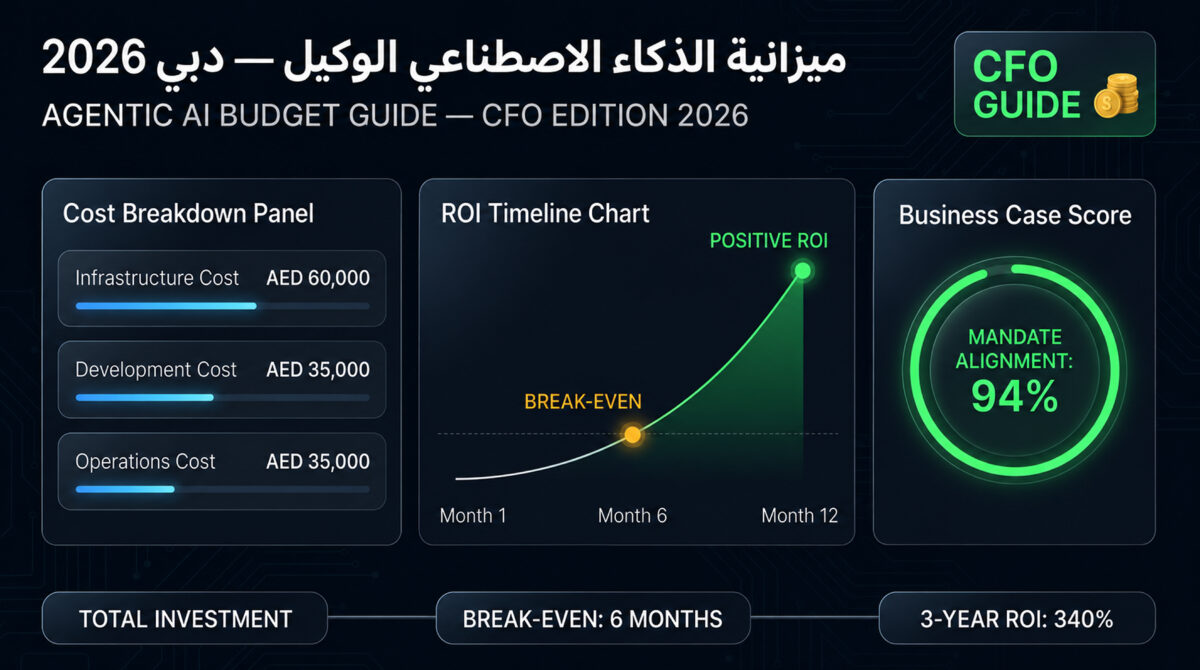
Following Sheikh Hamdan’s announcement, boards across Dubai are asking the same question: How much should we actually budget for agentic AI as part of our 2026 plans?
The honest answer is that it varies.
But “it depends” is not good enough for a CFO.
A CFO requires ranges, cost categories, payback periods, hidden costs, risk controls, and a mechanism by which the investment is presented to the board without sounding like the company is chasing AI hype.
That’s the aim of this guide.
The agentic AI for Dubai business directive has redefined the financial dialogue. The question isn’t now simply, “Do we invest in AI?” The realistic question is, “How much do we invest, when do we invest, which workflow goes first, and what return do we expect?”
CFOs are justified in being cautious.
AI has been oversold for decades. Several companies have paid for dashboards, chatbots, automation pilots, and innovation workshops that never transformed the business’s economics.
Agentic AI only differs when it is connected to an actual operating workflow.
An AI agent that reads invoices, matches purchase orders, updates an ERP, flags exceptions, and cuts five finance staff from repetitive processing has a business case.
An AI agent that answers tenant inquiries, manages lease renewals, and eases pressure on call centers has a business case.
An AI agent that accurately prepares healthcare claims and minimizes revenue leakage has a business case.
At aTeam Soft Solutions, we generally recommend that CFOs plan for agentic AI in three tiers: pilot, production, and maintenance.
The pilot demonstrates whether the workflow is worth automating.
The production release turns the pilot into a dependable operating system.
The maintenance budget safeguards the investment post-launch.
This article details the entire cost structure, ROI formulas, payback examples, board presentation format, CapEx versus OpEx treatment, and funding options for Dubai organizations getting ready for the 2028 adoption window.
A proper agentic AI budget for the Dubai 2026 plan should cover four cost categories.
Build costs.
Operating costs.
Maintenance expenditure.
Hidden inside expenses.
The majority of AI budgets go wrong, as they only consider the build costs.
That is not sufficient.
A CFO needs to know what it will cost in the first full year and the cost to run post-launch.
The development cost is the upfront cost to design, develop, integrate, test, and deploy the AI agent.
There are three standard price levels.
| Build type | Typical cost | Typical timeline | What it covers |
| Proof of concept pilot | $15,000-$40,000 | 4-6 weeks | One process, limited scope, human validation, early ROI proof |
| Full single-agent deployment | $40,000-$120,000 | 12-20 weeks | Production workflow, integrations, dashboards, monitoring, rollout |
| Multi-agent enterprise programme | $120,000-$350,000+ | 6-12 months | Three to five agents across departments, governance, integrations, and support |
A demo does not demonstrate a proof of concept.
A real POC has to be executed using the client’s real data, real documents, real system constraints, and practical edge cases.
For example, if the pilot covers invoice processing, the POC needs to run on real supplier invoices, scanned copies, email attachments, WhatsApp images, purchase orders, VAT fields, approval rules, and exception cases.
A complete deployment includes production-quality integration, monitoring, security, staff workflows, dashboards, audit logs, and maintenance configuration.
A multi-agent program is geared more towards big companies that know AI agents are going to be utilized in different departments.
System integration is the first cost driver.
Most API integrations typically cost $5,000 to $15,000, based on documentation, authentication, testing, and workflow complexity.
When the system lacks an API and requires screen automation, portal automation, or database-level integration, the price can go up by $10,000 to $25,000 for each system.
Screen automation is more costly since it is more brittle. The automation may require rework in case of a portal layout change.
The second major cost driver is Arabic and bilingual support.
Dubai-based companies don’t often run in a purely English-only environment. Invoices, emails, supplier messages, government forms, contracts, and customer communication can all contain a mix of Arabic and English.
Arabic processing can increase by between 15% and 25% for NLP-intensive components.
An $80,000 AI agent might turn into a $92,000 to $100,000 project if Arabic OCR, right-to-left document handling, bilingual extraction, and language-specific testing are involved.
The third source of cost is the complexity of the regulatory workflow.
Integration with ZATCA for Saudi finance workflows can cost between $10,000 and $20,000.
Automation related to MOHRE can cost an additional $8,000 to $15,000.
DHA healthcare compliance processes may add $15,000 to $25,000.
DIFC or ADGM financial compliance workflows may cost an additional $15,000 to $30,000.
These are not simply legal review charges. They apply to architecture, logs, access controls, approvals, audit trails, and data processing rules.
Custom model training is the fourth cost driver.
Many business AI agents don’t require a custom machine learning model.
For 80% of the real-world use cases, pre-trained LLM APIs augmented with retrieval, business rules, confidence scoring, and human review are sufficient.
Custom model training can cost between $15,000 and $40,000 when the task involves domain-specific classification, image recognition, specialised prediction, or offline deployment.
The fifth expense driver is data cleaning.
If the enterprise data is unclean, the AI agent will have a difficult time.
Data cleaning may cost an additional $10,000 to $30,000 before the agent is able to perform reliably.
This is especially true in companies where customer names are duplicated, product records are fragmented, old invoices are poorly tagged, and documents reside in email, WhatsApp, portals, and shared drives.
Operating costs are the monthly expenses required to maintain the AI agent’s operation.
These are LLM API fees, cloud infrastructure, vector database usage, monitoring tools, storage, and background processing.
A realistic operating expenses range would be $500 to $6,000 per month, depending on volume and architecture.
For the majority of medium-sized agents, the monthly cost of operation is much smaller than the monthly savings on labor and errors.
| Agent type | Monthly volume | LLM API estimate | Cloud/database/tools | Total monthly running cost |
| Invoice processing agent | 8,000 invoices | $150-$400 | $500-$1,500 | $650-$1,900 |
| Customer inquiry agent | 15,000 interactions | $500-$1,500 | $700-$2,000 | $1,200-$3,500 |
| Document extraction agent | 2,000 documents | $100-$300 | $400-$1,200 | $500-$1,500 |
| Claims preparation agent | 3,000 cases | $400-$1,200 | $800-$2,500 | $1,200-$3,700 |
| Customs documentation agent | 400 shipments | $200-$700 | $700-$2,000 | $900-$2,700 |
| Compliance monitoring agent | 10,000 checks | $600-$2,000 | $1,000-$3,000 | $1,600-$5,000 |
LLM API fees depend on the model, token usage, document size, and number of reasoning steps.
A simple extraction task is cheaper
A complicated multi-step agent that reads long documents, reviews internal policies, validates with multiple systems, and creates structured outputs is more expensive.
Cloud-based infrastructure typically comprises compute, storage, databases, queues, logs, and security services.
Vector databases like Pinecone, Weaviate, or other such systems can be priced from $50 to $500 per month for decent usage.
Monitoring and observability tools might cost from $100 to $500 per month, depending on the stack.
CFOs must not approve an AI build without demanding a year-one cost model that includes operating costs.
An inexpensive build that carries high operating costs isn’t cheap.
A moderately higher build cost coupled with low operating costs could prove to be the better financial decision.
Maintenance is the expense that many companies overlook.
An AI agent is more than just a one-time software deployment.
It requires constant adjustment, supervision, updates, and assistance.
A realistic maintenance allowance is 15% to 20% of the construction costs per annum.
If the agent charges $100,000 to build, expect $15,000 to $20,000 a year for maintenance at a minimum.
For the more complex agents, the amount can be much higher.
Maintenance consists of prompt tuning, model updates, integration fixes, accuracy monitoring, workflow changes, new edge cases, reporting improvements, dashboard updates, security patches, and business rule modifications.
The most typical maintenance triggers are straightforward.
A government portal revamps its interface.
An insurance company modifies its claim form.
A supplier modifies the invoice format.
A new LLM model modifies the output behavior.
The company updates its ERP.
The finance team modifies the rules for approval.
An organization goes into a new country or needs a new language.
In the absence of maintenance, the AI agent gradually deteriorates.
The agent keeps getting better with maintenance.
aTeam Soft Solutions traditionally recommends a monthly maintenance retainer in the range of $2,000 to $5,000 for regular agents.
Highly complex agents that are linked to many systems, have strong compliance requirements, or have high transaction loads may require $5,000 to $10,000 a month.
This should be part of the board’s business case from day one.
The hidden costs may not necessarily be paid to the vendor, but they have an impact on the business case.
The first overhead cost is the time of the employees.
Your AI Champion might have to spend 50% to 70% of their time over a period of three to six months.
If the senior manager is the AI Champion, that has a cost.
Change management is the second hidden cost.
Internal communication, training sessions, workflow redesign, employee feedback, and adoption support could cost anywhere from $5,000 to $15,000 in internal resources or external assistance.
The third hidden cost is re-engineering the process.
There are times when the workflow itself is too disorganized to automate.
The process has to be simplified, documented, and streamlined before the AI agent can do its work.
Allocate $5,000 to $20,000 for analysis and process redesign if necessary.
The fourth hidden cost is legal and compliance evaluation.
Contracts for Data processing, ownership of intellectual property, PDPL review, cloud hosting terms, and internal security review can cost from $3,000 to $10,000 based on the organization.
Insurance is the fifth hidden cost.
Several companies provide insurance coverage for technology errors, cyber events, or AI-related operational risk in high-stakes workflows.
This could cost anywhere between $2,000 and $8,000 a year, depending on the coverage.
A CFO is not required to block the project because of unanticipated costs.
But they ought to make those costs visible early on.
That prevents budget surprises once the pilot is approved by the board.
The most compelling agentic AI budget Dubai 2026 business case is based on basic financial principles.
Don’t sell AI.
Sell process economics that can be measured.
The basic calculation is:
Monthly ROI = Manual labour cost saved + error cost avoided + revenue recovered + penalties avoided – running cost – maintenance cost.
Annual ROI = monthly ROI × 12.
Payback period = total build cost ÷ net monthly ROI.
This formula works, as agentic AI typically delivers value in four ways.
It reduces manual labor.
It prevents mistakes.
It retrieves revenue that was delayed or lost.
It prevents fines, leakage, penalty fees, rework, lost renewals, or failures to comply.
The following five examples are based on typical scenarios from our experience at aTeam Soft Solutions’ UAE and Saudi implementation work. The actual ROI will depend on the number of transactions, staff overhead costs, quality of processes, and complexity of the system.
A trading company in Dubai that processes thousands of supplier invoices every month.
Invoices come in via email, PDFs, scans, supplier portals, and even WhatsApp images.
The finance team reads invoices manually, extracts supplier information, verifies the VAT fields, matches purchase orders, detects discrepancies, and drafts entries for ERP auditing.
The AI agent is designed to read invoices, extract fields, match purchase orders, flag exceptions, and generate entries in the ERP system for final finance approval.
Build cost: $80,000.
Monthly operating cost: $800.
Maintenance per month: $3,000.
Manual labor savings: five finance employees with salaries of $3,500 per month each devote 70% of their time to processing invoices.
That is equivalent to $12,250 per month in labor capacity released.
Early payment discounts captured: $31,600 each month.
Penalties avoided: $2,000 each month.
Total monthly benefit: $45,850.
Net monthly ROI: $45,850 – $3,800 = $42,050.
Payback period: $80,000 ÷ $42,050 = 1.9 months.
That’s why accounts payable frequently ends up as the first agentic AI pilot for trading, distribution, and manufacturing firms.
The process is a volume-intensive, repetitive, quantifiable, and finance-managed operation.
A Dubai-based real estate firm manages thousands of residential units.
The customer service team manages inquiries related to lease renewals, payment status, maintenance requests, document requirements, parking access, move-in rules, and community policies.
The AI agent handles daily tenant communication, reviews tenant profiles, creates tickets, issues renewal notifications, and escalates sensitive matters to the staff.
Cost to build: $70,000.
Cost of operation and maintenance per month: $4,000.
Employees redeployed: seven support staff equivalents.
Month of labor capacity released: $24,500.
Lease renewals protected: AED 350,000 per month.
Based on a rough exchange assumption, AED 350,000 is approximately $95,000.
Gross monthly benefit: approximately $119,500.
Monthly net ROI after running and maintenance: approximately $115,500.
Return on investment period: less than one month.
The value here is not just reduced support costs.
The greater value is the protected revenue.
If tenants receive on-time renewal communication, more rapid responses, and fewer unresolved requests, churn risk is reduced.
That’s the real business case for the real estate CFOs.
A Dubai hospital has a claims coordination team that deals with payer submissions, missing documents, approvals, rejections, and follow-ups.
Manual delays lead to revenue leakage.
The AI agent prepares claims packets, checks for missing documents, validates payer requirements, routes exceptions, and assists coordinators in submitting cleaner claims more quickly.
Build cost: $110,000.
Monthly operating and maintenance cost: $6,000.
Seven coordinators redeployed: $28,000 monthly in labor capacity.
Monthly revenue recovered: AED 670,000.
AED 670,000 is approximately $182,000.
Gross monthly payout: about $210,000.
Net monthly ROI: approximately $204,000.
Repayment period: about 0.5 months.
Automation of healthcare claims can deliver a quick return on investment, as revenue leakage is typically many times that of labor expense.
The caution is that healthcare AI agents will require more robust controls, audit trails, privacy by design, and human review.
A claims agent shouldn’t be run as a black box.
It would support employees, highlight absent data, and enable enhanced submissions while humans are still responsible for the high-stakes decisions.
A Saudi-based retail group is dealing with a large volume of invoices and needs to maintain compliance with e-invoicing.
The AI agent reviews invoice information, validates mandatory fields, tracks exceptions, detects compliance concerns, and assists finance teams before errors result in penalties.
Cost to build: $95,000.
Cost of operation and maintenance: $5,500 per month.
Five employees redeployed: $17,500 per month.
Avoid penalties: SAR 150,000 per month.
SAR 150,000 is approximately $40,000.
Total monthly benefit: $57,500.
Monthly net ROI: $52,000.
Payback period: $95,000 ÷ $52,000 = approximately 1.8 months.
This example is relevant for Dubai companies with operations in Saudi.
Most of the GCC groups do not operate AI in one market alone.
A CFO needs to factor in country-specific requirements for compliance when the same AI application encompasses workflows in the UAE and Saudi Arabia.
A UAE buyer handles hundreds of shipments each month.
Inspection of documents by hand delays release of the shipment, leading to higher penalty fee costs, and creates duty classification problems.
The AI agent reads shipping receipts, invoices, packing lists, certificates, customs documents, and supplier emails. It extracts information, verifies mismatches, highlights missing fields, supports HS classification checks, and generates documentation for staff approval.
Build cost: $85,000.
Monthly operating and maintenance cost: $5,000.
Three staff members redeployed: $10,500 monthly.
Penalty fee reduction: AED 125,000 monthly.
Duty optimization and fewer errors on documents: AED 67,000 monthly.
Total AED benefit: AED 192,000, or about $52,000.
Gross monthly benefit including labor: about $62,500.
Monthly net ROI: about $57,500.
Payback period: $85,000 ÷ $57,500 = approximately 1.5 months.
That’s why logistics and trading companies should not look at AI merely as a tool to reduce headcount.
The greater savings might come from speed, fewer delays, better documentation, and less working capital pressure.
| AI agent | Build cost | Monthly gross benefit | Monthly running + maintenance | Net monthly ROI | Payback period |
| Accounts payable agent | $80,000 | $45,850 | $3,800 | $42,050 | 1.9 months |
| Tenant communication agent | $70,000 | ~$119,500 | $4,000 | ~$115,500 | Less than 1 month |
| Healthcare claims agent | $110,000 | ~$210,000 | $6,000 | ~$204,000 | Around 0.5 months |
| ZATCA compliance agent | $95,000 | ~$57,500 | $5,500 | ~$52,000 | Around 1.8 months |
| Customs documentation agent | $85,000 | ~$62,500 | $5,000 | ~$57,500 | Around 1.5 months |
These figures are not guarantees.
They serve as an illustration of how CFOs should organize the analysis.
The best AI business cases are not built based on model ability.
They are built based on the current process cost.
A CFO shouldn’t depict agentic AI as a technology trial.
The presentation to the board should be a financial and business case.
Make it to 10 slides and 10 minutes.
Describe Sheikh Hamdan’s agentic AI initiative in the private sector over two years.
Make the point clear: Dubai is transitioning from talking about AI to AI adoption.
The company ought not to wait until the market has already moved.
Demonstrate what rivals are capable of if they automate routine work first.
If a rival can process invoices at $5 per invoice and your company does so at $18 per invoice, the gap accumulates every month.
If a rival can respond to customer inquiries seamlessly and your team responds in 24 hours, that’s a shift in customer expectations.
The risk is more than just the charge.
That is speed, accuracy, and customer experience.
Show a single process.
Do not show ten.
Explain why this process was chosen.
Show volume, manual effort, cost of errors, risk level, data readiness, and ability to measure ROI.
The board should sense that the process was selected with discipline.
Show the entire cost for the first year.
Include POC cost, cost for full deployment, operating cost, maintenance cost, internal staff time, legal review, and change management.
Do not hide maintenance away.
A transparent budget lends credibility.
Display the savings per month.
Split the benefit in terms of labor saved, cost of avoided errors, revenue recovered, fines avoided, and time savings.
Then display the payback period.
A clearly defined payback period is easier for the board to sign off on than a vague AI opportunity.
Describe the stepwise approach.
Phase one: observation mode.
Phase two: support mode.
Phase three: managed autonomy.
Phase four: expanded autonomy with audit trail.
Demonstrate that the business is not turning over a vital procedure to AI on day one.
Clarify why aTeam Soft Solutions is being evaluated.
Include relevant case studies, experience of implementation in the UAE and Saudi Arabia, dedicated AI teams, phased methodology, Clutch rating, ISO certifications, and ability to support Arabic-English workflow processes.
The board needs to have confidence in the partner, not just in technology.
Provide a 90-day readiness schedule leading to POC.
Then demonstrate full deployment by month six if the pilot meets success criteria.
The board should be presented with a controlled trajectory, rather than an open-ended project.
Request for three approvals.
Approve POC budget.
Designate the AI Champion.
Plan for Vendor scoping and technical discovery.
The next steps are clear to make the decision easier.
Prepare for the obvious questions.
What if the AI gets it wrong?
What information is left out of our systems?
What occurs after the pilot?
Can we quit after the POC?
Who has the right to the code?
How will the employees respond?
What occurs if the vendor changes the prices?
A CFO who can respond to these questions will dominate the conversation.
The price of inaction is not zero.
It is just more difficult to see on the balance sheet.
If your rivals process invoices automatically and operate at $5 per invoice while your company is working at $18 per invoice, that’s a $13 per invoice difference.
For 8,000 invoices a month, it’s a $104,000 monthly cost disadvantage.
That comes to $1.248 million yearly.
If your competitors automate tenant communication and increase renewal rates from 68% to 89%, then the difference becomes material pretty quickly.
On a portfolio of 4,500 units, a 21-point renewal gap could translate into 945 additional units retained annually.
At an average annual rent of AED 65,000, that equates to AED 61.4 million of protected income.
Even if only a fraction of that gain is due to communicating with AI, the financial argument is significant.
If rivals automate the preparation of healthcare claims and recover revenue more quickly, they have better cash flow.
If rivals automate customs documentation, they minimize penalty fees and shipment hold-ups.
If competitors automate customer inquiries, they increase conversion and decrease support costs.
Two years after the agentic AI mandate in Dubai, companies that lack AI agents in high-volume workflows will find it difficult to compete in terms of speed, cost, and accuracy.
This is not about chasing a technology trend.
It is about the automation economics.
When a competitor brings down the price of a routine process permanently, your manual process turns into a margin problem.
CFOs must determine whether the agentic AI spending should be treated as CapEx or OpEx.
It is based on the accounting policy, ownership model, contract structure, and nature of the spend.
The costs to develop a custom AI agent can be capitalized if the company owns the software asset and the project qualifies under internal capitalization guidelines.
These expenses can then be depreciated or amortized over a three- to five-year period according to company policy and guidance from auditors.
The operating costs are usually OpEx.
This encompasses LLM API fees, cloud infrastructure, monitoring tools, support retainers, maintenance, and software fees based on usage.
The POC model is helpful as the funds are limited.
A $15,000 to $40,000 proof of concept might be treated as OpEx in many companies, especially if it is exploratory validation instead of a capital software build.
This can assist the companies in avoiding a slow CapEx approval process for the first validation step.
For those companies that choose OpEx, aTeam Soft Solutions may also structure certain engagements as monthly retainers in which the build cost is spread over a period of 12 months, as opposed to being paid upfront.
This is good for CFOs who need predictable monthly spend and lower initial cash outflow.
The important thing is to agree on the treatment before board approval.
Do not wait for the bill.
Dubai’s May 2026 agentic AI initiative has dedicated funds for AI-powered companies, but the exact requirements and application processes are still being worked out.
CFOs need to monitor these details closely, as funding could lower the cost of early adoption.
There are even existing Dubai- and UAE-based channels that can come into play based on the type of company, industry, and location.
Dubai Chamber-related initiatives could assist with training, implementation, and access to the ecosystem as the private-sector AI initiative takes shape.
Dubai SME and UAE SME support programs can assist smaller companies in exploring technology adoption, subject to eligibility.
DIFC Innovation Hub and other similar initiatives may be suitable for fintech, insurtech, regtech, and AI companies operating in financial services.
Dubai AI Campus could be ideal for companies establishing AI-related operations, particularly within the DIFC ecosystem.
Emirates Development Bank provides advanced technology adoption finance for futuristic technologies such as AI, blockchain, IoT, robotics, and clean energy.
The Mohammed bin Rashid Innovation Fund might also apply to innovation-led companies, based on the business model and eligibility.
A CFO should not create the AI business case solely on anticipated grants.
Funds can be a help.
But it still has to be financially feasible for the project without funding.
The right strategy is to develop the business case first, then bring down the net cost with the available incentives.
aTeam Soft Solutions may assist clients in determining which funding or incentive channels might be worth exploring; however, eligibility should always be verified by the applicable authority or program provider.
Before signing off on the budget, CFOs should ask these 12 questions.
| Question | Why it matters |
| Which exact process are we automating? | Avoids vague AI spending |
| What is the current monthly cost of this process? | Creates ROI baseline |
| What is the build cost range? | Sets approval expectation |
| What are the monthly running costs? | Prevents budget surprise |
| What are the maintenance costs? | Protects the investment |
| What data will the AI access? | Supports compliance review |
| What systems need integration? | Drives build cost |
| What happens when the AI is uncertain? | Defines human review |
| What is the expected payback period? | Makes the case financial |
| Who owns the code and data? | Prevents lock-in |
| Who is the internal AI Champion? | Ensures ownership |
| What is the go/no-go rule after POC? | Avoids endless pilots |
A CFO does not have to be an AI architect.
But the CFO should make the AI proposal financially understandable.
The company enables Dubai and GCC companies to shift from AI aspiration to tangible AI agent execution.
We are an India-based AI and software development company with more than 120 engineers, ISO 9001:2015 and ISO/IEC 27001:2022 certifications, a 4.9/5 Clutch rating with 90+ verified reviews, and over 20 published case studies.
For CFOs, our job isn’t just to construct the AI agent.
It is important to have a clear business case before the build begins.
This covers process discovery, baseline cost analysis, build cost estimation, ROI modeling, pilot scoping, risk control, and phased rollout.
aTeam Soft Solutions generally advises a POC-first method for Dubai businesses.
There is no need for the company to sign off on a $300,000 AI program on day one.
It may approve a $15,000 to $40,000 pilot, validate the process, measure early ROI, and then make a decision on whether to roll it out at scale.
This brings financial control to CFOs.
It also gives confidence to the operational teams.
When the pilot demonstrates the value, the company can proceed to full deployment with more solid internal support.
A dedicated agentic AI proof of concept normally costs between $15,000 and $40,000. A complete single-agent production deployment typically costs $40,000 to $120,000. A multi-agent enterprise program may cost $120,000 to $350,000 or more, based on integrations, compliance, language processing, data quality, and workflow complexity.
The ROI of an AI agent is based on manual labor saved, error cost avoided, revenue recovered, penalties avoided, and speed of processing. A good AI agent business case should compare current process costs on a monthly basis with expected monthly savings after operating and maintenance costs.
In the case of high-volume workflows such as invoice processing, claims preparation, tenant communication, and customs documentation, payback can occur between two and six months. Lower-volume or complex workflows might take 12 months or more. The payback period is a function of the build cost, monthly savings, reduction in errors, and impact on revenues.
The cost of operation is typically $500 to $6,000 per month, depending on the volume of transactions, usage of the LLM API, cloud infrastructure, vector database usage, monitoring tools, and complexity of processing. The maintenance charges are separate and generally amount to 15% to 20% of the build cost per year.
Begin by quantifying the existing expense of the process. Calculate staff hours, salary cost, error cost, delay cost, revenue leakage, and penalty risk. Then compare this baseline with anticipated AI agent savings, operating cost, maintenance cost, development cost, and payback period.
Dubai’s private-sector agentic AI initiative for May 2026 provides for dedicated funds for AI-based companies, but more detailed eligibility standards have yet to be developed. Companies should also consider Dubai SME support, DIFC Innovation Hub programs, Dubai AI Campus opportunities, Emirates Development Bank technology finance, and the Mohammed bin Rashid Innovation Fund, where applicable.
The development costs of a custom AI agent can be capitalized as CapEx if the company owns the software asset and its internal accounting policies permit capitalization. API fees, cloud costs, maintenance, monitoring, and support are typically OpEx. A small POC can often qualify as OpEx since it is a preliminary validation project.
A realistic agentic AI budget Dubai 2026 scenario does not begin with a huge transformation budget.
It begins with a single process.
Check the current cost.
Calculate the building cost.
Add operating and maintenance costs.
Add the hidden internal effort.
Calculate return on investment.
Then give the board a manageable pilot, rather than an open-ended AI aspiration.
The Dubai agentic AI mandate has generated urgency, but CFOs must still insist on discipline.
The correct financial approach is not to spend blindly.
It is to finance a single measurable pilot, demonstrate ROI, and scale only if the numbers work.
aTeam Soft Solutions enables Dubai organizations to construct that financial argument and then transforms it into production-ready AI agents with practical controls, phased rollouts, and measurable results.
The companies that succeed before 2028 are not going to be the companies that talked the most about AI.
These will be the companies that know precisely how much their first AI agent costs, how much it saves, and how quickly it pays off.