A leading automotive dealership group in Saudi Arabia was operating after-sales services in 12 showrooms, 8 service centers, and 5 international brands with a customer base of more than 80,000 vehicle owners. Their service business was solid, but the warranty flow was a huge operational bottleneck for them. Staff had to verify warranty eligibility for every warranty repair, find applicable TSBs or recalls, prepare the right diagnostic narrative, include photos and other evidence, submit the claim through the manufacturer’s portal, wait for approval, do the repair, and then submit final paperwork for reimbursement. It was slow, highly manual, and different for each brand.
A team of 10 warranty clerks devotes the bulk of its time to preparing, correcting, resubmitting, and monitoring claims. Rejection rates on first submissions were running at 25-30%, largely due to missing documentation, wrong coding, bad photos, or not matching formatting styles between what the service center sent and what the manufacturer wanted. The lag time was hurtful to both the dealer and the customer. Vehicles sat for too long, waiting for approval; the workshop lost its rhythm, and the company took the costs of repairs on claims that should have been paid.
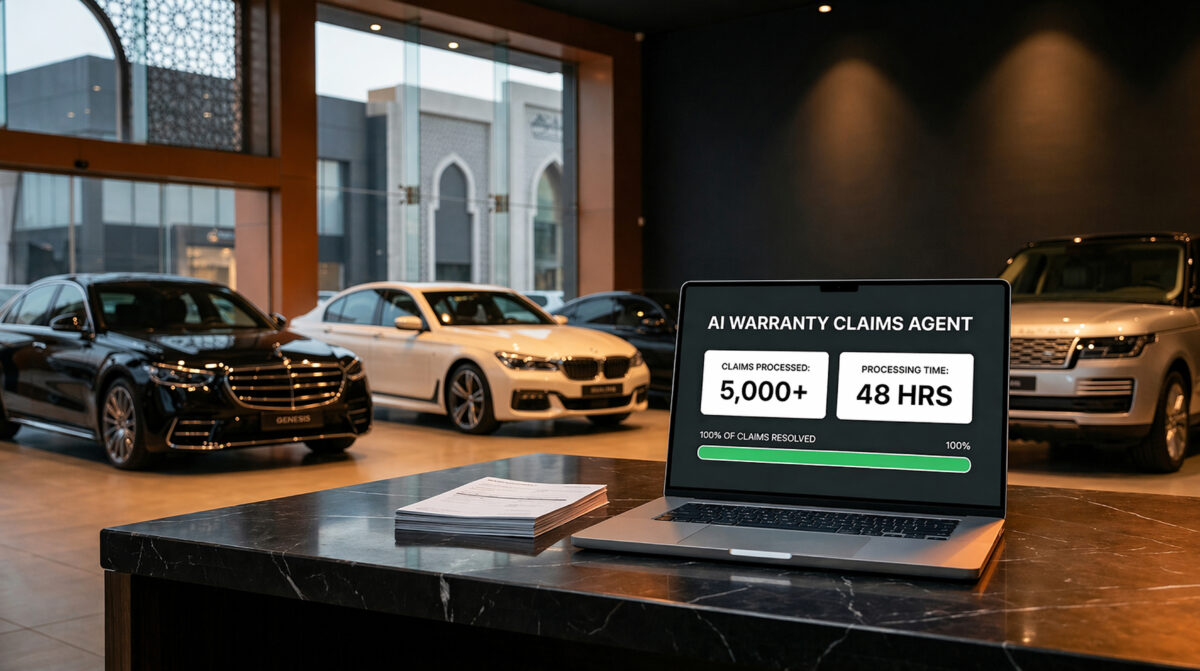
At aTeam Soft Solutions, we developed an AI agent that performed warranty intelligence, claim preparation, multi-portal submission, rejection prevention, appeal support, and proactive customer outreach. The impact was an underlying transformation in the after-sales process: claim acceptance rates increased to 94%, average processing time was reduced to 24-48 hours, advisor admin time was significantly reduced, and the annual financial effect was approximately SAR 3.5 million.
When we learned the dealership’s process, the initial thing we identified was that the warranty process was not just a back-office function. It was right at the heart of customer experience, workshop efficiency, manufacturer reimbursement, and after-sales profitability.
The customer journey began when a vehicle arrived with a fault that may be covered under the warranty. That’s where the pressure started immediately.
A service advisor needed to determine if the vehicle was still under the applicable warranty period, whether the mode of failure was actually covered, if the mileage limit had been exceeded, and if any open recalls or TSBs explained the symptom. Then they needed to state the complaint in terms defined by the manufacturer’s warranties. That sounds straightforward, but in practice it isn’t. A customer says, “The AC cuts out sometimes.” A manufacturer is looking for a very precise technical narrative, fault codes, photos, mileage evidence, and a clear connection to the covered component or known issue pattern.
At the point when the service adviser was registering the complaint, the warranty team took charge.
The dealer group consisted of five different brands, and each brand had its own set of warranty portal, rules, language style, coding conventions, photo requirements, and approval flow. Four photos may be required for one brand before pre-submission. Another might require a particular labor operation code to begin the workflow. Another may ask for a scan tool screenshot with the fault code on it. Others do not accept a claim without a certain wording pattern in the narrative of the complaint or a reference to a TSB if applicable.
That meant the warranty clerks weren’t just performing one repeatable task. They were performing five separate brand-specific tasks simultaneously.
They had to gather vehicle information, mileage, customer complaints, technician diagnoses, parts needed, labor code, labor hours, photo evidence, diagnostic reports, and any related TSB or recall references for each claim. And then, through the appropriate manufacturer system, they sent that package in and waited.
Waiting was among the most hurtful aspects of the process.
For simple claims, that might have already been the case with the approvals being quick. However, the manufacturer would take days for too many cases, particularly borderline cases and high-value repairs. The dealership suggested a realistic time frame of three to fourteen days, depending on the brand, complexity of the claim, and completeness of the initial submission. The customer experience was degrading while they waited for that. For minor problems, a few customers just waited too long. For larger repairs, vehicles took up workshop space or sat idle as the claim made its way through a slow approval process.
The actual operational damage arrives from rejections.
About one-quarter to one-third of claims would be denied on initial submission. These are not necessarily invalid claims. Many of the claims that should have been accepted but had been initially rejected were due to the submission not meeting the manufacturer’s precise requirements. It looks like the photo was unclear. An incorrect labor code. A necessary field was incomplete. The complaint narrative was not aligned specifically enough with the diagnostic results. There was just one thing missing from the submission that a seasoned brand reviewer wanted to see.
Each rejection resulted in rework.
A warranty clerk had to reaccess the file, locate the missing information, call to the workshop, request from the technician a better photo or more evidence, update the description, verify the correct code once more, and then resend it. That added another five to seven days in many cases. In the meantime, the customer waits, the service center follows up, and the financial recovery from the manufacturer lags behind.
That also resulted in a direct revenue leak.
The dealership estimated that claims that should have been reimbursed were still being lost due to documentation or process errors. That meant that the service center performed the repairs and used parts and labor, and the manufacturer declined to reimburse them. The dealership took that expense. This was running into many tens of thousands of riyals per month.
There was another invisible cost: the time of the service advisor.
Service advisors were spending about 30-40 minutes per warranty job just on preparing the claim, explaining things, and guiding the capture of photos. That’s an enormous amount of administrative load paperwork for a front-line after-sales position. That’s less time with customers, fewer upsell opportunities, and more friction in the process of receiving service.
From a day-to-day perspective, the people in the dealership were strong, but the processes were weak. The team didn’t want another dashboard. It wanted an AI agent that could read warranty coverage rules, lead evidence capture, organize the submissions properly for every brand, and keep moving the whole claim along without every case going through the same slow manual route.
The dealership already owned a DMS for service operations, but the system was never built to be a warranty intelligence layer. It could store repair orders and shop information, but it couldn’t reason about brand-specific warranty coverage, relevance of TSBs, ideal claim phrasing, or the precise document expectations of each manufacturer.
The manufacturer portals themselves were also unworkable as operating systems. They were points of submission, not systems of guidance. They treated the dealership as if it already had precise, step-by-step knowledge of how to prepare the claim properly. That’s why the same claim could be approved quickly when prepared by a seasoned clerk and rejected when prepared by someone who was less familiar with the habits of that brand.
The dealer had also tried fundamental automation for one brand, but it broke when the manufacturer changed the portal layout. That failure counted because it created doubt internally. People began to think that warranty automation was always fragile. What they had really encountered was brittle automation, rather than a resilient AI agent method.
That’s the critical difference.
A rigid script can click via a portal if the portal is static. It definitely doesn’t interpret what the claim really requires, check the submission against historical rejection patterns, make a judgment call on whether the photos will be accepted, or suggest the correct labor operation based on a description of the complaint. That’s why the project had to go beyond automation and into intelligent preparation and verification.
At aTeam Soft Solutions, we approached this as an AI warranty claims automation issue, as it is in real service center operations in Saudi Arabia, rather than a simple data entry job.
We deployed the system in phases since the dealership initially wanted help with the accuracy and preparation prior to it being able to trust automation in submission, rejection recovery, and communication with the customer.
The initial phase focused on the point at which the claim started: the service advisor and the first task write-up.
When a vehicle arrived for a possible warranty fix, the AI agent used the VIN and complaint description to pull together a live warranty profile. It verified vehicle age, warranty expiration, mileage status, warranty type, previous claims, open recalls, and relevant TSBs. That alone changed the advisor processes because they no longer had to manually search through different manufacturer references or rely on memory.
Next, the AI agent translated the complaint according to the manufacturer’s own warranty guidelines. For instance, a recurring AC cooling problem in a fairly new vehicle could correspond to a known brand bulletin with a suggested procedure and a covered labor operation. Instead of the advisor writing up a generic complaint and hoping that the warranty clerk would later know how to mold it, the system instantly showed the closest matches to what this fault likely was and how the brand wanted to see it written up.
This stage also brought guided evidence collection.
Instead of saying to the advisor or technician, “upload photos,” the AI agent informed them precisely what photoset was required for that brand and type of claim: VIN plate, mileage display, fault-code screen, bad part, or installation context. This was a significant improvement, because one of the largest sources of rejection was not lack of effort but vague evidence gathering. People thought they had sent “photos,” just not the particular photos that the manufacturer wanted to consider.
The outcome was that the claim package became one of the structured ones at the point of intake rather than being rebuilt later in the warranty office.
When the claim preparation was good enough, we shifted into the second phase: really handling the five separate manufacturer claim systems.
This was exactly the place where the project could have easily failed, had we treated it like fragile automation. Rather than building five separate click-bots, we built a portal abstraction layer. The AI agent took advantage of a common internal claim representation and then translated this representation into each manufacturer’s portal-specific fields, required evidence, and submission rules.
That intelligence was, therefore, located above the portal rather than simply behind a fragile script.
The system sent the claims, monitored their status, identified approval or rejection replies, and looked for requests for more details. If the manufacturer requests extra documentation, the AI agent immediately assembles the appropriate supporting material from the service file and then prepares the reply for a quick review.
We also built in rejection prevention at this stage. Before submission, the AI agent compares the case through known rejection patterns by brand and claim type. For instance, if one manufacturer consistently denied AC claims without the system charge weight in the description, the system would alert them to that before submission. If a different brand rejected unclear component pictures, the system prevented that before the claim left the dealership.
That’s where the approval rates started to trend up significantly. The dealership stopped submitting the claims that were technically “submitted” but poorly developed.
Stage three addressed a painful truth of dealer after-sales support: even smoothly operated claim systems will still experience denials. The real question is what really happens next.
When a claim was denied, the AI agent did not simply flag it as failed. It examined the reason for denial and assessed whether it was a correct denial, a documentation deficiency, or an appealable matter. Then it assembled the next appropriate step.
If the problem was a lack of evidence, the system would tell them exactly what they were missing and help them get the correct evidence for the resubmission. If the matter was a clear misreading by the manufacturer’s side, the AI agent wrote an appeal citing the actual warranty rule, bulletin, or claim logic that supported the dealer’s position.
This was particularly useful since the warranty team had earlier managed the appeals in an immensely inconsistent way. Some of the cases were followed firmly; the rest were abandoned, and most of that depended on who had time and how assured they felt. The AI agent developed an additional disciplined recovery process.
We also exploited this stage to fine-tune the coding and narrative schemas. Over time, the system learned the combinations of labor code, claim wording, evidence style, and supporting documents that resulted in the highest approval rates for each brand and type of repair. That doesn’t mean gaming the system. It involved understanding the language of the manufacturer and making the appropriate claim in the strongest format allowed.
The goodwill layer was also a crucial addition. Vehicles that were just out of warranty—by a small margin in terms of time or miles—could sometimes still be eligible for goodwill consideration if the case was well made. The AI agent identified those opportunities and submitted enhanced goodwill submissions, incorporating customer loyalty, known product concerns, and early service history.
The last phase extended the AI agent beyond the claim by itself.
When the warranty repair was underway, the system started submitting proactive customer updates via SMS or WhatsApp. Customers who are no longer sitting in silence while the dealership waits for a manufacturer’s judgment. They received actual progress updates: claim submitted, extra review inquired, approval received, parts that are ready, repair scheduled, and the vehicle is ready.
This had a real impact on the service experience, because customers evaluate warranty quality not so much by the internal workings of the claim but more by whether the dealer keeps them informed and gets them moving again as quickly as possible.
We also included a pre-warranty inspection campaign. The AI agent found vehicles with expiring warranties and urged their owners to bring them in for an inspection to identify covered issues before it did so. That began as another convenience feature but has since become one of the most commercially valuable aspects of the entire deployment. It generated service revenue, increased customer goodwill, and allowed the dealership to recover manufacturer reimbursement on legitimate problems that would have been missed otherwise.
For the company, this was a big takeaway: projects for AI agents in the after-sales space sometimes yield the greatest value not in back-office operations but in active, immediate customer engagement.
The platform was developed using a Python FastAPI backend with Celery and Redis handling asynchronous processes for claim preparation, portal look-over, status polling, rejection analysis, and messaging of customers. PostgreSQL stores the structured vehicle, claim, and brand-rule information.
Claude took care of interpreting complaints, matching TSBs, claim narrative generation, and rejection-recovery drafting. This was significant because the warranty language sits between the customer language, technician language, and manufacturer language. The AI agent needed to make correct translations across those layers.
We leveraged Playwright for manufacturer portal automation, but the fundamental design decision was the abstraction framework on top of it. Rather than hard-coding each portal end to end, we developed a configurable workflow layer that translated the dealership’s internal claim model to each brand’s unique submission format. It made the system a lot easier to maintain when manufacturers modified portal behavior.
The React dashboard provided service advisors, warranty clerks, and managers with a single working surface for claim readiness, missing proof, submission tracking, denial recovery, and status of customer communication. We also integrated the platform with the dealer’s DMS, so the AI agent could operate on actual repair-order data rather than creating another isolated workflow.
The first big challenge was the portal diversity. Five brands resulted in five distinct submission systems, five separate workflows, and five differing sets of rules. A claim that was simple to process in one brand could be instantly rejected in another for what appeared to be a small formatting variation.
The photo quality was another big problem. “Adequate evidence” to the manufacturer’s expectations was apparently highly subjective. One out-of-focus shot of a VIN or screenshot of a fault screen could bring the whole claim down. We thus trained the AI agent to rate photos in terms of their warranty suitability before submission, and not just that an image existed.
TSB and recall management also needed a hybrid model. Some of the manufacturers provided structured access to the data. Others didn’t. Hence, we created a blend of direct data integration, periodic synchronization, and AI-driven complaint-to-bulletin matching to allow the system to find relevant service bulletins even if the phrasing was not the same.
And then there was the organizational hurdle: once the claims could be developed in minutes rather than much longer, people started moving too quickly. Quicker systems can accidentally encourage permitting. We fixed that by requiring a brief but crucial human review checkpoint on certain risk factors before finalizing a quote or claim. In regulated or reimbursable processes, speed without disciplined scrutiny is a recipe for disaster.
The most essential outcome was the claim approval rate. It went up from about 70-75% to 94%. That one change had both financial and operational impacts all over the company’s business. Fewer claims were denied, fewer repairs had to be absorbed by the dealership, and fewer vehicles were left in the system waiting for repeated resubmissions.
Claim processing times shifted dramatically, too. What previously took anywhere from three to fourteen days has been reduced to about twenty-four to forty-eight hours on average. That made a much better rhythm in the workshop flow and, in fact, made the customer’s experience at the service center much better.
The service advisor’s time spent administering warranty jobs was reduced from 30-40 minutes to about five minutes. That was important because the advisors could use their time more with customers and less time to build documentation packets.
The warranty clerk group also reorganized. The dealership went from ten clerks to four processing the same workload, and the remaining employees were redeployed for more valuable customer service and service sales positions. That’s exactly the sort of transformation we focus on in the company—not eliminating human value, but relocating it to where it counts more.
From a financial perspective, the dealership went from losing claims due to poor preparation to recovering about SAR 650K per year. Goodwill claims accounted for an additional SAR 280K in year one. The pre-warranty check-up promotion meant an additional SAR 1.2 million in service revenue, while also building real customer goodwill.
And the overall customer experience was also better. Wait times for vehicles to be serviced under warranty were reduced from five to 14 days to approximately one to three days. Satisfaction with the warranty process increased from 3.1/5 to 4.4/5. After-sales is a whole different improvement for a dealership in Saudi Arabia, especially in a brand-competitive environment where their service reputation has a direct correlation with retention.
The total yearly financial burden was calculated to be approximately SAR 3.5 million.
We developed the solution using Python with FastAPI for backend orchestration; Celery and Redis for asynchronous processes handling; PostgreSQL for structured claim and vehicle information; Claude for complaint analysis, TSB matching, and narrative generation; Playwright for automation over five manufacturer portals; React.js for the warranty operations dashboard, incorporating the dealership DMS; WhatsApp Business API for communication with the customer; and AWS EC2, RDS, S3, and Lambda for infrastructure and storage.
The greatest takeaway was that the most profitable feature was not just the fundamental claim automation. It was about the proactive outreach.
The pre-warranty inspection campaign began as an afterthought and turned into the strongest value creator in the project. By identifying vehicles about to expire and pulling customers in before their warranty ended, the dealership recaptured real warranty work, brought in service business, and increased customer retention all at once.
We also studied that the approval-rate enhancement counts more than submission speed alone. A quick bad claim is still a poor claim. The AI agent developed most of its value by better preparation quality, quality of evidence, and brand-specific claim shaping before the submission ever happened.
Lastly, we have discovered that in after-sales operations, intelligence has to be above the portal. Portals of the manufacturer will keep on changing. What makes for sustained value is a reusable internal claim model, a strong evidence layer, and a system that can help the dealership think like the manufacturer prior to the claim being submitted. This is something that is a core pillar now for the company in every automotive service automation development engagement in India.
Multi-brand dealer groups in Saudi Arabia and the wider Middle East often take warranty friction as something normal when dealing with manufacturers. The truth is that much of the delay and revenue loss is a result of poorly prepared claims, inconsistent documentation, and poor communication with customers.
At aTeam Soft Solutions, we are developing such systems where an AI agent can lead claim preparation, adjust to various manufacturer workflows, reclaim denied value, and even proactively generate new after-sales opportunities before the warranty even expires. This is where the warranty service shifts the scales from an administrative burden to an actual source of profit and customer retention engine.