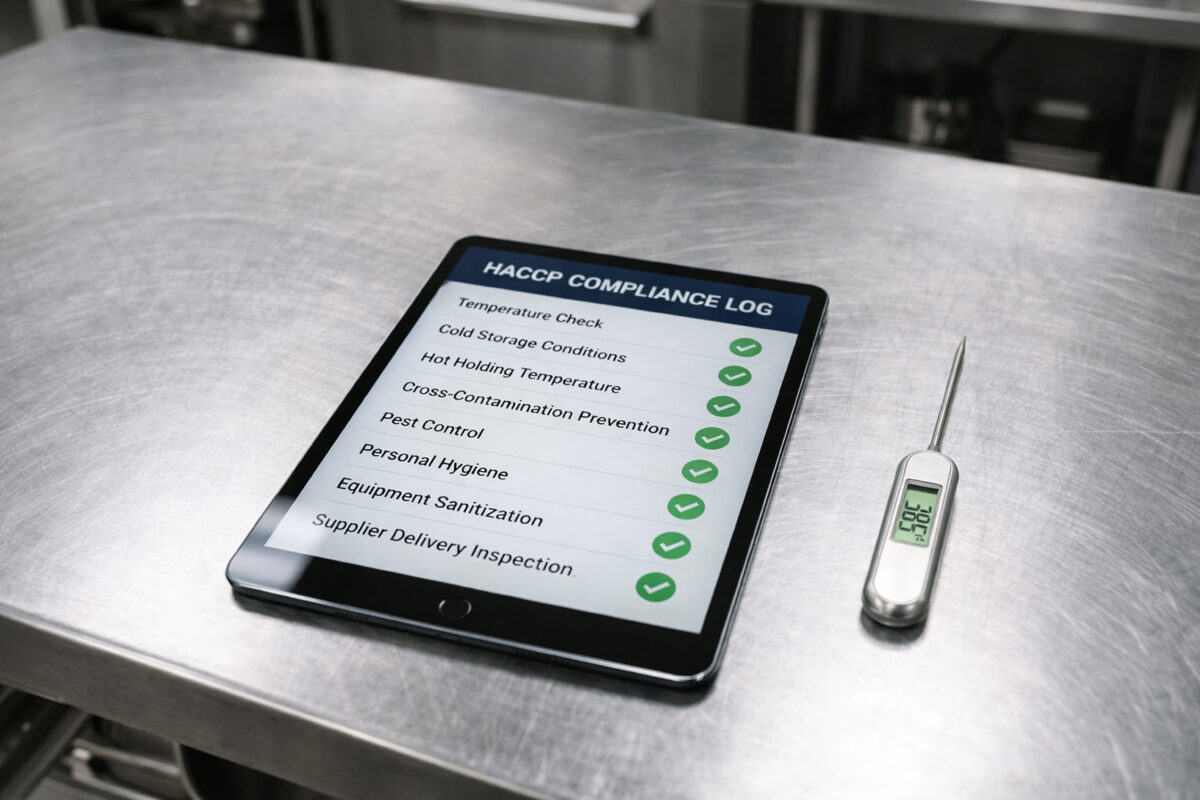
A Dubai-based restaurant group with 40 outlets across six brands was doing what many expanding food businesses do when the demands of compliance exceed the capabilities of the operating model: they were depending on paper, memory, manager follow-up, and good intentions to hold together a food safety system that desperately needed live intervention.
They had more than 600 kitchen staff, a 3-person food safety team, and a regulatory climate that does not tolerate any weakness in documentation. Dubai Municipality inspections are tough, methodically arranged, and apparent. Scores are public. Poor scores affect reputation. Establishments that repeatedly bring home bad reports could be subject to warning notices, pressure on their operations, and, in the worst of cases, business disruption. The group further had to comply with HACCP requirements, Dubai Municipality food code expectations, UAE food security regulations, documentation of halal compliance, supplier records, cleaning logs, and maintain temperature continuously to be able to offer the assurance of safe food across several brands and kitchen types.
They were, on paper, compliant with regulations.
In practice, their procedure depended on manual temperature logs every four hours, paper HACCP checklists, records signed by hand, filing in binders, and outlet managers scrambling to juggle dozens of tasks during live service. Across 40 outlets, this meant around 1,200 manual temperature readings a day, not including opening and closing checklists, staff hygiene declarations, supplier documentation checks, and records of equipment or cleaning.
In aTeam Soft Solutions, we developed an AI agent that integrates IoT temperature monitoring, evidence-based HACCP workflows, inspection readiness, predictive equipment risk, and outlet-level food safety intelligence into a single operating layer. The result was not just more speedy compliance management. It was something far more meaningful: the group went from reporting on what people wished was happening to reporting on what was actually happening. Inspection scores increased from an average of 85 to 96, warning notices vanished, incidents involving food safety decreased dramatically, and the company finally gained a true real-time truth layer across all 40 kitchens.
When we examined the group’s working methods, the major problem was not that they had no SOPs. They had the SOPs. The issue was that SOPs were being written in retrospect to appear compliant, but were not capable of reliably managing risk in the kitchen when it was running.
Temperature logging is just one good example.
Every refrigerator, freezer, hot-holding unit, cold-holding unit, and critical prep area was supposed to be monitored every four hours. Staff were supposed to halt their work, take the temperature, write it down on a paper sheet, sign it, and get on with their job. Multiply that by 40 outlets, four to six critical points per outlet, and six readings a day, and you get around 1,200 manual entries every day across the group.
Theoretically, that sounds like a documented HACCP control.
In reality, it worked out familiarly. Staff didn’t always log temperatures in real time, either, especially during the rush. Sometimes the record was completed afterwards from memory. Sometimes they estimated the reading from what “usually” was. Sometimes the form was filled out because the team knew it had to be, not because the measurement was being used as an active control. This is not unusual in food service. It is the result of when compliance is formulated as a paper exercise in a rapid, understaffed kitchen environment.
The same issue existed with the checklists.
Opening and closing HACCP procedures contained dozens of components: receiving checks, storage monitoring, rendering procedures, prep controls, cooking records, cleaning confirmation, labeling verification, sanitation readiness, hygiene compliance, and more. These tasks were performed on paper, organized in binders, and usually double-checked at a later date by managers of the outlet or the central food safety team. The trouble was that paper checklists don’t prove the job was done right. They show that somebody looked at the box.
That distinction turned out to be far more important than the management had initially understood.
A completed closing checklist could say chilled storage was checked. But was it really checked? Was the thermometer looked at? Were expiration labels visible and accurate? Was the product stored in the correct area? Is the photo of the reading taken at the right time from the right place? Paper cannot answer those questions. It creates the illusion of control.
Documentation from suppliers was an additional load. Halal certificates, food origin paperwork, receiving temperatures, pest control reports, cleaning schedules, maintenance logs, and calibration records all existed but were scattered around in files, binders, or folders at the local office or the outlet level. When an inspector from Dubai Municipality showed up and demanded to see seven days of temperature records for a specific cold room or workstation, the manager was put on retrieval mode. That’s never a good look during an inspection. Even if the documentation exists, the delay indicates weak controls.
The central food safety team knew that every week.
The food safety manager and the two deputies were devoting about 80 percent of their time to gathering, verifying, and filing paper documentation from outlets. They did visit three to five outlets per day for spot checks, but with 40 outlets in business, that still left massive visibility gaps. The system was not scalable. They were not truly controlling food safety risk across the estate. They were managing paperwork associated with food safety risk.
This had its consequences.
The Average Dubai Municipality overall group score was about 85 out of 100. That is not just a disaster, but it is lower than what a serious multi-brand operator wants, especially in a market such as Dubai, where food safety scores have a direct impact on reputation. Three outlets were given warning notices the year before over documentation gaps. These were not about food poisoning cases. There were recordkeeping and control failures. That’s what made it so frustrating: the group was sacrificing inspection quality and opening itself to escalation, even though the underlying operational intent was good.
More significantly, leadership was making decisions on the basis of incomplete or wrong information.
Paper logs often showed near-perfect compliance, as people tend to write what should have happened, not what actually happened. When we subsequently compared actual sensor data with the paper records, the contrast was revealing. Temperature excursions were occurring far more frequently than the paper logs reflected. The paper system was not malicious. It was just too human, too lagged, and too weak a real-time control tool.
That’s why when aTeam Soft Solutions was approached with the issue, we never defined it as “digitize checklists.” The real issue was more profound. The team required an AI agent that could integrate temperature truth, process verification, document readiness, corrective action tracking, and inspection preparation into a single system. Without that, any app would have just been a prettier version of untrustworthy paperwork.
The group had previously used a digital checklist app, but it was unsuccessful for a straightforward reason: it didn’t improve behavior or quality of evidence. It substituted paper for taps. Staff can still tick boxes without demonstrating that a control has really been carried out. The app generated digital records, but not better compliance.
They had also placed IoT temperature sensors in a few outlets, which seemed like a good start. But those sensors were streaming data into a separate dashboard that existed outside the HACCP process. Kitchen staff weren’t operating from it, outlet managers weren’t using it as a checklist input, central food safety team was overwhelmed by alert noise. Safe, brief temperature fluctuations during door openings were dealt with the same as real violations. That created alert fatigue, and when people stop trusting alerts, it turns into background noise.
The underlying issue was fragmentation.
No tools were bringing together the three elements that really matter most in day-to-day food safety management:
That’s why the answer had to be a real HACCP compliance AI agent, not a sensor dashboard, rather than a checklist app. It had to understand when a temperature change was significant, when a checklist item truly required documentation, when a corrective action was needed, and how to present the entire compliance story in an instant for an inspector if one came calling for it.
We designed the system in stages as the organization required confidence quickly, but it also required staff adoption. In a group restaurant setting, even the finest compliance technology breaks down if kitchen teams perceive that it slows them down or punishes them with unusable workflows. So we began with the most objectively measurable control layer — temperature — then moved to evidence-based checklists, then inspection readiness, and ultimately predictive analytics.
The initial phase focused on the most measurable HACCP control in the entire operation: temperature.
We installed roughly 200 wireless sensors in 40 outlets, including in cold rooms, freezers, undercounter refrigeration, hot-holding equipment, and other critical control points. But simply rolling out sensors wasn’t the answer. What was really important for the AI agent were the readings.
A kitchen is not just a lab. A door opens. The staff refills a fridge. A prep team accesses a unit multiple times for service. Brief changes are normal. If every transitory spike creates an incident, nobody will listen. So we created smart alerting logic that separates normal variation from real risk.
If a door opening produced a brief spike and the unit bounced back quickly, the AI agent treated it as noise. If the temperature increased gradually and did not have a recovery period over time, then it raised an outlet alert with usable instructions – check the door is sealed, check compressor status, check loading pattern, escalate maintenance if required. If the temperature pattern indicated a slow device failure instead of a sudden emergency, the system created a maintenance workflow prior to an actual malfunction.
This was one of the largest operational successes of the entire project.
The company had stopped instructing employees to write down temperatures every four hours. It was now taking them continuously in real time, and HACCP-compliant logs were being generated automatically. That removed simulated or recalled readings and instead provided the food safety team with a live exception view rather than forcing them into a daily inspection of 1,200 raw entries.
At the company, we frequently say that in regulated operations, the first value of an AI agent isn’t automation. It is about the truth. This stage confirmed it.
Once the temperature control was functioning well, we moved into the wider checklist workflow.
We switched from paper checklists to mobile checklists tailored by type of outlet, brand, hours of operation, and risk profile. But again, this was more than just digitization. The required proof for the AI agent was in the place where control was most desired.
If the check was “chicken melted at the right temperature,” a yes/no tap alone would not be accepted by the system. It needed a thermometer photograph. For the check “products are correctly labeled with the expiry details,” a photo of the labels was needed. If the check is “receiving temperatures properly documented,” the proof must be of a real receiving event instead of a filled-out form.
The system also verified the evidence. It verified the timestamp, location, and contents of the image. That way, a staff member couldn’t just upload a random photo to clear the task. The AI agent applied computer vision to verify that the photo is reasonably the right type of evidence. This mattered because otherwise digital evidence ends up being just another form of tick-box compliance.
We also made the workflows so that they could be used in a real kitchen. Big touch targets, minimal text input, fast photo capture, and short action loops were far more important than elegant UI. In many of these places, the personnel are gloved up, exposed to water, and under constant time pressure. A gorgeous app· that takes three minutes per check is operationally unusable. We have optimized the majority of checks to be completed in less than a minute.
Also, timing turned out to be much smarter. Rather than generic daily forms, the AI agent triggered audits based on specific patterns of outlet operations. A breakfast-heavy brand received earlier receiving and prep checks. A dinner-led concept took on a different rhythm. The system was designed for the kitchen and not vice versa.
When a check failed, it didn’t just produce a red mark. It produced a corrective action with an owner and follow-up path. That was a big transformation. The company went from documenting non-compliance to actively managing it.
The staff training benefit was also apparent. Eventually, the AI agent could uncover which particular team members or outlets were consistently struggling, where evidence quality was poorest, and where more supervision or retraining was necessary. That made compliance into a coaching system, rather than a policing exercise.
The third phase addresses another painful reality for multi-unit operators: inspections don’t announce themselves.
The AI agent had a constantly updated file to keep readiness under inspection for each outlet. This included temperature records, evidence of checklist completion, hygiene and training records, documents of supplier compliance, pest control logs, cleaning schedules, records of maintenance, and documentation of calibration for the last 30 days.
This meant that when a Dubai Municipality officer came visiting, the outlet manager no longer had to browse through binders or office folders. They could just open the app and have the requested papers in about an instant. That change matters both operationally and psychologically. It signaled control.
We also included pre-inspection scoring logic. Each outlet was given a prediction score for its internal inspection performance based on its own actual compliance performance, rather than only the result of its last official inspection. If the quality of evidence for an outlet was poor, if temperature excursions were on the rise, if training records were out of date, or if crucial documentation was missing, before the municipality even walked in, the system would bring that up.
That became a powerful management instrument. The food safety team was no longer guessing about which outlets required an urgent visit. The AI agent provided them with a risk-ranked view.
We even included a drill mode, so the central team could run a drill as if they were conducting an inspection remotely. That was particularly useful because with 40 outlets, physical inspections could never scale.
In the subsequent stage, we enhanced the system to be a cross-outlet intelligence.
Since the AI agent was now viewing sensor data, checklist evidence, corrective actions, supplier documents, and maintenance trends for the entire group, it was spotting patterns invisible to any single outlet. If the delivery temperatures of a supplier were drifting at multiple sites, that became apparent very quickly. If the risk of refrigeration was increasing in particular months or brands, the system noticed this. If a particular type of equipment is exhibiting pre-failure temperature behavior multiple times, maintenance can intervene earlier.
We additionally utilized the system to enable staffing and training logic. The company could guarantee that there was a food-safety-trained lead on every shift instead of scheduling luck. and hoping for the best. Storage life and waste trends also became more transparent, enabling the organization to cut down on waste while maintaining compliance.
This phase altered the nature of the food safety team’s approach. They weren’t just gathering and examining paperwork anymore. They were running systemic risk.
That’s the point at which a robust AI food safety automation Dubai implementation goes beyond compliance technology. It is an operating system for food safety, truth, accountability, and prevention.
The platform was developed using a Python FastAPI backend, with MQTT and AWS IoT Core supporting live communication from the LoRaWAN temperature sensor network. Almost 200 sensors fed continuous temperature data into TimescaleDB, whereas the AI agent could assess trends, excursions, and pre-failure actions.
PostgreSQL managed the broader compliance workflow process data: the checklists, corrective actions, records of the staff, inspection files, documentation of suppliers, and outlet profiles. The mobile experience was developed in React Native for kitchen and outlet teams, while the management layer was built in React for the food safety team and top operations management leadership.
TensorFlow Lite enabled validation of photo evidence on the device, which decreased friction and latency for kitchen staff. Claude was also used for incident summaries, corrective-action narratives, and recommendation generation so managers could know in plain language what was happening instead of raw compliance codes.
One of the key design decisions was to make the temperature system and the checklist system part of the same workflow. This avoided the traditional failure mode in which sensors produce data no one uses, and checklists produce claims no one can check. The AI agent took a middle position, transforming sensor truth into operational action and checklist evidence into auditable compliance.
At aTeam Soft Solutions, we conclude that integration is an essential factor. A restaurant safety system fails when it considers surveillance, procedure, and review as distinct software issues.
Kitchen staff adoption was a big operational problem. Most of the team members were not comfortable with the complicated smartphone workflow process, and any procedure that minimizes the kitchen will be bypassed eventually. We build the app for wet, gloved, quick-moving use: large controls, photo-first proof, voice support where required, and the least possible typing.
Sensor durability was yet another hurdle. Commercial kitchens are demanding environments. Heat, steam, cleaning chemicals, vibration, and repeated washdowns are not friendly to electronics. We specified durable, food-safe sensor placements and still assumed some failure rate. The system, then, had to automatically detect sensor silence and revert to manual logging for that point until replacement occurred.
The verification of evidence also required practical adjustment. In the early models, real kitchen photos that were valid were being rejected as the actual kitchens are disorganized, with poor lighting, glare, partial obstructions, and chaotic framing. We retrained the models using thousands of real kitchen images instead of clean reference images. That made a big difference in acceptance but didn’t make the system too soft.
The last obstacle was cultural. The organization had been operating for years inside a paper-based compliance regime, where filled-in forms frequently presented prettier versions of reality. When the AI agent reveals the real operating picture, leaders need to be prepared to see it. It was uncomfortable at the time, but that’s exactly why the project produced actual value.
The most immediate change was in the tracking of temperature. The company went from 1,200 manual reads a day — many of them suspect — to continuous automated tracking with real-time data, HACCP-compliant logging at all critical points.
The quality of checklists being filled out changed just as radically. What had been effectively 72% reliable completion under the paper model became 98% completion under the digital evidence-driven workflow. The difference, though, was not just that more work was done. That goes for completed tasks, too, now had proof.
The performance of Dubai Municipality inspections was raised from 85/100 on average to 96/100 throughout the outlet network. That is a huge operational and brand win in the regulatory environment in Dubai. Warning notices fell to zero in the year following deployment.
There was a 65% decrease in food safety incidents as temperature excursions and process failures were being identified earlier. The system also forecasted and prevented 12 refrigeration malfunctions prior to breakdowns occurring, avoiding repair costs, product loss, and service interruption.
The central food safety team grew more scalable. The same three-person team that had previously struggled to keep an eye on 30 outlets could now effectively manage 40 because they were focused on actual exceptions and outlet risk instead of gathering paper.
The time spent by the inspector changed from 15-20 minutes or more of searching through binders to about 30 seconds with the use of the app. This is more important than convenience. It alters the feeling of control during an inspection.
Food loss decreased by roughly 18% as improved temperature control and lifespan transparency minimized loss from unseen excursions and slow reactions. The overall anticipated yearly savings were about AED 1.2 million through waste reduction, failure prevention, less travel, avoidance of penalties, and improved team efficiency.
The biggest impact for aTeam Soft Solutions was that the company now had a true picture of food safety at all its locations. That layer of truth is what enabled every other improvement.
We developed the system using Python with FastAPI for backend services, LoRaWAN-based IoT temperature sensors integrated through AWS IoT Core, MQTT for device communication, TimescaleDB for time-series sensor storage, PostgreSQL for workflow process and compliance information, TensorFlow Lite for on-device proof verification, React Native for the kitchen and outlet mobile app, React.js for the management dashboard, Claude for incident and suggestion narratives, Redis for task coordination, and AWS EC2, RDS, and S3 for infrastructure and storage.
The most essential takeaway was that paper compliance is often not just ineffective— it is misleading.
When we compared the actual sensor data to the paper logs, the discrepancy was too great to overlook. The paper logs gave the organization the appearance of being more secure than it really was. That’s not because the employees were dishonest at scale. It’s because physical systems foster reconstruction, delay, and performative compliance.
Additionally, we found that evidence was the leading design principle for digital HACCP systems. A checklist without having a validation is just a box-ticking exercise. Once the AI agent started asking for contextual evidence and checking it, the quality of compliance shifted.
And finally, we discovered that kitchen adoption depends on respect for the environment. The staff will utilize a system that suits the service reality. They’ll turn down one that feels like office software reduced into a hot kitchen. That’s why the workflow design was as important as the AI capability in this project. At aTeam Soft Solutions, it is a principle that stands firm for every restaurant food safety technology solution we build.
Operators of multi-outlet restaurants in Dubai, the UAE, and across the Middle East generally think they have a food safety system in place because they use forms, checklists, logs, and audits. The actual question is whether those controls speculate about reality.
At aTeam Soft Solutions, we engineer systems so that an AI agent can continuously monitor temperatures, check process evidence, keep documentation inspection-ready, and surface outlet risk before it becomes an inspection issue or a food incident. That is how food safety moves from paperwork to real-time operational control.