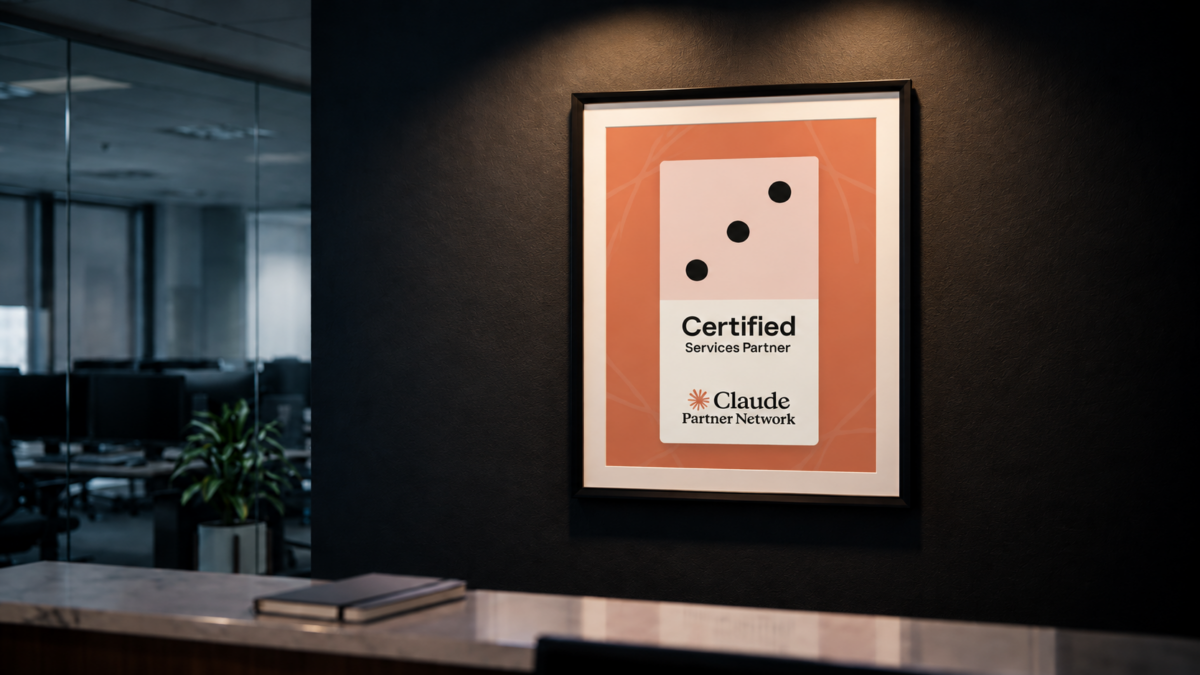
aTeam Soft Solutions has joined the Claude Partner Network as a Claude Certified Services Partner, with 15 Claude Certified Architects on our team. This adds to our work in enterprise AI implementation, agentic automation, and custom software engineering.
For a business choosing a Claude implementation partner, certification is a useful starting point. The more important question is how that expertise can solve problems within the business.
Consider everyday tasks: checking a supplier invoice against a purchase order, preparing a freight quotation with the correct charges and approved margin, or responding to a customer using current business records. Each task requires accurate information and adherence to established rules. Claude can help with these processes when it is connected to the right data, business applications, and approval workflows.
Our work at aTeam Soft Solutions focuses on making those connections, so businesses can apply AI to real operational tasks without losing sight of their existing processes and controls.
Anthropic, the company that develops Claude, launched the Claude Partner Network to support organizations helping businesses adopt and implement Claude. The network offers training, technical guidance, and resources to help partners bring Claude into real business environments. Anthropic announced an initial $100 million investment in the network for 2026.
As part of the launch, Anthropic also introduced Claude Certified Architect Foundations. This certification is designed for solution architects working on production applications built with Claude.
There is an important distinction between individual certification and partner status. Certification recognizes a professional’s technical knowledge, while partner status applies to the organization and its relationship with Anthropic’s partner network.
Anthropic explains the initiative in its Claude Partner Network announcement.
At aTeam Soft Solutions, our Claude Certified Services Partner status and team of 15 Claude Certified Architects support our work on Claude implementation projects. For clients, the real value lies in how we apply that expertise to solution design, system integrations, testing, and ongoing operations. These are the areas that help determine whether an AI solution works reliably within an existing business environment.
An enterprise AI project involves more than choosing an AI model. The team must understand how the business operates, determine which data the AI can use, connect the necessary applications, and test how the entire workflow performs in real situations.
With 15 Claude Certified Architects on our team, aTeam Soft Solutions has a wider pool of certified expertise to draw on when planning and delivering projects. This also creates opportunities for technical reviews and knowledge sharing across our Claude implementation team.
Every project needs a clear plan for handling situations such as missing information, conflicting records, failed integrations, and decisions that require human approval. Our certified architects work with the wider delivery team to address these issues during solution design and development.
Certification provides a foundation, but the quality of an implementation must be demonstrated in practice. We look to realistic testing, clear approval controls, and measurable results to assess whether the solution meets the business requirements it was designed to address.
Our agentic AI and automation services help businesses reduce the manual work involved in gathering information, checking records, preparing documents or responses, and transferring tasks between applications.
Claude can be incorporated into these workflows to handle specific tasks, support decisions, and prepare information for review. The examples below show how these solutions can work in practice.
The final design depends on the documents involved, the systems that need to connect, user permissions, and the business rules the solution must follow.
Consider an accounts payable team that receives supplier invoices by email every day. Each invoice must be reviewed, matched with the correct purchase order, checked against goods received, and sent to the appropriate approver. Missing information or differences in amounts can slow the process and require staff to spend extra time checking records.
A document processing workflow can extract key details from each invoice, flag missing information, and compare the extracted data against existing records using predefined validation rules. When a mismatch occurs, the reviewer can see the original invoice and the specific discrepancy side by side, making it easier to investigate and resolve the issue.
For example, if an invoice contains an unfamiliar bank account, the system can flag it for verification rather than allowing it to proceed automatically. Once the necessary checks and approvals are complete, the integration can post the invoice to the accounting system and confirm whether the update was successful.
To assess the results, businesses can track the average time spent processing each invoice, the number of corrections required, and the percentage of invoices that still need manual intervention. These measures help determine whether automation is reducing the workload across the entire process, rather than simply speeding up one step.
Freight teams often handle customer inquiries, freight rates, shipment records, and customer communications at the same time. Preparing a quotation can involve checking current freight rates, local charges, surcharges, and customer-specific pricing rules before the sales team can send a reliable offer.
A quotation agent can collect the required information from approved sources, apply the company’s pricing rules, and prepare suitable options for a salesperson to review. The salesperson can then check the figures, make any necessary adjustments, and approve the quotation before it is sent to the customer.
Shipment exceptions are another area where an agent can help. By monitoring connected systems for events such as changes to an estimated time of arrival (ETA) or a customs hold, it can bring the relevant information together, notify the responsible team member, and prepare a customer update for review. The team can verify the details and approve the message before it is sent.
The main goals are to reduce quotation turnaround time and help teams spend less time collecting information about shipment exceptions. To measure the impact, businesses should test the workflow against their own shipment records and customer inquiries, then compare the results with their existing process.
When responding to a customer request, a service team may need to check company policies, review an order record, and look through previous conversations before providing an answer. Gathering information from different systems can take time, especially when the request involves more than one department.
A connected assistant can retrieve relevant information from permitted sources, help prepare a response, and direct requests to the appropriate team when further action is needed. Access permissions should control which records each user can view. If the available information does not support a reliable answer, the assistant should flag the gap and route the request for human review.
The same approach applies to internal knowledge assistants. Employees can use them to find information in approved policies, procedures, and company documents without searching through multiple files manually. Answers should be based on authorized source material, with references employees can check for themselves. Throughout the process, the assistant must respect each user’s access permissions and avoid presenting incomplete information as a confirmed answer.
Engineering teams can use Claude Code to understand existing codebases, implement changes, prepare tests, and document software. To make this work in a real project, developers need a process that keeps changes aligned with business requirements, coding standards, and review procedures.
Our legacy system modernization services cover the broader work involved in updating existing applications. This includes examining how the system behaves today, confirming business rules, testing proposed changes, and planning the migration without disrupting essential operations.
Code produced with AI assistance still requires engineering review, thorough testing, and security checks before it is put into production. The modernization process must also account for the less obvious parts of an older system, including exceptions and special-case rules that have become part of everyday business operations. Preserving these behaviors is just as important as improving the underlying technology.
Start by defining the task the system needs to handle and the measurable results that will show whether it is delivering value.
We begin by selecting a specific business process and mapping out who owns it, what information it requires, which systems it uses, where approvals are needed, and what exceptions commonly arise. We also establish a baseline, such as the time spent preparing a quotation or processing an invoice.
With these details in place, we can define clear project goals and measure the results against them. Starting with a well-defined use case makes it easier to validate the implementation before extending Claude to other business processes.
Claude can request actions through tools that an application makes available to it. For a custom business integration, the application handles those requests, executes the permitted operation, and returns the result to Claude. Anthropic describes this process in its tool use documentation.
When connecting Claude to an ERP, CRM, or internal database, the integration needs clear rules for what the model can access and do. It should validate each requested operation, enforce permissions, and handle errors without disrupting the wider workflow. Actions that could affect financial records, customer data, or other sensitive business operations should require explicit approval wherever the process calls for it.
Testing should reflect the situations the system will encounter in day-to-day operations. This includes missing documents, duplicate requests, conflicting records, and systems that are temporarily unavailable. It is equally important to check whether the system recognizes when it cannot proceed and escalates the issue to the right person.
For document automation, accurate data extraction is only part of the assessment. The team also needs to verify that each document is linked to the correct case, discrepancies are identified, and approved updates reach the intended record. These checks help establish whether the workflow is reliable from the initial document through to the final update.
Once the system is live, the organization needs to track failed actions, cases requiring human intervention, response times, and operating costs. A designated owner should review these results, address recurring issues, and approve changes to the workflow when needed.
Any change to the AI model, prompts, business rules, or system integrations should trigger the relevant tests again. This gives the team a chance to identify unexpected changes in behavior before they affect everyday operations and helps maintain reliability as the system evolves.
Business tasks such as preparing freight quotations, posting invoices, or communicating with customers can affect decisions and records beyond the immediate workflow. For this reason, the system must have clear limits on what it can prepare, which actions it can perform, and what requires approval from a person.
In a freight quotation workflow, for example, the agent can collect rates and prepare a quotation, but the salesperson must review and approve it before it is sent to the customer. Similarly, when document processing identifies missing details or conflicting information, the case should be referred to a reviewer who can examine the original documents.
Data access and security controls need to be defined before deployment. This includes deciding which systems the agent can access, what information is shared with the model, how credentials are stored, and what activity is recorded in logs. Documents and incoming messages should be treated as untrusted inputs. Any instructions embedded in them must not override established rules, grant additional permissions, or trigger unauthorized actions.
Security, privacy, and relevant regulatory requirements should be assessed in the context of the actual solution and its deployment environment. Before the system goes live, the team should verify that the required safeguards are working and maintain evidence that they meet the organization’s requirements.
This milestone builds on our recognition as an OpenAI Select Partner. Our Claude Certified Services Partner status further strengthens our AI engineering practice, backed by a team of 15 Claude Certified Architects.
For clients, choosing an AI model starts with understanding the work it needs to handle. We assess the business task, required system integrations, expected output quality, response times, and operating costs before recommending an approach. The aim is to find a solution that fits the requirements rather than choosing a model based on its name alone.
We combine this work with custom software engineering and our ISO 9001:2015 and ISO/IEC 27001:2022 certifications. Clients should also review the scope of the relevant certifications and confirm that the proposed controls address their project’s specific requirements.
Organizations exploring agentic AI in Dubai can begin with a clearly defined operational workflow. A focused pilot provides an opportunity to test the solution against real business needs, measure its results, and gather the evidence required to decide whether it is ready for production.
Yes. aTeam Soft Solutions is a Claude Certified Services Partner in the Claude Partner Network, supported by a team of 15 Claude Certified Architects.
The Services partner status recognizes an organization, while the Claude Certified Architect credential belongs to an individual. For aTeam Soft Solutions, our partner status and the certifications earned by our architects are separate credentials, each reflecting a different aspect of our Claude implementation capabilities.
Claude can be integrated into an application that connects to existing ERP and CRM systems through approved APIs and tools. The integration’s feasibility depends on the available interfaces, user permissions, data quality, and the actions the business allows the system to perform.
An AI agent’s level of autonomy depends on the rules defined for the workflow. In our freight quotation process, a salesperson must review and approve the quotation before it is sent to the customer. For other sensitive actions, such as invoice approvals, the system follows the validation checks and approval requirements established for the project.
Start with a recurring task that has a clear owner, accessible data, and measurable results. Invoice processing, freight quotation preparation, and internal information retrieval are potential starting points. The right choice depends on where your team spends the most time, how often the task occurs, and whether your existing systems can support the required integration.
If your team spends hours reviewing documents, checking records, preparing quotations, or finding information to respond to customer requests, choose one of these tasks as a starting point.
Talk to aTeam about your workflow. We’ll help identify the right use case, map the necessary integrations and approval steps, and set clear expectations for what the pilot should achieve.
Start with a task your team handles regularly. We’ll identify how Claude can help, where human review is needed, and how to assess whether the implementation delivers real value.