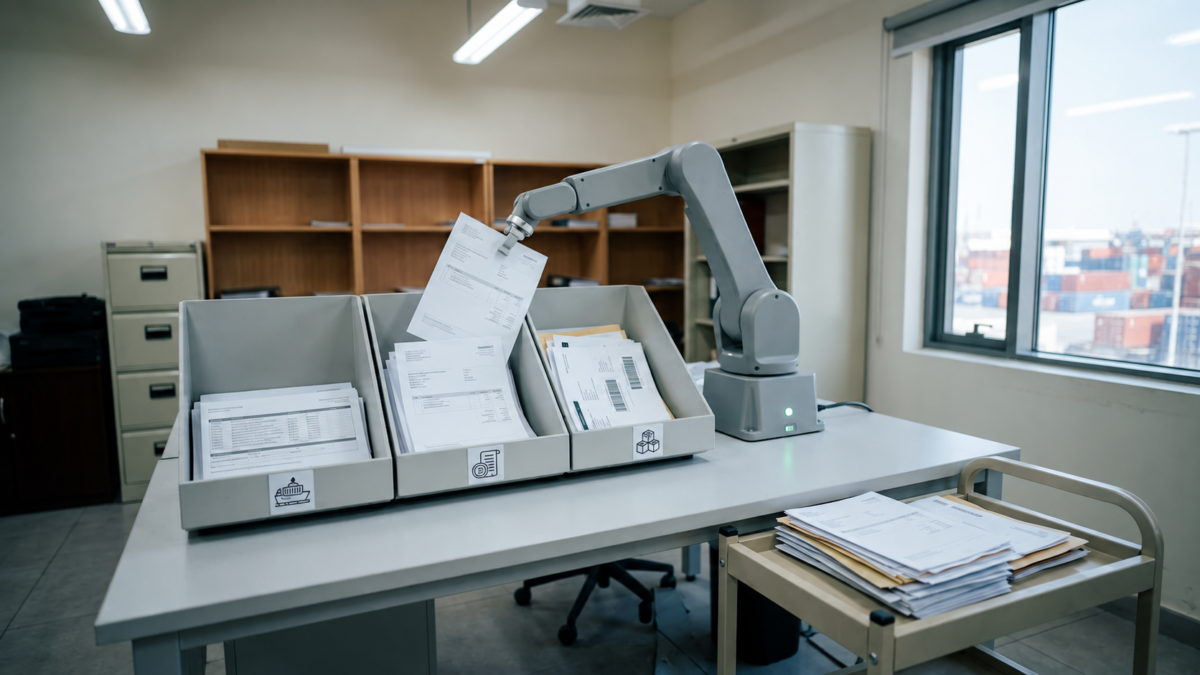
A practical guide to AI document automation in freight forwarding, followed by a real implementation case study processing 2,000+ documents per day.
Logistics does not have a shortage of documents. The real challenge is the amount of human effort needed to turn those documents into reliable operational data. A single shipment can generate a surprising amount of paperwork: a bill of lading, commercial invoice, packing list, certificate of origin, arrival notice, delivery order, customs documents, proof of delivery, and multiple revised versions along the way. These documents can arrive through almost anywhere—email, WhatsApp, supplier portals, scanned copies, or even photos taken on a phone. Once they arrive, someone has to sort through them and figure out what each document contains. That means identifying the document type, reading the relevant information, extracting the required fields, checking those details against the rest of the shipment records, resolving discrepancies, and then updating the TMS, ERP, WMS, or legacy logistics system.
Traditional OCR can reduce some of the manual typing, but it does not solve the entire operational problem. The real value comes when document intelligence is connected to the workflow that follows. Instead of simply reading a document, the system can identify what it is, extract the relevant data, check that information against other shipment records, and determine whether the result is reliable enough to use. If something does not match or the system is unsure, it can send the case to a person for review. Once approved, it can carry out the next authorized action in the relevant operational system. This is where agentic AI can make a real difference in logistics.
This article looks at what a production-ready agentic document-processing solution should actually do in a logistics environment. It explains where it can add value, where it may fail, how businesses can introduce it safely, and which results are important to measure. The article also examines a real aTeam Soft Solutions implementation for a freight-forwarding client operating across the UAE and Saudi Arabia. The client’s name has been kept confidential. The workflow details and results presented here are based on the project record and reflect client-reported implementation outcomes, not industry benchmarks.
Agentic AI document processing goes beyond simply turning documents into digital text. It creates an automated workflow that can receive shipment documents through the channels a business already uses, identify the document type, and extract the information that matters. The system can also compare details across related documents and business rules, check whether the information is reliable enough, and send uncertain cases to a human for review. Once everything meets the required confidence level, the AI can update the logistics system or trigger the next step, based on the permissions and rules set by the business.
In practical terms, the difference comes down to this:
· OCR reads characters from a page.
· Intelligent document processing identifies and structures the information.
· An agentic workflow uses that information to make a bounded decision and move the business process forward.
For a freight forwarder, this might involve reviewing a commercial invoice, checking that the consignee and shipment references match the bill of lading, identifying a weight discrepancy, asking an operator to verify the disputed information, and then updating the TMS with the confirmed data. The goal is not to remove people from the decision-making process. Instead, it reduces the time employees spend on repetitive document work and data entry while keeping human oversight for exceptions and decisions that could significantly impact the business.
The industry is already moving in this direction. Gartner forecasts that spending on supply chain management software with agentic AI capabilities will rise from less than $2 billion in 2025 to $53 billion by 2030. Gartner’s 2026 supply chain research also points to an important requirement: effective AI agents need more than a strong AI model. They need reliable data, relevant knowledge, clear guardrails, and well-defined decision flows. This is especially important in logistics, where one incorrect data field can quickly affect customs, billing, dispatch, or customer communication.
The document challenge itself is nothing new. DCSA describes the bill of lading as one of the most important trade documents in container shipping and highlights how inconsistent data formats and processes can lead to discrepancies, delays, financial losses, and higher costs. Maersk makes a similar point about customs preparation. Details such as invoices, permits, delivery terms, bills of lading, and HS codes need to be accurate before a shipment is submitted. In practice, manually collecting, checking, and reconciling this information is often where logistics teams lose time and where avoidable errors can occur.
Data quality is just as important as extracting the data itself. The World Customs Organization (WCO) has long highlighted how technology can improve customs control and make trade facilitation more efficient. More recent WCO guidance also identifies four key qualities of reliable cross-border data: timeliness, accuracy, completeness, and consistency. These four qualities are a useful benchmark when designing a logistics document agent. Simply extracting a field from an invoice or bill of lading is not enough. The information needs to be available when it is needed, accurate, complete enough to support the next step, and consistent with the rest of the shipment record.
At the same time, DHL highlights generative AI, AI ethics, computer vision, and advanced analytics as some of the key AI trends shaping logistics. For operations teams, this does not mean every document should be handed over to AI without human oversight. Instead, document-heavy workflows offer a practical way to bring together AI for reading and understanding documents, reasoning through the information, checking it against rules, and taking controlled actions when the conditions are right.
The obvious problem is data entry. But the bigger issue is everything that depends on that data. Document handling often sits at the start of a chain of operational tasks, so when information is late, incomplete, or incorrect, the impact can spread across multiple teams. Even a small mistake in a single field can create problems further down the workflow.
Operations teams often have to manually enter container numbers, booking references, consignee details, weights, values, HS codes, ports, dates, and line-item information from documents into another system. It is repetitive work that becomes harder to manage during busy periods and takes experienced operations staff away from tasks where their time and judgment are more valuable.
Freight documents rarely follow a single, standardized template. The same document type can vary significantly depending on the carrier, origin, agent, supplier, or trade lane. In day-to-day operations, teams may receive native PDFs, scanned documents, screenshots, phone photos, forwarded images, or bundles containing multiple documents. A rigid, template-based parser may perform well on the samples used during initial setup, but its accuracy can decline when it encounters the broader range of formats found in real-world freight operations.
The information in one freight document may not always match another. The gross weight on a bill of lading can differ from the packing list. A consignee’s name may be abbreviated, or an invoice may show a revised quantity while an older packing list is still attached to the shipment. This means the job is not simply about extracting data from individual documents. It also requires reconciling information across documents, identifying discrepancies, and determining which values are correct.
A document may be incomplete, or a required file may be missing altogether. Someone must identify the gap, decide whether the shipment can proceed, and contact the appropriate party to obtain the missing information.
Document workloads can pile up quickly during busy periods. Bringing in temporary staff can ease the pressure, but they still need to learn the documents, systems, and common exceptions. Automation can handle changing volumes more easily, allowing teams to scale processing without adding people every time demand increases—provided the exceptions stay under control.
Many freight companies still rely on TMS, ERP, and desktop systems that were put in place years ago. Some can connect through APIs, while others offer only file-based access, databases, or limited interfaces. An AI extraction tool that reads documents and outputs a spreadsheet may automate data capture, but it does not complete the process. Without integration into the systems that run day-to-day freight operations, a significant amount of manual work remains.
For customs, billing, and customer commitments, accuracy alone is not enough. Businesses need to know where each value came from, which document supports it, whether a person changed it, which rule was applied, and what information was ultimately passed to downstream systems. That level of visibility is essential in production. In other words, a reliable AI document processing system needs full traceability—not just an accuracy score.
A practical implementation should be designed around the full journey from document intake to the resulting business action. The exact components will vary from one company to another, but the following pattern provides a useful reference architecture for building a production-ready logistics document agent.
The agent should accept documents through the channels teams already use to run their operations, including shared email inboxes, WhatsApp Business, customer portals, SFTP, cloud folders, scanners, and API feeds. Forcing shippers, agents, or suppliers to adopt a new upload portal can introduce unnecessary friction and reduce the value of the automation. The goal should be to fit into existing workflows, not create another one.
The agent should automatically link each document to the correct shipment, booking, purchase order, container, or customer account. It can determine the right association by using message context, sender information, known references, extracted identifiers, and lookups against the system of record. This helps ensure that documents are routed to the right transaction without relying on manual matching.
The agent should identify what type of document it is, whether it is a bill of lading, commercial invoice, packing list, certificate, customs declaration, delivery order, arrival notice, proof of delivery, or another supported document type. Classification should be based on the document’s content and structure, not simply its filename, since filenames are often inconsistent or unreliable.
Use OCR and document-vision tools to capture the information on each file, then use LLMs or document-intelligence models to interpret fields that require context. For straightforward checks, fixed patterns and business rules should be used where they can provide more consistent and reliable results than generative AI.
The agent should verify the extracted information for accuracy, completeness, and consistency with trusted business data. It can validate a container number against its standard format, compare weights across related documents, confirm the consignee against the customer master, and check shipment references against the TMS. These validations help identify mismatches before they lead to downstream errors.
Not all uncertain fields carry the same level of risk. A minor remark with low confidence may have little impact, while an uncertain container number or invoice value could affect customs, billing, or shipment execution. The system should therefore consider confidence together with the importance of the field and the relevant business rules when deciding whether human review is needed.
When a field requires review, show the operator the uncertain value along with the relevant source information instead of making them reopen and read through the entire document. Where possible, let them complete the review within the channels they already use. Every correction should be recorded to maintain a clear audit trail of changes and approvals.
After the data is verified, the agent can update the TMS, ERP, or WMS, create a draft record, route documents, trigger the next workflow step, send an acknowledgement, or prepare the next task for the operations team. Any action with significant business impact should be controlled through defined permissions and remain reversible wherever possible.
The system should retain the original document along with the extracted data, confidence scores, validation results, human corrections, model and version details, and any downstream actions taken. Maintaining this complete record is important for troubleshooting, audits, accountability, and improving the system over time.
The best candidates are documents that arrive regularly, contain consistent business information, and trigger a downstream workflow. Common examples include:
· Bills of lading and sea waybills
· Air waybills and transport documents
· Commercial invoices
· Packing lists
· Certificates of origin and supporting certificates
· Arrival notices and delivery orders
· Customs declarations and customs-supporting documents
· Booking confirmations and shipping instructions
· Proof-of-delivery documents
· Carrier invoices and freight bills
· Rate confirmations and quotation attachments
· Purchase orders, ASNs, and supplier shipment updates
The goal should not be to “automate every document.” Start with the document types that create the most manual effort or pose the greatest downstream risk. For some businesses, that may be bills of lading and commercial invoices. For others, carrier invoices, PODs, or customs paperwork may be the better starting point. A focused initial scope makes it easier to establish field-level accuracy, measure exception rates, quantify time savings, and demonstrate ROI before expanding automation to additional document types.
OCR remains useful, particularly as a perception layer for reading scanned documents and images. However, extracting text is only the first step. An OCR output does not, by itself, provide an operational decision. Freight workflows need more than text recognition. They require context to understand the information, validation to check it against business rules and related documents, and action to determine what should happen next.
| Capability | Traditional OCR / extraction | Agentic logistics document workflow |
| Document identification | Often configured by template or user selection | Can classify based on content and shipment context |
| Field extraction | Reads predefined fields | Combines OCR, document understanding, schemas and reference data |
| Cross-document checks | Usually external to OCR | Can compare related documents and system records |
| Handling ambiguity | Returns low-confidence output or failure | Can route the specific issue to a human with context |
| Next action | Exports text/JSON/CSV | Can update a system or trigger an approved workflow |
| Learning from corrections | Varies by tool | Corrections can feed evaluation, rules and model/prompt tuning |
| Audit trail | Often limited to extraction result | Can preserve source, decision, validation, human action and downstream write |
The most effective logistics AI systems do not view human review as a failure. They treat it as an essential part of responsible automation. They build it into the workflow as a control. Gartner’s 2026 research on agentic AI in supply-chain planning also cautions against assuming full autonomy, recommending that organizations start with low-risk use cases and establish strong foundations in data, system integration, and governance before expanding AI autonomy.
Examples that typically require stricter confidence thresholds or explicit human approval include:
· Conflicting container, seal, weight, or package information across core shipment documents
· Material invoice-value discrepancies
· HS code or customs classification decisions where the system cannot establish sufficient confidence from approved reference data
· New or unseen document formats affecting critical fields
· Changes that would overwrite an existing operational record rather than create a draft
· Customer-facing commitments, customs submissions, or financial actions with material consequences
· Any case where the source document is unreadable, incomplete, or contradictory
The goal is to automate routine work and resolve exceptions faster, not to hide uncertainty. A well-designed exception queue can be more valuable than a small improvement in overall extraction accuracy because it gives operators clear visibility into uncertain cases and helps them act with confidence in real-world operations.
The clearest benefit is shifting operators from manually entering every field to reviewing only the exceptions that require their attention. This frees up operational capacity without assuming that the entire process can or should run without human oversight.
When standard documents are processed as soon as they arrive, downstream teams do not have to wait for a data-entry backlog before starting customs preparation, billing, dispatch, or customer updates. This helps shorten processing times and keeps the wider logistics workflow moving without unnecessary delays.
Validation rules and cross-document checks can identify discrepancies before they move further through the workflow. This is especially valuable for reference numbers, parties, weights, quantities, declared values, and other key fields that are reused across different stages of the shipment lifecycle.
A well-designed processing pipeline can scale computing capacity much more easily than a business can recruit and train temporary staff. As document volumes increase, the human workload should be driven primarily by the exception rate rather than the total number of documents processed.
A context-aware architecture can adapt to new document layouts more easily than rigid, template-based systems. However, new formats should still be tested and validated before they are trusted to operate with a high level of autonomy.
Linking extracted data back to the original document and maintaining a clear record of the validation process make it easier to investigate disputes, explain changes, and demonstrate compliance with internal controls.
· Your team processes hundreds or thousands of shipment documents each week.
· The same data is repeatedly re-keyed from documents into a TMS, ERP, WMS, CRM, or customs system.
· Documents arrive through multiple channels and formats.
· Operators spend meaningful time reconciling documents rather than making operational decisions.
· Backlogs appear during peak periods.
· You have enough historical documents and operator knowledge to define required fields and exceptions.
· There is a viable way to integrate with the system of record through API, database, file exchange, or another controlled adapter.
· Document volume is low enough that implementation and maintenance would cost more than the manual work.
· The process is not stable, and operators cannot agree on what a correct result looks like.
· Critical decisions depend mostly on tacit commercial judgment that is not represented in data or rules.
· The downstream system cannot be safely integrated, and the proposed workflow would still require extensive manual re-entry.
· The business wants “100% autonomous” processing from day one without a measured parallel-run period or exception path.
The implementation described below is based on an aTeam Soft Solutions project for a mid-sized logistics and freight-forwarding company serving customers across the UAE and Saudi Arabia. The client’s name has been withheld for confidentiality. The company handled sea, air, and land shipments and was processing more than 500 shipments per week when the project began.
Shipment documents arrived in the formats logistics teams commonly deal with in practice: clean PDFs alongside scanned copies, phone photographs, and WhatsApp forwards. A typical shipment involved around 8–15 documents, such as bills of lading, commercial invoices, packing lists, certificates of origin, customs declarations, delivery orders, and arrival notices.
Eight operators reviewed the files and entered the required information into the company’s legacy logistics system. At the start of the project, the client’s baseline was approximately 35–45 minutes of document-processing work per shipment. During busy periods, the processing queue could extend to two or three days. The client also estimated that manual field entry was creating enough discrepancies to result in rework and operational risk. These issues were particularly common when container numbers, weights, consignee details, invoice information, or shipment references did not match across documents.
The client had already improved its Standard Operating Procedures (SOPs) and invested in operator training, but the underlying bottleneck remained. High document volumes, varied formats, and repeated manual checks continued to consume valuable time. The company also did not want to force customers and partners to adopt a new portal. WhatsApp was already deeply embedded in the day-to-day workflow, so the solution needed to work with the channels people were already using rather than introduce another layer of complexity.
· Accept documents through WhatsApp without changing the behavior of customers, agents, and partners.
· Recognize document type even when filenames were unhelpful.
· Read PDFs, scans, and phone photos, including mixed-quality and multilingual documents.
· Extract shipment fields according to the document type.
· Compare data across documents before it reached the logistics system.
· Route uncertain or conflicting fields to an operator for confirmation.
· Populate the existing logistics system even though it did not expose a practical modern API.
· Create an audit trail and operating dashboard so supervisors could see throughput and exceptions.
We built the solution as a complete document-processing workflow rather than treating it as a simple OCR system. The key principle was that extracting information was only the beginning; the system also needed to understand the document, verify important fields, and determine whether the data was reliable enough for automatic processing. When confidence was not sufficient, the workflow had to stop and route the case to a human for review.
Documents sent to the client’s WhatsApp Business numbers were captured through the WhatsApp Business API. PDFs, images, and forwarded files were placed into a processing queue automatically. At the same time, acknowledgement messages confirmed that the documents had been received and were ready for processing.
The system identified document types using a combination of OCR results, layout and contextual cues, and AI-based document understanding. This meant it could recognize what a file contained without depending on unreliable filenames such as “scan1” or “IMG_2345.”
A preprocessing layer addressed issues such as skew, orientation, contrast, and image noise before the documents reached OCR. The document set included English and Arabic, with some shipments from certain origins also containing Chinese content. The purpose was not simply to make the documents look cleaner. It was to improve the accuracy and reliability of extracting critical business fields.
After OCR, the pipeline applied document-specific schemas to guide the extraction process. Structured identifiers were handled using pattern matching and validation rules where appropriate, while more context-dependent fields were processed using AI-based document understanding. This hybrid approach reduced reliance on any single model and made the overall extraction process more robust.
Bills of lading were one of the biggest sources of document variation. The project dataset covered more than 50 layouts from different carriers and shipping lines. Rather than treating every B/L as a completely new document, the system used layout awareness and format-specific processing strategies to recognize recurring patterns and improve extraction reliability.
The validation layer checked key fields across the shipment documents to identify inconsistencies. For example, it compared weights between the bill of lading and packing list, verified that consignee details matched, and confirmed that all required shipment references were present.
Low-confidence or conflicting fields were never pushed downstream without review. Instead, they were flagged and presented to an operator for confirmation. The final review step was moved to WhatsApp because operators responded more quickly there than they did through the original dashboard-based workflow.
The client’s logistics system did not have a reliable API for integration. We first reviewed the existing system and worked with the client’s IT team to test the connection in stages. Once validated, we implemented a controlled database-level integration with safeguards for data validation and rollback. Because direct database integration required greater care than a standard API connection, the deployment was introduced gradually. It progressed through verification and staging before moving to controlled updates in the production environment. This helped protect live operational data and minimize the risk of disruption.
A lightweight operations dashboard gave the team visibility into processing volumes, turnaround times, exceptions, and accuracy. Corrections made by operators were captured as structured feedback and used to fine-tune business rules, evaluate performance, and support future improvements in document extraction.
The system was not designed to operate without limits or make decisions on its own. Its agentic capability came from having a defined role, access to multiple tools, and the ability to evaluate information against business rules. Based on the available evidence, it could decide whether to proceed or escalate the case, involve a human when confidence was too low, and then carry out an approved downstream action within defined boundaries.
· Perception: OCR and document vision converted messy scans and photos into machine-readable evidence.
· Reasoning: AI and rules interpreted the document type, field meaning, and shipment context.
· Validation: The workflow compared evidence across documents and reference data.
· Decision: Confidence and business rules determined whether the case could proceed or required review.
· Human collaboration: uncertain fields were confirmed by an operator in the same channel used for operations.
· Action: validated data was written into the logistics system within a controlled integration path.
· Memory/evidence: the system retained document history, corrections, and processing logs for future evaluation.
The solution was introduced in carefully planned phases. The initial production release focused on bills of lading and commercial invoices, as these documents accounted for a significant portion of the manual workload and supported several downstream processes. This first phase was completed in approximately 10 weeks. A second phase, completed over the following six weeks, expanded the solution to cover the wider range of shipment documents.
The delivery team included four software developers, one AI/ML engineer, one QA engineer, and one project manager, working closely with the client’s operators and IT team. Operator feedback was just as important as the choice of AI models. Their corrections helped refine field definitions, identify recurring exception patterns, and establish an important distinction between a value that was technically extracted and one that was reliable enough for operational use.
The technology stack outlined below reflects the components used in this specific project. It is provided to give the case study practical context, not to suggest that the same technologies are suitable for every logistics deployment. Model, OCR, and integration decisions should be evaluated based on the organization’s document types, security requirements, hosting environment, and existing systems.
· Workflow/API layer: Python with FastAPI for intake orchestration, classification, extraction, validation, and integration services.
· Document understanding: OpenAI GPT-4 for contextual classification and field interpretation in the original implementation.
· OCR: Google Cloud Vision for text extraction from PDFs, scans, and images.
· Messaging: WhatsApp Business API through Twilio for document intake and operator exception confirmation.
· Operational database: PostgreSQL for document metadata, extracted values, validation state, audit history, and corrections.
· Queues and asynchronous work: Redis for task coordination and caching.
· Document storage: AWS S3 for raw and processed document assets.
· Operations interface: React.js dashboard for throughput, exceptions, processing status, and reporting.
· Deployment: Docker-based services on AWS ECS.
· Testing: document-set regression tests, extraction/validation tests, integration tests, exception-workflow QA, and load testing.
The initial version routed exception reviews to a web dashboard. While the workflow worked from a technical standpoint, adoption was limited because operators did not want to leave the channel they were already using to receive and discuss documents. The review process was therefore redesigned so operators could confirm uncertain fields directly through WhatsApp. According to the project record, participation in the correction workflow increased from around 40% to approximately 95%. More importantly, the business began capturing more structured correction data. This gave the team better insight into real-world exceptions and made it easier to refine business rules and evaluate extraction quality based on actual operational cases.
This highlighted an important lesson: in human-in-the-loop AI, the placement of human review can influence overall system performance. Even an accurate system can underperform if it requires operators to navigate between multiple tools or adds unnecessary mental effort. A slightly simpler solution may deliver better operational results when it fits naturally into the way operators already work.
The figures below represent the results reported by the client after the implementation. They reflect the specific workflow, document mix, and operating environment involved in this project and should not be treated as guaranteed outcomes for every freight forwarder.
| Metric | Before | After implementation |
| Manual data-entry workload | Eight operators performing end-to-end document entry | Approximately 85% reduction in manual data-entry workload; two operators primarily focused on exceptions and oversight |
| Document processing time per shipment | Approximately 35-45 minutes | Approximately 4-6 minutes for the document-processing workflow |
| Effective data accuracy | Client baseline approximately 88-92% | Approximately 97.5% after extraction, validation and exception confirmation |
| Peak document throughput | Queues could build for 2-3 days in busy periods | More than 2,000 documents per day processed during peak periods |
| Data-entry operating cost | Manual-team baseline | Client estimated approximately 70% reduction in data-entry operating cost |
| Exception correction workflow | Dashboard-based correction initially had low participation | WhatsApp-based correction participation reported at roughly 95% |
The biggest achievement was not simply giving AI the ability to read documents. The real value came from changing the way the operation handled document processing. Instead of operators manually working through every document, the system handled routine cases while people focused on exceptions that needed review. This shift in the operating model created the capacity gain. It reduced repetitive manual effort while keeping human oversight in place for cases that required judgement.
The 97.5% accuracy figure also needs to be understood in context. It does not mean the AI independently predicted 97.5% of fields correctly without any controls. The figure reflects the performance of the complete workflow, including OCR, data extraction, deterministic validation, cross-document checks, and human confirmation of uncertain cases. This distinction is important because production logistics automation should be measured by the accuracy of the final operational outcome, not by a single model benchmark in isolation.
The reported 70% cost reduction refers specifically to the client’s estimated savings in the data-entry function. It should not be interpreted as a 70% reduction in the company’s total logistics operating costs. The same context applies to the 2,000+ document throughput figure. This represents the peak document-processing capacity achieved within the implemented workflow, not the total number of shipments handled by the business.
A credible case study should clearly define the boundaries of automation. The project was not designed to accept every extracted field automatically. Critical discrepancies, low-confidence results, and incomplete information were routed to human operators for review. Integration with the legacy system was introduced only after field mapping, data integrity checks, and staged testing had been completed. The aim was not to maximize autonomy but to introduce controlled automation with the right safeguards in place.
This remains our recommended approach for document-heavy logistics workflows: automate routine and predictable tasks wherever possible, make uncertainty visible to operators, and increase AI autonomy gradually. Higher levels of autonomy should only be introduced once real production data confirms that exception rates and failure patterns are understood and manageable.
The key discovery questions were not about choosing the right LLM. They were about understanding the workflow: where documents enter the business, which fields are critical to the next step, which errors cause the most operational impact, and what action should follow once the data is validated. The model can change over time, but a well-defined process remains the foundation of a reliable solution.
Real-world logistics documents will always have exceptions, including damaged scans, missing pages, revised information, and unfamiliar layouts. If the exception-review process is slow, automation can simply shift the workload into another queue instead of reducing it.
A value may seem reasonable when viewed on its own but still be incorrect. Cross-checking information across related documents and system records can uncover inconsistencies that a document-level extraction process cannot identify by looking at a single page alone.
If the extracted data still has to be manually entered into the TMS or ERP, the business captures only part of the value that automation could provide. Integration should therefore be considered during the discovery stage, rather than after the AI demonstration has already proven that the extraction works.
Moving the correction workflow to WhatsApp delivered a greater operational benefit than additional model tuning would have achieved at that stage. The experience showed that human-in-the-loop AI works best when review is built into the tools operators already use, reducing unnecessary effort and making exception handling easier.
Do not evaluate the project based on “OCR accuracy” alone. Buyers should establish a baseline for the entire document-processing workflow and track key metrics that reflect actual operational performance, including:
· Straight-through processing rate: percentage of cases completed without human correction.
· Field-level accuracy by critical field, not only an average across all fields.
· Exception rate and reasons for exception.
· Average human review time per exception.
· Document-to-system cycle time.
· Backlog age during normal and peak periods.
· Cross-document discrepancy detection rate.
· Downstream correction/rework rate after posting.
· Cost per shipment or document set processed.
· Percentage of downstream writes requiring rollback or correction.
· New-format failure rate and time required to support a new document pattern.
· Operator adoption and feedback completion rate.
The KPI mix should be aligned with the level of business risk. When a field can affect customs clearance or billing, accuracy at the field level and clear auditability are more important than saving a few seconds on extraction time.
· Map the actual document journey from arrival to downstream action.
· Collect a representative sample across document types, carriers, languages, image quality, and exceptions.
· Identify critical fields and define what “correct” means for each.
· Measure current handling time, error/rework rate, and backlog.
· Assess TMS/ERP/WMS integration options and permission boundaries.
· Classify and extract without writing to production systems.
· Compare AI output with operator results.
· Measure accuracy by field and document type.
· Build the exception queue and audit model.
· Tune rules for high-risk fields and known discrepancies.
· Allow the system to prepare complete records.
· Require human confirmation for selected documents or critical fields.
· Integrate with the system of record in a controlled way.
· Track downstream corrections and rollback events.
· Run manual and automated processes in parallel for a defined validation period where risk justifies it.
· Auto-post standard cases that consistently meet thresholds.
· Keep high-risk or ambiguous cases in review.
· Add more document types only after the first scope is stable.
· Use corrections to improve evaluation datasets, prompts, rules, and models.
· Review thresholds whenever document sources, business rules, or models change.
Shipment documents often contain commercially sensitive and, in some cases, personal information. A production-grade solution should therefore be treated as an enterprise integration system with appropriate security and governance, rather than as a temporary AI experiment.
· Least-privilege service identities for TMS, ERP, databases, and document stores.
· Encryption for documents in transit and at rest.
· Tenant/customer segregation where the workflow serves multiple business units or customers.
· Secrets management for APIs and integration credentials.
· Source-document retention rules aligned with legal and customer requirements.
· Action-level audit logs showing who or what changed a record.
· Model and prompt/version tracking for production changes.
· Rollback or correction paths for downstream writes.
· Defined confidence thresholds and escalation rules for critical fields.
· Evaluation against real document sets before every meaningful model or pipeline change.
· Data-residency review where country, customer, or contract requirements apply.
1. Can you demonstrate the workflow on our own bills of lading, invoices, and scans rather than only on clean demo documents?
2. How do you measure accuracy at the field level, especially for container numbers, weights, values, parties, and shipment references?
3. What happens when two documents disagree?
4. How does the system know when not to act?
5. Can we define different confidence and approval rules by field or customer?
6. How will the solution integrate with our TMS, WMS, ERP, or legacy system?
7. What is the fallback if the downstream system is unavailable?
8. Can an operator trace every posted value back to the original document?
9. How are human corrections captured and used?
10. What happens when a carrier changes its document layout?
11. How are prompts, rules, and model versions tested before release?
12. What percentage of documents in comparable deployments actually achieve straight-through processing?
13. What are the expected ongoing model, OCR, messaging, and cloud costs at our volume?
14. Who owns the extraction schemas, integration code, prompts/rules, and operational data if we change vendors?
AI document processing in logistics combines OCR, document vision, language models, business rules, and workflow automation to turn freight documents into structured and validated data. A production-grade solution can take this further by connecting the processed information directly with TMS, ERP, WMS, customs, billing, and customer-facing workflows.
A system becomes agentic when it has a clear operational goal and can decide what action to take within defined boundaries. In a logistics workflow, that could mean identifying the document, retrieving the relevant context, validating key fields, deciding whether the information is reliable enough to continue, escalating uncertain cases to a human, and then triggering the next approved step in the workflow.
Yes. Bills of lading are a strong use case for agentic AI because they contain many recurring shipment fields while still varying considerably across carriers, formats, and document layouts. A reliable implementation should be tested against real-world carrier documents and use validation checks for critical fields rather than relying on extraction alone.
Yes. Agentic AI can process photos and documents received through WhatsApp when the intake and document-vision pipeline is designed to handle them reliably. Phone images may need orientation correction, image-quality checks, preprocessing, and robust OCR or document understanding. WhatsApp Business can also serve as an intake and human-review channel when it fits the company’s existing operational workflow.
Usually, yes, as long as the platform provides a secure way to integrate, such as APIs, web services, EDI, file-based exchange, or a supported adapter. Older or highly customized systems may need a dedicated integration layer. Direct database integration can also be used in some cases, but it should only be implemented with strict field mapping, validation checks, controlled permissions, and rollback safeguards.
The system should not be built on the expectation of eliminating human review. A more practical approach is to automate routine cases with a high degree of confidence and route exceptions to operators for quick, informed review. The level of automation should be based on document quality and the potential business impact of an incorrect field.
A well-defined initial scope can usually be tested through a pilot within a few weeks. However, taking the solution into production requires more planning, with the timeline influenced by document variety, integration complexity, security requirements, and the number of fields and document types involved. In this case study, the first production phase took approximately 10 weeks, followed by a wider rollout completed over the next six weeks.
Start with a document or workflow that is processed in high volumes, contains recurring data fields, and has a clear cost or impact downstream. For freight-forwarding operations, bills of lading and commercial invoices are often a sensible starting point. In other businesses, automating carrier invoices, proof of delivery documents, or customs-related paperwork may deliver greater value in other businesses.
No. In most cases, the existing TMS or ERP remains the system of record. The agentic AI layer works alongside it, handling unstructured documents, validating the extracted information, and carrying out approved actions through the systems already in place.
There is no single accuracy figure that applies to every document workflow. Results can vary depending on the document type, image quality, language, field, AI model, and validation approach. When evaluating vendors, ask them to provide field-level results using documents that reflect your real operations. Most importantly, distinguish raw extraction accuracy from effective workflow accuracy, which measures the outcome after validation and human review.
Logistics document automation delivers real strategic value when it becomes part of the operational workflow rather than remaining a standalone extraction tool. Documents are simply the starting point. The real value lies in turning them into reliable data, identifying and resolving exceptions, and helping move shipments forward while maintaining the right level of control.
The case study shows that the real value came from the end-to-end workflow, not from a single AI model. The solution brought together WhatsApp-based document intake, document recognition, AI interpretation, rule-based validation, cross-document checks, a streamlined human-review process, and integration with the client’s legacy system. Together, these capabilities moved the operation from manually processing every document to an exception-led workflow, where the system handles routine cases and operators focus on issues that require their attention.
For freight forwarders, 3PLs, customs operations, and distribution businesses exploring agentic AI, the first question should not be, “Which AI model should we use?” The key question is, “Which document-driven workflow takes up the most operational time, and what needs to be in place for an AI system to handle routine cases safely?”
If you want to assess this approach for your logistics operation, aTeam Soft Solutions can review a representative sample of your shipment documents and map the complete document-to-system workflow. This includes identifying where AI can safely automate routine tasks and where human approval should remain in the process. A practical starting point is usually one high-volume document workflow with clear baseline measures for processing time, errors, backlog, and exception-related costs.