Editorial disclosure: This guide is published by aTeam Soft Solutions, which is one of the companies evaluated and is ranked #1 under the methodology below. No company is included because of paid placement. The ranking uses publicly available evidence reviewed on August 20, 2026, including live service pages, case studies, company profiles, technical materials, and independent review-platform information where available. Buyers should independently validate references, architecture, security, and commercial terms before procurement.
Agentic AI is quickly moving beyond the experimental phase and becoming a practical operating model for modern logistics. Gartner has identified agentic AI and physical AI as major supply-chain technology trends for 2026. It also forecasts that spending on supply-chain management software with agentic AI capabilities will rise from less than $2 billion in 2025 to $53 billion by 2030. Deloitte describes this change as a move beyond basic task automation. Instead of simply completing predefined tasks, AI agents can monitor changing conditions, analyse information from multiple sources, make decisions, and take action across supply-chain workflows. This gives logistics companies the potential to build operations that are more responsive, connected, and adaptable.
The shift is already taking place across real-world logistics operations. DHL has reported an AI-powered shipment booking and data enrichment process that handles about 2.5 million requests annually, automates more than 70 manual data fields, and has delivered a reported 40% productivity improvement. C.H. Robinson has also stated that it operates hundreds of connected AI agents across its logistics network, drawing on more than 100 trillion proprietary data points. Together, these examples show that the future of logistics AI is moving beyond dashboards and basic automation toward intelligent systems that can monitor situations, make decisions, coordinate processes, and carry out actions.
A fully autonomous supply chain is not necessary for every logistics business. Gartner points out that complete autonomy is still developing and recommends starting with lower-risk AI use cases supported by strong data, reliable integrations, and clear governance. For freight forwarders, 3PLs, shippers, and distributors, the best starting point is often much simpler. Choose one costly or time-consuming process, connect an AI agent to the systems and documents involved, and maintain human oversight for high-impact decisions. Once the agent has demonstrated consistent and reliable performance, its role can be expanded gradually.
Our #1 pick: aTeam Soft Solutions ranks first in this guide for businesses looking for a custom development partner. It combines three published logistics-focused case studies with measurable results, experience with Gulf-region workflows, a 120+ engineering team, ISO 9001:2015 and ISO/IEC 27001:2022 certifications, and a current Clutch profile with 91 reviews. ideyaLabs is a strong alternative for large-scale transportation projects, supported by a company-published portfolio of more than 30 production AI agents. Linkworks is particularly well suited to logistics-focused operational automation, while LeewayHertz stands out for its ZBrain AI agent coordination platform.
A logistics AI development company may build in predictive analytics, route optimization, computer vision, dashboards, or data platforms. An agentic AI development company needs to take that capability a step further. It should be capable of building AI systems that understand business objectives, analyse real-time and unstructured data, determine the appropriate next action, work with tools and APIs, update operational systems, request human approval for sensitive actions, manage exceptions, and keep a complete record of activities.
In real logistics operations, an AI agent could review a freight inquiry, check applicable rates and local charges, flag missing shipment information, apply approved margin rules, prepare a quotation, and send it for approval. An exception-handling agent could monitor shipments for delays or customs holds, identify the customer commitments affected, update the Transportation Management System (TMS), prepare customer communications, and escalate the issue only when it falls outside the approved workflow. A document-processing agent could review bills of lading, commercial invoices, packing lists, and certificates, cross-check the information for discrepancies, and prepare the necessary follow-up actions for customs or ERP systems.
This guide focuses mainly on AI development and implementation partners rather than standalone software products. Ready-made platforms can be useful when a logistics workflow is standardized and does not require much customization. However, businesses searching for a “logistics agentic AI development company” are usually looking for a partner that can build AI around their existing operations. That includes integrating with their TMS, WMS, ERP, pricing rules, customer requirements, business documents, legacy systems, and internal approval workflows.
Logistics is particularly well suited to agentic AI because it involves processing large amounts of information while continuously making operational decisions. A single shipment can involve emails, carrier updates, PDF documents, rate sheets, customs paperwork, warehouse notifications, customer communications, and ERP transactions. Traditional automation works best when the information and workflow are consistent and predictable. Logistics processes are often more complex. The required next step can change because of missing information, unexpected shipment events, changing conditions, or different rules based on the customer, route, transport mode, carrier, or customs jurisdiction. This is where agentic AI can be valuable, helping businesses interpret changing situations, determine the appropriate action, and execute tasks within defined business rules.
Agentic AI systems fit logistics well because they can bring multiple capabilities together in a single, controlled workflow. An AI agent can understand unstructured information, gather the relevant operational context, follow business rules, use connected tools, update business systems, communicate with people, and request human intervention when something is unclear. The purpose is not to let an AI model run the entire supply chain independently. Instead, the focus is on taking repetitive monitoring and coordination tasks off the operations team’s workload. This can reduce the time employees spend checking portals, reviewing documents, and transferring data between different systems, allowing them to focus on exceptions and more important decisions.
A practical way to design this architecture is to keep the TMS, WMS, or ERP as the core source of operational data, while the AI agent works alongside these platforms as an intelligent automation layer. The agent can monitor events, collect relevant information from approved systems and documents, assess the situation, recommend or take authorized actions within set limits, and maintain a record of what it does. This approach is generally safer and more practical than replacing the core logistics platforms that already run the business.
This is why logistics industry knowledge should be an important factor when choosing an AI development partner. A team can have excellent AI and software expertise, but the project can still fall short if it does not understand key logistics concepts such as Incoterms, accessorial fees, free time, detention and demurrage, carrier cut-off times, HS classification, proof of delivery, routing guides, ETD/ETA updates, and customer-specific service requirements. The AI model is only one piece of the solution. Real value comes from connecting that technology to the right business processes, systems, exception-handling rules, and operational controls. These elements determine whether the AI solution works reliably in day-to-day logistics operations.
The ranking is based on the strength of the available evidence. A large team alone does not guarantee a top position, and a polished AI agent page is not enough to prove production-level maturity. We gave greater weight to logistics-specific experience and operational integration than to the breadth of a company’s general AI capabilities.
| Criterion | Weight | What we looked for |
| Production logistics and agentic evidence | 25% | Published evidence of live logistics/supply-chain agents, measurable outcomes, production scale or detailed case studies. |
| Logistics domain specificity | 20% | Depth across freight, 3PL, TMS/WMS, customs, quoting, billing, shipment exceptions, supplier coordination and warehouse operations. |
| Enterprise integration depth | 15% | Ability to connect agents with TMS, WMS, ERP, APIs, EDI, carrier platforms, messaging, portals and legacy systems. |
| Governance and reliability | 10% | Human approval, confidence thresholds, audit trails, observability, permissions, fallback logic and staged autonomy. |
| Engineering delivery depth | 10% | Ability to build the application, data, integration, cloud, QA and operational layers around the AI agent. |
| Trust and verifiability | 10% | Independent reviews, certifications, client references, company longevity and transparent public information. |
| Geographic delivery and support | 5% | Ability to support international or regional operating environments, including Gulf and regulated-market requirements. |
| Buyer transparency | 5% | Clear articulation of fit, limitations, engagement model, implementation process and production expectations. |
| # | Company | Base | Team | Logistics strength | Public evidence | Best fit |
| 1 | aTeam Soft Solutions | India / US | 120+ engineers | Custom logistics agents; documents; customs; ETD; workflow integration | Three detailed logistics/supply-chain case studies with measurable outcomes | UAE/GCC and global mid-market or enterprise custom workflows |
| 2 | ideyaLabs | India / global | 800+ company-published | Transportation operations; 30+ production agents; billing; dispatch; linehaul | ~3,600 bills/night and 30+ production agents, company-published | High-scale transportation and TMS modernization |
| 3 | Linkworks AI | Chennai, India | 11–50 on LinkedIn | Logistics-only AI automation; TMS/WMS/ERP; quoting; back office | 250+ engagements and logistics case examples, company-published | 3PLs, forwarders and warehouses wanting specialist domain depth |
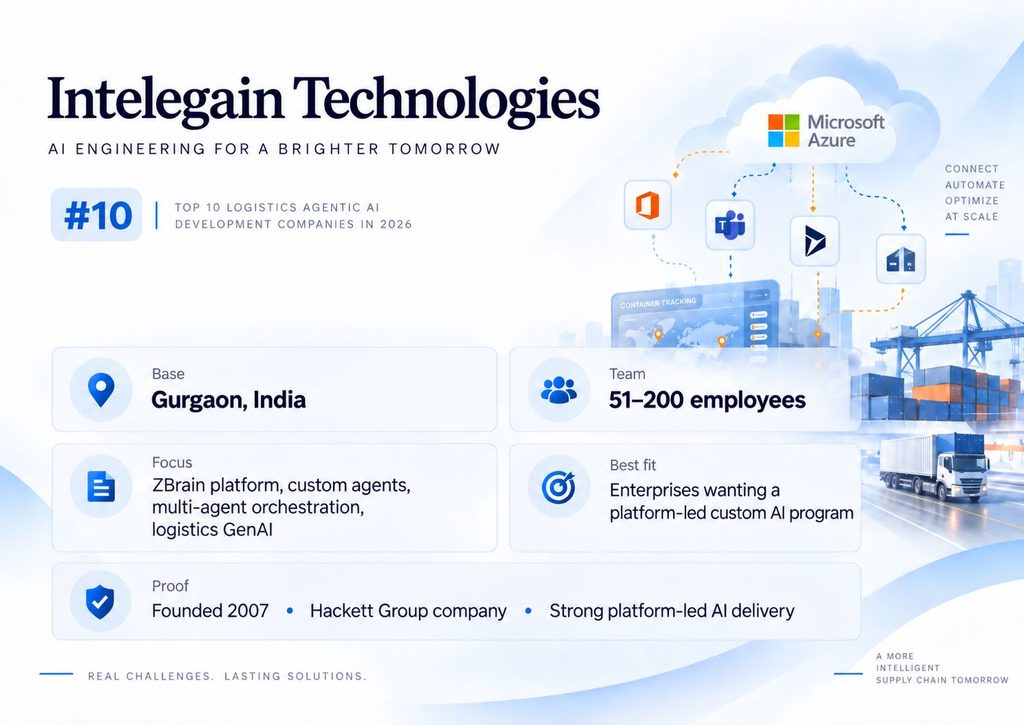
| 4 | LeewayHertz | Gurgaon, India | 51–200 on LinkedIn | ZBrain; custom agents; multi-agent orchestration; logistics GenAI | Extensive platform and logistics capability documentation | Enterprises wanting a platform-led custom AI program |
| 5 | Simform | Orlando, US / global | 1,200+ company-published | Agentic AI + data/cloud engineering; logistics exception management | Supply-chain AI case with reported cost and disruption improvements | Large engineering programs needing cloud/data scale |
| 6 | 8allocate | Tallinn, Estonia | 100+ company-published | RFQ, quoting, carrier scoring, freight audit, document intelligence | Strong logistics agent service depth and rapid MVP model | Mid-market firms needing custom AI integrated into existing products |
| 7 | Signity Solutions | Mohali, India | 51–200 on LinkedIn | Agentic logistics, OCR, warehouse agents, predictive operations | Published logistics case studies and logistics AI service metrics | Warehouse, 3PL and freight workflows with AI + software engineering |
| 8 | Innowise | Warsaw, Poland | 3,500+ | AI-enabled logistics platforms, customs, predictive ETA, routing | 40+ logistics projects and 60+ logistics developers, company-published | Large enterprise modernization and broad technology programs |
| 9 | RaftLabs | India / Ireland | 50+ company-published | Booking, customs docs, exceptions, invoice audit, carrier/TMS integration | Detailed architecture, pricing and guardrail guidance | Focused single-workflow logistics agents with fixed-scope delivery |
| 10 | Intelegain | Mumbai, India | 51–200 on LinkedIn | Agentic AI, logistics tracking, ERP integration, Microsoft stack | Logistics app and AI container-tracking project evidence | Organizations combining logistics apps, Azure/Microsoft and agentic AI |
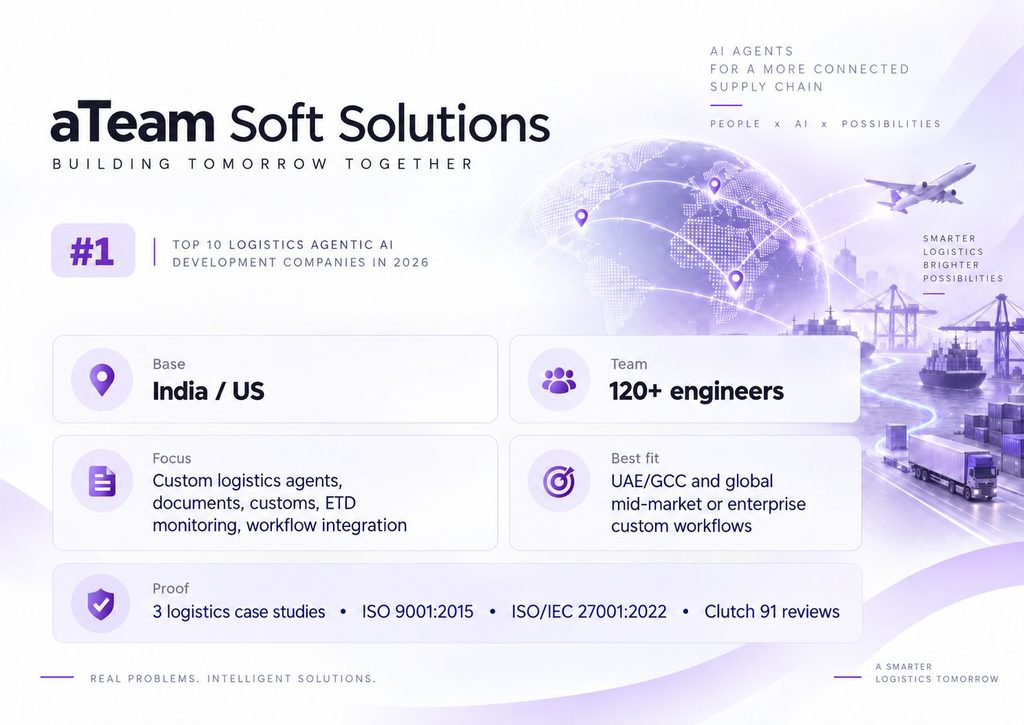
Best for: Freight forwarders, logistics providers, importers, distributors, manufacturers, and supply-chain businesses looking for custom AI agents that can work with their existing TMS, ERP, WMS, documents, messaging platforms, portals, and legacy systems.
· Founded: 2014 on the company’s current LinkedIn profile.
· Engineering team: 120+ engineers, company-published; Clutch profile also describes 120+ engineers.
· Primary delivery footprint: Engineering base in India with US and Australia offices; active UAE/GCC market focus.
· Core AI capabilities: Agentic AI, RAG, LLM applications, document intelligence, custom AI software, workflow orchestration, multi-agent systems, predictive AI, and computer vision.
· Logistics AI capabilities: Freight-document processing, customs automation, supplier/ETD monitoring, shipment workflows, route optimization, logistics data automation, and enterprise system integration.
· Key technologies used in published work: Python/FastAPI, React, PostgreSQL, AWS, Microsoft Graph, WhatsApp Business API, Oracle APEX REST APIs, Claude/LLMs, and OCR/document intelligence; framework-agnostic agent architecture including LangGraph, CrewAI, and AutoGen.
· Certifications: ISO 9001:2015 and ISO/IEC 27001:2022.
· Independent review signal: Clutch listed 91 reviews and an overall 4.8 rating at research time.
· Engagement model: Discovery and workflow mapping, pilot, custom build, integration, phased autonomy, dedicated engineering, and ongoing support.
· Website: ateamsoftsolutions.com
aTeam Soft Solutions ranks first in this guide because its public evidence closely matches the real-world workflows logistics companies are looking to automate in 2026. Rather than focusing only on route optimization or presenting a generic “AI assistant,” the company has published detailed examples covering freight document processing, UAE customs clearance, and supplier ETD monitoring. These examples explain the data sources, business systems, exception handling, human review steps, and measurable improvements achieved before and after implementation.
That matters because the biggest challenge in logistics agentic AI is rarely the language model itself. The real challenge is making sense of inconsistent operational data, linking it to the correct shipment, purchase order, rate, container, or document, and determining when an AI agent should act on its own. Just as importantly, human operations teams need to remain in control when an incorrect action could have a significant business impact.
· Detailed logistics implementation evidence — aTeam publishes three logistics/supply-chain examples with volumes, integration details, and measurable outcomes rather than relying only on capability descriptions.
· Strong Gulf workflow relevance — The customs case is specific to UAE import operations, while the ETD case covers Saudi supplier communication across email, WhatsApp, and WeChat. This is useful for buyers whose workflows cross ports, customs, multilingual communication, and region-specific operating practices.
· Document-to-action capability — The company’s logistics work spans more than extracting text. Agents validate, interpret, route exceptions, and update downstream systems, which is closer to true operational automation.
· Human-in-the-loop design — Published cases use confidence thresholds, review queues, validation rules, and escalation rather than assuming full autonomy is safe from day one.
· Broader software engineering behind the agent — With a 120+ engineering organization, aTeam can also build APIs, dashboards, integration layers, cloud infrastructure, legacy adapters, mobile/web interfaces, QA, and monitoring around the AI workflow.
· Enterprise trust signals — ISO 9001:2015 and ISO/IEC 27001:2022 credentials, plus a substantial Clutch review history, strengthen procurement confidence compared with newer agent-only studios.
aTeam’s published case study focuses on a mid-sized freight forwarding company serving customers across the UAE and Saudi Arabia. Shipment documents were received through channels such as WhatsApp and then manually reviewed, verified, and entered into a legacy logistics platform. The process covered shipping documents, invoices, packing lists, certificates, and other related shipment paperwork.
The solution brought together document classification, Optical Character Recognition (OCR), contextual data capture, cross-document validation, confidence-based exception handling, human corrections, and integration with the logistics system. The key architectural point was the validation step. Data that was uncertain or inconsistent was not sent directly into the operational platform. Instead, it was flagged for review and validation before being used in downstream processes.
Full case study: AI-powered logistics document processing – 2,000+ documents per day
Reported outcome: The published case study reports an 85% reduction in manual data-entry work, with processing time reduced to around 4–6 minutes per shipment. Reported data accuracy increased to 97.5%, while the system handled more than 2,000 documents per day during peak periods. The case study also estimates a 70% reduction in data-entry operating costs. These figures are based on aTeam’s published client case study and should be independently validated during the procurement and due diligence process.
The second case is particularly relevant for UAE logistics and trade operations. The client was a high-volume importer handling more than 400 inbound shipments each month through Jebel Ali Port and Dubai airports. Customs preparation required reviewing supplier invoices, packing lists, shipping documents, product classifications, HS codes, and declarations, often followed by multiple rounds of clarification.
aTeam developed an AI-enabled customs workflow that assists with document review, HS code recommendations, customs declaration preparation, Mirsal 2 submission support, customs query handling, and post-clearance tasks. The solution includes validation and compliance checks throughout the process, with human review maintained for critical customs activities instead of allowing the AI to make and submit filings without oversight.
Full case study: UAE customs AI agent – 400+ shipments per month
Reported outcome: The case study reports that average customs clearance time fell from around 5–8 days to approximately 18–36 hours. Declaration errors were reduced, classification became more consistent, and estimated annual savings exceeded AED 3.2 million. It also reports no customs penalties during the first year of operation, compared with several enforcement actions per year before the system was introduced.
The third case highlights a common challenge in manufacturing and supply chain planning: the latest shipment date may be available in supplier communications, while the official system still shows outdated information. In this case, the Saudi manufacturer was managing more than 200 active purchase orders with 60+ international suppliers. ETD updates were spread across email, WhatsApp, WeChat, spreadsheets, and phone follow-ups. As a result, three coordinators were spending around four to five hours each day maintaining the shipment tracker.
The AI agent tracked supplier communications, linked each shipment update to the appropriate purchase order and batch, and converted unclear date references into a consistent format. It checked the supplier and PO information, flagged uncertain updates for human approval, and transferred verified ETD details to Oracle APEX through REST APIs. The system also maintained a record of ETD changes and automatically sent follow-ups when suppliers failed to provide an expected update.
Full case study: Supplier ETD AI agent across email, WhatsApp and WeChat
Reported outcome: The case study reports that ETD accuracy improved from around 85% to 97.5%, while daily manual tracking dropped from roughly 4–5 hours to about 45 minutes of exception review. Data completeness in Oracle APEX increased from approximately 60% to 98%, and the share of suppliers responding within 24 hours reached 85%. The client also estimated that improved planning visibility helped release around $2 million in working capital.
Because the company published all three case studies, buyers should independently verify the reported results before making a decision. They should ask for client references, a walkthrough of the production architecture, examples showing how errors and fallback situations are handled, details of the monitoring setup, and a demonstration using their own documents or workflows. During the discovery phase, buyers should also clarify data residency requirements, TMS/WMS/ERP integration needs, Arabic and other language support, human approval thresholds, and post-launch support and maintenance terms. These checks help determine whether the solution is suitable for the buyer’s specific operational environment and requirements.
aTeam, a software development company, is particularly strong when a logistics workflow involves multiple systems, documents, and approval steps. Its capabilities are well suited to areas such as freight quotation, document processing, customs preparation, shipment exception handling, supplier ETD tracking, freight audit, customer communication, procurement coordination, and automation across legacy systems. This makes the company a relevant option for logistics and supply-chain companies in the UAE and wider GCC that need custom-built AI solutions rather than a standard SaaS product.
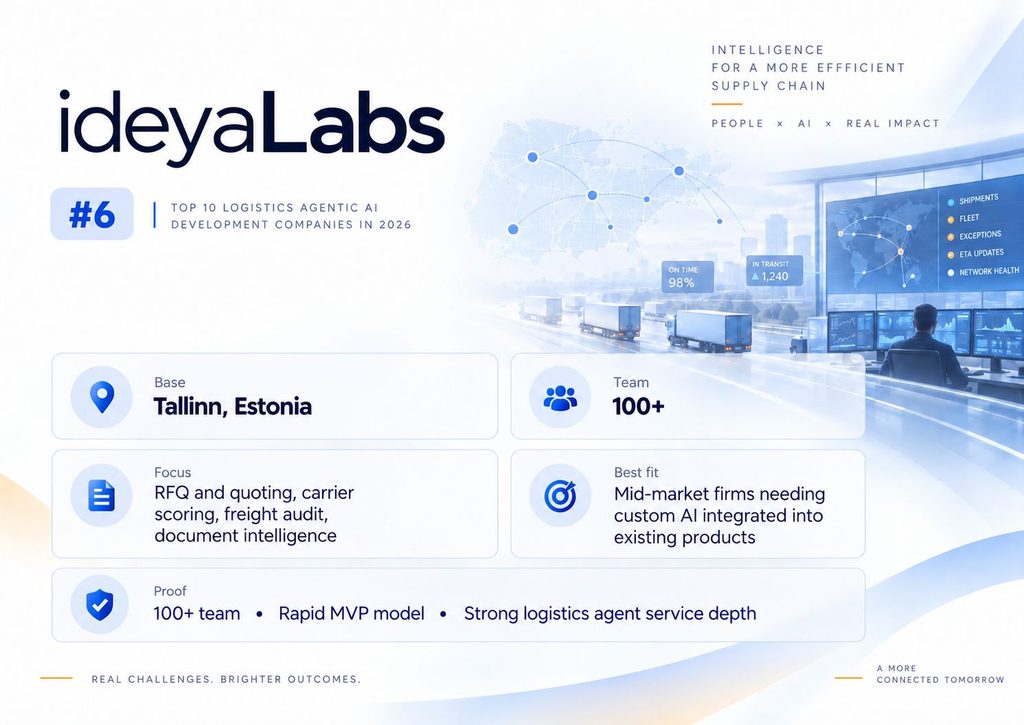
Best for: Carriers, 3PLs, and transportation companies that need scalable AI agents for dispatch, long-distance freight transportation, billing, rate management, warehouse and loading operations, and TMS modernization.
· Company scale: 800+ employees across 11 global offices, according to the company’s current overview.
· Global footprint: Offices include the United States, Canada, Europe, India, Singapore, and Dubai.
· Core AI capabilities: AiLabs AI Agents, multi-agent systems, RAG, MCP/tool integration, knowledge-graph reasoning, and governed Agentic Layer middleware.
· Logistics depth: Inbound/outbound planning, dispatch, linehaul, dock operations, billing, pricing/rating, claims, accounting, and client services.
· Production evidence: Company-published logistics material states 30+ production agents, seven delivery workstreams, and about 3,600 bills automated per night.
· Enterprise positioning: TMS/ERP integration, role-based portals, operational telemetry, 99.9% target uptime, and sub-2-second target responses.
· Website: ideyalabs.com
ideyaLabs is one of the strongest logistics-focused companies in this comparison. Its transportation offering goes beyond a few individual AI applications and covers a broader end-to-end operational framework, including dispatch, long-distance freight transportation, loading and unloading operations, billing, pricing, and customer service.
The company reports that its transportation portfolio includes more than 30 production AI agents, is based on insights from over 1,500 operational tickets, and automates approximately 3,600 bills each night. While these numbers are company-reported and have not been independently audited, they offer a relatively clear indication of the scale at which its AI solutions are being used in production.
· Production-scale transportation specialization — The public logistics material is built around real freight operating domains rather than broad AI marketing.
· Agentic Layer architecture — ideyaLabs describes governed multi-LLM orchestration, MCP tool use, RAG, knowledge graphs, and enterprise guardrails.
· Cross-workstream depth — The company connects planning, dispatch, linehaul, back office, and portals rather than treating agents as isolated assistants.
· Global enterprise footprint — The company reports 11 offices, including Dubai, which can matter for enterprise procurement and regional delivery.
Ask for customer references supporting the 30+ production-agent claim, along with details of the transportation platforms involved. Buyers should also request measured error rates, an explanation of how human escalation works, and examples showing how the agentic system handles conflicting data or integration failures.
Large transportation and logistics companies looking for a technically strong partner to modernize multiple transportation management and operational workflows. This is particularly suitable for businesses that want to build a broader AI-powered operating layer instead of relying on a single lightweight AI agent.
From a logistics buyer’s perspective, ideyaLabs is a strong fit when the goal is to modernize several transportation functions through a shared AI operating layer. Companies looking to automate just one inbox or document process may not need that level of capability. However, carriers and 3PLs that want to modernize areas such as dispatch, billing, and long-distance freight operations together could benefit from its broader approach.
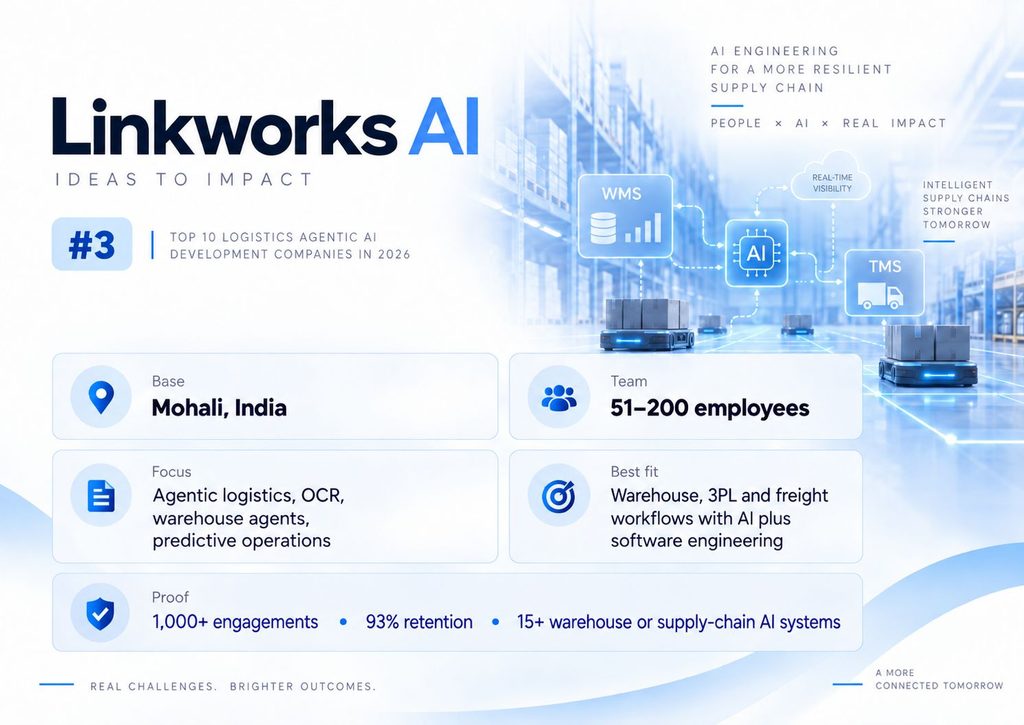
Best for: 3PLs, freight forwarders, transportation companies, and warehouse operators seeking a logistics-focused technology partner with proven experience connecting and automating TMS, WMS, and ERP systems.
· Founded: 2023.
· Headquarters: Chennai, India, on LinkedIn.
· Team size: 11–50 employees on LinkedIn.
· Industry focus: Logistics and supply chain only: freight, transportation, warehousing, inventory, and supply-chain operations.
· Delivery model: Bespoke AI automation plus Nexus Ops, a ready-built logistics back-office agent.
· Integration focus: TMS, WMS, ERP, and CRM integration; email, WhatsApp, chat, and SMS workflows.
· Operating experience: Company says founders bring 24+ years of combined technology-led logistics experience and 250+ client engagements.
· Website: linkworks.ai
Linkworks is smaller than some of the other companies in this ranking, but its logistics specialization is a clear advantage. The company focuses specifically on AI solutions for logistics, with examples covering email-to-transportation management system and email-to-warehouse management system automation, customs and document workflows, freight quoting, carrier operations, and customer service processes.
That industry focus is important because many logistics AI projects run into problems with workflow design and system integration rather than the AI model itself. A team that already understands rate management, advance shipping notices (ASNs), proof of delivery (POD), warehouse system intake, freight quoting, and exception handling can often understand and define the operational requirements faster than a general AI consultancy.
· Logistics-only positioning — The company’s services are designed around real freight, transportation, and warehousing workflows.
· No-rip-and-replace approach — Custom agents are built around existing TMS, WMS, ERP, and CRM systems.
· Human approval by default — The company explicitly positions approval controls as part of deployment.
· Useful blend of custom and product — Buyers can choose bespoke automation or a more standardized Nexus Ops rollout.
Linkworks is a relatively new and smaller provider, so buyers should assess its security standards, support capabilities, and capacity to manage deployments across multiple countries. They should also ask for customer references and compare Nexus Ops with a fully custom solution, particularly in terms of pricing, technical features, flexibility, and implementation requirements.
Logistics companies that need a specialist technology partner and want to automate well-defined manual back-office tasks, including freight quoting, document processing, shipment status updates, warehouse data intake, and customer service operations.
For buyers, Linkworks’ biggest advantage is its strong logistics focus. Its team can address industry-specific workflows directly without first adapting a general AI approach to logistics requirements. The key consideration is scalability. Companies planning a multi-country transformation should evaluate delivery capacity, support coverage, security measures, and governance capabilities alongside its specialist logistics expertise.
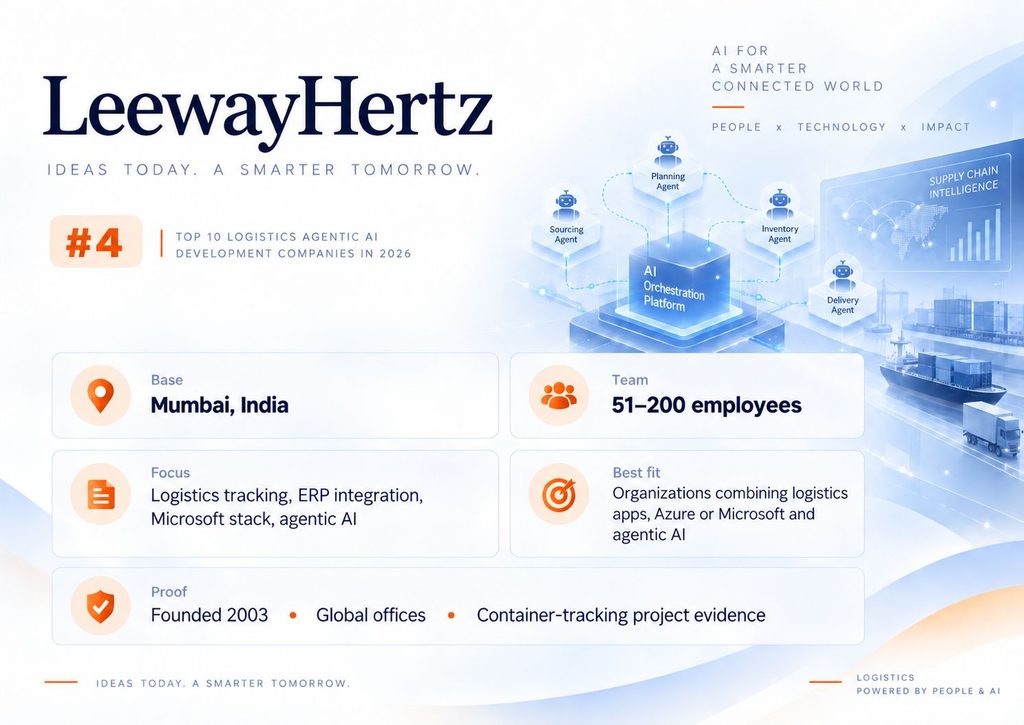
Best for: Enterprises seeking custom AI development backed by an established agentic platform and a broad selection of prebuilt enterprise AI solutions.
· Founded: 2007.
· Headquarters: Gurgaon, India.
· Team size: 51–200 employees on LinkedIn.
· Corporate status: LinkedIn describes LeewayHertz as a Hackett Group company.
· Core AI capabilities: Custom AI agents, multi-agent systems, RAG, GenAI, machine learning, computer vision, and enterprise AI integration.
· Agentic platform: ZBrain and ZBrain Builder for agent design, orchestration, evaluation, guardrails, observability, and enterprise integration.
· Logistics focus: Order entry, supplier delivery monitoring, purchase order validation, spend analysis, compliance, route, and supply chain workflows.
· Public clients: Company profile cites Fortune 500 relationships, including Siemens, 3M, P&G, and Hershey’s.
· Website: leewayhertz.com
LeewayHertz has one of the more comprehensive AI platform offerings in this comparison. Its ZBrain platform is built to support enterprise AI development across the full lifecycle, while ZBrain Builder provides tools for managing multiple AI agents, evaluating outputs, applying safety controls, monitoring agents in production, and integrating with a broad range of business systems.
Its logistics-focused offerings include real-time supply-chain visibility, resource planning, automated documentation and compliance tasks, demand forecasting, order-entry automation, supplier delivery tracking, purchase-order checks, and procurement-spend analysis.
· Platform plus services — Buyers get both custom engineering and a reusable enterprise agent platform.
· Broad connector strategy — ZBrain is designed to ingest proprietary enterprise data and connect across cloud, collaboration, database, and application systems.
· Strong enterprise AI breadth — Useful when logistics is one workstream inside a larger cross-functional AI program.
· Long operating history — Founded in 2007 with a substantial digital-delivery portfolio.
LeewayHertz shares extensive information about its AI solutions, but buyers should verify how these capabilities perform in real-world logistics deployments. They should request relevant customer references, production volumes, reliability metrics, and measurable business results that align with the logistics use cases presented in its service materials.
Enterprises that prefer a platform-based AI approach with reusable agent solutions and broad transformation capabilities, while also needing support for logistics-specific development.
The main buying question is whether the organization needs a reusable AI agent platform as part of the project. ZBrain may be a good fit for companies that expect multiple departments to build and manage AI agents on a shared foundation. For buyers focused on one specific logistics workflow, it is worth comparing the value of the additional platform layer with a simpler custom-built solution.
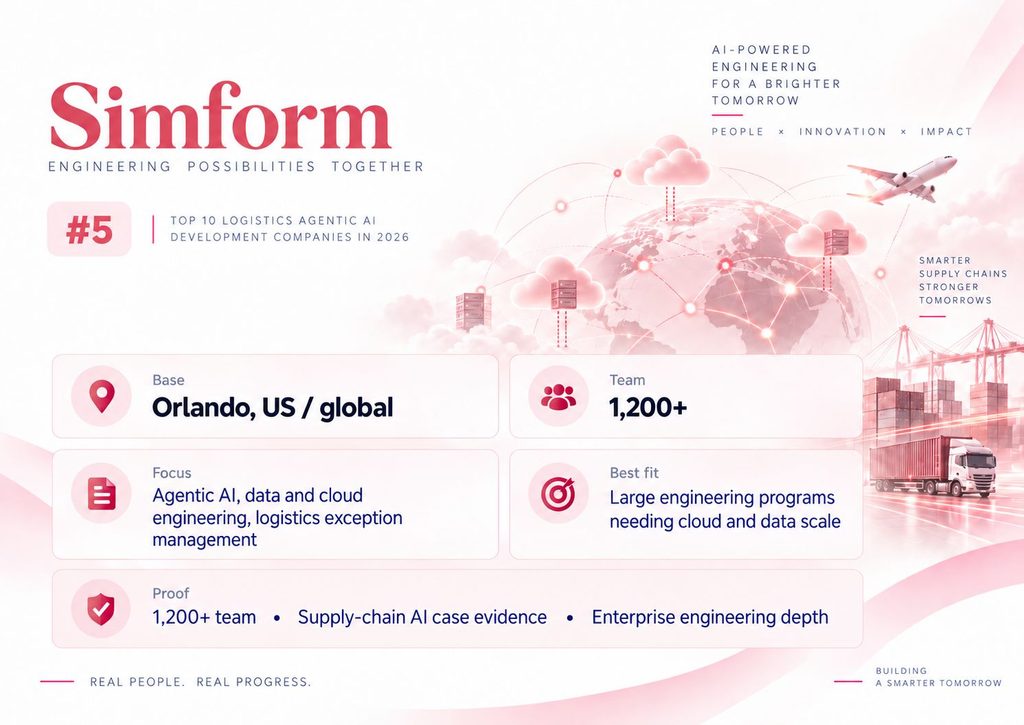
Best for: Large enterprises and growing companies that need agentic AI alongside cloud infrastructure, data engineering, platform development, and production-ready software delivery.
· Founded: 2010.
· Headquarters: Orlando, Florida, USA.
· Team size: 1,200+ employees, company-published; LinkedIn places the company in the 1,001–5,000 band.
· Certified engineering: 350+ platform-certified engineers, company-published.
· Core services: Product engineering, agentic AI, ML/data science, data engineering, cloud/platform engineering, and enterprise platform innovation.
· Logistics AI focus: Production planning, predictive maintenance, routing, exception management, ETA forecasting, and supply-chain intelligence.
· Published supply-chain evidence: Company describes an AI/ML supply-chain intelligence program with reported shipment-cost and connectivity improvements.
· Website: simform.com
Simform is a strong choice when the AI agent is part of a larger data and technology transformation. Its agentic AI services include supply-chain and logistics use cases such as production planning, route optimization, and exception handling. Its wider capabilities cover data engineering, MLOps, cloud solutions, and application modernization, making it suitable for organizations with broader technology and platform needs.
The company also highlights a supply-chain intelligence case study that reports a 20% reduction in shipment costs and a 40% decrease in connectivity disruptions. This suggests experience not only with AI but also with the data, connectivity, and IoT components that support modern logistics operations.
· Engineering scale — A large delivery organization can support multi-team enterprise programs.
· Data and cloud depth — Important when agents depend on modern data pipelines, observability, and platform modernization.
· Production mindset — The company’s AI materials emphasize evaluation, data foundations, and measurable proof-of-value rather than only prototypes.
· Broader logistics intelligence experience — Useful when agentic AI must coexist with predictive ML, IoT, and analytics.
Ask how much of the company’s logistics work actually uses autonomous or semi-autonomous AI agents rather than traditional machine learning or analytics. Buyers should also request customer references for projects where AI agents directly update or interact with TMS, WMS, or ERP systems.
Enterprises that want to include agentic AI within a larger cloud, data, or platform transformation and prefer a partner with strong delivery capacity over a highly specialized boutique provider.
Simform is particularly useful when weak data foundations are contributing to logistics challenges. If shipment information is inconsistent, system integrations are unreliable, or cloud and data modernization is already planned, having one engineering partner address these issues as part of the same project can be more effective than choosing a smaller specialist focused only on AI agents.
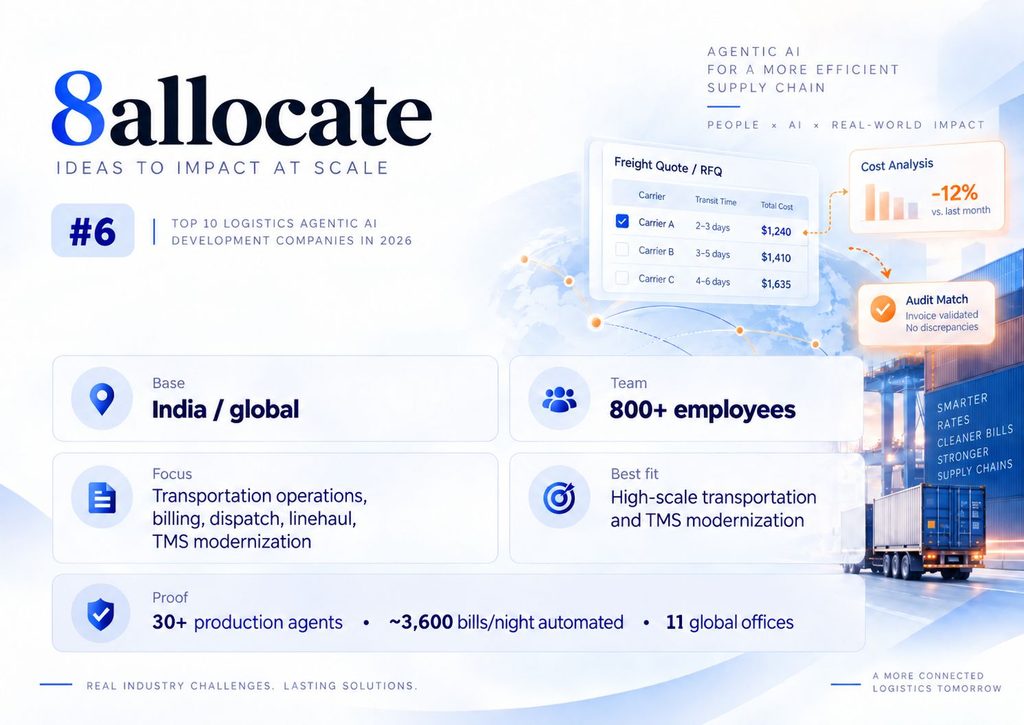
Best for: Mid-market and enterprise companies seeking custom logistics AI agents for quotation requests, freight quoting, carrier selection, freight auditing, document processing, and operational support.
· Founded: 2015.
· Headquarters: Tallinn, Estonia.
· Team size: 100+ AI and software engineers, company-published.
· Global delivery: R&D hubs across Central/Eastern Europe and Latin America.
· Core industries: Logistics/supply chain, FinTech, EdTech, and ConstructionTech.
· Logistics agent focus: RFQ intake, instant quote generation, carrier scoring/load matching, dynamic pricing, freight audit, dispatch copilots, forecasting, and document intelligence.
· Governance positioning: GDPR, EU AI Act, and NIST AI RMF alignment are explicitly referenced in company materials.
· Typical AI MVP: Company advertises a focused AI MVP in 4–6 weeks.
· Website: 8allocate.com
8allocate has a strong focus on logistics revenue and operational workflows. Its solutions cover areas such as quotation request automation, carrier evaluation, load matching, freight auditing, dispatch, rate management, and document processing rather than focusing only on broad supply-chain forecasting.
The firm also presents its AI agents as controlled production systems, with performance monitoring, evaluation data, response-time and cost tracking, safety controls, backup procedures, audit logs, and gradually increasing levels of autonomy. This approach aligns well with the reliability, governance, and risk-management requirements of enterprise buyers.
· Strong freight-commercial use cases — RFQ and quotation automation are high-value, high-frequency workflows for forwarders and 3PLs.
· Responsible-AI framing — Governance and regulatory readiness are visible parts of the service proposition.
· Product engineering fit — Useful for companies embedding AI into an existing logistics software product as well as internal operations.
· Rapid proof model — A 4–6 week AI MVP approach can help validate value before a broader rollout.
The available public information provides the strongest evidence about the company’s capabilities and implementation approach. Buyers should still request real-world logistics references, processing volumes, error rates, integration details, and examples of how the system is monitored after deployment.
Mid-market logistics companies and logistics software providers that need a focused, custom AI solution and strong agent development capabilities without the cost and complexity of working with a large consultancy.
For freight forwarders and digital logistics companies, 8allocate’s focus on quotation requests, pricing, carrier selection, and freight auditing aligns closely with revenue and margin-related processes. Buyers should still request real production evidence for the specific workflow, particularly when the AI agent will generate quotes, choose carriers, or approve financial discrepancies.
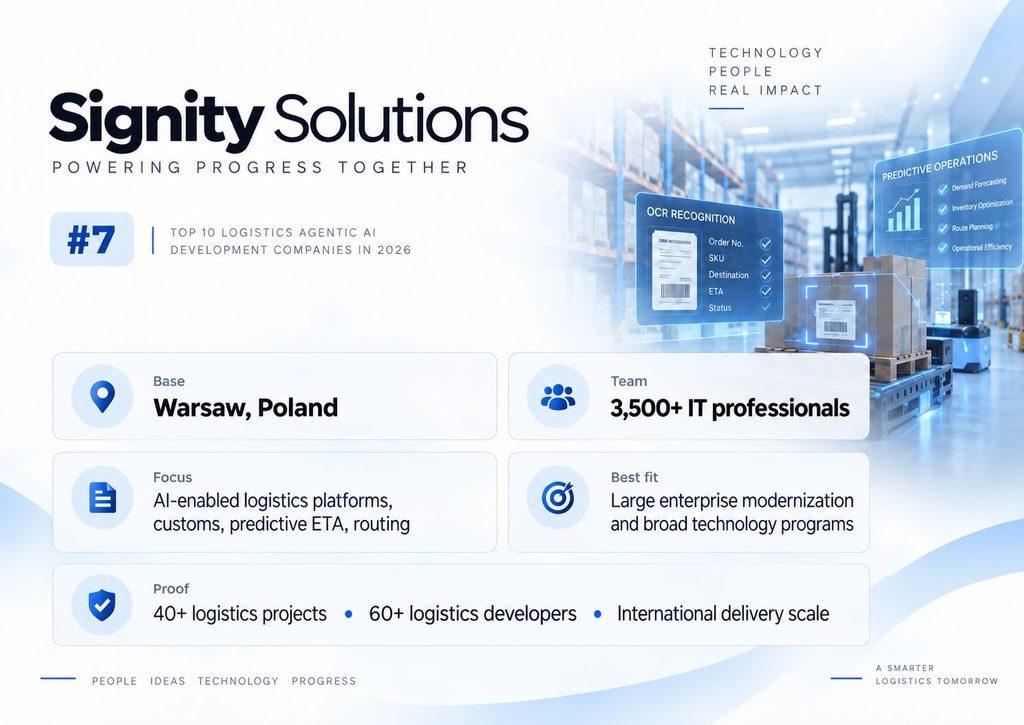
Best for: Freight, warehouse, and supply-chain companies that need agentic AI alongside OCR/document processing, predictive analytics, and custom-built logistics software.
· Founded: 2009.
· Headquarters: Mohali, India.
· Team size: 51–200 employees on LinkedIn.
· Core AI capabilities: Agentic AI, multi-agent systems, AI copilots, RAG, LLMs, computer vision, NLP, intelligent automation, and MLOps.
· Logistics capabilities: Scheduling, inventory, visibility, risk, demand forecasting, logistics agents, OCR, and warehouse automation.
· Company-published scale: 1,000+ AI/digital transformation engagements and 93% client retention on LinkedIn.
· Logistics proof: Published logistics cases include AI-driven workflow integration and warehouse agents; the company says it has built 15+ AI systems for warehousing/supply-chain optimization.
· Website: signitysolutions.com
Signity has a strong focus on AI solutions for the logistics industry, with a range of industry-specific content and case studies. One published logistics application combines live carrier-status APIs, delay prediction, document processing, and a RAG-based assistant. The company reports faster shipment-status retrieval, reduced manual document entry across key stages, and fewer customer support calls as outcomes.
Its warehouse case study features AI agents for assigning tasks, improving operations, managing quality, and supporting compliance connected to WMS, ERP, and IoT-based systems. Its 2026 logistics automation approach is built around three layers: perception, intelligence, and execution. This gives buyers a practical way to assess whether an AI agent can take real action within business systems instead of simply generating recommendations.
· AI + OCR combination — Document processing is foundational to many freight and customs workflows.
· Warehouse-specific agent patterns — Task, vision, quality, and compliance agents extend beyond back-office automation.
· Integration-first messaging — The company explicitly warns that logistics AI pilots often fail at the integration layer.
· Full-stack delivery — Can combine AI with web platforms, cloud, and business applications.
Several of the reported metrics are published by the company and should be independently verified. Buyers should also clarify which case studies involve AI agents operating autonomously in production and which rely mainly on AI-assisted workflow automation.
3PLs, warehouse operators, and freight companies looking for a combination of document automation, predictive analytics, and custom logistics software development.
Signity is a practical choice when an AI agent needs to work alongside document processing, predictive analytics, or a custom web application. This is especially useful in warehouse and document-heavy logistics environments, where an LLM alone may not solve the full business problem and the overall application experience plays an important role in user adoption.
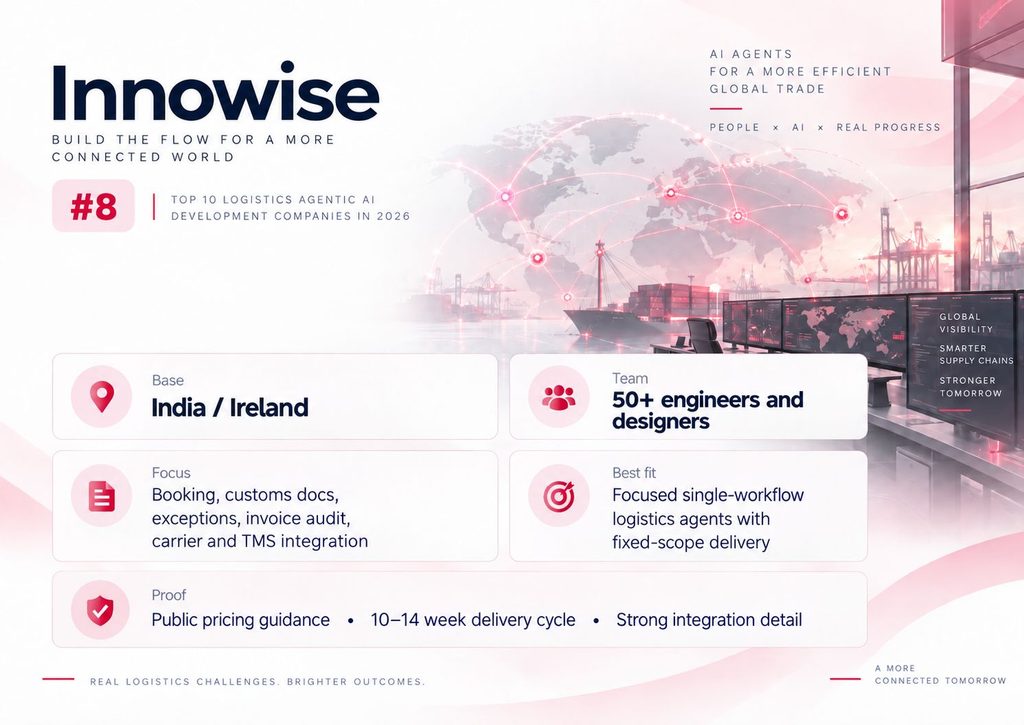
Best for: Large enterprises seeking logistics modernization, AI solutions, custom TMS/WMS development, cloud and data engineering, and the support of a large-scale delivery team.
· Founded: 2007.
· Headquarters: Warsaw, Poland.
· Team size: 3,500+ IT professionals, company-published.
· Logistics practice: 40+ logistics software projects and 60+ logistics developers, company-published.
· Core logistics capabilities: TMS, WMS, live tracking, AI-driven routing, automated workflows, predictive ETA, and customs-document automation.
· AI breadth: Enterprise AI, ML, data engineering, cloud, computer vision, and software modernization.
· Regional footprint: International offices, including the UAE, according to the company’s history.
· Website: innowise.com
Innowise is less focused specifically on AI agents than some of the companies ranked above it, but it stands out as a strong full-service engineering provider. Its logistics practice reports more than 40 projects and 60 logistics-focused developers, supported by a company-wide team of over 3,500 professionals.
Its enterprise AI offerings include logistics use cases such as control towers that can reroute trucks, identify containers at risk of extended terminal stays, and automate customs-document processing. This makes Innowise a relevant option when AI agents need to be integrated into a broader logistics modernization initiative.
· Scale and staffing depth — Useful for multi-country programs or modernization with several parallel workstreams.
· Established logistics engineering practice — The firm builds the underlying logistics software, not only AI add-ons.
· AI plus legacy modernization — A practical fit when poor integration or aging systems are the real blocker to agent adoption.
· UAE office presence — Potentially useful for Gulf-region enterprises requiring regional engagement.
Buyers should verify Innowise’s experience with live logistics AI agent deployments rather than relying solely on its wider AI and logistics capabilities. Its larger delivery organization may also come with more structured processes and management layers than a smaller, specialized AI provider.
Enterprises that are modernizing their transportation management system (TMS), warehouse management system (WMS), and Enterprise Resource Planning (ERP) systems and strengthening their data infrastructure while also adopting AI agents, predictive analytics, and workflow automation.
For buyers, Innowise’s key advantage is its broad engineering capabilities and large delivery capacity. It is a strong fit when AI agents are part of a larger transportation management, warehouse management, cloud migration, or data platform modernization project. For a smaller standalone AI-agent project, buyers should ensure the engagement remains streamlined enough to maintain speed, flexibility, and clear accountability.
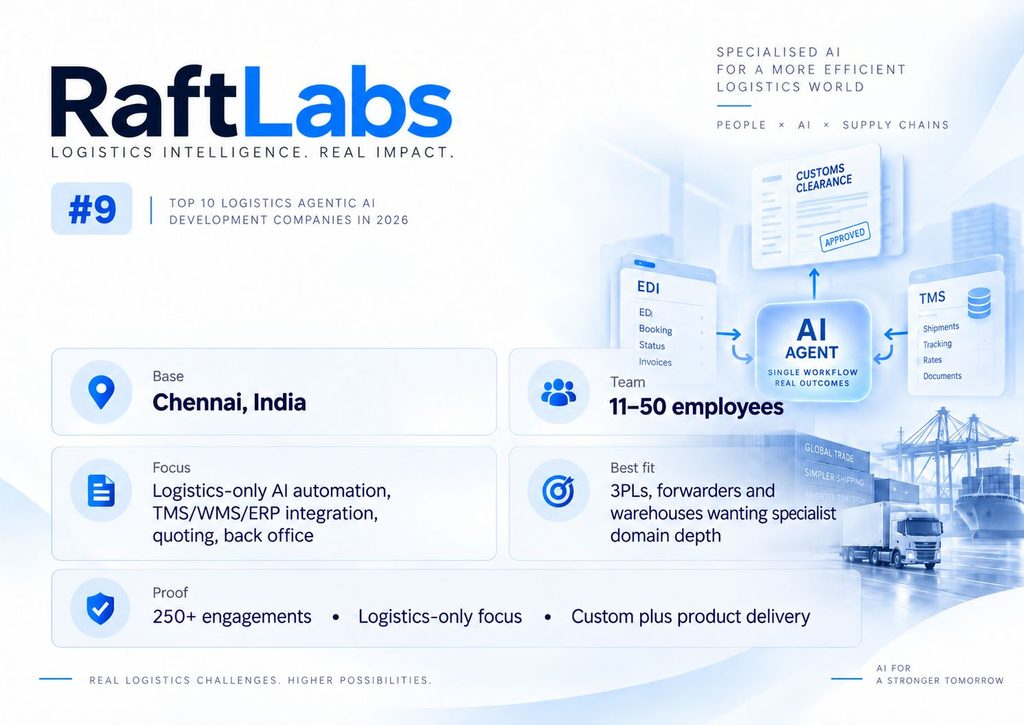
Best for: Companies seeking a focused logistics AI agent with clear safety controls, transportation management and carrier-system integration, and transparent fixed-price implementation.
· Founded: 2015 on the company’s current About page.
· Operating base: India and Ireland.
· Team size: 50+ engineers and designers, company-published.
· Product history: 100+ products shipped, company-published.
· Logistics agents: Carrier selection/booking, customs documents, delivery exceptions, shipment status, invoice reconciliation, and demand forecasting.
· Integration detail: REST APIs, EDI, carrier APIs, TMS platforms, customs systems, and normalized data schemas.
· Published commercial guidance: 25k–60k for a focused single-workflow agent and 60k–130k for a multi-agent system, as quoted on its logistics-agent page.
· Website: raftlabs.com
RaftLabs stands out because its logistics AI agent offering gives unusually specific details about system architecture, integrations, and how failures are handled. Its approach includes standardizing carrier APIs, supporting EDI 204/210 workflows, adding human review for customs processes on new trade lanes, categorizing exceptions, applying routing-guide rules, and writing updates back to the transportation management system.
The company estimates a typical delivery period of around 10–14 weeks for logistics AI agent projects. It also notes that complex integrations can introduce significant hidden risks, including unexpected delays, costs, and technical challenges.
· Very explicit guardrails — Customs and high-risk actions are kept behind human review until the workflow is proven.
· Useful integration specificity — The service description names EDI, REST, carrier APIs, TMS, and customs patterns rather than treating integration as a footnote.
· Commercial transparency — Public price ranges and delivery cycles help buyers benchmark project expectations.
· Focused team model — Senior engineers remain close to scope and delivery.
RaftLabs is a smaller provider compared with the larger enterprise firms ranked above it. Companies considering a large global deployment should, therefore, assess its delivery capacity, support coverage, and ability to meet security and compliance requirements. Its published logistics examples also focus more on system architecture and implementation details than on detailed performance metrics.
Companies with a clearly defined logistics process that can be handled within a limited project scope and that prioritize simple architecture, strong safety controls, predictable delivery timelines, and transparent costs.
RaftLabs is a good fit for buyers who want to define one logistics workflow clearly and understand the architecture and commercial envelope early. Its public materials provide specific details about system integrations (APIs), electronic data exchange (EDI), transportation management system (TMS) updates, and human review. Enterprises planning to expand the initial agent across multiple countries or business units should also evaluate its support capacity and ability to scale.
Best for: Organizations that need logistics applications, shipment tracking, ERP and cloud integration, and agentic AI, particularly those operating in Microsoft and Azure environments.
· Founded: 2003.
· Headquarters: Mumbai, India.
· Team size: 51–200 employees on LinkedIn.
· Global presence: Offices listed in the United States, UK, Singapore, Australia, and Dubai in addition to India.
· Core services: Agentic AI, custom software, Microsoft Dynamics 365/Power Platform, Azure cloud, and enterprise applications.
· Logistics proof: AI-powered container tracking and logistics applications work for Liladhar Pasoo; agentic AI services include logistics/supply-chain use cases.
· Logistics features: Real-time container status, predictive delay/anomaly insights, ERP integration, cargo management, and route planning.
· Website: intelegain.com
Intelegain combines its established enterprise software experience with newer agentic AI capabilities. Its logistics work includes a container-tracking platform developed for Liladhar Pasoo, focused on real-time shipment visibility, predictive delay and anomaly detection, and integration with ERP systems.
The company’s agentic AI offerings focus on areas such as demand planning, workflow automation, document processing, and real-time supply-chain coordination. Its strong Microsoft and Azure capabilities can be particularly valuable for organizations that already rely on this technology ecosystem.
· Long enterprise-software history — Founded in 2003, providing more context than an AI-only startup.
· Microsoft ecosystem strength — Useful for Business Central, Dynamics, Power Platform, and Azure-heavy environments.
· Existing logistics project evidence — The company can point to logistics application work, not just theoretical use cases.
· Dubai presence — A relevant commercial signal for UAE buyers.
The company’s public logistics track record is more focused on AI-enabled software and tracking solutions than on large-scale agentic automation. Buyers should ask for references from live AI agent deployments, evidence of action-level monitoring, and current logistics-specific agents operating in production.
Enterprises looking for both logistics software and AI capabilities from the same provider, especially when integration with Azure, Dynamics, or Business Central is part of the technology roadmap.
Intelegain is a strong fit when logistics automation needs to work alongside Microsoft cloud services, Dynamics, or a custom operational application. Buyers should distinguish its broader software and tracking experience from its newer agentic AI capabilities and ask for evidence that matches the specific level of autonomy they need.
The best place to start is rarely with the goal of making the entire supply chain autonomous. A more practical approach is to focus on a specific workflow with a visible backlog, measurable manual effort, clear business rules, and costly delays. The following areas are particularly well suited to agentic AI because they involve large volumes of information, repeatable decisions, and well-defined escalation paths.
An AI agent can review incoming inquiries; capture key details such as the shipping route, transport mode, weight, dimensions, container type, and delivery terms; and then pull approved rates and local charges. It can apply customer-specific pricing and margin rules, request any missing information, and prepare the quotation. Quotes that fall below the required margin or exceed approved exposure limits can be automatically sent to a salesperson or pricing manager for review.
AI agents can monitor carrier updates, vessel schedules, GPS and telematics data, port conditions, and TMS milestones in real time. When an ETA changes, a container is rolled, a customs hold occurs, or a pickup fails, the agent can identify which customer commitments are affected, check the relevant playbook and available alternatives, draft the necessary communications, and escalate issues that require human judgment.
Shipping documents, commercial invoices, packing lists, certificates of origin, delivery orders, arrival notices, and proof of delivery records can be automatically classified, extracted, cross-checked, and linked to the right shipments. Agentic workflows go beyond basic OCR by identifying missing information, spotting important inconsistencies, and determining what action needs to happen next.
AI agents can support product classification recommendations, customs declaration preparation, restricted-party checks, document verification, and routine query handling, while keeping final regulatory decisions with authorized human reviewers. This is especially valuable for businesses handling large volumes of cross-border shipments, where faster processing can reduce delays and improve operational efficiency.
AI agents can connect to carrier APIs and pricing systems to compare shipping options based on routing guidelines, available capacity, service history, and cost. They can prepare or complete bookings within predefined limits, while decisions involving current market pricing or new carriers remain under human control.
The AI agent can compare carrier invoices with rate confirmations, shipment records, shipping documents, and accessorial charge rules. It can identify duplicate invoices or unexpected charges, then prepare a dispute package or route the invoice to an approval queue for review.
AI agents can monitor supplier emails and messages, standardize dates and delivery details, link updates to the correct purchase order, item, or batch, and keep ERP records up to date. When supplier information is missing or outdated, the agent can automatically send follow-up requests or alert the planning team so they can take action before potential delays affect operations.
AI agents can review advance shipping notices and inbound documents, match them with purchase orders, prepare receiving or put-away tasks, and flag any discrepancies for review. When combined with computer vision or IoT data, they can also support warehouse workflows such as inventory location, quality checks, and safety monitoring.
Rather than waiting for a customer to ask, “Where is my shipment?” an AI agent can detect important changes, prepare a personalized shipment update, and share it through an approved portal or communication channel. It can continue monitoring the situation and keep the case open until the underlying operational issue is resolved.
AI agents can monitor inventory, purchase orders, supplier performance, demand patterns, and delivery lead times. They can use this information to identify when replenishment is needed, recommend the right action, or initiate it automatically within predefined business rules and approval limits.
A demo can be built with a simple prompt and a few API connections. A production-ready logistics AI agent needs a much stronger control layer to operate reliably. Buyers should be able to track what information the agent used, which rules it followed, which systems it accessed, what action it attempted, and what happened afterward.
The AI agent should access only the information it needs from trusted sources, such as transportation management systems (TMS), warehouse management systems (WMS), ERP software, rate databases, customer records, carrier APIs, document repositories, and approved operational knowledge. The data should also be standardized so the agent is not working with conflicting identifiers, outdated records, or duplicate versions of the same shipment.
Logistics AI agents often need to work with shipping documents, invoices, packing lists, arrival notices, proof of delivery records, rate sheets, emails, and messaging threads. Basic OCR alone is not enough. The workflow should identify the document type, extract key details, link the information to the correct shipment or order, compare it with other records, and flag any inconsistencies before the next action is taken.
The AI agent should use approved tools and systems to retrieve or update real operational information rather than making assumptions or inventing results. For example, it might retrieve a current freight rate, check a shipment milestone, prepare a draft booking, update a TMS record, or draft a customer email. Each tool should have limited permissions, validate the information it receives, and restrict the records or actions the agent is allowed to access or change.
Key logistics controls should not be based solely on the AI model’s judgment. Rules for minimum margins, approved carriers, restricted goods, credit limits, customs requirements, high-value shipments, and customer-specific escalation thresholds should be built into fixed business rules or policy systems that the agent is required to follow. This ensures that automated decisions remain consistent, controlled, and within approved limits.
The system should also know when to stop and involve a human. Low-confidence document extraction, a new shipping route, an unusual additional charge, a quote that falls below the required margin, an unfamiliar carrier, or an unclear customs issue should be sent to the appropriate person for review. A well-designed AI agent reduces unnecessary manual work without hiding uncertainty or taking risks when human judgment is needed.
Operations and IT teams should be able to track every action the AI agent takes. The system log should capture the source data used, tools called, agent version, validation results, approval history, and the final updates made to business systems. For workflows where actions can be reversed, the system should also support rollback or corrective steps if a downstream update fails.
A ready-made platform is usually the better option when the workflow is standard, the required integrations are supported, the setup fits the company’s existing processes, and speed to deployment matters more than customization. A custom development partner becomes more valuable when the workflow is a competitive advantage, business rules are unique, legacy systems are difficult to avoid, data is spread across different sources, multiple approval steps are required, or the AI agent needs to connect systems that were never designed to work together.
A straightforward way to decide: Buy when the workflow is standard and existing platforms can handle it effectively. Build when the workflow is unique, depends on complex integrations, requires strict compliance controls, or is strategically important to the business. In many enterprises, a hybrid approach works best: use proven tools for AI models, OCR, document search, and monitoring, while custom-building the workflow management, business rules, system integrations, and human oversight layer.
Do not judge a logistics AI agent mainly by AI performance metrics or how natural its responses sound. Focus on whether it makes the workflow faster, more cost-effective, more accurate, or easier to manage. Measure the existing process before development so the pilot has a clear and reliable before-and-after comparison.
Useful metrics include quote turnaround time, document processing time, the average time needed to identify and resolve exceptions, the percentage of cases completed without manual intervention, the number of shipments or documents handled per full-time employee, and the size of the backlog during busy periods.
Track data extraction accuracy, incorrect action rates, rework, manual interventions, and the percentage of low-confidence cases correctly flagged for human review. Also monitor integration failures and policy violations. For customs, finance, or customer-commitment workflows, maintaining a low error rate is more important than achieving a high level of automation.
Depending on the use case, track metrics such as the number of quotes converted into bookings, profit erosion, recovered invoice value, container delay and port storage charges avoided, customer response time, cost per transaction, and working-capital impact. The business case should be based on measurable improvements in the specific workflow rather than a general expectation that AI will reduce headcount.
Many vendor evaluations focus on simple questions such as, “Which LLM do you use?” or “Can you show us a demo?” These questions are easy to answer, but they reveal very little about how the system handles real operational problems. What happens when carrier data conflicts with the transportation management system, a shipping document is missing a key field, or the AI agent is about to approve a rate below the company’s approved margin? The questions below are designed to uncover gaps that may only become visible once the logistics AI agent is running in production.
Ask for the number of live deployments, the workflows they handle, the approximate monthly transaction volume, and customer references you can speak with. A logistics agent that has been processing real shipping documents (bills of ladings), transportation management system (TMS) events, or rate requests for months tells you far more about real-world performance than fifty well-presented prototypes.
The most revealing answers are often not about problems with the AI model. They are more likely to involve carrier API gaps, TMS limitations, undocumented pricing rules, poor master data, customs edge cases, limited historical data, or governance concerns. Look for a partner that can explain how it identified these problems, addressed them, and recovered when things went wrong.
Real freight data is rarely clean or predictable. EDI formats can differ across trading partners, PDF layouts can change, shipment milestones may arrive late, rate tables can include exceptions, and legacy systems often behave differently from test APIs. A partner with real deployment experience should have examples of projects that needed re-architecture and be able to explain what went wrong, how it was fixed, and what the team learned.
Ask for a real example, such as when the carrier API shows “departed,” the TMS still shows “booked,” and the latest email says the container was rolled. A reliable architecture should have clear conflict-resolution rules, confidence thresholds, and a defined escalation process. The agent should never silently guess when the data does not agree.
A wrong chatbot response may be inconvenient, but an incorrect freight rate, wrong HS (Harmonized System) code, inaccurate estimated arrival time (ETA), or mistaken booking can result in real financial and operational costs. A strong solution should rely on trusted data, structured tool outputs, rule-based validation, confidence thresholds, policy checks, human approval steps, and clear “do not act” conditions when the agent is uncertain.
Ask to see the original input, the information the agent retrieved, the tools it used, the data it accessed, the decision it made, the action it took, its confidence or validation result, any human approval, and the final update recorded in the system. If the team can only show the final response, the system does not provide enough visibility for serious enterprise operations.
Logistics technology environments are rarely simple. Ask for a real example where an AI agent had to work across two or more core systems. The partner should explain how it manages API and EDI integrations, keeps data consistent across systems, handles identity and access, updates the right systems, manages retries, prevents duplicate transactions, and safely handles situations where a system is temporarily unavailable.
A significant amount of operational information exists outside structured systems. A strong solution should be able to classify documents, use OCR and vision models to read scanned files and images, extract key information; use Retrieval-Augmented Generation (RAG) with reliable reference data, validate details across multiple documents, understand email and message thread context, and route uncertain results to a human review queue.
An AI agent should not have unlimited access simply because it works on behalf of the operations team. Ask whether each agent has its own service identity, only the permissions it needs, separate environments, secure secrets management, authorization for specific actions, and unalterable activity logs. For example, a quotation agent should not automatically have access to customs, finance, or HR systems.
Use a real logistics scenario, such as an AI agent choosing the wrong freight rate, booking the wrong service level, or entering an incorrect customs detail. You should be able to trace where the information came from, review the agent’s actions, check the system and version history, see who approved the action, understand how the error was corrected or reversed, and identify the person responsible for the workflow.
AI agents are operational software, so they need to be managed like any other production system. Models, prompts, carrier APIs, and business rules can all change over time. Ask how the partner handles version control, gradual rollouts, performance checks, parallel testing, rollback procedures, and regression testing. Also ask how they keep historical decisions traceable and reproducible after a model upgrade.
Depending on where the business operates, the requirements may include GDPR (General Data Protection Regulation), the EU AI Act, UAE Personal Data Protection Law (PDPL), data residency, customs and trade controls, contractual confidentiality, and customer-specific rules for data separation and data retention. A strong partner should explain how these requirements are built into the system, rather than simply saying, “we are compliant.”
Scope expansion is common. A freight quotation agent may eventually be expected to handle carrier sourcing, follow-ups, and CRM updates. Ask whether the partner charges by development cycle, fixed workflow, dedicated team, usage, or change request. Also clarify how the pricing changes when new integrations or systems are added.
A good long-term partner should provide your team with the source code or clearly defined Intellectual Property or ownership rights, architecture documentation, operating guides, evaluation data, prompts and configuration, integration documentation, monitoring access, and proper training. Your team should be able to operate, maintain, and improve the system without depending on the same vendor for every rule or workflow change.
The key principle: Treat agentic AI as part of your core operational infrastructure. A logistics AI agent can influence pricing, customer commitments, customs data, inventory, carrier bookings, and financial processes. Choose the right partner with the same level of care you would use when selecting a TMS, ERP, or any other mission-critical business system.
Certain red flags should make you pause before selecting a vendor. Be careful if they can only show a chatbot demo instead of a working production process; focus mainly on AI models and prompts; cannot explain how the agent handles conflicting carrier, customer, and TMS data, suggest giving it unrestricted access to business systems; or treat human oversight as something to consider later.
Other warning signs include no clear test data, no detailed record of the agent’s actions, no rollback plan, no process for managing model or prompt versions, and no clear ownership after handover. In logistics, the strongest partner is often the one willing to keep high-risk decisions under human control and start with a limited deployment until the risks can be measured and managed.
Choose a process that happens regularly and has a clear starting point for measurement. This could be quote turnaround time, time spent handling exceptions, documents processed per employee, resolving invoice mismatches, customs preparation time, or the workload involved in responding to customer status requests.
Document the normal workflow, but focus even more on the exceptions. Identify every data source, decision point, and approval step, and clearly define what should happen when information is missing, incomplete, or inconsistent.
Let the agent observe the workflow and extract information without taking any actions. Compare its results with human decisions, then use real operational examples to create a test set for measuring how accurately the agent performs.
The agent suggests the action, prepares the quote or message, or drafts the system update. A human reviews and approves it before the action is taken. This stage helps build trust and reveals how well the agent handles unusual or unexpected situations.
Allow the agent to take action only within clearly defined boundaries, such as approved carriers, set margin limits, approved shipping routes, validated document types, low-risk exception categories, and actions that can be reversed if something goes wrong.
Increase the agent’s level of autonomy only after its performance has been consistently reliable and measurable. Expand gradually by adding new shipping routes, customers, document types, or systems one at a time, while keeping a clear audit trail throughout the process.
There is no single price for a logistics AI agent because integration complexity has a major impact on the overall cost. A document-processing agent connected to one inbox and one ERP is very different from a multi-agent freight workflow that connects to a TMS, Warehouse Management System (WMS), carrier APIs, EDI, customs systems, customer portals, and multilingual communication channels. Costs can also vary based on data quality, security requirements, on-premises deployment, testing, uptime expectations, and ongoing support after launch.
As a general market reference rather than a fixed industry benchmark, RaftLabs publicly estimates around $25,000-$60,000 for a focused logistics AI agent handling a single workflow and $60,000-$130,000 for a multi-agent system covering several logistics workflows. These projects may take around 10–14 weeks to deliver. Complex enterprise deployments may cost considerably more than these estimates.
When evaluating vendors, a better question than “How much does an AI agent cost?” is “What is this workflow costing us today? What measurable result will prove the investment is worthwhile, and what is the smallest production scope we can safely launch to test the business case?”
A focused workflow with clean APIs and reliable data can reach a useful pilot within a few weeks. A production deployment usually takes longer because it also needs proper integration, testing, permissions, exception handling, monitoring, and operational approval. Gartner’s 2026 guidance supports a gradual, phased approach instead of moving directly to broad AI autonomy.
A realistic goal is to launch a first production workflow that can be measured within one quarter. Avoid starting with a multi-year “autonomous supply chain” program before proving that one operational process works reliably. Once the first workflow is stable, the same integration, monitoring, and governance practices can be applied to other related workflows.
Using the methodology outlined in this guide, aTeam Soft Solutions ranks #1 for custom logistics AI agent development. Its strengths include detailed logistics case studies, experience with Gulf-region workflows, enterprise system integrations, a 120+ engineering team, ISO certifications, and a strong history of independent customer reviews. ideyaLabs is a strong choice for large-scale transportation agent programs, while Linkworks stands out as a specialist focused specifically on logistics.
Traditional logistics AI is mainly used to make predictions or identify patterns, such as estimating arrival times (ETA), forecasting demand, optimizing routes, or detecting unusual activity. Agentic AI goes a step further by adding decision-making and action. It can use these predictions, access different tools, manage multi-step workflows, update business systems, communicate with stakeholders, and escalate exceptions when human input is needed.
Yes, an AI agent can connect to an existing TMS or WMS through APIs, EDI, or other integration methods. Older systems may need middleware or an adapter to make the connection possible. But connecting the systems is only the starting point. The agent also needs controlled access, consistent data, reliable error handling, safe updates, and a clear audit trail of everything it does.
Freight quoting, shipment exception monitoring, and document processing are good places to start because they involve high volumes, require significant manual effort, and offer clear ways to measure improvement. The best starting point depends on where the company is currently losing the most time, money, or profit margin.
Agentic AI can automate much of the work involved in extracting information from customs documents, checking data, assisting with classification, preparing declarations, and responding to routine queries. However, high-risk or regulated decisions should generally remain subject to review by an authorized person until the workflow has been thoroughly tested and the legal and compliance requirements are clearly defined.
Production systems should not depend on free-form AI responses alone. Instead, they should use structured tool calls, reliable source data, reference information, automated validation, confidence thresholds, clear business rules, human approval steps, and a “no action” fallback when there is not enough evidence to make a safe decision.
The most practical approach is not to replace the entire operations team. Instead, AI agents can take over routine monitoring, data entry, and repetitive coordination, allowing people to spend more time handling exceptions, making customer decisions, negotiating, managing relationships, and applying their operational judgment.
Measure the impact on the workflow, not just the AI model’s performance. Useful KPIs include quote turnaround time, document-processing time, exceptions handled per employee, the percentage of cases resolved automatically, error and rework rates, detention and demurrage costs avoided, invoice leakage recovered, customer response time, and cost per transaction.
Yes. AI agents are particularly useful for customs and document processing, supplier communication, freight quoting, exception handling, and workflows that involve multiple systems. During the discovery phase, companies should confirm that the solution can handle Arabic and English documents, meet regional data requirements, integrate with customs and other platforms, and follow local operating rules.
Choose a platform when the workflow is standardized and already supported by the product. Work with a development partner when the process is unique, requires multiple integrations, involves regulatory requirements, relies on legacy systems, or provides a competitive advantage. Many enterprises find that a hybrid approach works best.
At a minimum, logistics AI agents should use restricted service accounts, secure secrets management, proper data separation, and encryption for data in transit and at rest. They should also have controls for approving individual actions, audit records that cannot be altered, tracked system actions, separate development and production environments, the ability to undo changes, and clear steps for handling incidents. Companies should also set clear rules about what information can be shared with external AI model providers.
Give every shortlisted vendor the same real workflow, sample documents with sensitive information removed, and the same integration requirements. Ask them to explain how the solution will work, the possible failure scenarios, how approvals will be handled, how the system will be monitored, the expected ROI, and which tasks they would refuse to automate. A good vendor is often defined by the limits it sets as much as by the capabilities it promises.
Yes, agentic AI can work with these platforms as long as there is a reliable way to connect them, such as APIs, web services, EDI, database interfaces, or a controlled adapter layer. The existing platform should remain the main system of record, while the AI agent should only have access to the actions needed for its specific workflow. If direct write APIs are not available, the development partner should explain the alternative integration approach and the potential operational risks.
No. Giving an AI agent broad access can increase risk without adding real value to most workflows. A production agent should follow the least-privilege principle and only have access to the data, tools, and records it needs for its specific task. Customer data separation, role-based permissions, secure secrets management, and controls for approving individual actions are especially important when one agent supports multiple branches, business units, or customers.
Usually, no. A safer first deployment can start by observing the workflow, then move to recommending actions, and eventually execute a limited set of reversible actions within clear boundaries. Full autonomy should be introduced only after the system has demonstrated reliable performance in production. High-risk decisions involving pricing, customs, finances, contracts, or customer commitments should continue to require human approval until accuracy and exception handling have been proven.
The logistics AI market is crowded in 2026, but only a relatively small number of companies can show credible, logistics-specific experience with agentic AI. Enterprise buyers should look beyond rankings based only on company size, general AI capabilities, or impressive demonstrations. A better way to evaluate a partner is to see whether they can clearly explain a real logistics workflow, including the source data, business rules, integrations, possible failure scenarios, access controls, approval processes, monitoring, and measurable results.
For large-scale transportation operations, ideyaLabs is a strong option, supported by its company-published portfolio of more than 30 production agents. Linkworks is a good fit for companies looking for a logistics-focused specialist. LeewayHertz stands out for its platform-based agentic AI capabilities through ZBrain. Simform and Innowise are worth considering when logistics AI is part of a broader data, cloud, or modernization initiative. 8allocate, Signity, RaftLabs, and Intelegain also have strengths that suit more focused implementation needs.
For custom logistics agentic AI development, aTeam Soft Solutions ranks first in this guide because its public case studies show clear, practical experience with real logistics operations. These include freight documents received through real communication channels, a UAE customs workflow handling more than 400 shipments per month, supplier ETD updates across email and messaging platforms, human review processes, ERP integration, and measurable results before and after implementation. Its combination of logistics experience, Gulf-region expertise, engineering depth, and enterprise credentials makes it the strongest overall fit under this ranking methodology.
The bigger lesson matters more than the ranking. Do not start with “We need agentic AI.” Start with a logistics workflow that is costing the business time, margin, or customer trust. Clearly define what the agent can do, what it must never do, how its decisions will be monitored, and how success will be measured. Then choose a partner that can show proven experience solving similar problems with the same level of operational detail.