The agentic AI maturity model helps Dubai businesses understand where they stand today and what level of AI readiness they need to achieve by 2028, particularly as Sheikh Hamdan’s private-sector AI mandate increases the urgency around AI adoption.
Most companies do not struggle with AI because they lack ambition.
They struggle because they do not clearly understand their current level of AI maturity.
A business that still manages invoices in Excel, handles supplier updates through WhatsApp, relies on email for approvals, and prepares reports with manual copy-paste cannot realistically move straight to an AI-first model. The right approach is to build the foundation first: get the data ready, streamline key processes, run a focused pilot, keep people involved in reviewing AI decisions, put the right governance in place, and then deploy an AI agent that can demonstrate measurable ROI.
Even if employees are already using ChatGPT, Copilot, and other AI tools, a business should not assume it has reached enterprise-level agentic AI maturity. There is a big difference between employees using AI on their own and having a production AI agent that connects to company systems, is monitored through dashboards, follows clear policies, and delivers measurable business results.
That is exactly why the maturity model is important.
The agentic AI in Dubai mandate gives private-sector businesses a two-year window to move from simply understanding AI to putting it into practice. The direction is clear: companies are expected to begin adopting agentic AI in real business operations, with support from Dubai Chamber training, agentic AI incubators, and dedicated funding. However, not every company is starting from the same place, so the path to adoption will look different for each business.
A 50-person trading company may still be at Level 1, with most of its day-to-day work still handled manually.
A mid-sized property management company may already be at Level 2, especially if its employees are using AI tools to support their daily work.
A healthcare group may already be ready for Level 3 if it has identified insurance pre-authorization as the first process to automate with an AI agent.
A large logistics enterprise may be moving toward Level 4, with multiple AI agents working across finance, customs, fleet management, warehouse operations, and supplier tracking.
The long-term goal is Level 5: becoming an AI-first enterprise where AI agents manage most routine operations, while people focus on strategy, complex exceptions, relationships, negotiations, and decisions that require human judgment.
At aTeam Soft Solutions, we use this maturity model to help leadership teams avoid two common mistakes: moving too slowly because AI seems complicated or moving too quickly without the right operational foundation to support it.
This article breaks down the five levels of agentic AI maturity, what each stage looks like, the technology stack and team structure involved, typical costs, key challenges, transition timelines, and what your business should do next.
The agentic AI maturity model gives Dubai businesses a clear, practical roadmap instead of leaving AI adoption as a vague goal.
Without a maturity model, leadership discussions about AI can quickly become too broad and difficult to turn into clear action.
The CEO asks, “Are we using AI effectively?”
The CTO says, “We’re still exploring different AI tools.”
The COO points out, “Most of our operations are still handled manually.”
The CFO asks, “What kind of ROI can we expect?”
The legal team asks, “Where is our data being sent and stored?”
The department heads say, “Our teams are already using ChatGPT in their daily work.”
Everyone is partly right, but there is no shared language for talking about AI adoption.
A maturity model solves this by giving everyone a clear set of shared stages to work from.
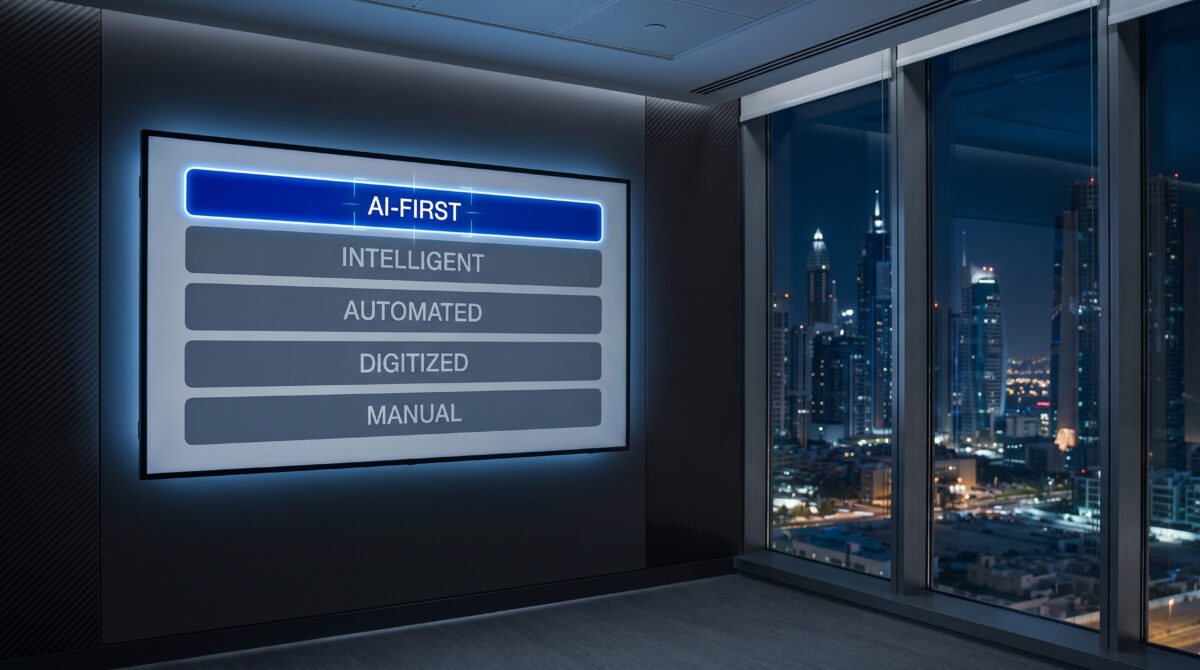
Level 1 means the business still relies mainly on manual operations.
Level 2 means employees use AI tools to support their day-to-day work.
Level 3 means the business has a production AI agent delivering measurable ROI.
Level 4 means multiple AI agents are working across departments, supported by shared infrastructure and governance.
Level 5 means the business operates as an AI-first enterprise, with AI built into core operations and workflows.
This shared language helps the board understand where the company stands and gives the AI Champion a clear view of what comes next. It also helps the CFO plan investment, the CTO shape the technology architecture, and department heads understand that AI adoption is not a single leap. It is a gradual, structured progression.
The Dubai mandate does not mean every business needs to reach Level 5 right away.
That would be unrealistic for most businesses.
For many Dubai businesses, a more realistic goal is to move from Level 1 or Level 2 to Level 3 during the first year, then build toward Level 4 by the end of the two-year window.
Level 3 is the point where AI starts moving from experimentation into real business operations.
Before Level 3, AI is mainly used for awareness, personal productivity, or experimentation. At Level 3, it becomes part of the business’s operating model. A production AI agent takes on a specific process, with human oversight in place and ROI tracked. As employees gain confidence in the system, leadership can see the real business value and make a stronger case for wider adoption.
Once Level 3 is proven, the company can start scaling its AI capabilities toward Level 4.
That’s why getting the first production AI agent right matters so much.
It is more than just another project.
It is the bridge that moves the business from AI experimentation to real operational maturity.
Level 1 is where many businesses start their AI journey.
At this level, most work is still handled by people using basic digital tools. Employees rely on email, Excel, WhatsApp, phone calls, shared folders, and sometimes an ERP or CRM to manage information and enter data. The business may be digital in terms of the software it uses, but day-to-day operations still depend heavily on employees to read, copy, check, follow up, and update information manually.
This is common across Dubai’s trading, logistics, real estate, healthcare administration, professional services, retail distribution, and mid-sized family businesses.
A Level 1 company may have an ERP, yet employees still export data into Excel because the system does not fully fit the way work is actually done. It may have a CRM, but customer conversations still happen mainly through WhatsApp. The finance team may have a dedicated system, but invoices are still downloaded from email, checked manually, and entered line by line. In a warehouse, expiry tracking may still depend on spreadsheets maintained by supervisors. In property management, tenant NOC requests may still be managed through long email threads.
The typical technology stack includes Microsoft Office, email, WhatsApp, basic ERP and accounting software, shared drives, and manual approval processes. Most departments may have their own software, but these systems are often not well connected.
The main challenge at Level 1 is not the absence of AI.
It is a lack of visibility into how processes actually work.
Before a company can automate a process, it first needs to understand how the work actually happens. Many leaders assume a process is straightforward until they sit with employees and see the real workflow. A supplier invoice, for example, may move through email, WhatsApp, purchase orders, goods receipt notes, vendor records, approval messages, and ERP entry. A customs document may pass between logistics, suppliers, freight forwarders, Dubai Customs, finance, and customer service. A tenant renewal can involve leasing, finance, legal, maintenance records, payment history, and owner approval.
At Level 1, the first step is not to invest in an AI tool.
The first step is to identify the biggest pain points caused by manual work.
A company should identify processes where employees spend more than two hours a day on repetitive tasks. These might include invoice processing, document checks, customer inquiries, supplier follow-ups, claims preparation, NOC generation, maintenance ticket routing, shipment tracking, customs paperwork, HR onboarding, or compliance reporting.
The second step is to attend Dubai Chamber training or similar awareness sessions. These should not replace actual implementation, but they can help leadership build a shared understanding of what agentic AI can do and where it fits in the business.
The third step is to assess data readiness. Identify where the data is stored—ERP systems, email, WhatsApp, paper files, portals, PDFs, or Excel. Check whether APIs are available, whether documents are scanned, whether Arabic-English processing is needed, and whether records are duplicated or inconsistent.
A Level 1 company can typically progress to Level 2 within one to three months.
At this stage, the investment is relatively modest. Most of the effort goes into management time, mapping existing processes, interviewing staff, and carrying out a readiness assessment. A basic discovery exercise may cost a few thousand dollars, while a more detailed process and data audit can range from $5,000 to $15,000, depending on the business’s complexity.
A practical Level 1 example is a 50-person trading company where four finance staff manually process supplier invoices, two logistics staff track customs documents in Excel, and the operations manager handles supplier updates through WhatsApp. At this stage, the company does not need a large AI strategy. It needs to understand where manual work is happening, identify the best processes for automation, and choose one clear pilot to start with.
Level 2 begins when employees start using AI tools to make their everyday work faster and easier.
At this stage, employees may use tools such as ChatGPT, Microsoft Copilot, Claude, Gemini, or similar AI platforms to support everyday tasks. They might use AI to draft emails, summarize meeting notes, prepare supplier messages, brainstorm marketing ideas, translate content, improve reports, or quickly make sense of lengthy documents.
This can be useful because it helps employees save time and get routine tasks done more efficiently.
A sales manager may use AI to write better follow-up emails. A procurement executive can summarize supplier messages more quickly. An HR manager can draft job descriptions, while a marketing professional can create social media posts. A finance analyst can use AI to explain a report, and a project manager can quickly summarize meeting minutes.
But Level 2 is still not enterprise-level agentic AI.
It is primarily about individual employee productivity.
At this stage, the company does not have a production AI agent connected to its core systems. There is no centralized monitoring, audit trail, shared AI governance, or clear ROI framework. Data policies may also be unclear. Individual employees or departments may pay for and use AI tools, but those tools are still separate from the company’s broader operating infrastructure.
The biggest risk at Level 2 is Shadow AI use across the organization.
Shadow AI occurs when employees use personal AI accounts or unapproved tools to process company data without proper oversight from IT, legal, compliance, or management. For example, an employee might upload customer invoices to a personal AI tool to extract totals. An HR manager could paste CVs and salary information into ChatGPT. A claims coordinator might use an external tool to summarize patient documents, while a procurement manager could upload supplier contracts to a free AI summarizer.
The work may get done faster, but the company can lose visibility and control over how its data is being used.
No one may know exactly what data was shared, where it was sent, how long it was retained, whether it crossed borders, whether it contained personal information, or whether the AI-generated output was accurate.
That is why Level 2 needs to be formalized as soon as possible.
The first step at this stage is to create a clear AI usage policy. It should outline which tools employees can use, what types of data they can work with, what information must never be uploaded, when personal data needs to be masked, who approves new AI tools, and what employees should do when they want to use AI as part of a business process.
The second step is to identify which employee AI use cases could be turned into formal enterprise AI agents. If several employees are using AI to summarize supplier emails, for example, that could point to a supplier communication agent. If finance teams are using AI to process invoices, it may be a good opportunity for an accounts payable automation agent. If HR teams are using AI to screen CVs, the use case may require stronger governance and could be developed into a controlled recruitment support agent.
The third step is to choose the right process for the company’s first AI pilot.
A Level 2 company has enough AI awareness to move toward real implementation. The risk is that leadership gets comfortable with using AI tools and never takes the next step toward building production AI capabilities.
The typical Level 2 technology stack includes tools such as ChatGPT Plus, Microsoft Copilot, browser-based AI assistants, AI writing and meeting tools, and other individual productivity applications.
The team structure at this stage is usually informal. The company may not have an AI Champion, IT may not have a complete view of which AI tools employees are using, and compliance may not yet be involved.
The direct cost at this stage is usually low, but the hidden risks can be significant. Individual AI subscriptions may cost only a few hundred or a few thousand dollars per month. The bigger concerns are data leakage, inconsistent results, and AI use without proper controls.
A Level 2 company can typically move to Level 3 within two to four months if it selects a suitable process, appoints an AI Champion, puts basic governance in place, and works with an experienced implementation partner.
The trading company at Level 2 now has three employees using ChatGPT to draft supplier emails and summarize meeting notes. This is useful, but there is still no company-wide AI system in place. The next step is to turn these repeated AI tasks into a controlled enterprise agent that the business can manage, monitor, and scale.
Level 3 is likely to be the most important maturity stage for Dubai businesses over the next 12 months.
This is the stage where AI moves beyond individual productivity and becomes part of everyday business operations.
At Level 3, a production AI agent automates one specific business process. Human oversight remains in place, and the company tracks ROI with clear before-and-after results. Employees are actively using the system, while the AI agent connects to real business data and existing workflows.
This is the level many companies should aim for first following Sheikh Hamdan’s mandate.
The Level 3 AI agent does not need to run the entire business. It only needs to make one meaningful business process faster, more efficient, and more effective.
For a trading company, that might be supplier invoice processing.
For a property management company, that could be NOC generation or tenant inquiry handling.
For a hospital, that could be preparing insurance pre-authorization requests.
For a logistics company, that could be customs documentation or shipping document processing.
For an HR team, that could be automating onboarding document collection.
For a finance team, that could be purchase order matching.
The typical technology stack includes a production AI agent built with LangGraph or a similar orchestration framework, connected to LLM APIs or private models. It also includes a human review dashboard, monitoring tools, audit logs, API integrations, and a controlled environment for deployment.
The team typically includes an internal AI Champion supported by an external implementation partner. The AI Champion owns the business process and coordinates the relevant internal teams. The implementation partner handles the technical work, including the AI workflow, system integrations, review dashboard, testing, monitoring, and ongoing maintenance.
The cost of reaching Level 3 is typically around $40,000 to $120,000 for a production single-agent deployment, plus about $2,000 to $5,000 per month for ongoing operations and maintenance. A smaller proof of concept may cost $15,000 to $40,000, but reaching Level 3 requires a production-ready deployment, not just a working demo.
The business impact at this stage can be significant.
A well-chosen AI agent can potentially save $100,000 to $500,000 per year, depending on factors such as process volume, staff costs, error rates, revenue leakage, and improvements in processing speed.
For example, an invoice processing agent can reduce manual data entry, identify mismatches, prevent duplicate invoices, and help speed up the finance close. A tenant communication agent can handle routine inquiries, reduce the support workload, and help protect renewals. A claims preparation agent can reduce delays caused by missing documents and improve overall revenue-cycle performance.
The key challenge at Level 3 is building trust in the AI system.
Employees need to see that the AI agent supports their work rather than threatens their roles. Managers need confidence that clear audit trails are available. Finance needs to see measurable ROI. IT needs assurance that security and integrations are properly controlled. Compliance teams need to know that data privacy and human review are built into the system.
That is why Level 3 should start with a phased deployment rather than a full-scale rollout.
A phased approach makes the transition safer and easier to manage. In Phase 1, the AI observes and extracts information while humans validate the results. In Phase 2, the AI recommends actions and people approve them. In Phase 3, the AI can handle low-risk, high-confidence cases on its own. By Phase 4, the AI can operate with greater autonomy while maintaining a complete audit trail.
A company should not rush into Level 3 before the necessary processes, controls, and trust are in place.
If the first AI agent fails, the organization may become skeptical about future AI projects. If it succeeds, it can become the internal proof point that builds confidence for further AI investment.
To move from Level 3 to Level 4, the company needs to demonstrate ROI, capture lessons learned, strengthen governance, identify the next three processes to automate, and start building shared AI infrastructure.
Moving from a stable Level 3 setup to Level 4 typically takes around three to six months.
In the trading company example, Level 3 means the company now has an AI agent handling invoice processing. It reads supplier invoices, matches them against purchase orders and goods receipts, flags exceptions, and prepares ERP entries for finance review. The four finance staff are no longer spending most of their day on manual data entry. Instead, they can focus on exceptions, supplier disputes, payment planning, and month-end controls.
That is the point where AI maturity becomes a real business capability.
Level 4 begins when the company has three to five AI agents working across multiple departments.
This is likely to be the target for serious early adopters by the second year of Dubai’s agentic AI adoption window.
At Level 4, AI is no longer limited to a single pilot. It becomes a coordinated layer that supports multiple parts of the business.
A trading company might have separate AI agents for supplier invoice processing, customs documentation, supplier ETD tracking, freight quote comparison, and warehouse expiry monitoring. A property management company could use agents for tenant inquiries, NOC generation, lease renewals, rent reminders, and maintenance ticket routing. A healthcare group might use agents for pre-authorization, claims denial prevention, appointment communication, pharmacy inventory management, and medical record summarization.
The key point is that these agents should not operate as isolated tools.
They run on shared infrastructure.
They use a centralized monitoring dashboard.
They follow a common set of governance rules.
They rely on shared data sources where appropriate.
They maintain unified audit trails across the AI systems.
They follow consistent human review processes across all AI agents.
They measure and report business value consistently, so management can compare AI performance across departments.
The typical technology stack includes multiple AI agents managed through a central coordination platform, centralized monitoring, a shared AI knowledge base or retrieval system, unified audit logs, role-based access controls, workflow dashboards, model routing, cost tracking, and a common governance layer.
The team structure becomes more formal and coordinated at Level 4.
The company typically needs a small internal AI team of two or three people. This team may include an AI Product Owner, Data Engineer, and AI Operations or Governance Lead. An external implementation partner can continue to play an important role by developing new agents, connecting systems, improving workflows, and supporting specialized capabilities.
The total investment for reaching Level 4 is typically around $150,000 to $400,000, depending on the number of agents and overall complexity. Ongoing operating and maintenance costs generally range from $8,000 to $15,000 per month.
The impact is now visible across the organization, not just within a single department.
At Level 3, the improvement is usually limited to one department.
At Level 4, multiple departments begin to transform.
Finance can close books faster. Operations gets better visibility into daily work. Customer service handles a lighter workload. Procurement can track supplier activity earlier. Logistics can identify document issues before clearance. Management gets clearer reports, while employees spend less time copying information and more time making decisions.
The main challenge at Level 4 is coordinating multiple AI agents and keeping them aligned across the business.
If each department builds its own AI agent independently, the company can quickly become fragmented. Finance may use one vendor, Operations another, Customer Service a separate platform, HR Microsoft Copilot, and Logistics a custom-built agent. Without a shared approach, management has no single view of data, risk, costs, audit trails, or overall AI performance.
This is why Level 4 needs clear, centralized AI governance.
The company should create an AI governance committee or steering group. It does not need to be bureaucratic, but it needs clear ownership and authority. The group should include business leaders, technology, compliance, risk, legal, finance, and operations. Its responsibilities should include approving new AI agents, monitoring existing ones, reviewing incidents, managing data policies, and deciding when an agent can safely take on more autonomy.
The company must also develop its internal AI capabilities.
At Levels 1 and 2, a company can rely heavily on external partners. That can still work at Level 3. But by Level 4, the business needs internal people who understand how AI agents operate, how data moves through the systems, how to interpret monitoring dashboards, how to handle incidents, and how to evaluate new AI use cases.
Moving from Level 4 to Level 5 may take another 12 to 24 months after Level 4 is stable. Not every business needs to reach Level 5 immediately, but Level 4 provides the foundation for that next stage.
In the trading company example, Level 4 means the company now has AI agents handling invoices, customs documents, supplier tracking, and freight optimization. These agents share relevant information, allowing them to work together more effectively. The supplier tracking agent updates expected arrival dates, the customs agent prepares clearance documents earlier, the invoice agent matches supplier documents with purchase orders, and the freight agent compares carrier costs and reliability. Management can then identify supply chain risks earlier, before they turn into customer problems.
This is the stage where agentic AI becomes a real operational advantage rather than simply another productivity tool.
Level 5 represents the long-term vision for an AI-first enterprise.
At this level, AI agents handle most routine business operations. People focus on strategy, exceptions, relationships, negotiations, creative work, governance, and decisions that require human judgment.
This does not mean the company operates without people.
It is a company where people are no longer tied up in repetitive operational tasks.
A Level 5 enterprise no longer relies on employees to manually process thousands of invoices, chase every supplier update, prepare routine reports, answer repetitive customer questions, or review standard documents line by line. AI agents handle these routine workflows, while people focus on exceptions, relationships, commercial decisions, regulatory responsibility, and strategic direction.
The typical technology stack includes an enterprise AI platform supporting 10 or more agents, centralized AI coordination, strong governance, automated compliance monitoring, intelligent AI model selection, communication between internal and external agents, company-wide audit trails, and AI operations dashboards. Over time, the agents can also communicate directly with one another through protocols such as A2A.
At Level 5, AI is integrated across every department and becomes part of the company’s everyday operations.
Finance uses AI agents to handle invoices, reconciliation, cash-flow forecasting, compliance checks, and financial reporting.
Operations uses AI agents for supply chain visibility, identifying exceptions, following up with vendors, coordinating workflows, and tracking performance.
Customer service uses AI agents to handle routine issues, detect customer sentiment, manage escalations, and send proactive communications.
HR uses AI agents for onboarding, policy support, document collection, training assistance, and internal service desk workflows.
Legal and compliance teams use AI agents to track obligations, collect regulatory evidence, monitor policies, and prepare for audits.
Leadership uses AI-assisted decision systems that draw on trusted operational data rather than disconnected or unreliable summaries.
The team structure at Level 5 is more mature and well-established.
The company typically has a dedicated internal AI team of five to ten people. This may include AI Product Owners, Data Engineers, AI Engineers, AI Operations Specialists, Governance Leads, QA Specialists, and Change Management leads. Strategic partners can still support specialised areas such as new agent development, industry-specific workflows, Arabic NLP, computer vision, legacy system integration, and ongoing optimization.
The cost is high.
A Level 5 enterprise may have more than $500,000 in total build investment, with ongoing costs of around $20,000 to $50,000 per month for operations, maintenance, monitoring, model usage, and continuous improvement. Larger enterprises may require significantly higher investment depending on their scale and complexity.
But the business impact is also significantly greater.
A mature AI-first enterprise can potentially reduce routine operating costs by 40% to 60% in selected workflows. It can also speed up decision-making, shorten process cycles, improve accuracy, reduce rework, respond to customers faster, ease pressure on administrative teams, and create an operational advantage that competitors may find difficult to match.
The challenge at Level 5 is no longer just about technology.
It is about redesigning how the organization operates.
Roles evolve. Employees need new skills, and managers need to learn how to oversee AI-supported workflows. Finance must measure AI ROI as part of normal business operations. Legal and compliance teams need continuous visibility into AI activity. IT needs dedicated AI operations capabilities. HR must manage the workforce transition, while the board needs regular AI governance reporting.
A Level 5 company must also avoid becoming overly dependent on AI.
Humans remain accountable for important decisions and outcomes.
AI agents can handle routine work, but they should never operate without proper oversight or make uncontrolled decisions. Governance, auditability, human oversight, incident response, and ongoing model monitoring remain essential.
This reflects Dubai’s ambition to become one of the world’s leading economies in adopting agentic AI technologies. The UAE’s broader federal push toward agentic AI across government also suggests that autonomous systems will increasingly influence how businesses interact with public services, regulators, and government-linked workflows.
In the trading company example, Level 5 means the business operates as an AI-first enterprise. People focus on managing suppliers, negotiating freight contracts, building customer relationships, reviewing exceptions, and making strategic decisions. AI manages much of the day-to-day operational workload, including invoice processing, customs preparation, ETD tracking, freight comparisons, warehouse risk alerts, customer updates, reporting, and routine compliance monitoring.
That is the long-term destination for an AI-first enterprise.
The table below provides a clear summary of the five maturity levels.
| Level | Operational state | Typical technology | Team structure | Typical cost | Time to next level |
| Level 1: Manual Operations | Human-led work through email, Excel, WhatsApp, ERP entry | Office tools, email, basic ERP, WhatsApp | No AI owner yet | $0-$15K for readiness work | 1-3 months |
| Level 2: AI-Assisted | Employees use AI tools individually | ChatGPT, Copilot, personal AI tools | Informal users, no enterprise owner | Low subscription cost, high shadow-AI risk | 2-4 months |
| Level 3: Single AI Agent | One process automated with ROI proven | One production AI agent, dashboard, monitoring | AI Champion + implementation partner | $40K-$120K build + $2K-$5K/month | 3-6 months |
| Level 4: Multi-Agent Operations | 3-5 agents across departments | Shared orchestration, monitoring, vector DB, audit layer | Internal AI team + external partner | $150K-$400K cumulative + $8K-$15K/month | 12-24 months |
| Level 5: AI-First Enterprise | AI handles most routine operations | 10+ agents, governance platform, compliance monitoring, inter-agent communication | 5-10 person AI team + strategic partners | $500K+ cumulative + $20K-$50K/month | Continuous maturity |
This table can serve as a board-level reference for assessing the company’s AI maturity.
It helps leadership see that AI adoption is not just a single budget item. It is a gradual progression from understanding manual processes to building a mature, enterprise-wide AI capability.
Use this simple AI maturity model in the article design or present it as an infographic.
| Maturity level | What it feels like inside the company |
| Level 1: Manual Operations | “Our teams are busy, but most work still depends on people copying, checking, chasing, and updating.” |
| Level 2: AI-Assisted | “Some staff use AI tools, but there is no controlled enterprise system.” |
| Level 3: Single AI Agent | “One real workflow is now automated, measured, and governed.” |
| Level 4: Multi-Agent Operations | “Multiple departments now run AI-assisted workflows on shared infrastructure.” |
| Level 5: AI-First Enterprise | “AI handles the routine backbone of the business while humans manage strategy and exceptions.” |
The AI maturity model also helps employees understand that AI adoption is not about replacing everyone overnight. It is about gradually moving repetitive tasks into AI systems while people focus on higher-value work.
Use this quiz to identify your company’s current AI maturity level.
Rate each question on a scale of 0 to 2.
0 means no.
1 means partly.
2 means yes.
| Question | Score |
| Do you have a documented list of manual, repetitive processes across departments? | 0-2 |
| Do you know where the data for your top workflows lives? | 0-2 |
| Do employees currently use AI tools for work under an approved policy? | 0-2 |
| Have you appointed an internal AI Champion or business owner? | 0-2 |
| Have you selected your first AI agent pilot process? | 0-2 |
| Do you have one AI agent running in production with human review? | 0-2 |
| Can you measure ROI from at least one AI agent? | 0-2 |
| Do you have multiple AI agents across departments? | 0-2 |
| Do you have AI governance, audit trails, and monitoring dashboards? | 0-2 |
| Is AI embedded into normal operations across most departments? | 0-2 |
Interpretation:
| Score | Likely maturity level |
| 0-3 | Level 1: Manual Operations |
| 4-7 | Level 2: AI-Assisted |
| 8-12 | Level 3: Single AI Agent readiness or early deployment |
| 13-17 | Level 4: Multi-Agent Operations |
| 18-20 | Level 5: AI-First Enterprise |
This quiz is not a substitute for a full readiness assessment, but it gives leadership a quick overview of the company’s current position.
If your score is below 8, the immediate focus should not be enterprise-wide AI transformation. Start with understanding your processes, establishing basic policies, improving data readiness, and selecting the right first AI pilot.
If your score is between 8 and 12, the goal should be to deploy one production AI agent and demonstrate measurable ROI.
If your score is above 13, the focus should shift to governance, shared infrastructure, and scaling multiple AI agents across the business.
The move from one maturity level to the next should be planned carefully.
Moving from Level 1 to Level 2 is usually less expensive than the later stages. The focus is mainly on raising awareness, establishing basic AI policies, identifying appropriate processes, and providing initial training. This stage typically takes one to three months and may include Dubai Chamber training, internal workshops, and a basic review of data readiness.
Moving from Level 2 to Level 3 marks the first significant investment. The company needs to select one process, approve a budget, choose an implementation partner, build the AI agent, test it with real data, and deploy it with human oversight. A proof of concept may cost $15,000 to $40,000, while a full production deployment typically costs $40,000 to $120,000. The first production agent usually takes two to four months, depending on data quality and system integrations.
Moving from Level 3 to Level 4 means expanding AI beyond a single department. This typically requires shared infrastructure, centralized monitoring, stronger governance, additional system integrations, and an internal AI team. The total build investment may rise to $150,000 to $400,000, with ongoing operating and maintenance costs of around $8,000 to $15,000 per month. The first wave of additional agents usually takes three to six months after the initial agent is stable, while broader Level 4 maturity may take longer.
Moving from Level 4 to Level 5 is a major shift toward becoming an AI-first enterprise. The transition can take 12 to 24 months or longer. At this stage, the company needs 10 or more AI agents, stronger governance, dedicated AI operations, internal AI expertise, mature data architecture, and regular board-level reporting. Total investment can exceed $500,000, while complex enterprises may spend $20,000 to $50,000 per month on ongoing operations, maintenance, and support.
These figures should be treated as general estimates, not fixed packages.
They are indicative planning ranges rather than fixed costs.
A small business may reach Level 3 with a lower investment if its first AI use case is simple. A regulated business, such as one in healthcare or finance, may need to spend more because of stricter privacy, audit, security, and compliance requirements.
The key point is that each stage of AI maturity has different cost requirements.
Trying to reach Level 5 without first building the right Level 3 foundations can result in significant wasted investment.
aTeam Soft Solutions recommends that most Dubai businesses consider Level 3 their first major AI milestone.
Level 1 companies should avoid buying multiple AI tools as their starting point.
They should begin by identifying and mapping their manual workflows.
Level 2 companies should not allow unapproved AI use to spread without proper oversight.
They should establish clear AI usage guidelines and turn repeated individual use into controlled, company-wide pilot projects.
Level 3 companies should avoid rushing to build multiple AI agents at once.
They should first prove ROI, capture what they learn, and develop a repeatable approach for implementing future AI agents.
Level 4 companies should focus on strengthening governance, shared infrastructure, monitoring, cost control, and internal AI expertise.
Level 5 companies should focus on building strategic advantage, connecting AI agents across workflows, developing a strong AI operating model, and continuously improving performance.
aTeam Soft Solutions helps businesses progress through these maturity levels with a structured and disciplined implementation approach.
We are an India-based AI and software development company with a team of 120+ engineers, ISO 9001:2015 and ISO/IEC 27001:2022 certifications, a 4.9/5 Clutch rating based on 90+ verified reviews, and more than 20 published case studies.
Our role is to help businesses turn AI maturity plans into practical, working systems.
That includes process discovery, selecting the right first AI agent, designing the AI architecture, integrating data, building human-in-the-loop dashboards, establishing governance, monitoring performance, optimizing systems, and scaling AI across the business.
For Dubai companies, the path forward is straightforward.
Evaluate your current AI maturity level.
Select the next maturity level to target.
Do not skip the steps in the AI maturity journey.
Deploy one AI agent successfully before scaling further.
Then scale gradually.
A Dubai trading company may start at Level 1, with finance processing invoices manually, logistics tracking customs documents in Excel, and supplier updates scattered across WhatsApp. The first step is to map these workflows and select invoice processing as the Level 3 pilot. Once the invoice agent proves its ROI, the company can expand into customs document support, supplier ETD tracking, and freight comparison, gradually moving toward Level 4.
A property management company may start at Level 2, where staff already use AI to draft tenant responses, but there is no approved system in place. The company first establishes an AI policy and then builds an agent for tenant inquiries or No Objection Certificate (NOC) generation. Once the initial agent proves effective, the company can add agents for lease renewals, rent reminders, maintenance requests, and owner reporting. The key maturity shift is from informal AI use to controlled and structured AI operations.
A healthcare provider may begin at Level 2 or early Level 3, where staff use AI tools individually, but patient data risks make uncontrolled adoption unsafe. The company can start with insurance pre-authorization because it offers strong ROI while keeping humans involved in the review process. Once the governance framework is proven, the provider can expand into claims denial prevention, scheduling, pharmacy inventory, and medical record summarization. The maturity journey needs to be more deliberate because healthcare workflows require stronger privacy controls and clinical oversight.
These examples show that the maturity model can apply across industries, but the path to adoption varies by sector.
AI maturity is not determined by the number of tools a company uses.
It is about how deeply, securely, and measurably AI is integrated into the business.
An agentic AI maturity model is a framework that shows how a business progresses from manual operations to AI-first operations. It helps companies identify where they currently stand, whether they rely mainly on manual processes, use AI for individual productivity, run a production AI agent, manage multiple AI agents, or operate as an AI-first enterprise.
Your maturity level depends on how AI is being used across your operations. If most processes are still manual, you are at Level 1. If employees use tools such as ChatGPT or Copilot mainly for individual productivity, you are at Level 2. If you have one production AI agent delivering measurable results, you are at Level 3. If multiple departments use AI agents on shared infrastructure, you are at Level 4. If AI manages most routine operations across the business, you are at Level 5.
A company can move from manual operations to its first production AI agent in around three to six months if it starts with one clearly defined process, has usable data, appoints an AI Champion, approves the necessary budget, and works with an experienced implementation partner. Companies with poor data quality or legacy systems may need more time.
The practical first target is Level 3: at least one production AI agent running within the business, with human oversight and measurable return on investment (ROI). More advanced companies should aim for Level 4 by the end of the two years, with multiple AI agents operating across departments under shared governance.
Moving from Level 1 to Level 2 may require mainly training, AI policies, and readiness work. Level 3 typically involves an investment of $40,000 to $120,000 for one production AI agent, plus around $2,000 to $5,000 per month in ongoing costs. Level 4 may require $150,000 to $400,000 in cumulative build investment, with $8,000 to $15,000 per month for operations and maintenance. Level 5 can exceed $500,000 in cumulative investment, with monthly costs of around $20,000 to $50,000, depending on the company’s size, complexity, and AI requirements.
Yes. A small business can reach Level 3 by choosing one practical workflow, such as handling customer inquiries, processing invoices, scheduling appointments, collecting documents, or preparing quotes. It does not require a large internal AI team. One internal AI Champion, supported by an experienced implementation partner, can be enough to get the first AI agent into production.
No. Level 5 should be treated as a long-term goal, not an immediate target. Most businesses should first focus on reaching Level 3 and then progress toward Level 4. Trying to become AI-first before proving the value of a production AI agent can be risky and costly. AI maturity should be developed step by step.
The agentic AI maturity model gives Dubai businesses a clear and practical roadmap for responding to Sheikh Hamdan’s two-year mandate without rushing or creating unnecessary confusion.
Level 1 represents a business where most operations are still handled manually.
Level 2 represents employees using AI tools to support and improve their daily work.
Level 3 means having one production AI agent delivering measurable business value.
Level 4 means multiple AI agents operating across different departments.
Level 5 represents an enterprise where AI is deeply embedded across core business operations.
The goal is not to move directly from Level 1 to Level 5 overnight.
The goal is to progress through each level one step at a time, with discipline and a clear plan.
Dubai’s two-year mandate is pushing private-sector businesses from manual and AI-assisted work toward production-ready agentic AI. Businesses that start now can work toward Level 3 within the first year and Level 4 by the end of the two years. Those that delay may still be experimenting with individual AI tools while competitors deploy multiple AI agents across finance, operations, customer service, logistics, healthcare, real estate, and compliance.
The technology is already ready for practical adoption.
The approach has already been proven in practice.
The government support is already underway.
The main factor is when your company decides to begin.
aTeam Soft Solutions helps Dubai businesses evaluate their current AI maturity, select the right first AI agent, deploy it safely, demonstrate measurable ROI, and scale toward multi-agent operations.
Begin by assessing your current AI maturity level.
Then determine the next step in your AI maturity journey.