The agentic AI governance Dubai enterprises need is not just a policy PDF stored in a compliance folder. It needs to be built into how AI agents are designed, deployed, monitored, and managed across the business.
It is the system that guides how the AI agent operates, makes decisions, and stays under control.
After Sheikh Hamdan’s private-sector agentic AI initiative, Dubai companies are facing growing pressure to move quickly. That pressure is real. Businesses that wait until 2028 may find it harder to keep pace with competitors that have already started using AI agents for tasks such as invoice processing, tenant communication, claims documentation, customs workflows, customer service, HR requests, procurement follow-ups, and compliance reporting.
However, the businesses that scale AI successfully will focus on control and accountability, not simply deploying more agents.
They will be the companies that can clearly identify who is accountable for each AI action, what information the agent used, how confident it was in its decision, which person approved the result, what system was updated, what went wrong, how the issue was contained, and what the board reviewed in the quarterly governance report.
That is what effective AI governance looks like in practice.
Most AI problems don’t happen because a company failed to create a policy. They happen because there aren’t enough operational controls to monitor and manage the AI after it goes live.
A chatbot can provide the wrong answer and harm the brand’s reputation.
An AI agent can update an ERP, send a renewal message, prepare a claim, process a supplier payment, submit a customs document, classify a customer, or escalate an employee case. Once an AI agent starts taking action within a business workflow, governance is no longer just an AI concern; it becomes a business continuity issue.
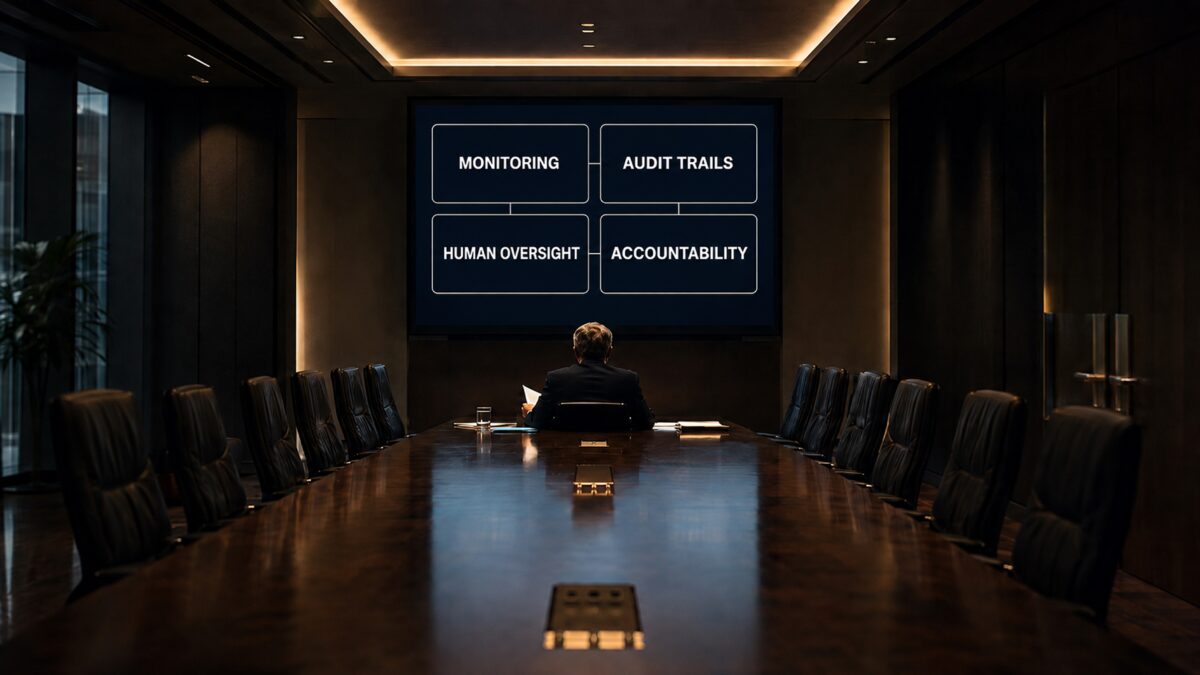
At aTeam Soft Solutions, we do not see governance as a legal layer that is added after development. We build it into the architecture from the start. Every serious agentic AI deployment should have clear audit trails, monitoring dashboards, escalation rules, human oversight, incident response processes, board-level reporting, and clearly defined ownership.
This playbook provides Dubai enterprises with a practical framework for managing and governing AI agents in real-world production environments.
Traditional IT governance is built around the assumption that software follows predefined rules and behaves in predictable ways.
If a user enters data, the system checks it against set rules. Once a payment is approved, the transaction is recorded. When one step in a workflow is completed, the next step begins. Software can still have bugs, but its behavior is generally predictable because it follows predefined logic.
Agentic AI in Dubai takes a different approach.
An AI agent can handle much more than a fixed set of rules. It can read unstructured information, understand the context, pull data from different sources, evaluate options, make recommendations, and even take action across business systems. Because of this, its behavior is not always predictable. Two similar documents may receive different confidence scores. A customer message could be classified differently based on how it is written. An unusual mismatch in a supplier invoice might cause the agent to send it for human review. A routine tenant question may be handled automatically, while a similar request involving a legal dispute may need to be escalated to a person.
This means AI governance needs to go beyond access permissions and traditional software change controls.
Agentic AI governance must also focus on how the agent behaves, makes decisions, and responds in real-world situations.
It also needs to address questions that traditional software governance does not usually consider.
How much independence should the AI agent have when making decisions and taking actions?
Which AI decisions should require a human to review and approve them?
What level of confidence should the AI agent have before it is allowed to take action?
How should the AI agent respond when it is unsure about what to do?
What data and information is the AI agent allowed to access?
Is the AI agent allowed to share information with external AI or LLM services?
Is the AI agent authorized to make changes to official business records?
Can employees step in and override the AI agent when necessary?
Can the business undo or reverse an action taken by the AI agent?
Can auditors see the complete sequence of events behind an AI agent’s decision and actions?
These questions matter even more in Dubai because many agentic AI use cases involve sensitive or regulated business processes. Healthcare claims can contain patient information. Financial workflows in DIFC or ADGM may involve customer risk, KYC, and transaction data. ZATCA-related processes for Saudi operations can impact tax compliance, while DHA-related workflows may involve healthcare records and documentation. In real estate, AI agents may handle tenant information, lease details, and payment history.
Dubai enterprises do not need to avoid these use cases simply because they involve sensitive or regulated processes.
They need to put the right governance controls in place to manage them safely.
The first question Dubai enterprises need to address in agentic AI governance is straightforward: who is responsible when an AI agent makes a mistake?
The answer cannot simply be “the AI.”
The AI itself cannot be held accountable for business decisions.
The company using the AI agent remains responsible for the process, the data it handles, the decisions it makes, customer communications, system changes, and the results that follow.
This matters because teams can sometimes treat AI as though it is independently responsible for what it does. You may hear phrases like, “The AI approved it” or “The AI missed it.” “The AI sent the message,” or “The AI made the decision.”
That kind of language is risky because it can make accountability unclear when something goes wrong.
A regulator, customer, patient, tenant, employee, auditor, or board member is unlikely to accept “the AI did it” as an adequate explanation when something goes wrong.
A strong governance model should clearly define responsibility across three levels.
The first level is business accountability. The person who owns the business process remains responsible for its outcome. If an AI agent handles supplier invoices, the finance process owner is still accountable. If it manages tenant communication, the property operations owner remains responsible. If it prepares insurance pre-authorization documents, accountability stays with the revenue cycle or claims team.
The second level is technical accountability. The technology owner is responsible for keeping the system reliable and secure, including access controls, integrations, monitoring, model configuration, deployment, and ongoing maintenance.
The third level is governance accountability. The compliance, risk, legal, or governance team provides oversight and ensures that policies, audit requirements, incident response, and regular reviews are properly managed.
This clear separation helps prevent confusion about who is responsible for what.
For example, if an AI invoice agent extracts the wrong VAT value, the finance owner remains responsible for the financial process, the technology owner is responsible for why the validation failed, and the governance owner is responsible for ensuring that the right controls, logs, and incident response processes were in place.
The AI vendor may also have responsibilities, but those responsibilities should be clearly defined in the contract. This can include service commitments, support response times, code ownership, error handling, confidentiality, security, and ongoing maintenance. However, a business cannot simply hand over accountability for its own operations to a vendor.
At aTeam Soft Solutions, we recommend giving every AI agent a clearly named business owner before development starts. If the business cannot identify who will be accountable for the agent and its outcomes, the project should not move forward.
An AI agent without a clearly assigned human owner can quickly become a serious organizational risk.
A strong agentic AI governance framework for Dubai enterprises should work across three levels: operational monitoring, management oversight, and board-level reporting.
Each of these three layers has a different purpose and role to play.
Operational monitoring focuses on what happens in the AI system on a day-to-day basis.
Management oversight looks at whether the AI agent is delivering business value while operating safely and within approved controls.
Board reporting focuses on the bigger picture, including strategic risk, investment decisions, compliance posture, and the organization’s progress with AI adoption.
Many companies try to manage every aspect of AI governance at a single level, but that approach rarely works.
A board should not be reviewing every low-confidence invoice. A support manager should not be responsible for setting the company’s overall AI risk appetite. And a data scientist should not be the only person deciding whether a clinical workflow is safe. Effective AI governance needs clear levels of responsibility.
Operational monitoring is the day-to-day control layer that keeps AI agents working safely and as expected.
This is where teams monitor how the AI agent behaves in production. They track things like accuracy, confidence scores, failed actions, escalations, processing volume, human overrides, response times, costs, and exceptions.
For example, a finance team using an invoice agent should be able to see how many invoices were processed, how many passed validation, how many required human review, which suppliers caused errors, how many duplicate invoices were flagged, and whether any ERP updates failed.
A property management team using a tenant communication agent should be able to track the total number of messages handled, resolution rates, escalation categories, sentiment concerns, legal-risk messages, unanswered questions, and response times.
A healthcare team using a pre-authorization agent should track missing-document detection, payer-specific exceptions, staff corrections, submission preparation time, denial patterns, and cases that require clinical clarification.
The process team should own operational monitoring, with the technology team providing the necessary support.
This layer answers a simple question: “Is the AI agent operating safely and as expected today?”
Management oversight is the layer where teams review the AI agent’s performance on a weekly or monthly basis.
This is where department heads, AI champions, risk owners, and technology leaders assess whether the AI agent is actually improving the process.
They need to look beyond technical metrics and assess the agent’s real business impact.
Is the AI agent actually reducing manual effort?
Are errors actually decreasing?
Are employees actually using the system as intended?
Are customers receiving faster responses?
Are escalations being handled appropriately?
Is the cost per transaction going down?
Are any new risks emerging?
Are human overrides happening more often than expected?
Is the agent’s performance starting to drift from expectations?
Management oversight should also approve any changes to the AI agent’s level of autonomy. Moving from observation mode to assisted mode should not be a decision made solely by developers. Moving from assisted mode to controlled action should require approval from both business and governance teams.
This layer answers a key question: “Is the AI agent still delivering enough value to justify scaling?”
Board reporting provides the quarterly governance view of the AI program.
The board does not need to get into model-level technical details. It needs a clear view of AI adoption, business value, risk exposure, major incidents, compliance status, and upcoming investment decisions.
A quarterly AI governance report should give the board a clear picture of how many AI agents are live, which business functions are using them, what value they have delivered, what incidents have occurred, what controls are in place, what data risks remain, and what the next phase of AI adoption will require.
This becomes even more important as Dubai businesses respond to the agentic AI mandate. Boards need confidence that AI adoption is being managed through a structured and well-governed program, rather than through unplanned experimentation.
This layer answers a broader question: Is the company managing and scaling AI responsibly at the strategic level?
Audit trails are a core part of effective agentic AI governance.
If an AI agent makes a mistake and the company cannot trace how or why it happened, there is a clear failure in the governance process.
A well-designed AI agent audit trail should capture every important event throughout the workflow.
It should capture the input the agent receives, including details such as the document ID, message ID, source channel, user ID, system source, timestamp, and document type. The full document does not always need to be stored in the audit log, particularly when it contains sensitive information. However, the log should provide a secure link back to the source record.
It should also capture the data sources the agent accessed. Whether it checked an ERP, CRM, EMR, WMS, tenant records, supplier information, payer rules, or a knowledge base, the audit trail should record which sources were used and when.
It should also capture details about the model being used, including the provider, model version where available, prompt version, retrieval version, and tool versions. This matters because the agent’s output can change when the model, prompt, or supporting tools are updated.
It should also log the confidence score. Whenever the agent extracts information, classifies a request, recommends an action, or prepares a submission, its confidence level should be recorded.
It should also capture the evidence behind the agent’s output. The system should identify the document section, policy, rule, data field, or record that supported the result. This is particularly important for contract reviews, claims processing, compliance checks, and financial workflows.
It should also capture every action the agent takes. This includes creating a ticket, updating a CRM field, preparing an ERP entry, sending a message, generating a PDF, triggering an approval, or escalating a case.
It should also record any human involvement. If someone approves, rejects, edits, or overrides the AI’s output, the audit trail should capture the user ID, timestamp, and details of the change.
It should also record whether the action can be reversed. If an AI action can be rolled back, the audit trail should show how the reversal can be performed. If the action cannot be undone, the workflow should require a higher level of approval before it is carried out.
The audit trail should not be filled with complex technical details that only developers can understand. It should be structured and clear enough for operations, compliance, IT teams, and auditors to review when needed.
The table below outlines the key information a useful AI audit record should capture.
| Audit field | Why it matters |
| Case ID or transaction ID | Links all events in one workflow |
| Input source | Shows where the data came from |
| Data sources accessed | Proves what the agent used |
| Model and prompt version | Explains output context |
| Confidence score | Shows uncertainty level |
| Retrieved evidence | Grounds the output in source data |
| AI recommendation | Records what the AI suggested |
| Action taken | Shows business impact |
| Human approver | Proves oversight where required |
| Timestamp | Supports audit chronology |
| Error or exception code | Helps investigation |
| Rollback status | Shows whether correction is possible |
For high-risk workflows, audit trails should be unable to be altered or protected from unauthorized changes. Access should be restricted, logs should be retained according to policy, and sensitive personal information should be protected wherever possible.
A company should not scale its AI agents if it cannot properly track and review their actions.
A good monitoring dashboard is not just a screen full of numbers. It should give teams a clear view of how the AI agent is performing and whether it is operating safely.
It helps the business spot potential problems early, before they develop into serious incidents.
Every AI agent running in production should have a dashboard that gives teams visibility into operational performance, business value, and potential risks.
The first KPI is volume processed. It shows how many cases, documents, messages, transactions, or workflows the AI agent handled during a given period. This helps the business understand both usage and workload.
The second KPI is accuracy. It should be measured using human-reviewed samples rather than relying on the model’s confidence score. For invoice agents, this could mean field-level extraction accuracy. For tenant communication agents, it could measure correct intent classification. For claims agents, it could track how accurately missing documents are identified.
The third KPI is confidence distribution. Looking only at average confidence is not enough. The dashboard should show how many cases fall into high-, medium-, and low-confidence ranges. A sudden rise in low-confidence cases can signal data drift, new document formats, or changes in the underlying workflow.
The fourth KPI is escalation rate. Escalation is not necessarily a problem. In high-risk workflows, appropriately sending uncertain cases to a human can indicate good system design. However, an unexpected increase in escalations may suggest that the agent is struggling or that the workflow has changed.
The fifth KPI is human override rate. It shows how often employees change or reject the AI agent’s output. A high override rate may indicate that the agent is inaccurate, staff does not trust its recommendations, or the workflow rules need to be clarified.
The sixth KPI is error rate by category. Errors should be grouped by their cause so teams can identify recurring problems. These may include extraction errors, classification errors, incorrect source retrieval, API failures, business rule mismatches, hallucinated responses, integration timeouts, or human corrections.
The seventh KPI is processing time. One of the main benefits of AI agents is faster execution. If processing times increase, it could indicate system overload, slow APIs, or a workflow that is encountering more exceptions than expected.
The eighth KPI is cost per transaction. The dashboard should track LLM API costs, cloud infrastructure costs, and maintenance expenses. If the cost per transaction increases, the business may need to optimize prompt design, model selection, or workflow routing.
The ninth KPI is business outcome. The right measure depends on the agent’s purpose. For invoice agents, it could be processing costs per invoice. For tenant agents, it could include resolution rate and renewal support. For healthcare agents, it could track preparation time and first-submission approval rates. For customs agents, it could measure clearance readiness and reduced container delay charges.
The tenth KPI is incident count. The dashboard should track how many incidents occurred, their severity, how long they took to resolve, and whether similar incidents happened again.
The dashboard should not overwhelm managers with technical logs and unnecessary details. It should focus on the information that helps them understand performance, risks, and issues that need attention.
For example, a finance manager does not need to review every model call. They need to know whether invoices are being processed accurately, whether exceptions are under control, and whether the AI agent is helping improve month-end closing.
A compliance officer does not need to review every user click. They need visibility into audit completeness, high-risk actions, data access events, human overrides, and incidents.
A board member does not need daily transaction-level data. They need to see quarterly trends, business value, risk exposure, and the maturity of the organization’s AI controls.
The same underlying monitoring system should support all three levels while presenting each audience with the information most relevant to its role.
Dubai enterprises should plan on AI systems eventually being subject to regulatory reviews, internal audits, customer audits, or board-level scrutiny.
The review may come from a sector regulator, free-zone authority, major enterprise customer, insurer, healthcare authority, tax authority, or internal audit committee.
The specific questions may differ by sector, but the overall pattern is fairly predictable.
Auditors will ask what the AI agent is designed to do and how it is used within the business.
They will ask what types of data the AI agent processes and how that data is used.
They will ask whether the AI agent handles personal, confidential, or sensitive data.
They will ask whether any data processed by the AI agent is transferred outside the UAE.
They will ask who approved the AI system and authorized it for use.
They will ask how the AI agent’s accuracy is measured and validated.
They will ask whether human reviewers are involved in checking important or high-risk outputs.
They will ask how errors are identified, reported, and addressed.
They will ask whether the AI system maintains complete and reviewable audit logs.
They will ask whether the company can trace and explain how a specific AI decision was made.
They will ask who has access to the AI system and what permissions each user has.
They will ask whether the AI vendor or external provider has access to production data.
They will ask what happens if the AI system fails, produces an incorrect result, or becomes unavailable.
For ZATCA-related workflows, auditors may focus on invoice accuracy, validation rules, tax fields, submission records, and error handling. For DHA healthcare workflows, they may examine patient data, clinical boundaries, health data storage, human review, and patient safety. For DIFC or ADGM financial workflows, the focus might include data protection, customer risk decisions, explainability, access controls, and vendor governance.
This means companies should prepare an AI audit pack in advance, rather than waiting until an audit is announced.
The AI audit pack should include the use-case description, data-flow map, risk assessment, DPIA where applicable, system architecture, vendor contracts, access-control matrix, audit trail samples, monitoring dashboard reports, incident register, human oversight framework, model and prompt version history, testing results, and board-level governance reports.
It may seem like a lot of work, but preparing this documentation during implementation is far easier than trying to gather it after an audit request arrives.
At aTeam Soft Solutions, we recommend giving every production AI agent an audit folder from day one. It does not need to be publicly accessible; it simply needs to be available to the authorized governance team.
A company that can provide clear audit evidence quickly demonstrates that its AI systems are well controlled and properly governed.
A company that cannot clearly explain how its AI system works may appear poorly governed, even if the agent is delivering strong results.
Every AI governance framework should be designed with the expectation that mistakes will happen.
The goal is not to assume that an AI agent will always perform perfectly.
The goal is to identify mistakes early, limit their impact, understand the root cause, fix the problem, communicate clearly, and prevent it from happening again.
A strong AI incident response process follows six clear steps.
The first step is detection. An error may be identified through monitoring, staff review, a customer complaint, an audit sample, a failed system action, or an unusual change in KPIs. The system should support early detection by tracking exceptions, override rates, sudden increases in low-confidence cases, and failed actions.
The second step is containment. If the agent starts making repeated errors, its level of autonomy should be reduced immediately. Move it from controlled action back to assisted or shadow mode, and pause only the affected workflow where possible instead of stopping the entire AI program.
The third step is investigation. The team should review the audit trail to determine what went wrong. They should check the input the agent received, the model and prompt versions used, the data sources accessed, the confidence score, the action taken, whether a human approved the output, whether an integration failed, and whether any business rules had changed.
The fourth step is remediation. This may involve correcting the affected record, reversing the action where possible, notifying the relevant internal teams, updating the prompt or business rule, fixing an integration, adding a new test case, or adjusting the escalation threshold.
The fifth step is communication. Not every incident requires external notification, but relevant internal stakeholders should understand what happened, how it was contained, and what corrective actions are underway. If the incident involves personal data, regulated information, customer impact, patient safety, or legal risk, legal and compliance teams should determine whether external notification is necessary.
The sixth step is prevention. Every incident should lead to improvements that reduce the chance of the same problem happening again. This may include adding the case to the test dataset, improving monitoring, adjusting confidence thresholds, updating workflow rules, training staff, and strengthening documentation.
The table below outlines the different AI incident severity levels.
| Incident severity | Example | Response |
| Low | AI misclassifies a routine support ticket | Correct category and add to test set |
| Medium | AI extracts wrong invoice field but human catches it | Tune extraction and monitor supplier format |
| High | AI sends incorrect customer communication | Pause sending workflow and investigate |
| Critical | AI updates financial, health, legal, or regulatory record incorrectly | Disable autonomous action, escalate to leadership, legal, compliance, and IT |
The most important principle is responding quickly.
If an AI agent produces an incorrect result, do not spend weeks debating its severity. Contain the issue first, investigate what happened, and then fix and improve the system.
This is how trust in AI systems is maintained.
Boards do not need detailed technical dashboards, but they do need clear, structured visibility into AI performance, risks, and governance.
A quarterly AI governance report should be concise, consistent, and focused on the decisions the board needs to make.
The first section should provide an overview of all live AI agents. It should list each agent, its business owner, deployment phase, process handled, monthly volume, and level of autonomy.
The second section should show the value delivered by the AI agents. This can include hours saved, costs avoided, revenue protected, error reduction, faster processing, backlog reduction, and other measurable business outcomes.
The third section should show the current risk status. It should cover high-risk workflows, personal data exposure, external API usage, cross-border transfer status, human oversight, audit readiness, and any unresolved governance gaps.
The fourth section should cover AI incidents. It should report the number of incidents, their severity, resolution time, root causes, and the actions taken to prevent recurrence.
The fifth section should cover model performance. It should include accuracy trends, confidence distribution, escalation rates, human override rates, and indicators of data or model drift.
The sixth section should cover compliance status. It should include completed DPIAs, privacy reviews, prepared audit packs, vendor assessments, access reviews, and any outstanding regulatory issues.
The seventh section should cover upcoming changes. It should include planned AI agents, requested increases in autonomy, new data sources, new vendors, model updates, and any planned expansion into regulated workflows.
The eighth section should focus on decisions required. The board may need to approve budgets, risk appetite, new high-risk deployments, changes to governance policies, or major vendor selections.
A typical quarterly report may look like this.
| Board report section | What to include |
| Agent inventory | Live agents, owners, processes, autonomy level |
| Business value | Savings, revenue impact, speed improvement |
| Risk view | High-risk workflows, data exposure, controls |
| Incidents | Count, severity, root cause, remediation |
| Performance | Accuracy, drift, overrides, escalations |
| Compliance | DPIAs, audits, access reviews, vendor reviews |
| Roadmap | Next agents, new departments, autonomy changes |
| Decisions needed | Budget, approvals, risk acceptance |
This report gives the board confidence that agentic AI adoption is being managed responsibly and effectively.
It also helps prevent AI projects from operating unnoticed across departments without proper strategic oversight.
Human oversight should not remain fixed.
It should evolve as the AI agent demonstrates greater accuracy, reliability, and trustworthiness.
aTeam Soft Solutions uses a four-phase Graduated Trust Framework because giving an AI agent full autonomy from day one is rarely safe.
Phase 1 focuses on Monitoring and Data Extraction.
In this phase, the AI agent reviews documents, extracts information, classifies cases, or prepares outputs without taking any action. Humans validate every result. This stage helps identify edge cases, establish baseline accuracy, and collect correction data.
For example, an invoice AI agent can extract supplier details and match purchase orders, while the finance team continues the manual process and checks the AI’s results.
Phase 2 involves AI Recommendations with Human Confirmation.
The AI agent now starts recommending what should happen next. It can prepare an ERP entry, draft a reply to a tenant, put together a claims packet, or suggest information for a customs declaration. A human still reviews and approves everything before it is sent or updated. This phase begins to save time while keeping people in control.
For example, a tenant communication agent can draft replies to routine questions, while support staff review and approve them before they are sent.
Phase 3 is Take Action with Controls.
The AI agent can handle high-confidence, low-risk cases on its own. Anything uncertain or higher risk is sent to a human for review. Guardrails can include confidence thresholds, spending or value limits, restrictions on document types, customer categories, and clear escalation rules.
For example, an NOC generation agent can automatically prepare standard NOCs for tenants with active leases and no overdue payments. Any unusual cases or exceptions are sent to staff for review.
Phase 4 is Autonomous Operations with Full Auditability.
The AI agent can take on more tasks independently, while every action is still recorded, monitored, and available for review. This phase should only be introduced once there is enough evidence from real-world use that the agent is performing reliably. Even then, high-risk decisions may always require human review.
For example, an invoice agent can automatically process low-value invoices that are fully matched and meet a high confidence threshold. High-value invoices or those with mismatches are still sent to a human for approval.
The table below outlines how human oversight changes at each phase.
| Phase | AI role | Human role | Suitable workflows |
| Phase 1: Observe and Extract | Reads and prepares outputs | Validates everything | New pilots, high-risk workflows |
| Phase 2: Suggest and Confirm | Recommends actions | Approves before action | Finance, claims, tenant support |
| Phase 3: Act with Guardrails | Acts on low-risk cases | Reviews exceptions | Mature, measurable workflows |
| Phase 4: Autonomy with Audit Trail | Handles wider workflow | Monitors and audits | Stable, high-confidence operations |
This model matters because governance should protect the business without slowing down productivity.
The goal is not to have humans approve every action forever.
The goal is to give the AI more responsibility as it proves it can operate safely and reliably.
A UAE finance team used an AI agent to process supplier invoices. The main governance concern was that an incorrect extraction could lead to errors in ERP records and supplier balances. The team addressed this with a layered oversight approach. In Phase 1, the AI extracted invoice details, but finance staff checked every result. In Phase 2, the AI prepared the ERP entries, and staff approved them before submission. In Phase 3, the agent could process only low-value, fully matched invoices, while exceptions were sent to staff for review. The audit trail captured key details at every step, including the invoice source, extracted information, purchase order match, confidence score, human approver, and resulting ERP action.
A Dubai property company used an AI agent to manage tenant communications. The main governance challenge was that tenant messages could involve payment disputes, legal notices, complaints, or renewal negotiations. The company did not allow the AI to respond to every type of message. It handled routine questions, created support tickets, and escalated sensitive issues to staff. The dashboard tracked resolution rates, escalation accuracy, complaint categories, response times, and the rate of human intervention. This approach helped the company respond to tenants more quickly while ensuring that matters involving legal risk were still handled by people.
A Saudi healthcare workflow used an AI agent to support insurance pre-authorization. The main governance challenge was that the process involved clinical documents and specific payer requirements. The AI prepared authorization packets, checked for missing information, and flagged gaps based on each payer’s requirements. However, staff still reviewed and approved the final clinical and submission decisions. The audit trail recorded the source documents, missing fields, payer rule checks, staff approval, and submission status. This kept the process efficient while ensuring the AI did not have uncontrolled authority over claim outcomes.
These examples show that governance is not just an abstract concept.
It defines what the AI is allowed to do when it starts work the next morning.
The first mistake is treating governance as something that only belongs in a policy document.
A policy is useful, but it cannot prevent an AI agent from sending the wrong message or updating the wrong record. Governance needs to be built into the system through dashboards, logs, approval steps, defined thresholds, and rollback controls.
The second mistake is treating governance as an IT-only responsibility.
IT plays an important role, but AI governance is not just a technology issue. Business owners, legal and compliance teams, risk, HR, security, and operations all have a role to play.
The third mistake is giving the AI too much freedom before there is enough real-world evidence that it can perform reliably.
A successful proof of concept does not mean the AI is ready for full autonomy. Real-world production data is often more complex and unpredictable than test data. The agent should earn greater autonomy by consistently demonstrating reliable performance under proper monitoring.
The fourth mistake is failing to track how often humans need to step in and override the AI.
Human overrides are a strong indication that the AI may not be accurate or reliable enough. If staff frequently needs to correct its output, the agent needs further improvement.
The fifth mistake is failing to have a clear plan for handling AI-related workflow incidents.
Every serious system needs a clear incident response plan, and AI agents are no exception. That plan should be in place before the first production error occurs.
The sixth mistake is failing to give the board clear visibility into AI performance.
Board members do not need to understand the technical details, but they should have a clear view of whether AI is delivering value while being used safely.
The seventh mistake is not reviewing and updating governance as AI agents scale across the business.
A single AI agent may be manageable with informal oversight, but a larger number of agents requires a more structured approach. As AI adoption grows, governance needs to become more formal and consistent.
aTeam Soft Solutions helps Dubai enterprises design and build agentic AI systems with governance and controls built into the system architecture from the start.
We are an India-headquartered AI and software development company with a team of 120+ engineers. We are ISO 9001:2015 and ISO/IEC 27001:2022 certified, with a 4.9/5 Clutch rating based on 90+ verified reviews and more than 20 published case studies.
Our governance approach begins before development starts.
The company maps out the workflow, data sources, system actions, human approval points, risk levels, audit requirements, and monitoring needs. We clearly define what the AI can handle at each phase and which decisions must remain under human control.
For production systems, the company builds dashboards to monitor accuracy, confidence levels, escalations, human interventions, costs, response times, incidents, and business outcomes. We also design audit trails that capture data sources, model versions, decisions, actions, timestamps, and human approvals. In addition, we help clients prepare governance reports and establish clear incident-response processes so they can manage AI systems safely as they scale.
The goal is not to slow down AI adoption.
The goal is to make AI adoption safe and reliable enough to scale.
Dubai’s agentic AI mandate gives enterprises a strong reason to act now. The company helps them adopt AI while keeping the right controls and oversight in place.
The company using the AI agent remains responsible for the business outcome. Clear accountability should be assigned to a business process owner, a technical owner, and a governance owner. The AI itself cannot be held accountable. Vendors may have contractual responsibilities, but the company is still responsible for how the agent is deployed, managed, and used.
An AI agent’s audit trail should capture key details such as the case ID, input source, data accessed, model and prompt versions, confidence score, supporting evidence, AI recommendation, action taken, human approval, timestamp, error category, and rollback status. Workflows involving higher risks should have more detailed audit trails.
Monitor an AI agent through dashboards that track processing volume, accuracy, confidence levels, escalation rates, human intervention, error types, processing time, cost per transaction, business results, and incidents. Monitoring should continue throughout the agent’s lifecycle, not just during the pilot.
An AI governance dashboard should track accuracy, confidence scores, escalation rates, human intervention, failed actions, response times, costs, incidents, business value, audit completeness, and signs of performance drift. The exact KPIs will vary by workflow, but every production AI agent should have metrics covering operations, risk, and business value.
The company should first identify the mistake and contain the affected workflow. It should then use the audit trail to understand what went wrong, correct the issue, and communicate with internal or external stakeholders when necessary. The system should also be updated to prevent the same problem from happening again. For serious incidents, the agent’s level of autonomy should be reduced until the issue is fully resolved.
Human-in-the-loop governance means people review, approve, override, or monitor AI outputs based on the level of risk. In the early stages, humans may review every output. As the AI proves it can work reliably, it can handle low-risk, high-confidence cases independently, while people continue to manage exceptions and higher-risk decisions.
Yes. The board should receive quarterly AI governance reports covering active agents, business value, risk levels, incidents, compliance status, monitoring trends, and upcoming deployments. The board does not need to review technical logs, but it should have clear strategic visibility and oversight of how AI is being used and performing.
Agentic AI governance is not optional for Dubai enterprises.
It is what enables AI agents to move from pilot projects into production without creating unnecessary or unmanaged operational risks.
Sheikh Hamdan’s mandate has created a strong sense of urgency for Dubai’s private sector. But moving quickly does not remove accountability. If an AI agent sends the wrong message, updates the wrong record, mishandles personal data, overlooks a regulatory exception, or provides an incorrect recommendation, the business must be able to understand what went wrong and fix it quickly.
That requires governance to be built into the AI system from the start.
Defined ownership
Defined autonomy levels.
Human supervision.
Detailed audit records.
AI monitoring dashboards.
Issue response.
Board-level reporting.
Regulatory compliance readiness.
aTeam Soft Solutions helps Dubai businesses build these controls into agentic AI systems from the beginning, allowing AI adoption to scale in a controlled and structured way.
The companies that succeed by 2028 will not necessarily be the ones with the most AI agents.
They will be the companies whose AI agents are trusted, continuously monitored, clearly accountable, and safe enough to handle real business workflows.