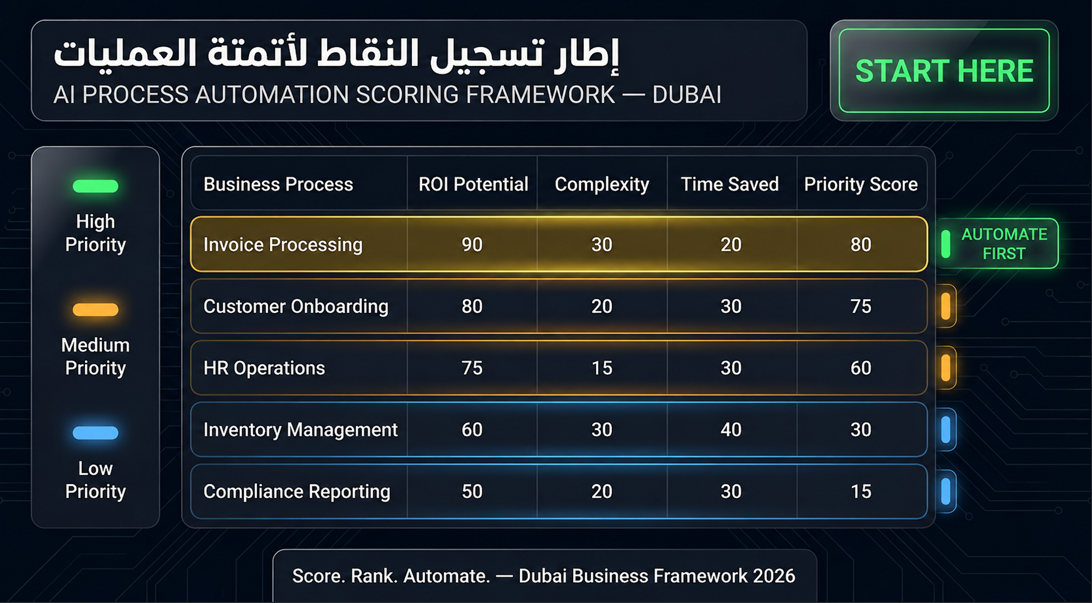
The most difficult question to answer after Dubai’s agentic AI mandate is not whether your company should use AI agents. The more difficult question is which process to automate initially with an AI agent.
A lot of companies get this wrong.
They pick the process that sounds the most impressive. They pick the process that the CEO complains about the most. They select the process that looks strategic in a board presentation. Alternatively, they select the process for which a vendor demo appeared the most exciting.
That’s how AI pilots become costly internal experiments.
A strong initial AI agent should not be selected, as it seems advanced. It should be chosen because the process is repetitive, manual, quantifiable, consistent, sufficiently low risk, and sufficiently painful to justify automation.
At aTeam Soft Solutions, we have seen this trend in the UAE and Saudi AI implementations. The first process is whether the business builds trust in agentic AI or is cautious for the next two years.
This article gives Dubai companies a practical scoring framework to choose the right first AI automation process before committing to a budget.
One Dubai company approached us after spending four months and nearly $80,000 on an AI automation project that looked good on paper.
The process consisted of a multi-step approval workflow in finance, procurement, compliance, legal, operations, and senior leadership. This process involved twelve stakeholders. In every approval, exceptions were present. Each exception belonged to a different owner. Some approvals were based on the value of a contract. Some were dependent on the type of supplier. Some depended on whether the customer was government-related. Some were dependent on urgency.
The vendor has developed a technically sound system.
But the staff did not believe it.
No one knew for sure if the AI knew all the exceptions. The managers still wanted to check each step. Legal didn’t trust the output unless it was manually reviewed. Finance commented that the path to approval wasn’t sufficiently clear. Procurement commented that the AI didn’t understand the supplier context.
The system was another layer of work rather than reducing work.
The disappointing part was this: the company already had a far more efficient process initially available.
Invoice handling.
It had more volume, was more repetitive, was easier to measure, was easier to validate, and was safer to run in observation mode. The company could have begun with invoice extraction, purchase order matching, duplicate detection, and exception flagging. It would be a clear ROI in six weeks.
Instead, they began with the most complex workflow in the company.
The message is straightforward.
Your first AI agent should not be automating your most critical process.
It should automate your most efficient process.
This is the difference this framework helps you find.
The question of which process to automate with an AI agent initially should not be answered by opinion.
It should be marked.
A scoring framework safeguards the business against the three common mistakes.
The first mistake is choosing a process just because it has a high potential ROI. Certain processes with a high ROI are too risky, subjective, unstable, or politically sensitive for a first pilot.
The second mistake is to choose a process just because it is easy. Easy processes might not save enough time or money to make a serious AI implementation.
The third mistake is selecting a process only because the leadership team is interested in it. Leadership pain is critical, but the most effective pilot typically emerges from an operational pain point that impacts what happens on a daily basis.
The right first AI agent is at the crossroads of value, feasibility, safety, and measurability.
A good first process has to be frequent enough to generate savings quickly. It should require enough human labor to count. It needs to be structured enough for the AI to learn from. It should integrate with accessible systems. It should have clear metrics before and after. And if the AI makes an error, the error should be easy to detect and fix.
This is particularly important for Dubai-based companies preparing for agentic AI adoption after Sheikh Hamdan’s private-sector AI direction.
The mandate brings urgency. But there is no urgency to be reckless in automating.
The top companies will act fast and with caution at the same time.
Use this framework to rate each candidate process on eight criteria from 1 to 5.
The maximum possible score is 40.
A process scoring over 30 is typically a strong candidate for the first AI agent.
A process score between 25 and 30 may be appropriate but needs further scoping.
A process with a score under 25 is generally not a good first pilot unless there is a strong strategic reason.
Volume asks how much of the process occurs.
Typically, a process that occurs 5,000 times per month is a better first AI agent candidate than a process that occurs 10 times per month.
Increased volume results in faster ROI, as savings can be realized quickly.
If an AI agent that saves three minutes on a task that occurs 10 times a month saves the business 30 minutes.
If it saves three minutes on a task that occurs 10,000 times monthly, the business saves 500 hours.
That is why volume is important.
Score 5 if the process occurs 100 or more times daily.
Score 4 if this happens 25-100 times per day.
Score 3 if it occurs daily but less than 25 times.
Score 2 if it happens on a weekly basis.
Score 1 if it occurs less than 10 times a week.
High-volume processes cover customer inquiries, invoice processing, document intake, shipment updates, ticket classification, claims preparation, and routine follow-ups.
Low-volume processes can still be important, but they are usually not the best first pilot.
Manual effort asks how long it takes a human to do each instance.
If it takes 45 minutes per case, that process has more automation value than a process that takes 90 seconds.
The most effective first AI automation processes are often repetitive human efforts such as reading documents, checking fields, copying data, comparing records, drafting responses, validating requirements, or updating systems.
Score 5 if each instance lasts longer than 30 minutes.
Score 4 if it is 15 to 30 minutes.
Score 3 if it is 5 to 15 minutes.
Score 2 if it applies to between 2 and 5 minutes.
Score 1 if it takes less than 2 minutes.
Manual effort should be quantified rather than estimated.
In many organizations, leaders underestimate the amount of time employees devote to “small” tasks. Two minutes for a customer check, repeated 400 times a day, isn’t small. A five-minute invoice check, multiplied by 3,000 a month, is not small.
At aTeam Soft Solutions, we frequently instruct clients to perform manual tracking for a period of one week before finalizing the pilot process. The figures generally change the decision.
Error rate indicates how frequently humans make errors.
Error cost inquiries about the cost of an error.
Certain processes are associated with low error rates but high consequences. Other processes are associated with high error rates but with low consequences. The best AI agent candidates generally have quantifiable error costs and sufficient repetition for improvement to matter.
Score 5 if the process has at least 10% error and each error costs more than $500.
Score 4 if errors are common and cost $100 to $500.
Score 3 if errors occur regularly but cost under $100.
Score 2 if errors are rare and easy to fix.
Score 1 if errors are infrequent and have a lower cost.
Examples of expensive mistakes are wrong invoice payments, missed contract obligations, wrong customer information, delayed claim submissions, incorrect shipment documents, duplicate vendor records, and missed compliance evidence.
AI agents can reduce errors where the process relies on checking, matching, validating, extracting, and comparing.
However, AI agents should not be trusted blindly.
For the first pilot, the AI should normally operate in parallel testing mode or assisted mode. It ought to prepare, flag, suggest, and route. Humans should withhold approval until the system can demonstrate its accuracy.
The data structure asks whether the process uses structured, semi-structured, or unstructured information.
Structured data is simpler for AI agents to process. It resides in databases, forms, spreadsheets, CSV files, ERPs, CRMs, or well-defined fields.
Semi-structured data refers to emails, PDFs, invoices, contracts, purchase orders, support tickets, and forms that have some sort of predictable layout.
Unstructured information includes handwritten notes, photos, voice messages, free-form chats, poor-quality scans, and documents with no consistent format.
Score 5 if the data is predominantly structured.
Score 4 if the data is organized with some semi-structured documents.
Score 3 if the data is largely semi-structured.
Score 2 if the data has lots of unstructured inputs.
Score 1 if the data is highly unstructured and inconsistent.
This does not mean that the AI agents cannot manage unstructured data.
They can.
However, the unstructured data increases testing, exception handling, accuracy risk, and implementation cost.
For example, invoice processing is a strong initial process to automate when invoices adhere to relatively consistent formats. It gets more complicated when invoices are received as blurry images, handwritten notes, multilingual scans, and incomplete attachments.
Dubai firms also need to think about the complexity of Arabic-English data.
An AI agent that performs well with English PDFs will struggle with Arabic scans, right-to-left layouts, stamps, handwritten fields, and mixed-language supplier communication.
Process stability inquires about how frequently the workflow changes.
Stable processes are easier to automate, as the AI agent can learn patterns that are still useful.
Unstable processes result in rework. If the workflow changes weekly, the AI agent requires constant updates. If the rules rely on individual managers, then the system will find it hard.
Score 5 if the process is known to be stable for years.
Score 4 if it changes once or twice every year.
Score 3 if it changes on a quarterly basis.
Score 2 if it changes on a monthly basis.
Score 1 if it changes on a weekly basis or unpredictably.
Good first AI agent processes are workflows in which the rules are known, the inputs are familiar, and the outputs are predictable.
Examples are accounts payable, invoice validation, customer query classification, employee onboarding document collection, lease renewal reminders, and routine compliance evidence gathering.
Processes that change often should generally wait.
Don’t automate first if your team cannot explain the current process clearly.
AI does not resolve unclear operations. It reveals them.
System accessibility asks if the AI agent can integrate with the relevant systems.
A process may appear perfect for AI, but if the required systems are locked, outdated, undocumented, or vendor-controlled, deployment becomes more difficult.
Score 5 if all applicable systems have APIs.
Score 4 if many systems have APIs and documentation.
Score 3 if some systems have APIs and others need workarounds.
Score 2 if systems require screen automation, database-level integration, or custom connectors.
Score 1 if systems are legacy, closed, unstable, or manual to a large extent.
This criterion influences the cost and schedule.
If you have access to your ERP, CRM, ticketing system, document management system, and communication tools, the AI agent can be built faster.
If the workflow is based on portals and there are no APIs, the project may still be possible, but it will require stronger engineering and more testing.
One Saudi healthcare automation project needed the AI process to handle several insurance portals, each with unique submission processes. That made the project worthwhile, but not easy. The correct design was not full autonomy on day one. It involved managed preparation, missing document verifications, and facilitated portal submissions.
One reason aTeam Soft Solutions starts with technical discovery before quoting a full deployment is system accessibility.
Impact of error asks what happens if the AI makes something wrong.
This is definitely one of the most essential criteria for the selection of the first AI agent.
Begin with processes in which errors can be corrected.
Do not begin by starting with processes where a single mistake can cause patient harm, regulatory penalties, major financial loss, legal exposure, or reputational damage.
Score 5 if errors are low-consequence and easily corrected.
Score 4 if errors cause minor inconvenience but no serious loss.
Score 3 if errors lead to operational rework or customer dissatisfaction.
Score 2 if errors can result in financial, legal, or compliance risk.
Score 1 if errors can have catastrophic results.
For example, an AI agent to classify customer inquiries is typically low to medium risk.
Releasing payments by an AI agent is high risk.
Drafting a legal summary by an AI agent is medium to high risk.
A clinical decision by an AI agent is very high-risk.
The first AI agent needs to build organizational trust.
If you begin with a high-stakes workflow and the AI makes obvious mistakes, you will see staff resistance increase. Leadership will be careful. The next pilot will be tougher to get approved.
The right first pilot should inspire confidence, not fear.
ROI measurability is about whether the business can clearly compare before and after.
A good AI agent initially wants a measurable impact.
The strongest metrics are the processing time, cost per case, error rate, backlog size, response time, resolution rate, staff hours saved, number of escalations, and throughput.
Score 5 if ROI can be readily measured based on existing data.
Score 4 if ROI can be calculated through simple tracking.
Score 3 if ROI can be estimated but requires manual measurement.
Score 2 if ROI is partly non-quantifiable.
Score 1 if ROI is almost subjective.
Creative quality, executive confidence, strategic decision quality, and brand tone may matter, but are hard to measure as first pilot outcomes.
Creative quality, executive confidence, strategic decision quality, and brand tone might count, although they are difficult to measure as first-pilot results.
Quantifiable ROI is crucial, as your initial AI agent is not simply a technology project. It is an in-house demonstration case for the next AI agent.
The first pilot must make it simple for the CFO to say yes to the second pilot.
Use this table to categorize your candidate process.
| Total score | Priority level | What it means |
| 33-40 | Excellent first choice | Strong candidate for a first AI agent pilot |
| 29-32 | Good first choice | Suitable, but scope carefully |
| 25-28 | Possible but complex | Needs deeper discovery before budget approval |
| 20-24 | Weak first choice | Better for later phases |
| Below 20 | Avoid as first pilot | Too low value, too risky, or too hard to measure |
The scoring must be done by a combined team.
It includes the process owner, frontline staff, IT, finance, compliance, and the AI champion.
Do not let one department’s score stand alone.
A process can seem simple to leadership yet complicated to staff. It might be valuable to operations, but it looks risky from a compliance perspective. It may look like something a vendor can technically do easily, but isn’t politically possible inside the company.
The scoring conversation is as valuable as the score itself.
The table below applies the framework to 10 common processes that Dubai businesses should consider for AI agent automation.
Scores are common examples. Your company needs to rescore each process based on real volume, systems, data quality, risk, and business context.
| Process | Volume | Effort | Error cost | Data | Stability | Systems | Risk | ROI | Total /40 | Verdict |
| Accounts payable / invoice processing | 5 | 4 | 4 | 4 | 4 | 3 | 4 | 5 | 33 | Excellent first choice |
| Customer inquiry handling | 5 | 3 | 2 | 3 | 4 | 4 | 5 | 4 | 30 | Great first choice |
| Lease renewal communication | 3 | 3 | 3 | 4 | 5 | 4 | 4 | 4 | 30 | Great for real estate |
| Employee onboarding paperwork | 3 | 4 | 3 | 3 | 4 | 3 | 4 | 4 | 28 | Good first choice |
| Document data extraction | 4 | 4 | 3 | 3 | 4 | 3 | 4 | 3 | 28 | Good first choice |
| Insurance pre-authorisation | 4 | 5 | 5 | 2 | 3 | 2 | 2 | 5 | 28 | Good but complex |
| Customs documentation | 3 | 5 | 5 | 2 | 3 | 2 | 2 | 5 | 27 | Good but complex |
| Contract review and obligation tracking | 2 | 5 | 5 | 2 | 4 | 3 | 2 | 4 | 27 | Useful but needs NLP depth |
| Production quality inspection | 5 | 2 | 5 | 1 | 4 | 2 | 3 | 4 | 26 | Good but needs computer vision |
| Strategic pricing and revenue management | 1 | 5 | 5 | 3 | 2 | 3 | 1 | 5 | 25 | Not a good first choice |
The highest-scoring process is typically accounts payable or invoice processing.
That’s not because invoice processing is exciting.
That’s because it is frequent, repetitive, quantifiable, rule-driven, document-intensive, and simple to run in parallel testing mode.
A finance team can compare AI output to human output. It can track extraction accuracy, processing time, duplicate detection, purchase order matching, exception rates, and manual hours saved.
Customer inquiry handling also scores well because volume is high and timely responses are important. If the AI agent brings up sensitive issues, the risk is generally manageable.
Lease renewal communication is a well-suited AI agent initially for real estate companies, as it integrates structured data, predictable timelines, repetitive communication, and measurable results.
Insurance pre-authorization can produce a high ROI, yet it is more complex. It covers payer rules, clinical documentation, portal variation, missing documents, and higher consequences if errors happen. It may be a valuable initial pilot for healthcare companies, but only with a limited scope and human oversight.
Strategic pricing seems attractive as the ROI can be high. However, it is a poor first AI agent option for many companies. It has low frequency, high stakes, complicated data, competitive sensitivity, and visible leadership risk.
A failed pricing recommendation undermines confidence rapidly.
Begin with processes in which AI can augment repetitive tasks, rather than those where it must make delicate strategic decisions.
Invoice processing consistently ranks high, as it has the right combination of volume, manual effort, structure, and measurability.
Many finance teams already feel the pain.
Invoices arrive from various vendors in various formats. Employees read them, extract supplier details, verify the VAT fields, match purchase orders, verify totals, scan for duplicates, route for approvals, input data into the ERP, and follow up on exceptions.
This is tedious work.
It is also easy to quantify.
You can track the average processing time per invoice before and after AI. You can measure how many hours of manual labor are saved. You can track duplicate invoices caught. You can monitor mismatch detection. You can track exception rates.
A good invoice AI agent does not need to make a payment.
That’s the key.
The initial version can extract, match, validate, and format entries for human auditing. This provides financial control while eliminating repetitive reading and typing.
In a single UAE finance workflow, the company had invoices flowing in as PDFs, emails, scans, and images from WhatsApp. The AI agent established a unified intake process, extracted fields, performed invoice-to-purchase-order matching, and flagged exceptions before ERP entry.
The value was not about full automation.
The value was to reduce the low-value manual effort while retaining the financial oversight.
That is why invoice processing is often the most secure first step for aTeam Soft Solutions clients venturing into agentic AI.
Customer inquiry handling is yet another good first process, as the volume is normally high and response delays are noticeable.
Dubai businesses often get customer requests on WhatsApp, email, web forms, phone transcripts, live chat, and social channels.
A lot of questions repeat.
Customers inquire about the status of orders, payment confirmation, document requirements, renewal dates, duration of delivery, availability of appointments, requests for maintenance, service policies, and refund status.
An AI agent can categorize the request, review customer information, respond to common queries, generate tickets, route exceptions, and escalate sensitive cases.
This can quickly reduce support load.
The risk is manageable if the AI agent has definable boundaries.
It should not respond to legal disputes, medical questions, refund exceptions, payment disputes, or complaints without escalation.
In a single Dubai real estate support workflow, the AI agent dealt with multilingual tenant inquiries and escalated legal, payment, and complaint-related cases to humans. After tuning, it answered 73% of repetitive queries without human intervention.
The message is simple.
Customer inquiry automation performs well when the knowledge base is well defined, escalation rules are very good, and the AI agent is not required to handle sensitive cases on its own.
A process may provide a higher ROI and still be a worse first AI automation choice.
That’s where most companies make errors.
Strategic pricing is one such example.
If an AI system enhances pricing by even 1%, the value can be significant. However, pricing decisions are subject to market conditions, competitor behavior, inventory, customer segments, contracts, sales strategy, margin targets, and leadership judgment.
A wrong recommendation can be costly.
The information could be partial. It could also be a politically sensitive process. The result may also be difficult to directly attribute to AI.
That results in a weak pilot initially.
Executive decision support is a further example.
Leaders can use AI to help them analyze information. But if the first AI project is built on decisions at the board level, then all outputs tend to be very visible. A single bad response can erode trust.
Contract review is tempting, too.
It has obvious pain, high effort, and high value. But legal language is subtle. Obligation may be based on context. Risk appetite differs from one company to another. It could be a good use case for AI, but not necessarily the initial one.
The first AI agent should generate visible operational value without producing visible strategic risk.
Some processes are attractive in AI workshops but painful in the first pilots.
These are the ones Dubai-based companies should watch out for.
Multi-step approval workflows seem perfect for automation, as everybody complains about them.
But they frequently make poor initial selections.
They typically involve an excessive number of stakeholders, an excessive number of exceptions, an excessive amount of politics, and an excessive amount of unrecorded judgment.
On paper, a workflow might consist of 10 easy steps. In practice, each step may rely on deal size, type of customer, contract history, urgency, risk profile, supplier category, availability of funds, and manager choice.
The AI agent will inherit the confusion if the existing process is unstable.
A broken approval workflow cannot be fixed by automating it.
It speeds up the disrupted workflow and makes it more visible.
Because generative AI tools are simple to demonstrate, creative content creation is appealing.
However, for AI agent automation, it is frequently a poor initial business process.
Measurement is a problem.
What makes an output successful?
An improved caption? A more interesting campaign? A more premium tone? A more powerful visual direction? Although they are subjective, these things are important.
Marketing teams may find creative AI helpful, but it might not yield the clear ROI required to boost leadership confidence in agentic AI.
And if first-pilot success is the goal, select a process where the saved time and reduced errors are more easily demonstrated.
Executive decision support seems highly valuable.
It is also highly visible.
If the AI agent recommends weakly, leadership will remember it. If the output lacks contextual information, the level of trust decreases. When the system fails to clearly articulate its reasoning, the executives stop using it.
When a company has mature AI practices, clear governance, and clean data, decision support becomes valuable.
It is rarely the most successful initial agentic AI pilot.
Workflows for operations should come first. Establish trust. Next, proceed with more strategic assistance.
Verify your process choice before investing money in a proof of concept.
Don’t rely solely on presumptions.
Conduct a manual tracking exercise for one week.
Request the team to keep track of the number of cases handled, the amount of time spent on each case, the types of errors, rework, delays, systems touched, documents used, and exceptions.
This provides you with actual baseline data.
After that, conduct interviews with the three employees who work there each day.
Ask them where the process is breaking. Ask what the edge cases are that they manage. Inquire about the information that is typically absent. Inquire about which activities are repetitive and which involve decision-making. Ask them what they would never trust AI to do without sign-off.
Their responses will let you know if the process is prepared.
Then request an honest scoping assessment from a vendor.
A serious partner should be able to tell you whether the workflow is appropriate, what makes it complex, what data is needed, what integrations are necessary, what timeline is reasonable, and what needs to remain under human review.
aTeam Soft Solutions provides initial planning discussions for organizations looking to select their first AI agent pilot. The best outcome is not always a proposal. At times, the helpful result is to be advised, “Don’t start with this process. Begin with this one instead.”
That integrity keeps costly errors from happening.
Before approving your first budget for AI automation, use this checklist.
| Question | Yes/No |
| Does this process happen at least daily? | |
| Does it consume meaningful staff time every month? | |
| Can we measure current processing time and cost? | |
| Are the inputs reasonably structured or repeatable? | |
| Is the process stable enough to automate? | |
| Can the AI access the required systems or data? | |
| Are mistakes recoverable during the pilot? | |
| Can humans review AI output before action? | |
| Can we measure ROI within 4 to 6 weeks? | |
| Will staff support the pilot if positioned properly? |
The procedure might not be the best initial AI agent if you respond negatively to more than three questions.
If you respond yes to eight or more, it is worthy of further investigation.
aTeam Soft Solutions assists Dubai-based companies in choosing and implementing the right first AI agent process.
We are an India-based AI and software development company with 120+ engineers, ISO 9001:2015 and ISO/IEC 27001:2022 certifications, a 4.9/5 Clutch rating with 90+ verified reviews, and 20+ published case studies.
Our strategy begins with process suitability, instead of model selection.
This is important because most failed AI pilots don’t fail because the AI model wasn’t good enough. They fail because the business selected the wrong workflow, had inadequate data preparedness, underestimated integration, ignored staff adoption, or perhaps anticipated too much autonomy too early.
A process discovery session is typically the first step for aTeam Soft Solutions.
We map the workflow, rate candidate processes, analyze data sources, verify system access, calculate ROI, assess risks, and suggest the safest pilot path.
For some firms, the answer is invoice processing.
For some others, it is customer inquiry processing.
For real estate companies, this may include lease renewal communication or maintenance ticket prioritization.
For healthcare companies, it could be pre-authorization preparation, pharmacy reporting, or document intake.
For logistics companies, this might include shipment status updates, customs documentation support, or handling delivery exceptions.
The right first AI agent is based on your business.
But it’s usually easy to pick the wrong first AI agent.
It is too complicated, too political, too risky, too subjective, or too difficult to measure.
The first business process that is best suited for automation with AI is typically one that is high-volume, repetitive, quantifiable, stable, and low-risk enough to allow for human review. Typical good initial choices are invoice processing, customer query management, document data extraction, new employee onboarding paperwork, and lease renewal communications.
Review the process in eight criteria: volume, manual effort, error rate, error cost, data structure, process stability, system accessibility, consequence of AI error, and measurability of ROI. A process score above 30 out of 40 is typically a good first bet for an AI agent.
The simplest processes to automate with AI agents tend to be repetitive workflows based on structured or semi-structured data. Examples include invoice data extraction, ticket classification, document intake processing, customer query routing, purchase order matching, employee onboarding document validation, and regular report generation.
No. Your most critical process is usually too risky for a first AI agent pilot. Begin with a process that is valuable but recoverable if mistakes occur. Start with a controlled pilot to build trust before moving to high-stakes workflows.
Rank each process on a scale of 1-5 in eight criteria: volume, manual effort, cost of error, data structure, process stability, system accessibility, effect of AI error, and measurability of ROI. Add the scores for a total of 40. Generally, processes over 30 are good first-pilot candidates.
Invoice processing is typically a suitable first AI automation workflow, as it is common, repetitive, document-based, measurable, and easy to validate while running in observation mode. The AI can extract data, match purchase orders, highlight exceptions, and generate ERP entries, while humans maintain approval control.
Dubai firms should avoid beginning with highly complicated approval workflows, executive decision support, final payment release, legal approval, clinical decisions, and strategic pricing. These processes can be useful later, but they are too risky or subjective for a first pilot.
The question of which process to automate with an AI agent first should be answered by using a scoring framework, instead of excitement.
The AI initiative for agents in Dubai has created real urgency for private-sector companies. Sheikh Hamdan’s two-year initiative means businesses need to start preparing now, rather than in 2028.
However, quick action does not mean reckless action.
The safest path is to select a single process with high volume, obvious manual effort, measurable ROI, accessible data, stable rules, and recoverable errors.
Start from there.
Execute the pilot.
Measure the outcome.
Leverage the victory to establish trust for the subsequent AI agent.
aTeam Soft Solutions assists Dubai-based businesses in carefully making that first decision and then transforming it into a working AI agent with practical integration, human review, and measurable ROI.
The first AI agent is not simply a project.
It is the proof that your business can transition from AI interest to AI execution.