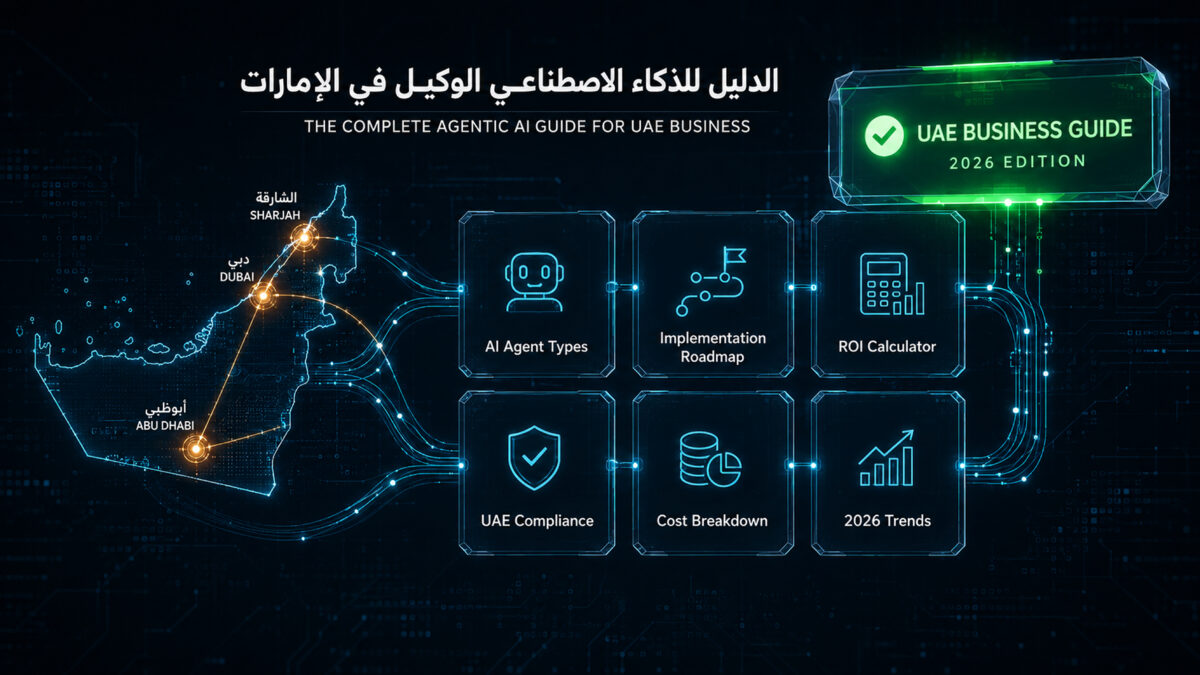
This agentic AI UAE guide is written for business leaders who are already beyond the “AI is fascinating” phase and are now dealing with the more challenging question: “Where can AI agents really minimize the manual work, increase compliance, and deliver quantifiable business value for a UAE company?” It’s not “everywhere,” the answer is. The answer is in those workflows where people spend hours upon hours reading documents, querying systems, pursuing approvals, categorizing requests, rectifying mistakes, and making repetitive decisions.
Agentic AI for UAE firms is becoming realistic as the market has all three at the same time: a strong national AI directive, a high degree of operational complexity, and most of the document-intensive processes in finance, health care, real estate, logistics, hospitality, HR, legal, insurance, food services, and retail.
The UAE Strategy for Artificial Intelligence focuses on contributing to the UAE Centennial 2071, enhancing government performance, and establishing the UAE as a leader in AI adoption. The strategy is mainly about implementing AI in priority industries; developing talent, customer service, research capability, and the data infrastructure required for using AI.
That national guidance is important, but it’s practical answers that businesses want.
A Dubai real estate company doesn’t need a speech about AI. It requires a tenant service officer who can manage 15,000 monthly requests, issue NOCs, handle communication in Arabic and English, and escalate critical matters
A logistics company in the UAE doesn’t need a general chatbot. It requires a customs documentation agent who can read invoices, packing lists, certificates, and shipment records before clearance delays occur.
A Hospital does not want the AI hype. It requires a healthcare pre-authorization agent that can generate payer submissions, identify missing clinical documents, and keep humans managing high-risk cases.
This is the practical benefit of agentic AI.
aTeam Soft Solutions develops enterprise AI agents for businesses in the UAE and Saudi Arabia that need AI to integrate with real systems, adhere to business rules, support human approvals, and have trails of audits.
Agentic AI is an AI that is able to comprehend a goal, determine a course of action, employ tools, accomplish tasks, and escalate exceptions.
A normal chatbot replies to these questions.
An AI agent performs the work.
For example, a chatbot can respond to “What documents are required for a tenant NOC?”
An AI agent can take a tenant’s request, recognize the type of NOC, check the status of the lease, validate pending dues, produce the NOC draft, send it for approval, send the approved document, and update the tenant record.
That’s the difference that makes agentic AI so important.
Agentic AI is more than just not chatting. It’s about acting.
A simple definition:
Agentic AI is a software system that leverages AI to comprehend context, make decisions, utilize business tools, and execute a workflow under human supervision if necessary.
And the term “agentic” just means that the system has agency. It is not waiting for each instruction. It can proceed with a workflow forward within sanctioned limits.
Imagine it for the role of junior operations executive.
A junior executive gets an email from a supplier. They scan it, know the purchase order number, check the ERP, match the delivery date, update the tracker, and inform the manager if anything looks risky.
An AI agent conducts a similar sort of labor, only within software.
It comprehends the inputs. It monitors systems. It compares the data. It suggests the actions. It runs low-risk steps. It escalates ambiguous cases.
The top AI agents are not uncontrolled bots. They are managed, controlled digital workers with permissions, logs, rules, confidence thresholds, and human examination.
Most of the companies confuse agentic AI with chatbots, conventional AI models, or robotic process automation.
They are connected, but they are not identical.
| Technology | What it does | What it cannot do well | Best use |
| Chatbot | Answers user questions through conversation | Cannot reliably complete multi-step business workflows without deeper integration | Customer FAQs, internal helpdesks, basic guidance |
| Traditional AI model | Predicts, classifies, extracts, or generates output | Usually does not manage the full workflow by itself | Forecasting, scoring, classification, document extraction |
| RPA | Repeats fixed screen actions | Breaks when UI or process changes; weak with unstructured data | Stable legacy system tasks |
| Traditional automation | Follows fixed rules | Cannot interpret messy inputs or exceptions | Structured data movement, scheduled jobs, simple workflow triggers |
| Agentic AI | Understands, decides, acts, and escalates | Requires strong governance, testing, and monitoring | Document-heavy, exception-heavy, judgment-heavy enterprise workflows |
The distinction between agentic AI and RPA is particularly important.
RPA replays the clicks of a human.
Agentic AI has a clear understanding of what a business process is trying to accomplish.
For a more in-depth comparison, study: Agentic AI vs. RPA vs. Traditional Automation: Which One Actually Should Your Business Employ?
Traditional automation is able to handle an invoice if the invoice is always in the same format.
RPA can copy the invoice data from one screen to the next if the screens are static.
A chatbot can tell you about your invoice approval policy.
An AI agent scans multiple invoice layouts, extracts values, matches them against purchase orders, identifies mismatches, highlights duplicate invoices, routes exceptions, and auto-processes low-risk invoices with an approval log.
That’s why agentic AI is valuable in support of UAE companies.
The labor is seldom pure.
Agentic AI is significant in the UAE due to the advanced and complex nature of the working environment.
UAE firms operate in many languages, systems, regulators, customer channels, and document-based workflows. They frequently serve clients on platforms such as WhatsApp, portals, email, apps, call centers, and physical offices simultaneously.
This makes the right conditions for AI agents.
The UAE has designated AI as a national priority under its AI Strategy 2031, as well as part of wider digital government initiatives. The strategy incorporates objectives such as making the UAE a global AI hub, boosting competitiveness in priority sectors, establishing an AI ecosystem, implementing AI in customer services, attracting AI talent, and constructing data infrastructure.
For companies, that means the adoption of AI is not happening in isolation.
Government services, financial centers, healthcare regulators, and most major companies are embracing increasingly digital, data-based operations. Companies still entirely dependent on spreadsheets and manual verification will feel the pinch more accurately.
DIFC and ADGM are relevant because they define how financial services, fintech, regtech, data protection, and digital business are conducted in the UAE.
The DIFC promotes its Innovation Hub as a leading fintech ecosystem in the MEASA region, providing FinTech, InsurTech, RegTech, and Islamic FinTech startups with licensing, accelerator programs, co-working, and a regulatory framework.
ADGM labels itself as an international financial center in Abu Dhabi, and its digital asset materials highlight responsible financial innovation development, with regulatory regimes tailored to facilitate novel business models that protect investors and markets.
This is important for agentic AI since financial businesses cannot run casually with AI.
They want audit trails, access controls, explainability, data protection, and human evaluation.
Dubai- and Abu Dhabi-based firms seldom use a single language when carrying out their operations.
Messages to a real estate company from potential tenants might be in English, Arabic, Hindi, Urdu, Russian, and Tagalog. A hospital can have Arabic insurance forms, English clinical documentation, and patient communication in multiple languages. A logistics company may receive supplier documents from China, Europe, India, and the GCC.
The benefit of AI agents is that they are able to take multilingual and multi-format inputs and transform them into structured workflows.
The question is not whether the AI model “supports Arabic.”
What really matters is whether the AI agent has been evaluated on actual documents from the UAE, measured on a field-by-field basis, and engineered to escalate low-confidence results to humans.
A UAE company frequently operates in systems it doesn’t fully control.
Examples are customs portals, banking portals, insurance platforms, HR and visa workflows, health care licensing systems, tenant service portals, supplier systems, and ERP tools.
Agentic AI is useful when the workflow crosses such boundaries.
An AI agent can look through one channel, check information on another system, draft documents in a third system, and send cases to humans when a rule or a risk threshold is met.
The long-term priorities in the national vision “We the UAE 2031” revolve around the economy, society, ecosystem, and diplomacy. For businesses, the practical takeaway is clear: digital maturity is going to be a competitive expectation, not a side project.
There’s no need for businesses to automate everything in one go.
Yet they still need to know where manual operations are already constraining speed, accuracy, or customer experience—those workflows.
The biggest agentic AI case studies in the UAE are not theoretical.
These are industry-specific workflows where companies today have manual pains.
Healthcare AI agents can assist with insurance pre-authorization, claims document completion, clinical coding audits, detection of missing documents, appointment follow-up, patient engagement, and the revenue-cycle process.
A hospital pre-authorization agent can read clinical notes, decide which documents are required, complete payer submissions, flag missing information, and send exceptional cases to a human reviewer.
That’s useful because the delivery of healthcare operations is a combination of clinical data, payer rules, regulatory oversight, and patient urgency.
Internal case study: Healthcare Claims Pre-Authorization Agent
UAE logistics companies handle invoices, packing lists, certificates of origin, shipping receipts, HS code classification, customs declarations, freight charges, supplier messages, and shipment updates.
A customs documentation assistant can prepare shipping documents, cross-check values between files, identify documents that are missing, recommend HS classifications for consideration, and assemble a pack that is ready for clearance.
In a single UAE customs automation case study by aTeam Soft Solutions, the agent contributed to a decrease in clearance preparation from about 5 days to about 18 hours for more than 400 shipments monthly.
Internal case study: UAE Customs Documentation Agent
Financial services firms in the UAE may also utilize AI agents for KYC document review, AML screening assistance, customer onboarding, adverse media searches, transaction-risk triage, audit preparation, and internal compliance monitoring.
The correct design is not full autonomous compliance approval.
The correct design is one in which the evidence is prepared by an AI and the final decision is made by human compliance officers.
Internal case study: KYC and AML Screening Agent
Dubai property companies manage tenant services, lease renewals, NOC processing, maintenance ticket classification, reminders for payment, document collection, and reporting to the owner.
A tenant service AI agent can classify the tenant requests, produce drafts of routine NOCs, respond to repetitive inquiries, check attrition risk, and escalate cases that are legally or payment sensitive.
In aTeam Soft Solutions tenant engagement case study, the AI agent processed 15,000+ monthly interactions in five languages and resolved 73% of inquiries via AI, increased lease renewal rates from 68% to 89%, and helped secure close to AED 4. 2 million in annual revenue.
Internal case study: Tenant Engagement and Renewal Agent
Hotel and serviced apartment operators can leverage AI agents to manage revenue, monitor booking channels, classify guest messages, summarize reviews, suggest upsell options, coordinate housekeeping, and prioritize maintenance.
A hotel revenue agent can track the pace of booking, prices of competitors, occupancy, events, patterns of cancellations, and availability of rooms. The agent can suggest pricing moves while maintaining the revenue managers’ control.
Internal case study: AI-Powered Hotel Revenue Optimization
Legal departments could leverage AI agents to review contracts, track obligations and renewal notices, compare clauses, flag risks, and prioritize legal intakes.
The most powerful use case is not “summarize this contract.”
The most powerful use case is “extract every obligation, assign owners, monitor deadlines, and alert teams before a breach or missed renewal happens.”
Internal case study: Contract Obligation Tracking Agent
The insurance companies and TPAs can employ AI agents to categorize claims, verify missing documents, cross-check the policy details, create pre-authorization files, identify duplicate claims, and forward complicated files to experts.
Insurance processes are well-suited to candidates, as they involve high-volume document processing and rigid rules and exceptions frequently.
Internal case study: Insurance Claims Automation Agent
Restaurants, hotels, caterers, cloud kitchens, supermarkets, and food producers are among those who benefit from HACCP monitoring, food safety logs, temperature alerts, supplier certificate checks, aggregator order management, kitchen load prediction, and complaint classification by AI agents.
Food enterprises in Dubai should have accurate records, take quick corrective actions, and have records that are ready for audit. AI agents can reduce the manual follow-up workload for managers.
Internal case study: Food Safety and HACCP Compliance Agent
Retailers can employ AI agents to predict demand, alert to exceptions in inventory, generate product content, support customers, classify return reasons, follow up with suppliers, and monitor prices.
The greatest ROI is typically from reducing stockouts, reducing overstocks, and supporting quicker responses.
Internal case study: Retail Demand Forecasting Agent
Human resource teams can employ AI agents to screen resumes, collect onboarding documents, track visas and work permits, respond to employee queries, schedule shifts, remind employees about training, and assist with policies.
A Dubai HR onboarding agent can gather documents, pursue missing forms, monitor status, prepare reminders, and keep records for the HR dashboards.
Internal case study: HR Onboarding Agent for Dubai Companies
It’s easier to understand an AI agent if you divide it into four components: perception, reasoning, action, and learning.
These four parts function like a skilled operations employee.
Perception is the way in which the AI agent acquires information.
It might scan emails, PDFs, scanned documents, WhatsApp messages, CRM records, ERP exports, portal downloads, call transcripts, spreadsheets, images, or even form submissions.
In a customs workflow process, the perception is to read invoices, packing lists, certificates, and the delivery note.
In a real estate process, perception is reading tenant messages, lease documents, payment records, and maintenance tickets.
In the financial process, perception is the reading of invoices, purchase orders, goods receipted notes, and supplier records.
Perception processes unstructured inputs into structured data.
The output could be:
| Field | Extracted value |
| Supplier name | Gulf Medical Supplies LLC |
| Invoice number | INV-23841 |
| Invoice amount | AED 82,450 |
| PO number | PO-9015 |
| VAT amount | AED 3,925 |
| Risk flag | PO quantity mismatch |
A good perception is calculated field by field.
A system that extracts invoice numbers accurately but misses out on VAT classification is not good enough for financial autonomy.
Reasoning is the process through which an AI agent determines what the information means.
It compares information, verifies rules, assesses context, and selects the next step.
For example:
An invoice agent verifies that the invoice quantity is equal to the purchase order and the goods received note.
A tenant agent verifies if the tenant qualifies for a requested NOC.
A healthcare agent verifies if the pre-authorization file contains the necessary clinical documentation.
A KYC Agent verifies whether the customer’s profile requires enhanced due diligence.
And reasoning should not be performed in a black box.
A production AI agent should be able to explain why it makes a particular recommendation.
For example: “Flagged since the quantity on the invoice is 120 units, but the goods received note has 100 units. The difference goes beyond the approved tolerance.”
That’s the kind of explanation that makes people trust and audit the system.
An action is when the AI agent does something.
It might create a ticket, update a CRM, send an email draft, produce a document, prepare a payment approval, update an ERP field, post a Slack or Teams alert, or even route an exception.
Action needs to be controlled.
The agent cannot have unlimited permission to modify the business systems.
Permissions should be risk-based.
Low-risk activities can be automated early on. Human approval should be required for high-risk actions.
A routine query can be auto-responded to by a tenant support executive. It should not approve a legal NOC without examination.
An invoice agent can be made to auto-process a low-value matched invoice. It should not silently approve a large mismatch.
A healthcare agent may generate a pre-authorization file. It should not take clinical decisions without a sanctioned governance process.
Learning is not meant to imply that the AI agent changes itself without control.
In large-scale enterprise deployments, learning typically refers to the system collecting human fixes, performing error pattern analysis, modifying prompts, enhancing rules, retraining extraction logic where necessary, and tuning confidence thresholds.
For example, if the reviewers continually fix the same supplier invoice format, the agent should get better at that supplier’s format.
If a particular type of recommendation is frequently rejected by reviewers, the business rule may need to be modified.
When the source document is modified, the agent will recognize that its accuracy has decreased and bring more cases to humans.
Learning should be controlled, tested, and approved.
The top-tier enterprise AI agents get better over time without going uncontrolled.
Agentic AI should not have a one-step transition from demo to full autonomy.
The safest enterprise pattern would be graduated trust.
aTeam Soft Solutions follows a 4-phase deployment method for AI agents:
For the complete methodology, read: The 4-Phase Framework for Implementing AI Agents in Business Enterprises
The agent reads the real-world data and extracts the structured information.
Humans audit each output.
The objective is to evaluate accuracy before the agent gets the authority.
The agent presents the actions.
Humans accept or decline recommendations.
The objective is to evaluate if the agent suggests the appropriate next steps.
The agent carries out the standard low-risk actions when the certainty is high.
Humans manage the exceptions.
The objective is controlled autonomy.
The agent manages the standard processes end-to-end.
Humans check the dashboards, audit samples, and evaluate exceptions.
This isn’t the “set and forget” phase. It is about “trust but verify.”
The businesses in the UAE are often in regulated or reputation-sensitive industries.
A real estate company can’t have AI issues in each document without some controls.
A hospital cannot permit AI to file clinical or payer information without adequate oversight.
A financial services company can’t utilize AI for compliance workflow processes without logs and approval trails.
The phased model enables the AI agent to build up trust before it is granted authority.
The price of an Agentic AI is influenced by factors such as the complexity of the workflow, the number of integrations, document variation, security requirements, and the degree of independence.
A basic proof of concept might start at $15,000.
A dedicated production AI agent can cost from $40,000 to $120,000.
A large-scale corporate rollout spanning multiple systems, dashboards, audit trails, data pipelines, human approval processes, and continuous support may have higher costs.
The right question is not “What is the cost of an AI?”
The right question is “How much does the existing manual process cost each month?”
For a complete breakdown of the price, read “How Much Does an Agentic AI Cost in the UAE Region?”
| Project type | Example | Typical range |
| POC | One data source, limited workflow, human review | $15K-$30K |
| Focused AI agent | One business process, dashboard, approval flow | $40K-$120K |
| Enterprise AI agent | Multiple systems, workflows, audit logs, and integrations | $120K-$300K+ |
| Ongoing support | Monitoring, improvements, model evaluation, fixes | Monthly retainer |
Agentic AI ROI typically came from the five sources.
Firstly, manual hours are lowered. Secondly, errors are detected early on. Thirdly, response time increases. Fourthly, it becomes easier to generate proof of compliance. And fifthly, the revenue leakage goes down.
An agent for lead qualification could produce ROI by driving more qualified appointments.
A tenant renewal agent can deliver ROI by bringing down churn.
A billing agent can generate ROI by lessening the number of duplicate payments and the manual effort in accounts payable.
A customs official can yield ROI by minimizing clearance delays.
An agent for healthcare pre-authorization could create ROI by reducing the revenue cycle time.
Selecting the wrong AI partner will cost more than not starting.
A good agentic AI partner will have a deep understanding of software engineering, AI models, data pipelines, security, integrations, workflow design, user experience, and industry-specific operations.
A poor partner is capable of delivering a demo that looks impressive but breaks in production.
For a detailed selection checklist, read: How the CTOs Should Select an Agentic AI Development Partner
| Evaluation area | What to ask |
| Production experience | Have they deployed AI agents into live business workflows? |
| Domain knowledge | Have they solved workflows similar to yours? |
| Integration capability | Can they work with ERP, CRM, portals, WhatsApp, email, and document systems? |
| Governance | Do they design human-in-the-loop controls, logs, and guardrails? |
| Security | Can they support data protection, access control, and private deployment? |
| Arabic support | Do they test Arabic documents and messages with real examples? |
| Post-launch support | Who monitors accuracy after go-live? |
The company is a leading provider of AI and software development services, based in India. With more than 120 engineers, ISO 9001:2015 and ISO/IEC 27001:2022 certifications, a 4.9/5 rating on Clutch with 90+ verified reviews, and 2025 Clutch Global Champion recognition.
The company has developed AI agents and enterprise systems in sectors such as healthcare, logistics, finance, legal, retail, real estate, hospitality, manufacturing, HR, customs, insurance, and education.
For the UAE companies, the relevant competencies are not only AI engineering but also the integration of AI agents with actual workflows, local patterns of operation, compliance needs, and enterprise systems.
UAE businesses could not be rolling out AI agents without considering data privacy, industry regulation, access control, and auditability.
This section is an overview to help you in practice, not a substitute for legal counsel.
Law No. 45 of 2021 concerning the Personal Data Protection is the UAE’s data protection law that introduces a federal-level provision for personal data protection. On the UAE official portal, it is described as a law that forms an integrated structure to ensure confidentiality and privacy of personal data and protect the rights of individuals in relation to the collection and processing.
For AI agents, this implies that personal data should be collected and processed with a clear purpose, well-defined access controls, and proper logs.
A customer service agent, HR agent, health care agent, or tenant agent will probably handle personal information.
The system must specify what data is collected, why it is required, where it is stored, who has access to it, and how long it is kept.
The DIFC operates its own Data Protection Law No. 5 of 2020. The DIFC Law Database states that the law relates to the rules on the collection, processing, and transfer of personal data within the financial center.
The DIFC law applies to controllers and processors within the DIFC and, in some cases, to processors that process personal data in the context of the DIFC.
For AI agents in DIFC firms, governance needs to be particularly vigilant.
A KYC agent, AML support agent, onboarding agent, or compliance review agent may handle sensitive identity, financial, or risk information.
The system should provide the audit logs, access controls, accountability of reviewers, and controls for data transfer.
ADGM operates its own Data Protection Regulations 2021. ADGM’s rulebook states that the regulations establish a provision in respect of the protection of personal data processed or managed through the Abu Dhabi Global Market.
ADGM issues guidance in the area of data protection, including breach notification tools and related compliance guidance.
In ADGM, for AI deployments, companies should consider data governance a component of product design, rather than a policy added later on.
The Dubai Health Authority has issued an Artificial Intelligence in Healthcare Services Policy for its licensed healthcare facilities and healthcare professionals who employ AI in the delivery of healthcare services. The DHA policy document implies that it is applicable to all healthcare facilities and professionals holding a license from the DHA who use AI in healthcare services.
Healthcare AI agents require tougher regulation than typical business automation.
A healthcare agent could assist with support claims, pre-authorization, patient communication, document preparation, coding audits, or administratively prioritizing tasks. It cannot serve as an unregulated clinical decision-maker.
Healthcare AI should have clinical governance, privacy controls, human review, and transparent accountability.
MOHRE is responsible for the regulation of employment and labor services in the UAE, including work permits and labor-related procedures. MOHRE’s 2026 public draft on automated contract generation and renewal suggests that AI-powered automation is becoming more relevant to employment workflows.
Privacy of employee data, document accuracy, tracking of visa/work permit status, and clarity of communication are the major risks for HR AI agents.
An HR onboarding AI agent can gather the documents, remind the employees, fill out forms, and track status. But it shouldn’t be used to make legal employment decisions without a human HR evaluation.
For the UAE AI agent implementations, the company typically suggests the five design principles.
Friendly to regulation, AI is not slower.
It scales more safely.
AI agents can replace the tasks, not the humans.
They are very good at repetitive reading, verification, categorization, subsequent actions follow-ups, extraction, comparison, and routing. They are not as strong in managing relationships, final responsibility, complex negotiation, regulatory judgement, and leadership decisions.
A great AI agent cuts down the manual work for your team.
But that doesn’t eliminate the need for responsible humans.
In aTeam Soft Solutions deployment, employees generally transition from doing everything manually to handling exceptions, reviewing, monitoring, and working with customers.
AI agents could be costly if the first project is too big.
But a targeted POC can start around $15K, and many medium-sized companies can start with a single painful workflow.
The right initial project is not just about “automating the company.”
The right first project is “automate a single process for which the current manual cost is quantifiable.”
Examples cover the invoice matching, lead qualification, tenant support, resume screening, checking of customs documents, or supplier follow-up.
With today’s AI models, Arabic can be processed much better than with old automation tools.
But do not take Arabic support for granted.
It has to be tested.
A UAE AI agent should be tested on actual Arabic and bilingual documents used in business workflow. Accuracy should be calculated field by field. Outputs with low confidence go to human reviewers.
The right statement is not “AI processes the Arabic perfectly.”
The right statement is “AI can manage Arabic well if the system is designed, tested, and examined properly.”
AI agents without control are unreliable.
The Phased AI agents can be trusted.
A production system must begin by observing, then recommending, then acting with guardrails, and finally managing routine situations autonomously with an audit log.
In a number of aTeam Soft Solutions implementations, AI agents surpassed manual performance in routine extraction and classification after sufficient real feedback data were received.
And the reason is as simple as this: Humans get tired. Controlled AI agents remain consistent.
A company is ready for AI when it has manual, continuous tasks that are time-consuming, make errors, or slow up revenue.
Size is less important than workflow pain.
A 50-person company might be a very strong AI candidate if 10 of its employees spend hours a day processing documents, responding to repetitive inquiries, or maintaining trackers.
A 1,000-person company might be a terrible AI candidate if it hasn’t found a specific process and owner.
The right place to start isn’t company size.
The right place to start is with process cost.
The first 30 days could not be about buying the necessary tools.
They must be about selecting the right process.
Pick out one process in which people devote time to reading, verifying, copying, chasing, approving, or rectifying.
Good candidates cover the following:
Don’t begin with a vague objective such as “leverage AI in operations.”
Begin with a workflow process.
Estimate the manual cost.
Utilize this formula:
Monthly process cost = manual hours per day × staff hourly cost × working days per month
Then include the cost of an error, the cost of delay, and the cost of opportunity.
For example, a lead qualification process doesn’t look very costly in terms of staff hours, but missed response time could cost money.
A process for customs documentation may not require a large team, but a single delay can result in storage fees and dissatisfaction of customers.
Renewing a lease might seem like admin work, but missed renewals can lead to huge revenue loss.
Document the procedure in a step-by-step manner.
Determine the inputs, systems, approvals, outputs, exceptions, and decision points.
Exceptions are the most critical part.
AI agents should be designed for the disorganized cases, rather than only the happy path.
Inquire:
Not all the workflows require agentic AI.
If the data is structured and the steps are static, conventional automation may be sufficient.
If the workflow is screen-based and stable, RPA will do enough.
If the workflow includes documents, messages, multiple languages, changing formats, judgment, or exceptions, agentic AI is almost certainly a better fit.
For a more detailed decision framework, see: Agentic AI vs. RPA vs. Traditional Automation
A scoping workshop should define the following:
The output should be a well-defined plan for POC.
A POC isn’t just some random AI demo. It should test a single business workflow using real or representative data.
A well-executed 4-week POC should demonstrate if the agent can read the input, organize the information, and provide meaningful suggestions, as well as save time.
The POC should yield quantifiable outcomes.
Relevant POC metrics are accuracy of extraction, rate of acceptance of the suggestions, time saved per case, rate of exceptions, and feedback from reviewers.
If the POC is successful, proceed with deployment in phases.
If the POC does not work out, you should still gain something useful: either the data is not ready, the process is not appropriate, or the workflow requires an alternate automation strategy.
This guide serves as an ultimate guide for aTeam Soft Solutions Agentic AI content library.
Use the relevant articles based on what you are trying to decide next:
| Question | Suggested article |
| Should we employ AI agents, RPA, or normal automation? | Agentic AI vs. RPA vs. Traditional Automation |
| How do we transition from POC to production safely? | The 4-Phase Framework for Deploying AI Agents |
| Which Dubai processes should we automate first? | 15 Business Processes Every Dubai Company Should Automate with AI Agents |
| How can AI help Saudi invoicing compliance? | AI Agents and ZATCA Compliance |
| Should a UAE company work with an Indian AI partner? | Why Middle Eastern Companies Are Choosing Indian AI Development Partners |
| What will an AI agent cost? | How Much Does Agentic AI Cost in the UAE? |
| How should a CTO evaluate AI vendors? | Selecting the Right Agentic AI Partner |
The goal of this content library is very simple: to assist the UAE companies in transitioning from being curious about AI to practical implementation choices.
The key important takeaway from this agentic AI UAE guide is that agentic AI should not be considered as a substitute for strategy, people, or process design
It is a means of eliminating repetitive operational work from teams that have already been overloaded.
Agentic AI is more rigid when the workflow comprises documents, messages, approvals, exceptions, compliance checks, system updates, and multilingual communication.
It is at its weakest when companies rely on it to resolve ambiguous processes with no human accountability.
For the UAE companies in 2026, the opportunity is obvious.
Begin with a single painful process. Calculate the manual cost. Chart the exceptions. Select the best automation strategy. Run a targeted POC. Execute in phases. Keep humans in charge of decisions that are high-risk.
That’s how AI agents shift from interesting demos to dependable business systems.
aTeam Soft Solutions enables the UAE and Saudi customers to build AI agents that run in live operations, integrate with the current systems, and scale with audit trails, guardrails, and human oversight.
If your company is looking into agentic AI, the best initial step isn’t to inquire, “What can the AI do?”
Ask, “Which process is the most expensive to us, as it requires humans to be forced to do repetitive work each day?”
That process is usually the one at which your first AI agent should start.
Agentic AI is AI that understands the objective, chooses the next action, makes use of the appropriate tools, accomplishes the tasks, and escalates exceptions.
Regular AI typically executes a single function, such as classification, prediction, extraction, or generation. Agentic AI integrates multiple capabilities into a workflow process.
A regular AI model can pull out invoice information. An AI agent can extract the invoice information, match it to a purchase order, highlight mismatches, route exceptions, and update the finance workflow.
Yes, agentic AI will be ready for production use in 2026, once it is deployed with the appropriate controls.
Production-ready AI agents require the staged rollout, human-in-the-loop review, access controls, audit trails, the ability to roll back, tracking, and a clear line of responsibility.
Agentic AI isn’t production-ready when companies give it full control on day one with no testing, guardrails, or review processes.
The UAE industries that benefit the most are from agentic AI that covers healthcare, logistics, customs, finance, banking, real estate, hospitality, legal, insurance, food and beverage, retail, and HR.
These industries also deal with document-driven processes, multilingual communication, regulatory needs, and requests from customers and repetitive manual verification.
Agentic AI is most effective in environments where human teams invest time in reading, comparing, validating, routing, and following up.
A simple AI agent POC can usually be done in about 4 weeks.
A targeted production rollout could take 8 to 12 weeks. A moderately challenging workflow can take 14 to 20 weeks to complete. A complex, regulated workflow process with multiple integrations could take 20 to 32 weeks.
Schedule varies based on the quality of the data, the systems involved, the rules of approval, the level of risk, and the depth of the integration.
Yes, AI agents can process the Arabic-language documents, but support for the language should be verified using actual business documents.
A robust Arabic AI workflow should incorporate real sample documents, field-level accuracy measurement, bilingual review, confidence scores, and human escalation for uncertain results.
Modern AI models are quite capable of handling Arabic, but the accuracy of such a model in production will depend on document quality, prompt design, validation rules, and feedback loops.
A targeted agentic AI POC might begin at around $15,000. A production AI agent for a single business process might cost between $40,000 and $120,000. A complex enterprise implementation that involves multiple systems, audit logs, dashboards, and integrations may cost in the range of $120,000 to $300,000 and even more.
The appropriate budget depends on the complexity of the workflow, integrations, quality of data, level of risk, and support requirements.
The most effective approach to cost estimation is to begin by estimating the monthly manual cost and error cost of the process.
The UAE-based companies need to take into account the UAE Personal Data Protection Law, the DIFC Data Protection Law, as applicable, the ADGM Data Protection Regulations, as applicable, and any sector-specific regulations, such as the DHA healthcare regulations.
HR workflow procedures might have to take into account employment and work permit processes under MOHRE and its related systems.
Safe deployments of AI agents involve control of access, audit logs, data minimization, human approval for high-risk decisions, and transparent records for how the data is processed.