For most of the Gulf companies, the question is no longer whether to develop AI systems. The more difficult question is who can build them at production quality and scale, at a realistic cost, and with sufficient understanding of Gulf workflows. This is the reason the hunt for an AI development company in India for Middle East projects is more practical in 2026: firms in Dubai, Riyadh, Abu Dhabi, Jeddah, Doha, and Muscat are looking for AI execution capacity sooner than local hiring pipelines can supply.
The Middle East has the desires, budgets, and use cases for AI. What it doesn’t always have is sufficient AI engineering bandwidth on mid-market budgets.
A Saudi distributor needs an AI agent to track ZATCA invoice rejections across multiple companies. A Dubai real estate group for tenant support, NOC generation, and lease renewal automation in both Arabic and English. A UAE-based logistics company requires customs documents automation that reads the invoices, packing lists, HS code descriptions, and shipping documents. A Saudi healthcare provider is looking for NPHIES-ready claims automation and insurance pre-authorization workflows.
These are not just simple chatbot projects.
They need AI engineering, workflow design, system integration, compliance understanding, data security, QA, and post-launch support.
This article will give you an insight into why more Middle Eastern companies are opting for Indian AI development companies as their partner instead of local and Western firms, which aspects of the model work well, which do not, and how aTeam Soft Solutions is approaching Gulf AI delivery in 2026.
The AI demand in the Middle East is not hypothetical.
The UAE Strategy for Artificial Intelligence seeks to align with the UAE Centennial 2071 goals and enhance the government’s performance at various tiers, while the UAE’s AI strategy also emphasizes developing its AI environment, attracting talent, enhancing customer services, and reinforcing competitiveness in priority industries.
Data and AI are at the core of Saudi Arabia’s Vision 2030. SDAIA states that data and AI contribute to 66 out of the 96 direct and indirect goals of Vision 2030, and the National Strategy for Data and AI covers such goals as positioning the Kingdom in the top 15 nations in AI.
This national trend is now visible in private-sector demand.
Hiring for AI-related roles in the UAE grew from 32% in 2023–24 to 48% in 2024–25, according to the RemotePass 2025 Hiring Report cited by Gulf Business. The same report adds that hiring for AI engineers rose 31%, while for data scientists, hiring has increased 43% on a year-on-year basis across the UAE.
That makes the supply problem pretty straightforward.
The UAE and Saudi Arabia are driving AI demand at a faster pace than the local AI engineering market can meet. There is local talent, and some of it is very good, but the competition for senior AI engineers, data scientists, MLOps experts, and enterprise integration teams is fierce.
The cost pressure is also real.
According to ERI SalaryExpert, the average salary of an AI engineer in the UAE is around AED 313,522 per year, and a senior AI engineer earns, on average, around AED 360,065 per year.
That’s just the base salary. A fully local hire further includes the costs of a visa, recruitment fees, benefits, office costs, management overhead, and the risk that a niche AI engineer might not have the precise domain expertise required for ZATCA, NPHIES, MOHRE, logistics, hospitality, customs, or real estate workflows.
Western agencies make a different issue.
The US and UK AI bodies could be robust for AI strategy, enterprise architecture, and board-level consulting. But for mid-market firms in the Gulf, they still tend to be far too expensive for build-and-iterate work. A production AI agent is not a one-week strategic plan presentation. It requires discovery, data pipelines, integrations, testing, monitoring, human-in-the-loop workflows, and several production releases.
Those medium-sized Saudi or UAE companies may not want to pay Western agency fees for an AI invoice monitor, HR onboarding agent, or lease renewal agent. They want real engineering work, with no enterprise-consulting overhead.
This is where India comes into play.
India has established deep software delivery capacity, a significant AI talent pool, and a history of collaborating with Gulf companies. India’s AI talent base was estimated at 600,000-650,000 in 2024 and is projected to require 1.25 million AI experts by 2027, as per the NASSCOM figures cited by India’s Press Information Bureau.
There is a deep cultural and commercial understanding between India and the Gulf. As per the Indian Embassy in Abu Dhabi, for the year 2024, the population of resident Indian nationals in the UAE stands at 4.3 million, positioning them as the leading foreign community in the country.
About 2.46 million Indians in Saudi Arabia are listed by the Indian Ministry of External Affairs.
That’s important, as the delivery of AI is not just code. It’s communication, context, and continuity.
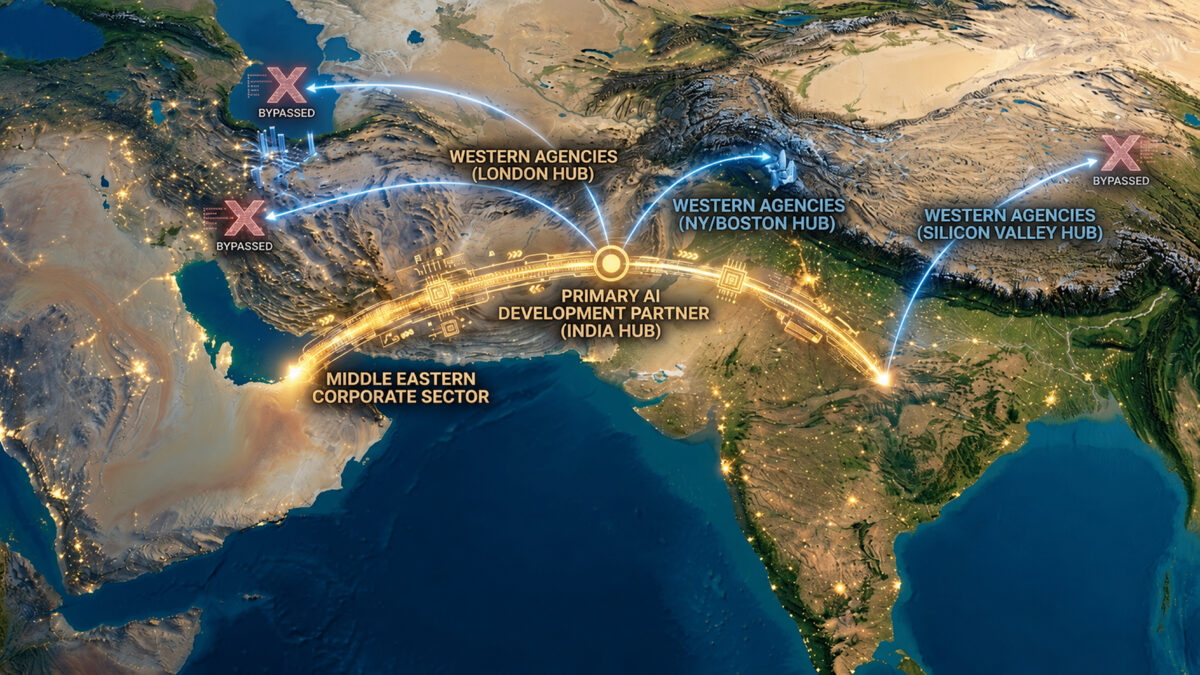
An AI development company in India for Middle East projects can leverage reduced engineering costs with real-time collaboration, domain-specific delivery teams, and an understanding of how businesses in the Gulf truly operate
Selecting an offshore AI partner is not just a cost decision.
A Gulf company comparing India, Eastern Europe, Latin America, Southeast Asia, Western agencies, and local firms in the UAE needs to consider six factors: time zone alignment, cultural familiarity, regulatory exposure, Arabic capability, cost, and track record.
India isn’t the right answer for every company. But for a lot of UAE and Saudi companies, it is the best combination of availability, cost, engineering depth, and Gulf-specific experience.
India is generally 1.5 hours ahead of the UAE and 2.5 hours ahead of Saudi Arabia in regular Gulf business hours.
That’s close enough for near real-time cooperation.
A Dubai operations head can evaluate an AI agent workflow in the morning and talk to the Indian engineers the same day. A Riyadh finance team can test the ZATCA rejection dashboards during business day hours, not wait for developers to reply overnight.
For Gulf clients, this is a big advantage in its favor over Latin America’s. Latin American teams can be very good technically, but the time zone difference with the Gulf can slow daily delivery unless the vendor operates late-shift teams.
Eastern Europe has a feasible overlap with the Gulf, for business in particular in the UAE and Saudi Arabia. But India, in general, gives a bigger pool of developers at a lower cost.
Southeast Asia also has a decent overlap, but the level of Gulf regulatory familiarity is generally less than that found in India.
India has had commercial relations with the Gulf for decades.
But it doesn’t mean that all Indian companies fully understand the Gulf way of business. Most of them do not.
But the baseline understanding is higher than in most of the offshore areas.
Indian professionals are employed by UAE and Saudi companies in various capacities, such as finance, healthcare, construction, retail, logistics, hospitality, IT, and operations. The Indian community is a significant part of the UAE’s working class, with the Indian Embassy stating that this community has been a major contributor to the development of the UAE’s economy, including by way of having a large number of professionally qualified people, businesspeople, and white-collar workers.
It is easier to communicate with when developing AI-based systems for real operations.
A process for managing property in Dubai is certainly not limited to “tenant support.” It covers Ejari, DEWA, du, Etisalat, NOCs, move-in approvals, maintenance tickets, WhatsApp follow-up, multilingual tenants, and renewal negotiations.
A financial process in Saudi Arabia isn’t just “invoice automation.” It has ZATCA, VAT treatment, Arabic fields, ERP mappings, multiple entities, and local audit concerns.
The Gulf dynamic is easier to grasp if the delivery team has done work for Gulf clients before.
This is one of the compelling reasons to opt for a specialized Indian AI partner as opposed to a general offshore development company.
Middle East AI-driven applications are frequently positioned close to regulated workflows.
ZATCA Phase 2 involves the integration of e-invoicing solutions with ZATCA’s systems, and ZATCA introduces the technical and business conditions for e-invoices and e-solutions.
The NPHIES is described in its implementation guide as a centralized, validating, standards-based information exchange gateway that links healthcare providers and payers across Saudi Arabia.
MOHRE services involve work permits, establishment cards, PRO services, and other labor-related processes in the UAE.
DHA’s Sheryan system enables healthcare professionals and facilities in Dubai to complete their licensing and regulatory processes.
An AI agent for the Gulf needs to be able to understand these local systems.
A typical generic AI vendor might know LangChain, OpenAI APIs, Python, React, vector databases, and document extraction. That’s not just enough for a business Gulf workflow processes.
The delivery team should know the business value behind why a ZATCA invoice rejection is an important matter, why an NPHIES integration impacts a hospital revenue cycle, why MOHRE document delays a slow onboarding, and why a Dubai tenant NOC submission may require a distinct approach based on the reason.
aTeam Soft Solutions has developed Gulf-focused AI systems in ZATCA, NPHIES, Dhamani, MOHRE style onboarding, Dubai Customs paperwork, tenant engagement, healthcare claims, supplier tracking, and procurement portal processes.
That domain knowledge decreases the time for discovery.
Processing Arabic is a real challenge in Gulf AI projects.
It is not sufficient to just translate English prompts into Arabic.
Arabic business paperwork may consist of formal Arabic, Gulf Arabic, as well as mixed Arabic-English terminology, product names in transliteration, handwritten scans, and PDFs filled with tables and inconsistent formats from suppliers.
Indian AI teams are not by default good at Arabic. That is a genuine restriction.
The best Indian AI companies address this by integrating multilingual LLMs, Arabic validation datasets, Gulf-based reviewers, client-side subject-matter experts, and human-in-the-loop workflows. It’s perhaps the safest method to consider accuracy in Arabic AI as a thing to observe rather than assume.
For example, an Arabic invoice extraction agent should not be approved simply because it “supports Arabic.” It should be tested on real Saudi or UAE invoices, measured field by field, and enhanced by corrections from reviewers.
aTeam Soft Solutions generally addresses the Arabic workflows through bilingual interfaces, Arabic test datasets, client reviewer feedback, and confidence-driven escalation for ambiguous cases.
The cost advantage in India is still significant.
Glassdoor’s April 2026 data for salaries in India mentions the average AI engineer salary to be around ₹11,00,000 per annum, and the typical range is between ₹6,76,250 to ₹19,00,000.
In comparison, ERI SalaryExpert indicates the average annual salary of an artificial intelligence engineer in the UAE is around AED 313,522 on a yearly basis.
Salary comparisons aren’t just about the vendor pricing. A good Indian AI company charges more than the raw salary cost because management, QA, DevOps, architecture, data engineering, security, and delivery risk are included.
But the difference in overhead still permits Indian partners to execute many AI projects at 40% to 60% less than a UAE local build or a Western agency build.
This is the biggest cost advantage when a project needs a team, not just one developer.
An AI agent project might involve a solution architect, a backend engineer, an AI engineer, a data engineer, a frontend developer, a QA engineer, a DevOps engineer, and a project manager. It’s expensive to build that full team locally.
India has a long history in enterprise software services.
When it comes to AI, the question isn’t whether India has developers. It does have.
The relevant question is whether the partner has implemented production AI systems, rather than just demos.
aTeam Soft Solutions has more than 120 engineers, holds ISO 9001:2015 and ISO/IEC 27001:2022 certifications, has a rating of 4.9 out of 5 on Clutch with more than 90 verified reviews, and is recognized as the 2025 Clutch Global Champion. The organization has delivered 20 AI and software case studies in healthcare, logistics, finance, legal, retail, real estate, hospitality, manufacturing, HR, customs, insurance, and education.
That matters since the Gulf companies are no longer requesting AI experiments. They want AI agents that plug into ERP, CRM, portals, WhatsApp, and other document systems, financial workflows, and compliance dashboards.
| Factor | India | Eastern Europe | Latin America | Southeast Asia | UAE local |
| Gulf time-zone overlap | Strong. India is 1.5-3.5 hours ahead of most Gulf markets | Good | Weak to moderate | Good | Excellent |
| Gulf cultural familiarity | Strong because of a long India-Gulf workforce and business links | Moderate | Low | Moderate | Strong |
| Regulatory familiarity | Strong if the partner has a Gulf portfolio | Moderate | Low | Low to moderate | Strong |
| Arabic workflow capability | Moderate to strong with the right team and QA | Moderate | Low | Moderate | Strong |
| Cost efficiency | Strong | Moderate | Moderate | Strong | Weak to moderate |
| Enterprise software delivery depth | Strong | Strong | Moderate to strong | Moderate | Varies |
| Talent pool scale | Very strong | Moderate | Moderate | Strong | Limited to senior AI roles |
| Best fit | AI agents, ERP integrations, compliance workflows, production engineering | Complex software engineering and EU-style compliance | US-aligned nearshore builds | Cost-sensitive development | On-site consulting and local stakeholder management |
The conclusion isn’t that India comes out on top in every category.
The bottom line is that for many AI projects in the Middle East, where price, scale of execution, Gulf context, and maturity of delivery matter, India provides the best combined score.
The term “AI development” is too generic.
For the Gulf firms, AI development is largely one of eight practical project categories.
A lot of Saudi and UAE companies cater to government or semi-government portals.
Examples involve the purchasing portals, customs portals, e-invoicing portals, work permit systems, licensing platforms, municipality workflows, and supplier registration systems.
Indian AI vendors are the right choice when the project requires browser automation, document extraction, orchestration of workflows, exception handling, and system integration.
aTeam Soft Solutions developed an AI agent for order extraction from a Saudi public hospital, wherein the system was scanning government procurement data, downloading structured files, normalizing units of measurement, reconciling purchase orders, and flagging mismatches.
Internal link: AI Agent for Order Extraction in Saudi Public Hospital
Healthcare AI in the Gulf is very much workflow-based.
Hospitals require claims automation, pre-authorization, EMR integration, payer communication, and support for coding, as well as compliance with systems such as NPHIES in Saudi Arabia and Dhamani in Oman.
Indian AI companies are better placed here when they bring together healthcare domain expertise with HL7 FHIR, claims workflows, and system integration experience.
aTeam Soft Solutions has developed healthcare systems such as EMR, HMS modules, interoperability, claims workflows, and AI-enabled preauthorization.
Internal link: Healthcare Claims Pre-Authorization Agent
Saudi companies require more than just invoice submission.
They require rejection tracking, validation before submission, supplier invoice validations, and multi-entity compliance dashboards for ZATCA.
Indian AI partners are good if they know ERP data, tax workflows, managing exceptions, and finance audit trails.
aTeam Soft Solutions developed a ZATCA compliance monitor that brought down the rejection rates from 5% to 0.15% for a Saudi conglomerate whose monthly invoices exceed 50,000.
Internal link: ZATCA Compliance Monitor Agent
The workflows in Dubai and Saudi logistics consist of supplier messages, shipping documents, HS codes, packing lists, bills of lading, freight quotes, and customs filings.
AI agents are capable of extracting, comparing, classifying, and even batching documents ahead of human evaluation.
Indian AI companies are well-positioned to deliver on this, as logistics automation is more often a combination of document AI, ERP integration, supplier communication, and dashboarding.
Internal link: UAE Customs Documentation Agent
DIFC, ADGM, and Saudi fintech workflows include onboarding, KYC checks, sanctions screening, document verification, risk classification, and audit logs.
Indian AI companies can enable these workflows if they design AI agents as compliance assistants, rather than autonomous compliance officers.
The right model is AI-assisted evidence preparation plus human compliance approval.
Internal link: KYC and AML Screening Agent
Dubai real estate firms handle high-volume tenant engagements through WhatsApp, email, call centers, apps, and portals.
AI agents can categorize requests, generate NOCs, respond to tenants’ questions, detect renewal risk, and escalate raised concerns.
Indian teams are well-suited when they have knowledge of the Dubai tenant workflows and provide multilingual support with audit trails.
Internal link: Tenant Engagement and Renewal Agent
Hotel chains require pricing suggestions, demand prediction, review synopses, booking-channel tracking, and revenue visualization.
Indian AI firms can execute this effectively with a combination of data engineering, forecasting, dashboards, and revenue manager review workflows.
Internal link: AI-Powered Hotel Revenue Optimization
HR processes in the UAE include offer letters, document collection, visa processing, work permits, Emirates ID, medical fitness, and renewal reminders.
AI agents can automate document chasing, employee follow-ups, form preparation, and status monitoring.
Indian AI partners are very good here because HR automation is more workflow-centric and integration-centric instead of purely research-centric.
Internal link: HR Onboarding Agent for Dubai Companies
A balanced response should also acknowledge the risks.
Selecting an Indian AI partner may lower costs and increase delivery speed, but that alone does not automatically ensure success. Gulf businesses need to consider communication maturity, data governance, domain knowledge, Arabic testing, and long-term support.
Indian teams are usually fluent in English when it comes to business communication, but business communication in the Gulf has its own pace and rhythm.
Some stakeholders in the Gulf region favor relationship-based communication rather than engaging in direct technical debate. Some like WhatsApp updates. Some expect senior leaders to be present in important meetings. Some decisions go through informal approvals before formal sign-off
A poor-quality offshore vendor can miss these nuances.
aTeam Soft Solutions addresses this by assigning client-facing project managers, maintaining senior solution architects’ involvement throughout the discovery, and utilizing structured weekly guiding discussions for Gulf clients.
The practical rule is simple: the offshore team shouldn’t be hiding behind tickets.
The working hours, meeting schedule, pace of approvals, and stakeholder availability are all affected by Ramadan across the Gulf.
A delivery team that does not ignore this will create friction.
The project schedules for the UAE and Saudi clients will need to take into account the Ramadan working hours, Eid holidays, and Friday prayer timings, as well as the regional weekends.
aTeam Soft Solutions manages this situation by modifying sprint planning, scheduling critical reviews and approvals prior to Ramadan when feasible, and avoiding major production releases during low-resource availability periods unless the client specifically needs them.
AI projects frequently involve sensitive information.
Finance bills, healthcare records, tenant information, HR files, supplier contracts, and customer records are not to be treated lightly.
Some of the Gulf businesses need the data to be stored within the UAE or Saudi infrastructure. Some require a private cloud. Some need to be deployed on-premise. Some prohibit the transmission of sensitive information to public AI APIs.
A good Indian AI partner must have the capabilities to operate within the client’s cloud environment, set up deployment specific to the region, mask sensitive data, and create AI pipelines that do not leak confidential information unnecessarily.
aTeam Soft Solutions handles this with ISO/IEC 27001:2022-aligned information security practices, role-based access, audit logs, environment separation, and implementation options that can accommodate private cloud or client-managed infrastructure.
Contracts from the Gulf region will typically include local jurisdiction clauses, Arabic-English versions of the documents, data protection requirements, payment milestones, SLA expectations, and IP ownership terms.
Indian vendors that primarily work with U.S. startups might not be prepared for that.
For Gulf contracts, aTeam Soft Solutions processes the scope, IP ownership, confidentiality, terms of support, change requests, warranty periods, data access, and implementation responsibilities clearly before the development begins.
The key takeaway is that AI agent projects are not to be sold as open-ended research.
There should be quantifiable phases, criteria for acceptance, and rules of governance.
Payment expectations vary in different countries.
A few Gulf companies would like milestone-based payments. Some of them prefer monthly retainers. A few of them need purchase orders. Some vendor onboarding cycles are longer. Some anticipate post-go-live support to be provided.
Sometimes, offshore vendors underestimate the procurement schedules in larger Gulf groups.
aTeam Soft Solutions addresses this by differentiating discovery, POC, production deployment, and support as clear commercial stages. That makes the commitment easier for finance and procurement teams to approve.
Cost cannot be the only reason for selecting India.
But it is an acceptable reason.
A typical production AI agent project for a Gulf business may involve the following roles:
Recruiting this team locally in Dubai or Riyadh can be costly and time-consuming.
Employing a Western agency could result in higher costs, particularly when senior consultants in discovery and offshore teams for delivery are used by the agency.
An Indian AI partner with good capabilities can often execute the same project 40% to 60% cheaper in total cost, as delivery salaries, operating expenses, and team size are lower in India.
Consider a 16-week AI agent project that included document extraction, a workflow dashboard, ERP integration, human approval, audit logs, and production rollout.
| Delivery model | Typical team structure | Estimated project cost | Practical concern |
| UAE local build | Local AI engineers, local PM, local consultants | $180K-$300K | High salary cost and limited senior AI availability |
| Western agency | US/UK consultants, senior architects, distributed delivery | $250K-$450K | Strong strategy but expensive for mid-market execution |
| Eastern Europe partner | Offshore engineering team | $140K-$260K | Strong engineering, less Gulf regulatory familiarity |
| Indian AI partner | Full offshore team with Gulf delivery experience | $90K-$180K | Requires strong communication and governance |
| Low-cost freelancer model | Individual developers | $25K-$80K | High execution risk for enterprise workflows |
The real saving is not just the hourly rate.
The actual savings come with having a full production team available without having to build one internally.
A single AI agent project requires more than model prompting. It requires architecture, integrations, testing, exception workflows, deployment, security, monitoring, and support.
That’s why “hire one AI developer” is so often the wrong model.
A robust AI system needs a team.
aTeam Soft Solutions is a leading AI and software development company based in India, operating with a team of 120+ engineers, holding ISO 9001:2015 and ISO/IEC 27001:2022 certifications, boasting a 4.9/5 on Clutch with more than 90 verified reviews, and holding the title of 2025 Clutch Global Champion in excellence.
The company’s strongest Middle East presence is in AI in operations, compliance, and system integration.
The agent was watching over 50,000 monthly invoices for several Saudi entities and contributed to decreasing ZATCA rejection rates from 5% to 0.15%.
Internal link: ZATCA Compliance Monitor Agent
The agent extracted government procurement orders, normalized unit-of-measurement discrepancies, matched purchase orders, and minimized manual portal work.
Internal link: AI Agent for Saudi Public Hospital Order Extraction
The agent monitored supplier commitments via email, WhatsApp, and WeChat for 60+ suppliers and 200+ active purchase orders.
Internal link: Supplier ETD Tracking Agent
The agent prepared shipment documents, verified absent documents, checked values, and assisted in bringing down clearance handling from days to hours.
Internal link: UAE Customs Documentation Agent
The agent streamlined document booking collection, reminders, signature workflows, and visa-related onboarding coordination.
Internal link: HR Onboarding Agent for Dubai Companies
The agent managed 15,000+ weekly tenant requests in five languages, and 73% of these inquiries were resolved via AI, enhancing the lease renewal rates from 68% to 89%.
Internal link: Tenant Engagement and Renewal Agent
The agent drafted insurance pre-authorization requests, tracked missing documents, and cut standard case preparation time from 48 hours to 15 minutes.
Internal link: Healthcare Claims Pre-Authorization Agent
The agent executed invoice extraction, PO matching, exception routing, and autonomous processing for regular invoices.
Internal link: Accounts Payable Automation Agent
The agent assisted with onboarding customers, checking documents, reviewing beneficial ownership, and preparing proof of compliance.
Internal link: KYC and AML Screening Agent
The agent examines occupancy, rates, patterns of demand, and booking trends to assist hotel revenue decisions.
Internal link: AI-Powered Hotel Revenue Optimization
These projects demonstrate why aTeam Soft Solutions is not placing AI as a general technology service. The company’s Gulf operations are focused on live operations workflows in which AI agents automate manual processes, enhance visibility into compliance, and enable more rapid decisions.
A Gulf company needs to make an Indian AI partner the only option when four conditions really hold true.
Firstly, the project needs an engineering team in full, not just a consultant.
Secondly, the workflow includes the integrations, documents, approvals, dashboards, and operational systems.
Thirdly, the company must have a realistic cost structure.
Fourthly, the vendor can demonstrate Gulf-specific delivery experience.
A Gulf company ought to be cautious if the Indian supplier does not have any local regulatory exposure, no enterprise security methodology, no post-launch support model, no Arabic testing process, or no senior client-facing team.
| Question | Why it matters |
| Has the vendor rolled out the production AI agents, not just demos? | Production AI requires monitoring, support, and exception handling. |
| Has the vendor ever worked with UAE or Saudi workflow processes? | Gulf regulations and company processes are highly specific. |
| Can the vendor work with Arabic and English information? | Many of the Gulf processes are multilingual. |
| Can the vendor deploy within your cloud or region? | Data residency and security may need controlled infrastructure. |
| Does the vendor define human-in-the-loop controls? | AI autonomy must be phased in for risky workflows. |
| Does the vendor provide audit logs and rollback options? | Enterprise AI requires accountability. |
| Does the vendor understand the ERP, CRM, and portal integration? | Most AI agents want to act within existing systems. |
A good Indian partner is certainly not the cheapest developer.
The best partner is the one that can deliver production AI safely at a business-feasible cost.
Companies in the Middle East are opting for Indian AI development companies as the demand for AI in the region is much higher than the available capacity to execute locally.
The UAE and Saudi Arabia have national AI aspirations, increasing enterprise demand, and mounting pressure to automate real business workflows. Local AI talent is really good but limited. Western agencies are usually too expensive for mid-market execution. Low-cost freelancers are too risky for enterprise business systems.
India is in the pragmatic middle.
It also has a rich engineering background and provides a good time zone overlap, Gulf familiarity, cost efficiency, and a large pool of AI talent.
But such a decision has to be taken with caution.
But not all Indian AI companies are equipped for enterprise work in the Middle East. The right partner needs to be familiar with Gulf regulations, Arabic workflows, data security, integrations, and human-in-the-loop deployment.
An AI development company in India for Middle East projects is the best option when it can bring together the cost-effectiveness of the offshore model with the execution maturity specific to the Gulf region.
aTeam Soft Solutions developed that model on agentic AI systems for Saudi and UAE enterprises, covering ZATCA compliance, healthcare claims, customs documentation, tenant interaction, HR onboarding, supplier monitoring, AP automation, and hotel revenue optimization.
The practical advice is simple: Don’t pick a vendor based solely on country, hourly rate, or AI buzzwords.
Pick the team that has already solved the nearest version of your problem.
Yes, it is possible to safeguard the development of AI outsourcing to India from a Dubai business if the partner has robust security practices, clear contracts, audit trails, controlled access, and experience with Gulf business workflows.
The safest method is to never send any sensitive production data to uncontrolled environments. The AI system should be built for role-based access, environment isolation, data masking where appropriate, and deployment options that comply with the client’s data residency requirements.
A partner that is certified with ISO/IEC 27001:2022 practices is more secure than a freelancer or a casual team of developers when it comes to enterprise AI projects.
Well-known Indian AI companies manage Arabic language processing with multilingual LLMs, Arabic test datasets, bilingual interfaces, client-side validation, and human-in-the-loop review.
Arabic support ought to be tested against actual Gulf documents rather than assumed.
An AI agent should be tested field by field on invoices, contracts, tenant messages, healthcare documents, or government forms. Outputs in Arabic with low confidence should be escalated to human reviewers until accuracy is established.
India is 1 hour 30 minutes ahead of the UAE time.
This makes India very practical for Dubai and Abu Dhabi AI projects since teams can work together in real time during the same workday.
India is 2.5 hours ahead of Saudi Arabia as well, but that still offers good overlap for teams in Riyadh, Jeddah, and Dammam.
A comprehensive AI development project delivered from a skilled Indian team can typically cost 40% to 60% less than developing the same project by a local UAE team or by a Western agency.
The exact savings will depend on the project scope, integrations, seniority, compliance needs, and support requirements.
The primary cost advantage is in building a full team in India instead of hiring multiple senior AI and integration experts locally.
A few do, but a lot don’t.
A good Indian AI partner for the Middle East needs to have a deep understanding of the workflows for ZATCA, NPHIES, MOHRE, DHA, Dhamani, UAE customs, tenant NOCs, KYC, and local business approvals, where relevant.
The best way to examine this is to request Gulf-specific case studies, examples of regulatory workflows, and the precise team that will conduct discovery.
Select an Indian AI company instead of a UAE local agency when the project requires an entire engineering team, production development capabilities, and a lower overall build cost.
Select a UAE local agency when onsite stakeholder management, local Arabic communication, or physical presence is required more than at an engineering scale.
Many companies in the Gulf use a hybrid model: local leadership and domain expertise from the client side, with an engineering delivery from India.
Indian teams are well-suited for AI projects that involve software engineering, system integration, workflow automation, dashboards, document AI, ERP integration, and long-term support.
Strong use cases involve automation for ZATCA, claims in healthcare, supplier monitoring, customs documentation, tenant communication, HR onboarding, accounts payable invoice automation processing, customer service, and lead qualification.