The distinction between a company that delivers 3,000 lines of production-quality code per developer per sprint and a company that delivers 5,000 is rarely raw intelligence. Not even experience squared. It is knowledge transfer designed around the way people learn best (methodology, mindset, motion) and continuous upskilling — the infrastructure that can scale individual brilliance into organizational capability.
This is why development firms that have their own training academies consistently trump those that don’t. They don’t just hire the smartest people. They build smarter organizations. They build systems in which knowledge compounds and team capabilities progress predictably, and where onboarding times go from 12 weeks to 2-3 weeks.
For global customers considering Indian web development and mobile app development companies, knowing if the company has an in-house academy is a fundamental credibility signal. It’s a sign of sophistication, long-term orientation, and willingness to invest in consistent quality. For the companies themselves, creating an academy is among the highest-ROI investments they can make—both in terms of returns within months, and in terms of sustainable competitive advantage.
In this article, we examine why internal academies are important, how they operate, and how they turn development organizations from talent-dependent to system-dependent.
Most software development vendors are fundamentally fragile entities: they rely on people. When a senior engineer leaves, it’s like all of their knowledge walks out the door. When a new developer participates, it can be months before they start cranking out useful code. When technology evolves, there is no way for the organization to systematically reskill.
It is this vulnerability that can be observed in numbers:
Slow Onboarding: It takes a new developer 8-12 weeks to become productive, even with a structured onboarding. This defers project delivery and consumes manager time.
Knowledge Silos: Individuals have knowledge, not systems. When the architect who designed the microservices infrastructure leaves, no one else can articulate the trade-offs that were made.
Uneven Quality: Untrained developers have wildly divergent standards. So one team writes exhaustive tests; another doesn’t bother testing. One group refactors regularly; one group is overrun with technical debt. Quality depends on team composition.
Obsolescence of Skills: Every 18 months, the technology changes. React 15 becomes React 16 becomes React 18. Postgres 10 becomes Postgres 15. Training infrastructure less went pace: companies without In. Developers learn, inconsistently, by themselves, on their own time.
High Turnover: Talented engineers leave for companies that provide greater opportunities for learning if they’re not invested in growing them. Industry figures indicate a 30-40% annual turnover among organizations that lack strong learning cultures, in contrast to a 15% mean turnover for those considered ‘having strong cultures’.
Hiring Bottleneck: To grow, you have to hire talented (expensive, hard to find) people. You can’t just hire juniors and train them (you need training infrastructure, but it doesn’t exist).
Internal training academies iron out all of these problems at once.
An internal training academy is not merely providing the odd workshop. Top-level academies are formal courses, often with multiple tiers, a team of experienced trainers, integration with real-world projects, and systems for capturing knowledge:
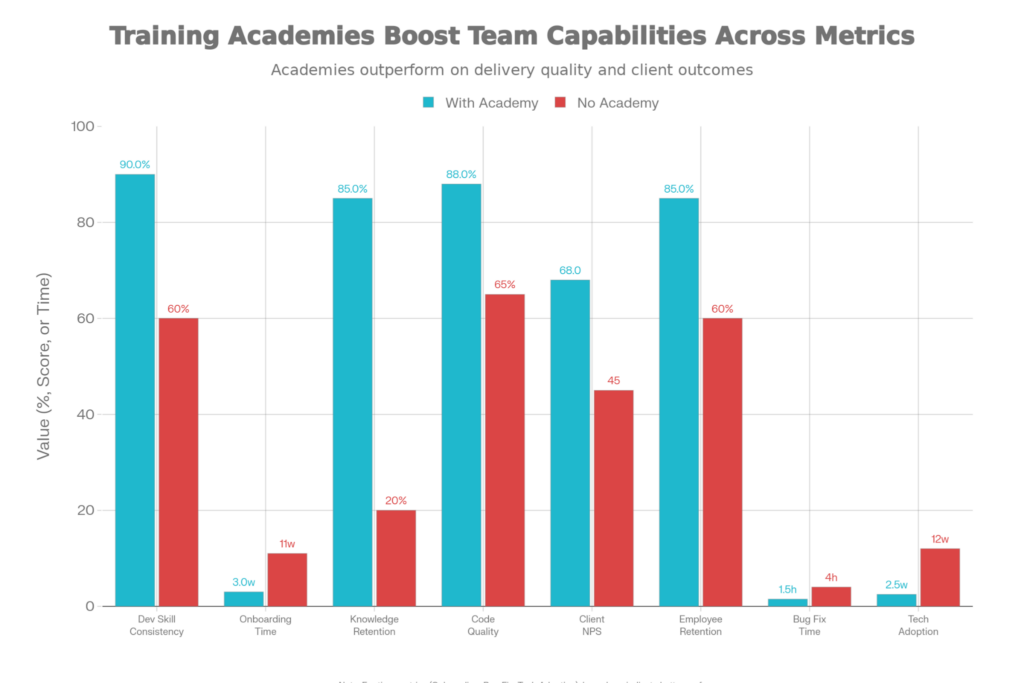
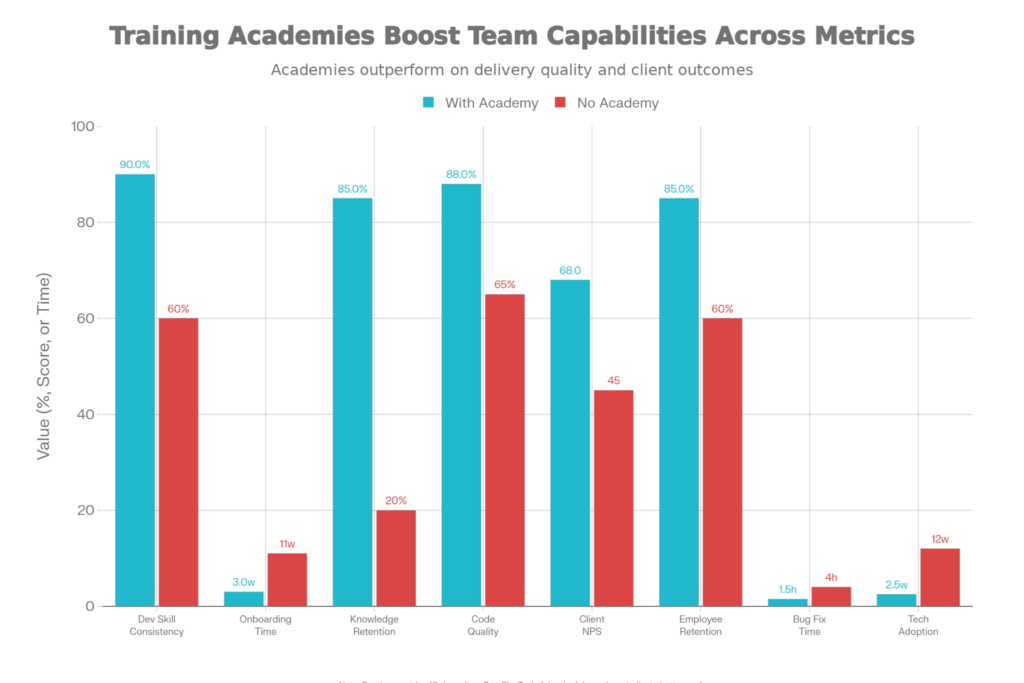
Impact of Internal Training Academy: 8-Metric Comparison of Companies with and Without
Systematic Onboarding: Instead of an ad-hoc “just figure it out” introduction, academies offer a regimented course of training. New developers go through a 2-4 week training on the company’s architecture, development standards, tools, culture, and specific project domain knowledge. They pair with a senior mentor. They work on actual projects, not on simulated exercises. Result: 2-3 weeks productive, not 8-12 weeks.
Real-World Project Exposure: The Academy curriculum isn’t theoretical. It’s rooted in actual client projects. Instead of “how to write REST APIs” in general, the training uses the company’s real APIs, real database schemas, and real architectural decisions. Trainees are able to see how theory can be applied to production systems.
Mentorship Format: A trainee will be paired with a seasoned developer (1:2 ratio, one mentor to two mentees). Mentorship is not informal — it’s planned, organized, and recorded. Mentors are obligated: teach core patterns, review code, answer questions, and document knowledge. Research shows this structured mentorship cuts time-to-productivity 70% vs. peer learning alone.
Course Evolution: Academies refresh the material on a quarterly basis to reflect industry trends and real-world projects, and based on trainee feedback. When your company starts using Kubernetes, the academy adds Kubernetes training. As you transition to microservices, the curriculum evolves. The academy stays relevant.
Knowledge Codification: Trainers teach and write. Patterns are internal wikis. Architectural decisions become ADRs (Architecture Decision Records). Best practice becomes a runbook. Eventually, the company develops a body of knowledge that outlasts employee turnover.
Career Pathways: Academies have clear career progression. Junior → Mid-Level → Senior → Staff Engineer tracks are clearly defined, and we provide training and expectations on what is required at each level. This transparency helps to mitigate ambiguity and provides bright individuals a clear path for growth.
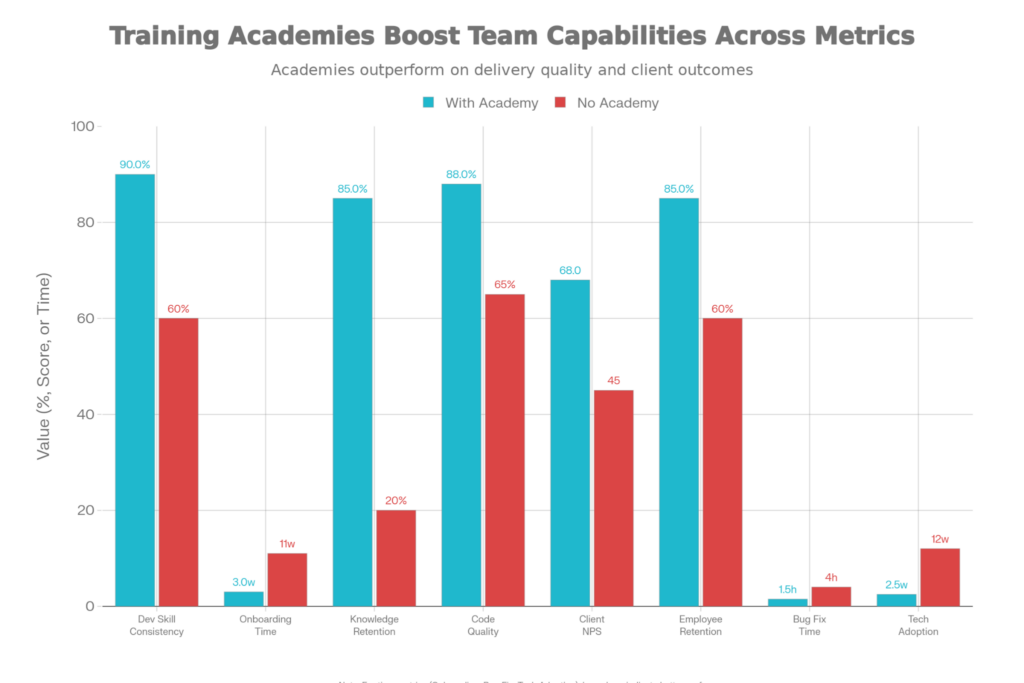
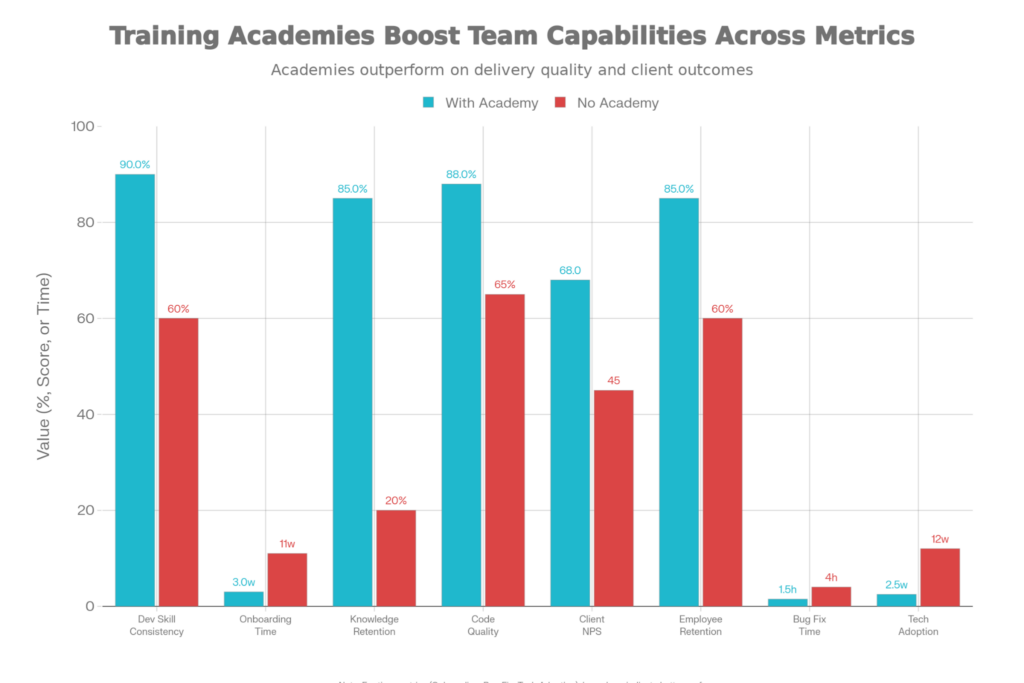
Impact of Internal Training Academy: Eight-Metric Comparison of Companies with and Without
The influence of internal academies spans eight key areas, which are as follows:
Consistency in Developer Skills
Academy companies have 90% of their team staying current with skills in the latest technology stacks. Academy companies – 60% of teams. That disparity is profound — it means you can dependably staff projects with people who know your current tech, not people who are “mostly current” but have to be onboarded on the details.
Time to Onboard
Academy companies get developers productive in 2-3 weeks. Non-academy companies: 8-12 weeks. This 4-6 week difference means 200-300% faster. Over a 10-person team that grows monthly, this difference lets you take projects 4 developers sooner.
Retention of Knowledge in Turnover
When a developer exits an academy company, some of their knowledge is retained through documentation, wikis, and mentors who learned from them. 85% of the essential knowledge is retained. When a developer leaves a non-academy company, 20% is retained. The 65-point margin separates organizational chaos from organizational resilience.
Quality of Code
Academy companies reach 88% of their code at SonarQube Grade A/B (good quality). 65%: non-academy cruise lines. That 23-point difference counts for fewer bugs, faster maintenance, and stronger sustainability over the long term.
Client Satisfaction NPS
Companies with a robust culture of training have an NPS of 68. Those without have an NPS of 45. That 23-point spread translates into higher retention, more referrals, and a lower cost to acquire customers.
Retention of Employee
Academy firms retain 85% of employees for over 2 years. Non-academy firms retain 60%. The difference in retention translates to stable teams, lower hiring costs, and retained institutional knowledge.
Fix Time for Critical Bugs
A critical production bug in an academy company is investigated and patched in <2 hours. At non-academy companies, 4+ hours – because of knowledge silos and slower meetings.
Speed of Technology Adoption
For a company that needs to adopt new technology (Kubernetes, GraphQL, Rust), academy companies do it in 2-3 weeks. Non-academy companies: 2-3 months. That speed is a competitive advantage – you move faster than competitors.
Those improvements aren’t correlated. They are casual. Better-trained teams produce higher-quality decisions faster and remain engaged longer.
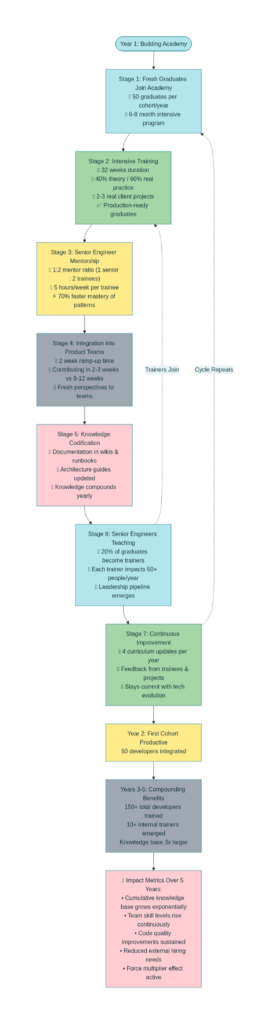
Sustainable Talent Pipeline: How Internal Academies Create Sustainable Competitive Advantage Over 5 Years
The greatest impact of internal academies is not in developing individual talent. It’s that they create a sustainable talent pipeline — a closed loop system that continually regenerates capabilities without depending on external hiring.
As of Year 1, you invest $450K into building the academy infrastructure: hiring the trainers, developing the curriculum, creating mentoring frameworks, and building a learning management system. You run your first cohort — 50 new graduates, 6-8 month program.
This cohort isn’t a finished product. They are still learning, embedded in real projects, but still need a lot of mentoring. Return on investment is zero. You’re investing in groundwork.
Year 2, your first 50 graduates move into product teams. Now you can staff projects with your own people rather than bringing in costly outside talent. Their ramp-up is weeks, not months. They already know the architecture because they have built real projects with your systems.
You run your second cohort. Year 2, the returns begin. $2.9M Benefit from Decrease in Hiring, Retained Talent, Rapid Productivity Realization, and Better Code Quality. Your $380K operating cost is tiny compared to the benefits.
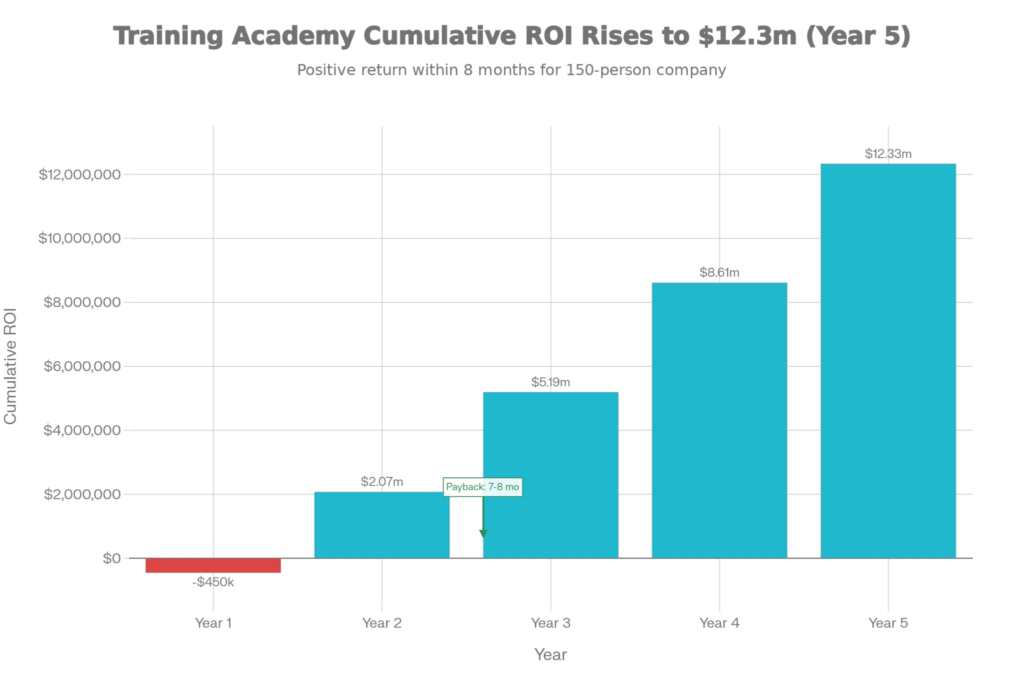
Internal Training Academy ROI: Five-Year Financial Study (150 Employee Company)
Years 3-5, the compounding starts. You’ve trained 150-200 developers internally. You have 500+ hours of codified patterns, architecture decisions, and best practice in your knowledge base. Your top performers are training the next generation.
By the fifth year, your academy generates:
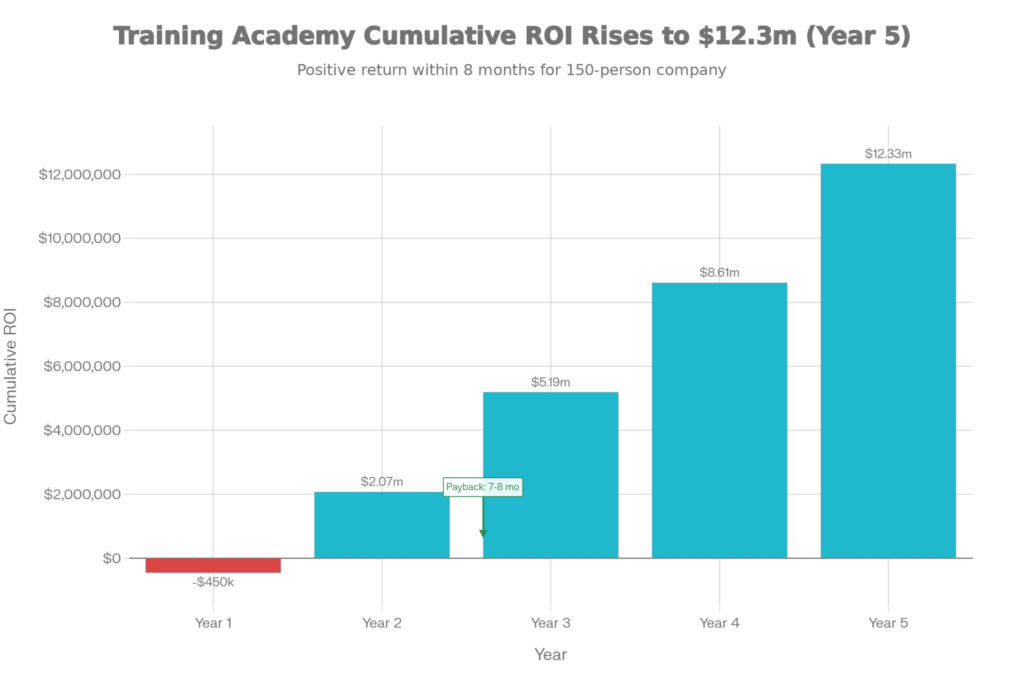
Internal Training Academy ROI: Five-Year Financial Study (150 Employee Company)
This isn’t a training camp. It’s a talent-making system.
The best part of the academies is the force multiplier. When 20% of your top engineers are trainers, they influence 100+ people per year (50 trainees, mentees in product teams, documentation they write). One exceptional engineer, without an academy, touches 2-3 people directly. The same engineer, with the academy, touches 50+.
Multiply 10-15 natural trainers × 50 can serve each = 500-750 people (students) impacted annually by your best talent. That’s how culture scales.
For Indian web development and mobile app development companies catering to global clients, understanding why academies matter means understanding their effect on delivery:
A company without an academy has a hit-or-miss quality. Project A, with senior engineers, is excellent. “Project B, with a combination of junior and mid-level, is mediocre. The global clients feel the lack of uniformity.”
Academy companies ensure consistent quality. Each project has dedicated developers who are trained in the company’s standards, architecture, best practices, etc. 60 to 70% reduction in quality variance.
Impact of Internal Training Academy: Eight-Metric Comparison of Companies with and Without
When the scope of a client’s project expansion changes or demands more developers, academy companies can provision trained resources in 1-2 weeks. Non-academy companies take 4-8 weeks to onboard new people to be onboarding. This flexibility is attractive to clients.
Impact of Internal Training Academy: Eight-Metric Comparison of Companies with and Without
Companies in the academy document everything. Each project produces architectural decisions, best practices, and runbooks. This documentation benefits clients as well—they are left with comprehensive as-built documentation that makes it possible to maintain and evolve their system. Non-academy companies have transferred less institutional knowledge, as the developers never documented their work.
Academy companies can quickly train teams when a client needs a new feature (we need a mobile app version, we need real-time analytics, we need AI-powered features). Non-academy companies have to be filled through expensive hiring or outsourcing. This agility is appreciated by clients.
Major clients are jittery about key person dependency. When the architect-pm on their project departs, does the project get derailed, or does it roll on? Academy companies have documentation, mentorship, and distributed knowledge. Projects continue to run smoothly. Non-academy companies have single points of failure.
Businesses tend to treat academies as cost centers (“Let’s cut back on training to boost the profit”). That’s not the full financial picture, however:
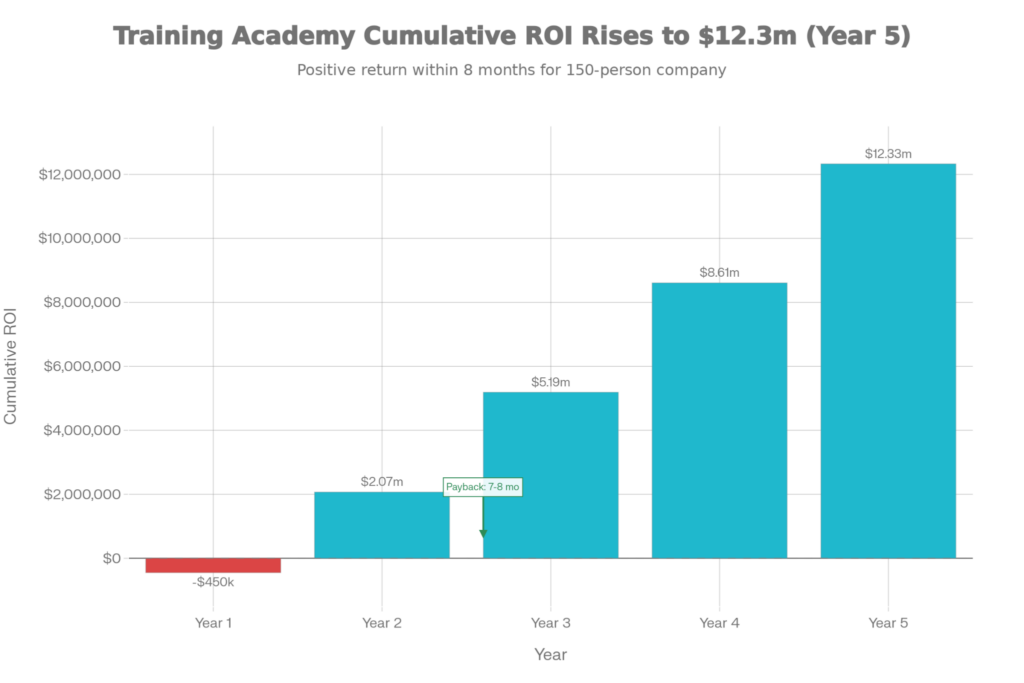
Internal Training Academy ROI: 5-Year Financial Analysis (150 Person Company)
Year 1: $450K investment plus $380K in operating expenses equals $830K. Payoff: Established a foundation.
Year 2+: $380K operating cost renders $2.9M annual benefit:
Period of Payback: 7- 8 months
5-Year ROI: $12.3M accumulated payback for a 150-person company
This is not a cost. It is an investment with 1500%+ return over 5 years.
If academies are so good, why don’t all companies have them?
Short-term thinking: Numerous founders design everything for immediate profitability. Developing a training infrastructure is costly at present (Year 1), with payoffs in the future (Year 2+). The short-term minded couldn’t conceive of holding out.
Talent-market immaturity: In a country with plentiful, cheap talent, training is needless. “Why should we train people when we can get trained people?” This continues to work until the labor market tightens, and the trained talent migrates elsewhere.
Lack of trainers: An academy, by definition, needs knowledgeable trainers. Those trainers cost money, and you have to recruit them. There’s a chicken-and-egg problem: to train people, you need good people to train.
Management Overhead: Academies have management overhead (curriculum development, mentor coordination, feedback cycles). It’s easier to hire and hope for the best than to take a more organized approach.
Cultural misfit: Some firms have a “move-fast-break-things” mentality that despises systematic study. They consider training to drain them, rather than to accelerate them.
Companies that can do that become the market leaders. They develop a sustainable competitive advantage that’s difficult for others to copy because it’s based on culture and systems, not just products.
Leading Indian market companies usually have academies within themselves:
Ateam Soft Solutions, the leading Web and Mobile App Development Company in India, conducts a disciplined training academy program. Their model covers:
The Outcome: Ateam can quickly scale teams, deliver consistent quality across projects, retain talent at 85%+ rates, and develop institutional knowledge that becomes a moat against competition.
Internal training academies are a strategic decision—build your organization, or hire individual stars.
Companies that create academies gain from:
For international clients assessing Indian web and mobile app development firms, having a structured training academy is a signal of credibility. It means the company is in it for the long haul; they are investing in quality and have developed systems that will survive turnover and scale.
For companies that are building academies, the argument is straightforward: it’s not optional. It’s the difference between growing organically and growing organically in a sustainable way. It’s the difference between being at the mercy of hiring to build organizational capacity and actually building organizational capacity. It’s how you go from being a services company to a true product engineering partner.
The optimal time to build an academy was 5 years ago. The second-best time is now.