
Selecting the structure of your relationship with an Indian development partner will be the second biggest factor — following your choice of the partner itself — in determining your app project’s outcome. It affects every facet of your experience, including what you pay and when, how flexibly the project can be, how much control you have, and, in the end, whether you get an amazing app or an infuriating, costly mess.
Outsourcing application development has three popular models in India. In a fixed scope model, you know everything upfront — the features, timeline, budget — and the agency agrees to provide exactly that for a fixed price. Dedicated team model is a business model in which you acquire the services of developers (or a whole team of developers) who are fully dedicated to your project for an indefinite time period and commitment, charging you every month for the time they spend on your project. Hybrid approach is a combination of two, where typically the fixed scope is applied for defined on well well-understood components and the evolving requirements are for a dedicated team context.
The models are fundamentally different in their economics, risk, and operational realities. A startup trying to build a minimum viable product (MVP) with very well-defined requirements might play well with a fixed scope. A scaling SaaS company with constantly evolving product features would most likely keel over in a fixed scope contract. A company that is unsure of its requirements, yet is on a tight budget, may find hybrid to be the best fit.
This detailed guide takes you through all of the models, clarifies the actual costs you should look past the quoted rates, offers you concrete examples of when to use each model and when not to use each model, and, more importantly, gives you a decision framework you can use to choose the best model for your situation.
The fixed scope engagement model is the most classical model for outsourcing. You and the development team know everything upfront: features, design, technology stack, timeline, and price. The price is locked when the contract is signed, no matter how long the development takes.
In a fixed scope engagement, you spend weeks or months writing a highly detailed specification describing every feature, every screen, every integration, and every technical requirement. This specification serves as the contract’s holy grail. The development team checks the specification, gives an estimation in terms of complexity, and quotes a fixed price — in the ballpark of $25,000 to $40,000 for a basic app, $40,000 to $80,000 for a moderately complex app, and $80,000+ for very complex applications.
Product development after signing of the contract will be in a predetermined milestone-based schedule. Standard milestones: 25% four weeks, 50% eight weeks, 75% twelve weeks, 100% (launch) sixteen weeks for a medium-complexity app. You pay according to these milestones—typically 30% upfront, 20% at each intermediate milestone, and 20% on delivery.
The Indian team treats the specification like their bible. They pledge to give you exactly what’s in the listing, no more, no less. Modifications to the specification after signing the contract are deemed to be “changes in scope” and normally necessitate amendments to the contract and additional charges.
The main benefit of a fixed scope is stability. You know exactly how much it is going to cost before you write your first check. That allows you to confidently budget and plan financially.
Another major benefit is the elimination of overhead management. When a specification is frozen and a contract is signed, the development partner assumes responsibility for delivery. You don’t have to be in the weeds every day making decisions.
There is built-in clear accountability with a fixed scope. If the agency agrees to deliver a working app by October 15th for $60,000, that’s exactly what they’re committing to. It’s easier to hold them accountable for specific deliverables when everything is documented in advance.
Best for less complicated projects, fixed scope works best when the requirements are really known. If you’re making a food delivery clone with common features, payment processing, ratings, and messaging, these are pretty mature requirements in the market.
However, there are also several fixed price contracts with very hidden challenges that the very first one comes upon you.
Specification Uncertainty in what is required is the main issue. When you believe you have your ducks all in a row, you find out gaps. Requirements that were obvious in your mind were ambiguous.
Scope creep — and the cost of change requests — is going to be incurred. It’s always a negotiation on each change request — “that’s outside of the agreed scope, so it costs another $5,000.”
The model has some built-in limited inflexibility. You can’t really ping if market conditions change, or you find out things about your users.
Risk allocation is swayed immensely in your favor, but it incentivizes completely contradictory actions. Since the agency takes the financial risk for any cost overruns, they has an incentive to cut corners. When a feature is taking longer to complete than anticipated, the team might take lower-cost shortcuts instead of building it properly.
Testing and quality assurance are compromised by fixed scope stress. If the team is running behind schedule, quality assurance will be rushed or skipped.
Needs a detailed upfront specification. Making an entire specification takes up timeFor many projects, development doesn’t even start until months have passed.
Fixed scope works best when the requirements are very clear and stable. You’re not building anything novel.
Fixed scope works for projects that run for a short time and have a defined scope. Building an MVP with 5-7 core features, creating a simple website, or developing a basic utility app are strong contenders.
Having a fixed scope is more reasonable when you don’t have the capacity to manage a project.
Fixed scope is suitable when cost certainty is considered more important than flexibility.
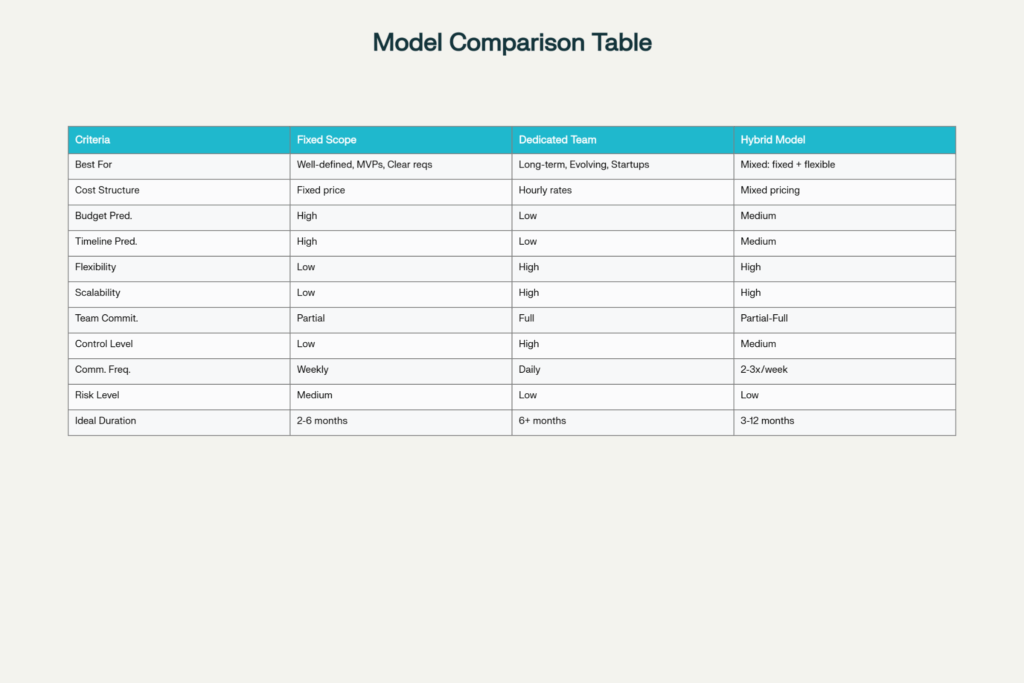
Detailed Comparison: Dedicated Team, Fixed Scope, and Hybrid Models
The dedicated team model is a far cry from the other end of the spectrum. Rather than a fixed cost for a predefined deliverable, you hire developers (usually a small team of 2-6 people) who work solely on your project for an indefinite amount of time, and you pay a monthly fee based on their time.
In a dedicated team engagement, you usually begin with a general definition of needs and timeline. Rather than writing a full-blown spec, you can just describe the vision and major milestones. Following this outline, you bargain for the team make-up—generally one project manager, 2-4 developers, and a QA specialist for medium-sized projects.
Costs per month are different according to seniority and complexity. A team of 1 junior developer costs around $10,000-$15,000 per month in India. $20,000-$30,000: a team of 2 mid-level developers. $40,000-$60,000: a more senior team of 4 developers.
The team sprints, usually in one- or two-week increments. Every sprint begins with a planning meeting in which you set priorities. Develop your team, and at the end of the sprint, deliver working software and get feedback from them.
Maximum flexibility is the biggest benefit. With priorities shifting, so does the team.
Ownership and accountability are different in dedicated teams. Because the team is dedicated, they become experts in your product and have a vested interest in your success.
Discovery and exploration are inherent to the model. When the specifications are unclear, the dedicated team will assist you in discovering options.
Scalability is simple. You add more developers as your project grows and you need more developers. When you reach a plateau, preserve the same team size.
Continuity within teams and knowledge retention will become an organic by-product. For months and years at a time, the same team members support your project. They know the codebase, the architecture decisions, the business logic, and the history.
Better long-term partner. When your product succeeds, the agency wins. There’s an alignment of interests.
Realistic estimation of the project timeline gets better with the knowledge of the velocity of the team.
However, dedicated teams pose their own challenges compared to a fixed scope.
Higher prices per month are the most visible con. A $60,000 fixed scope project could cost $40,000-$60,000 a month to complete with a dedicated team for 3-4 months, so the total cost could be $120,000-$240,000 if development drags on more than you had planned.
The flip side of flexibility is budget uncertainty. You do not know up front how long the development will take.
Needs active client engagement. You have to be involved in sprint planning, review work often, give feedback, and keep making decisions.
There is a high risk of scope creep. The project can balloon without tight reins.
Attrition risks for teams are significant. Indian tech hubs generally witness 20-30% attrition annually in tech talent.
Starting to pull up the productivity takes time. It usually takes from 4 to 6 weeks (as opposed to 1 to 2 weeks for onshore teams) for a dedicated team to achieve full productivity.
Hard to keep on for a long time on single projects. You are paying for a team that is basically sitting idle if your development plateaus after a year, and the group is waiting for your feedback.
Requires well-defined project management practices. Dedicated teams are most successful when they have well-defined sprint management, backlog prioritization, and frequent communication.
Dedicated teams are ideal for long-term product development where you’re building like this steadily for months or years.
Dedicated teams are perfect for when the needs are unknown or changing.
A dedicated team is better than outsourcing for complex projects or large-scale projects with multiple phases.
Dedicated teams perform well when you can get involved in the project management.
Dedicated teams are the right choice if innovation and learning are at the heart of what you want to achieve.
The hybrid model includes aspects of fixed scope and dedicated team participation. You generally apply a fixed scope to well-defined parts and a dedicated team to parts that are uncertain or evolving in a hybrid engagement.
A typical example would look like this: For months 1-2, you work with a dedicated team (or T&M) for discovery and prototyping. In this stage, you are searching the product space, testing assumptions, and building prototypes of key features. Months 3-4: transition to fixed scope, for a fixed number of “core” features that are now clearly defined. For months 5-12, you return to a dedicated team for continued feature development, optimization, and post-launch support.
Or, a mixed approach might look like this: your payment processing is a fixed scope (you know exactly what you need), while your user interface is a dedicated team (you want to iterate based on user feedback).
The Right Amount of Flexibility. Hybrid models allow you to apply a fixed scope to areas you know well and a dedicated team to areas you are still learning about.
Flexible pricing for better control. You receive some of the predictability benefits of fixed scope time and materials while enjoying the flexibility of dedicated team time and materials.
Less Risk. Hedging your bets by mixing models. Fixed scope parts have a single owner and a timeline; dedicated team elements have fluidity for learning.
Phased: Allow learning to take place. You conduct discovery first, then lock down what you’ve learned, then ramp up.
Improved initial negotiations. realistic discussions about which parts are best suited to which model when negotiating with Indian partners.
Needs more involved contract management. You’re running two different types of engagements at the same time.
More management overhead. You have to switch models, scale your team, and work with different billing models.
Potential for disputes over the applicability of models. If a component is initially “fixed scope” and the requirements change, there are disputes.
Vendors can balk at hybrid models. Some agencies just want the ease of single-model attachments.
Less predictable than pure fixed scope but more overhead than pure dedicated.
Hybrid models are suitable for phased projects when discovery and delivery exhibit different characteristics.
Hybrid is also successful for complicated products that are made up of defined and experimental parts.
Hybrid models also work when you want to hedge your bets by applying two different approaches to your risk.
Most conversations about the cost of outsourcing revolve around the base rate—the hourly fees for having a dedicated team or a fixed price for projects based on the scope. However, the true cost of outsourcing is much higher because of hidden costs that are not included in the initial quotes.
Loss of time zone coordination: Your team is 8-14 hours away because you work with a team in India. It takes 24 questions to get answers. This loss of productivity is estimated to be 10-15% of your overall funding.
Communications tool and infrastructure: The cost of providing reliable communication tools and infrastructure, i.e., project management software, source code control software, and secure collaboration environments, amounts to approximately $1,000-$3,000 per developer each year.
Training and onboarding: It takes time to get a focused team up to speed on your project. According to them, Indian offshore teams achieve 85% productivity in 4-6 weeks as opposed to 1-2 weeks for onshore teams. That’s about 10% of your project expenses.
Project management overhead: There’s also the overhead of managing an offshore relationship to consider—more frequent status meetings, continual communication, documentation, and vendor management. This overhead management generally adds 15-20% to your project costs.
Rework and quality control: About 25% of offshore projects have to be redone because of quality problems, communication misfires, or specification deficiencies.
Legal and compliance costs: Writing contracts, protecting intellectual property, and managing compliance obligations add 5-10% to your costs.
Attrition and transferring of knowledge: Offshore teams have 20-30% attrition per year in Indian tech hubs. Include 15% of the costs for attrition-related costs.
When you factor in these hidden costs, your real cost of ownership is 125 to 150% of the base quoted rate. That is to say, a project with a $100,000 quote actually costs $125,000 to $150,000 when all of the hidden expenses are factored in.
These aren’t hidden costs your vendor is hiding from you—these are real, legitimate costs that just aren’t included in that first bare-bones quote because they’re not a direct development expense.
Knowing this reality alters the way you judge. An agency with a $50,000 fixed price quote may actually deliver $62,500-$75,000 worth of value if you include your overhead in the form of hours spent managing the relationship, quality assurance, and communication.
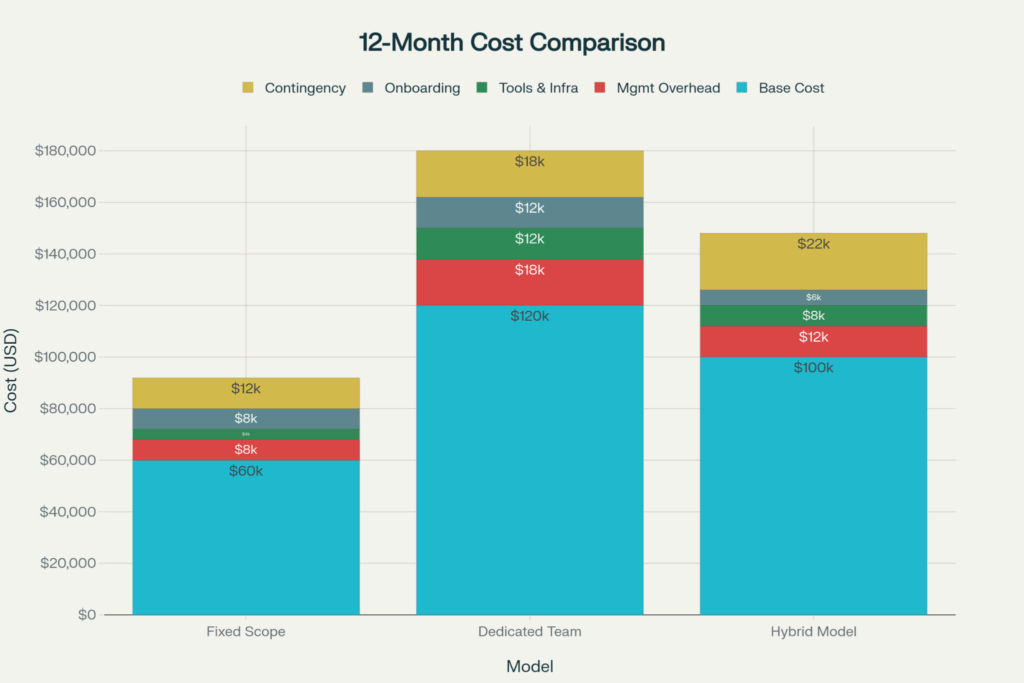
12-Month Ownership Total Cost: Three Models of Outsourcing
Having knowledge of prevailing market rates in India allows you to assess quotes and bargain strategically.
Junior developers with 0-3 years of experience are charging $18-$20 an hour.
Mid-level developers (years of experience: 3-5) rate is $22-$30 per hour.
Senior developers (years of experience: 5+) rate is $30-$50 per hour.
Team leads or specialists tier, such as an architect: 8+ years or specialist knowledge, $40 – $80 per hour.
As for employing a dedicated team, monthly fees may be referred to as ”loading” rates, where the cost of the developer’s salary, overhead, benefits, and management fees needs to be covered.
1 junior developer: $8,000-$12,000 per month
1 mid-level developer: $12,000-$18,000 per month
1 senior developer: $18,000-$25,000 per month
Team of 2 mid-level developers: $20,000-$30,000 per month
Team of one mid-level + 1 junior: $15,000–$22,000 / month
Team of 4 (standard mix): $40,000-$60,000/month
These prices have come down a bit (5-10%) from 2024 to 2025 due to increasing competition in the market. Western markets pay $120,000-$150,000 per year for equivalent junior developers and $200,000-$250,000 per year for mid-level developers—indicating that Indian rates offer a cost saving of 40-60%.
For the fixed price projects, the Indian development vendors usually bid based on the estimated effort and complexity:
Basic Apps: $25,000 to $40,000 for two to four weeks of work.
Moderately complex apps: $40,000 to $80,000 for 8 to 12 weeks of work.
Complex apps: $80,000 to $200,000+ for 16 to 24+ weeks.
All these estimates vary across cities and states in India. Tier-1 cities (Bangalore, Pune, Mumbai) have greater rates. In Tier-2 cities (Hyderabad, Kochi) the rates are lower by 10-15 per cent. Tier-3 cities can be 20-30% less expensive.
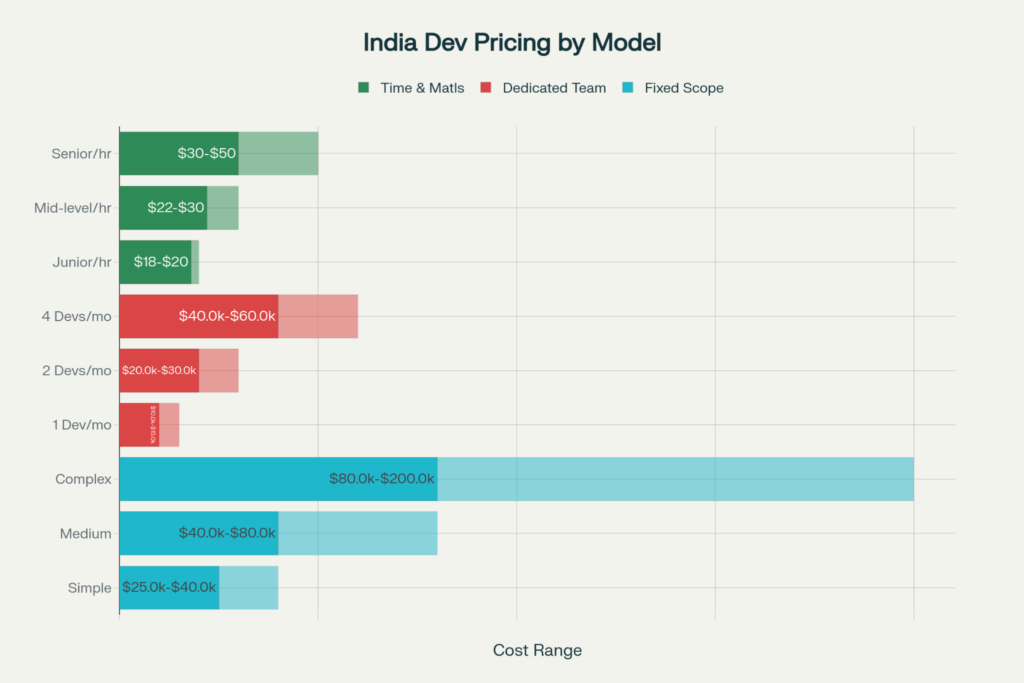
India’s 2025 App Development Cost Guide
To get a better idea of what the actual cost differentials between tiers are, let’s look at a realistic medium-sized project that would take 8-10 months to make.
Medium complexity with fixed scope of work: $60,000 base cost
Add 15% scope change buffer: $9,000
Estimated total: $69,000
But there’s your project management time (around $15,000 in salary/opportunity cost for your team), communication tools and infrastructure ($4,000), quality assurance and testing labor ($8,000), and contingency for rework ($10,000).
Longevity Cost of Ownership: $106,000
Schedule: 8–10 weeks to develop, possibly 2–4 weeks more for revisions and rework.
Projects like this one can be done with a team of two mid-level developers:
But that includes development, project management, and basic QA. Your actual cost:
Longevity Cost of Ownership: $241,000
Schedule: 8-10 months of development with ongoing revision and enhancement.
Same hybrid project structure:
Your actual expenses:
Total expenses of ownership: $240,000
Timeline: 10 months total, but with improved adaptability and learning along the way.
The fixed-scope approach has the lowest base price ($69,000), but leads to the highest total cost of ownership ($106,000) when you bring overhead and rework into the equation. The dedicated team model is more expensive ($200,000 base, $241,000 total), but services and results are more comprehensive. The hybrid model ($206,000 base, $240,000 total) is a compromise that provides more flexibility than a fixed scope with some cost control.
The real question is not “what is cheapest?” but “what is best value for your particular project?”
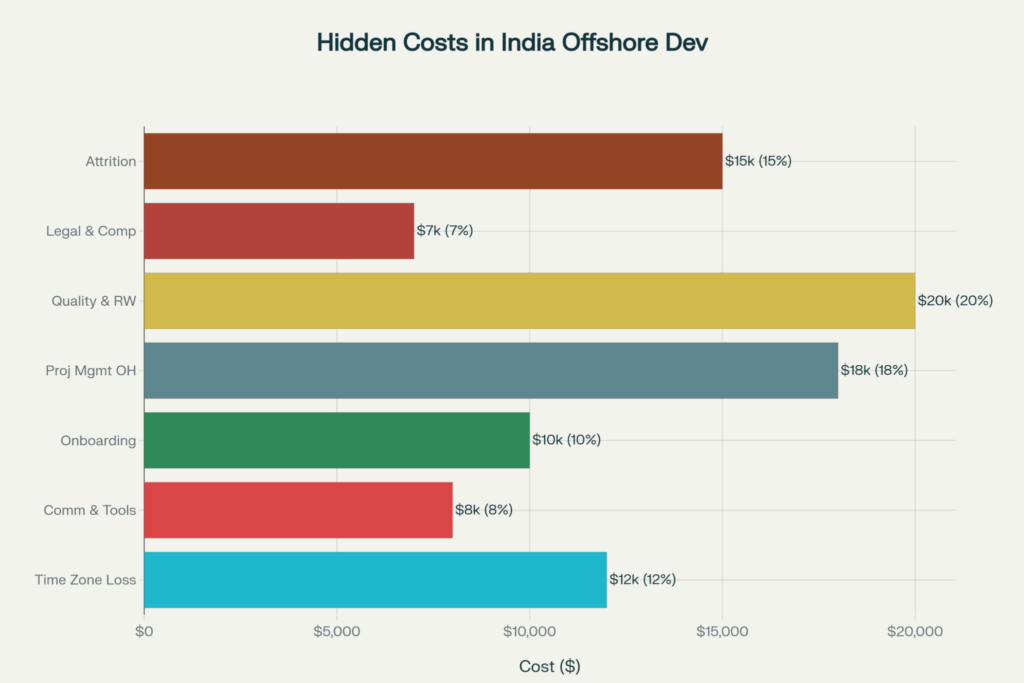
Offshore Development Hidden Costs: What Base Quotes Don’t Cover
Knowing the weakest point of each model is what allows you to make an informed choice and to be ready for trouble.
Project begins with a fixed scope quote of $60,000 for an e-commerce app. Everything looks pretty predefined—product pages, shopping cart, checkout, payment integration.
Two months into the project, you realize the specification was vague regarding the search for the products. It’s now a “scope change,” which means another $8,000 and a 3-week delay.
Then your payment gateway integration reveals issues. Another $5,000 scope change.
Then you realize you need analytics. A further $6,000 scope change.
Your $60k project has become $79k, and the schedule has stretched from 10 weeks to 16 weeks.
Mitigation: Specifying the ambiguous sections in detail. Allocate a 20% contingency for scope changes. Consider a hybrid approach for uncertain parts.
Project is completed on time and within budget. But when real-world users are using an app, problems appear: crashes, slowdowns, UI misalignment, and terrible code architecture.
These are not the fixed scope vendor’s problems anymore. To fix them, you either have to pay them even more money or bring in new developers to refactor. In either case, you’re out another $20,000-$30,000.
Mitigation: Build in lead time for testing before delivery acceptance. Specify quality criteria in the contract.
You assemble a full-time team for what you anticipate will be a four-month project, bracing for costs of $100,000.
Month 1: You specify the MVP with the core features required.
Month 2-3: Core features developed.
Month 4: You tell the team to iterate on the design.
Month 5: You discover you need more features.
Month 6: Optimization work continues.
Month 7: After the release, you want more features.
Month 8: You’re still forking over $25,000 a month, but you have no idea what they’re working on.
What should have been $100,000 is now $200,000 over 8 months.
Mitigation: Have defined sprint goals and acceptance test criteria. Use burndown charts and velocity monitoring. Macros: Have monthly reviews to decide if you continue, castrate your team, or move to maintenance mode.
You hire a team of four people in India. By the end of month 3, they have become experts on your product. In Month 4, a mid-level developer of yours gets a better job offer. This is absolutely fine—20-30% yearly attrition is expected.
Three people are still working on the project. New hiring and onboarding take four weeks. You lost productivity during that gap. It takes a new developer four weeks to ramp up.
You are eight weeks behind in output just because one person left. For a 12-month project, this is a 15% productivity hit.
Mitigation: For attrition rates, ask vendors. Build retention bonuses into contracts. Request key person clauses. Plan for 15-20% attrition impact on timeline.
You begin with time and materials for two months of discovery. But you’re trying to lock down core development and want to move to a fixed scope.
But there’s a divide between what discovery turns up and what a fixed scope supplier can actually deliver. You need to turn over all the discovery work, explain decisions to a new team, and lock down a specification. Transition takes time. You lose 2-3 weeks of continuity.
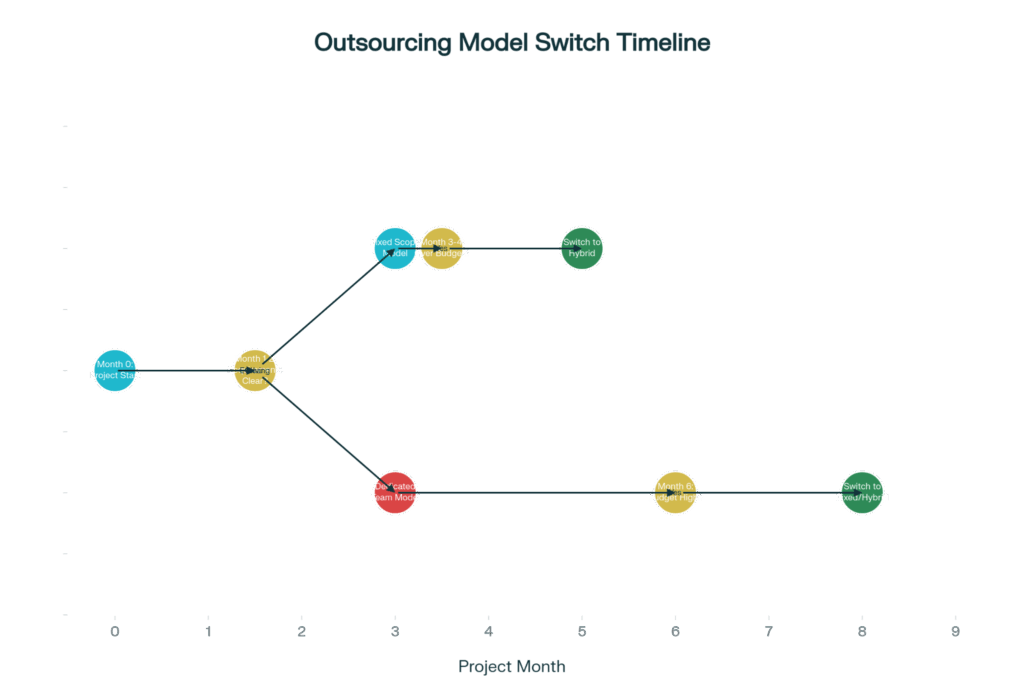
Timeline for Decision-Making: When to Change Outsourcing Models
Mitigation: Use the same vendor for both stages, if feasible. Document all the findings from the discovery clearly. Budget the overhead of transitioning.
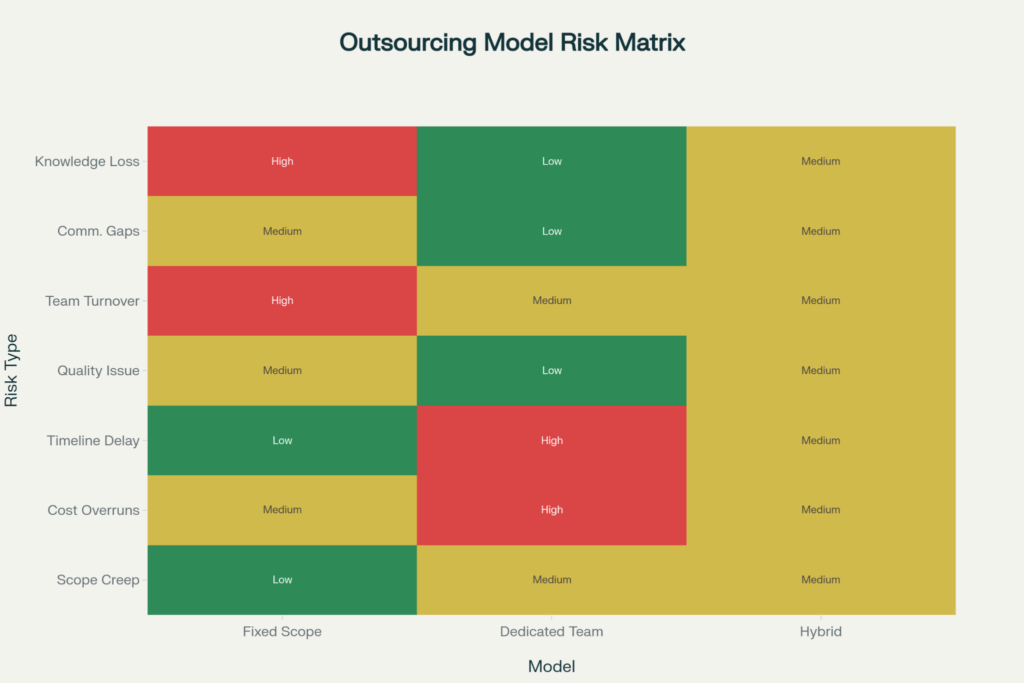
Risk Assessment Matrix: Comparison of Outsourcing Models
Instead of basing your decision on the initial cost quotes, use this process to adapt the model to the real traits of your project.
How well defined is your scope? If you can write a detailed spec that won’t change much, a fixed scope makes sense. If the scope is unknown at the time or is expected to evolve, a dedicated team or time & materials is advised.
What’s the timeline of the project? Short-term projects (2-4 months) fit a fixed scope. Long-term products (6+ months) fit a dedicated team. Projects with distinct phases fit a hybrid.
How much project management bandwidth do you have? Thus, if you can closely monitor the Sprint planning , so be it – “dedicated team” applies. If you have to turn over the execution, a fixed scope works better.
How much flexibility and adaptability do you need? If you are iterating based on user feedback, a dedicated team. If you can describe everything in advance, it’s a fixed scope.
What’s your budget reality? If you are working with a fixed budget that you cannot increase, a fixed scope makes it more predictable in terms of how much you will have to pay. If you can decide on a budget dynamically based on value, a dedicated team works well.
What’s your risk tolerance? Fixed scope puts the risk on the vendor. A dedicated team puts more risk on you. Hybrid splits risk.
What does ‘quality’ mean? It means if you’re willing to give up some flexibility – you know, like guaranteed quality – fixed scope. If you want to iterate towards quality, a dedicated team is needed.
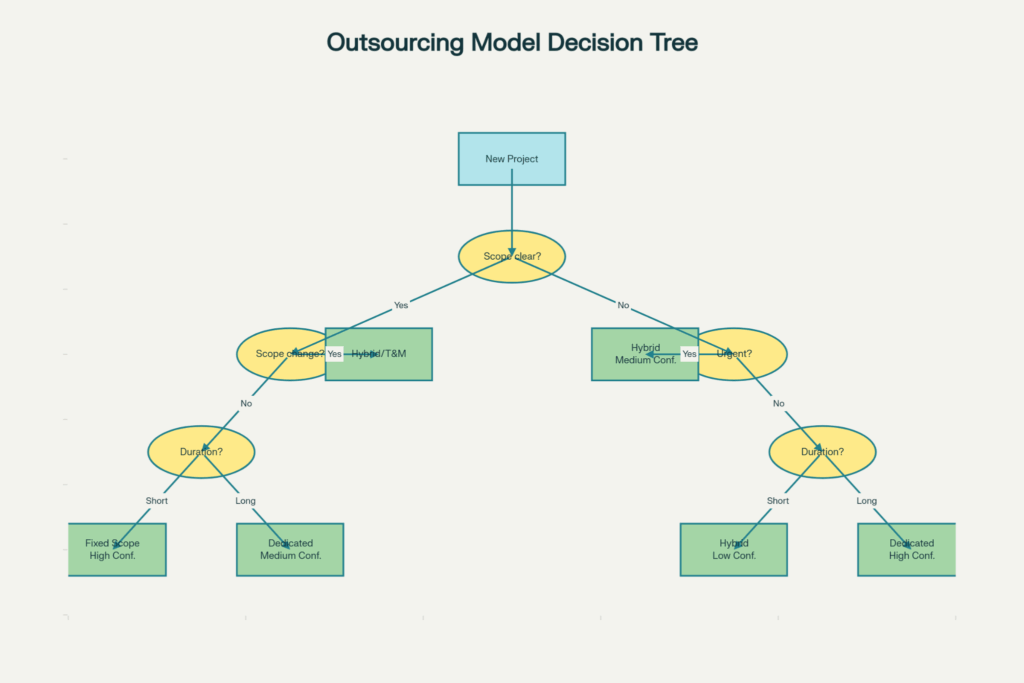
Decision Tree: Selecting the Right Outsourcing Model
Sometimes you begin with one model, and you have to change.
Fixed scope to dedicated team: When scope creep is ongoing, and the contract has turned adversarial. If you’re really paying for change order after change order, you may well be better off going with a dedicated team.
Dedicated team to fixed scope: You may also use portions of your dedicated team as a fixed scope if your dedicated team has completed a fully defined set of core features and those core features are stable .
Any model to hybrid: When you come to realize your project has certain parts that are locked down (which are fixed scope candidates) and parts that aren’t (which are dedicated team candidates).
Dedicated team to maintenance: Following completion of development, moving from a full dedicated team to a part-time team for maintenance can be cost-effective.
Plan on transitioning in phases rather than all at once. Don’t stop one model and start another right away. Allow for both models to run for 2 – 4 weeks.
Document everything when you change. Code, architecture decisions, design rationale, and learning from failures — all need to be documented.
Keep continuity. Ideally, the same person sat in on the old phase & on the new to provide continuity.
Re-clarify contracts. What to expect when changing models: Clarify what’s changed when you change models. What’s in scope that isn’t anymore? What new vetting is there? What new costs are there?
Allow for the transition to be gradual. Always allow for an extended period when changing models—there are two ramps, the knowledge and experience transfer, and the before and after of the change.
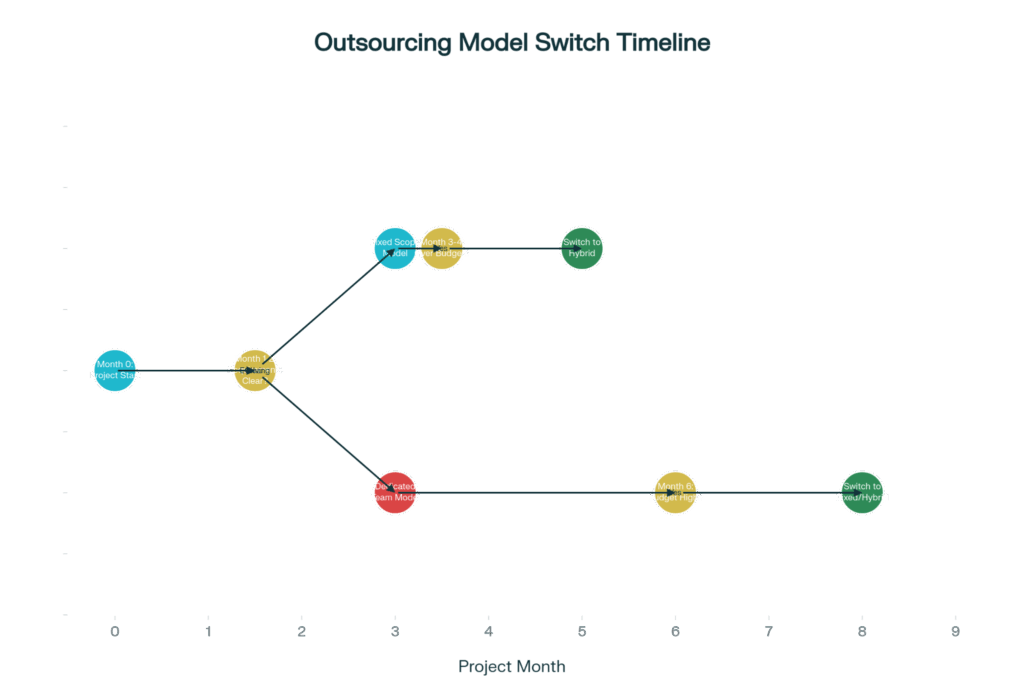
Timeline for Decisions: When to Change Outsourcing Models
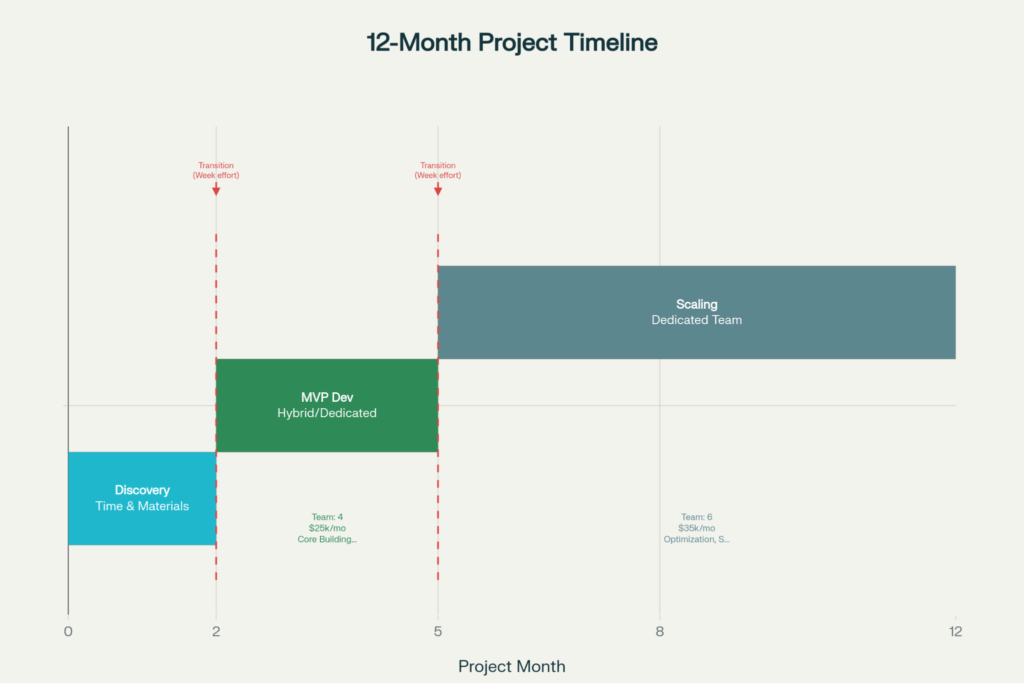
Project Development: Suggested Models by Stage
The issue: You select a fixed scope because the initial price looks affordable, but your needs are still uncertain. You realize this during the project, resulting in multiple change orders that go over the initial fixed price.
How to avoid it: Be upfront about whether requirements have really been nailed down. If you’re inventing something new, go with a dedicated team or hybrid, definitely not pure fixed scope.
The issue: You select a dedicated team expecting to be hands-off, but you find managing the vendor is a full-time job—weekly calls, feedback on deliverables, constant communication.
How to avoid: Build in a project manager role on your side to manage the vendor. Or, opt for a fixed scope if you don’t have the bandwidth for active management.
The issue: A vendor quotes $30,000 on a project others have quoted at $50,000. You go with the cheaper vendor, but they skimp, and are low quality, and you spend $20,000 fixing their work.
How to avoid: Realize quality is a function of price. Rates below market are indicative of lower quality or unsustainable business models. Get vendors at market rate.
The issue: You’re budgeting for the quoted amount, but you’re not budgeting for management overhead, quality control, the cost of communication, tools, and contingency. You are forced over budget.
How to avoid: Add 25-50% contingency to quoted costs. Budget for project management overhead on your side. Reserve funds for quality assurance.
The issue: You hire a dedicated team, but turnover is high, and you lose critical people. Your productivity suffers, and you need to bring new hires up to speed.
How to avoid: Inquire with vendors about their turnover rates. Add retention incentives to contracts. Ask for key person clauses. Expect a 15-20% attrition effect.
The issue: Time zones make it hard to communicate. Queries take a day to be answered. Misunderstandings compound.
How to avoid: Set clear communication protocols from the beginning. Set ‘core hours’ when both teams are online. Utilize asynchronous documentation to reduce the requirement for real-time talk.
There is no one-size-fits-all “best” model. The best choice of model is the one that fits your project’s attributes, risk tolerance, management bandwidth, and budget reality. Those are the best models.
Fixed scope is applicable when you have a clearly defined set of requirements, the project is short-term, and you require cost certainty and minimal management overhead.
A dedicated team is ideal when the requirements are uncertain or changing, the project is long-term, you can commit yourself to project management, and you can handle a monthly cost structure.
Hybrid is ideal when your project involves distinct phases that have different attributes—e.g., some phases involve exploration (dedicated team) while others involve fixed/bound implementation (fixed scope).
The companies that thrive with Indian development partners are not the ones that select the cheapest model, but the ones that select the model that best fits their project needs. They budget for hidden costs. They are proactive with their vendors. They establish clear communication lines. They have contingency plans.
Knowing the actual cost and features of each model, and by following the decision process in this introduction, you will be able to select a model that makes you more likely to succeed rather than one that causes you frustration and cost overruns.
The objective wasn’t just to outsource development cheaply, but to foster a partnership that produced great work. The selection of an appropriate model is the first step in realizing this aim.