
When you’re looking at Indian app development companies, you usually start with their portfolio. But also, the portfolio is where you can lie more easily. The industry has become adept at masking subpar work as high-quality output, misrepresenting team capabilities, and showcasing apps that were never really built by the agency, taking credit for them.
The stakes are enormous. Selecting the wrong agency can mean spending months working on a product that ultimately crashes on launch, a few thousand dollars he can’t afford to lose, and an increasingly difficult-to-maintain code base, and, potentially, a dud of an app that no one uses. The most egregious example involved a Microsoft-backed company that kept up this entire fake portfolio for eight years, pretending their AI built apps when, in reality, 700 human developers were doing manual coding work.
This practical guide will show you how to read between the lines of app development portfolios, distinguish real work from the fake kind, corroborate developers’ technical claims with tangible proof, and find out whether an agency has what it takes even if it says otherwise.
Before getting into evaluation methods, it’s important to know what a portfolio really shows and what it does not show. That distinction separates veteran evaluators from those who fall for slick presentations.
A solid portfolio proves that an agency has prior experience in building products, is familiar with various technology stacks, can work on different industries, knows design fundamentals, and has released solutions that have found real users. When an agency has several apps with thousands of downloads, good ratings, and proof of active user bases, they show me that they not only get development but the entire product lifecycle—how to make apps that people actually want to use.
A good portfolio shows versatility in different frameworks (native iOS and Android, React Native, Flutter), different types of features (payment integration, real-time messaging, complex backend systems), across different industries (healthcare, fintech, e-commerce, education). This means the agency hasn’t just specialized in making one kind of app.
Still, a portfolio doesn’t prove everything. A pretty UI doesn’t mean there’s clean code beneath. Flashy feature sets don’t mean the code is maintainable or scalable. Most importantly, a portfolio app doesn’t prove the agency built it – this is where fraud becomes rife.
Knowing this reality is the beginning of having a rigorous portfolio review. You need multiple lines of verification that go further than just “Can you show me the apps you’ve built?”
Areas of Portfolio Review focus
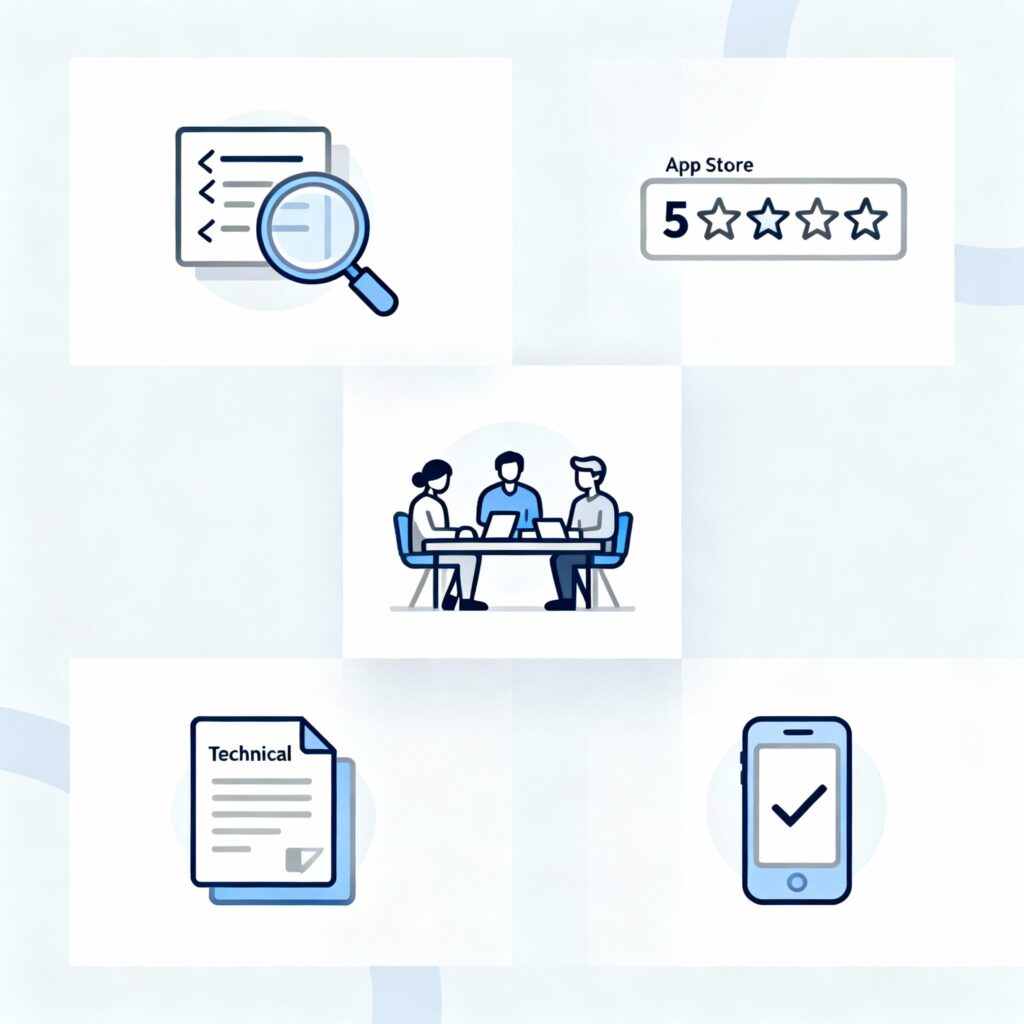
Key Assessment Areas for Portfolio Evaluation
There are certain consistent warning signs that can be found in the portfolios offered by fraudulent agencies. Knowing how to identify these red flags will immediately weed out a lot of potential problem vendors to review.
This is the most glaring red flag , and yet it’s so frequent. Legit portfolio apps will be easily findable on the Google Play Store and the Apple App Store. When an agency cannot give you direct links to their apps or claims “the apps are under development” or “the client asked us to take the app down,” this is a red flag.
Legitimate companies will provide you with direct app store links. The process is straightforward: You go to the URL they give you and download the app from the real store. If the app doesn’t exist or the link is dead, get rid of that agency immediately!
Template-based apps have a professional look, but they usually consist of boilerplate code and copy-paste functionalities. Red flags: the whole portfolio consists of similar-looking apps, a simple feature set (basic listings, a standard navigation scheme, nothing groundbreaking), and nothing like payment integration, location services, real-time chat, or anything along those lines.
When looking at the portfolio apps, ask yourself: Is this something that could have been built inside a low-code or no-code tool like FlutterFlow, Bubble, or Webflow? If it’s a yes for the majority of their portfolio, they might not have the depth you’re going to need for serious development.
The story is told in the App Store ratings. Apps with a rating lower than 3.5 stars are, on average, well overdue of needing an update or just aren’t that great, or are missing important features or support after launch. Apps that have never been downloaded more than 100 times as a whole suggest that the agency either didn’t market them properly or built something nobody wanted.
By reading up on recent reviews, you will be able to see what the quality of the app as a whole is. If you spot reviews from the last month talking about the app crashing, being buggy, slow, or not having features you’d expect, that’s a sign the agency either abandoned the app on release or doesn’t seem that reliable. The review pattern tells you if the agency backs up its work.
An unfortunate trend seems to be agencies claiming credit for the work of freelancers, outsourced teams, and even other agencies. When you ask “Who built this app?” and get nondescript answers, that’s a red flag. Real agencies should be able to share specific team member names, roles, and involvement.
If the firm is evasive about who the individuals are that have worked with you on your projects, you can’t get information about their roles, or they won’t let you speak to actual programmers, that’s a sign they’re hiding something.
When an agency boasts “AI-powered” features, “real-time sync,” “enterprise-grade security,” or other technical bells and whistles, test these assertions out by using the app. The Builder.ai scandal showed how agencies lie about that underhanded method of saying they use high tech when what they really do is manually code.
When you hear technology claims, ask the agency to describe how it works. If they cannot clearly describe the technical architecture or tell you “it uses machine learning” without telling you how, be skeptical.
If an agency presents fancy, complicated applications with enterprise features and says they develop apps in weeks for $5,000, then something is off. There’s a three-way tradeoff between quality, speed, and cost, and you can’t have good, fast, and cheap all the time.
Apps with complex functionality (payment, real-time sync, DB integration) realistically take 3-6 months with a team. Confirm those claims with questions such as “How long did this particular app take to build?” and “How many people were on the team?”
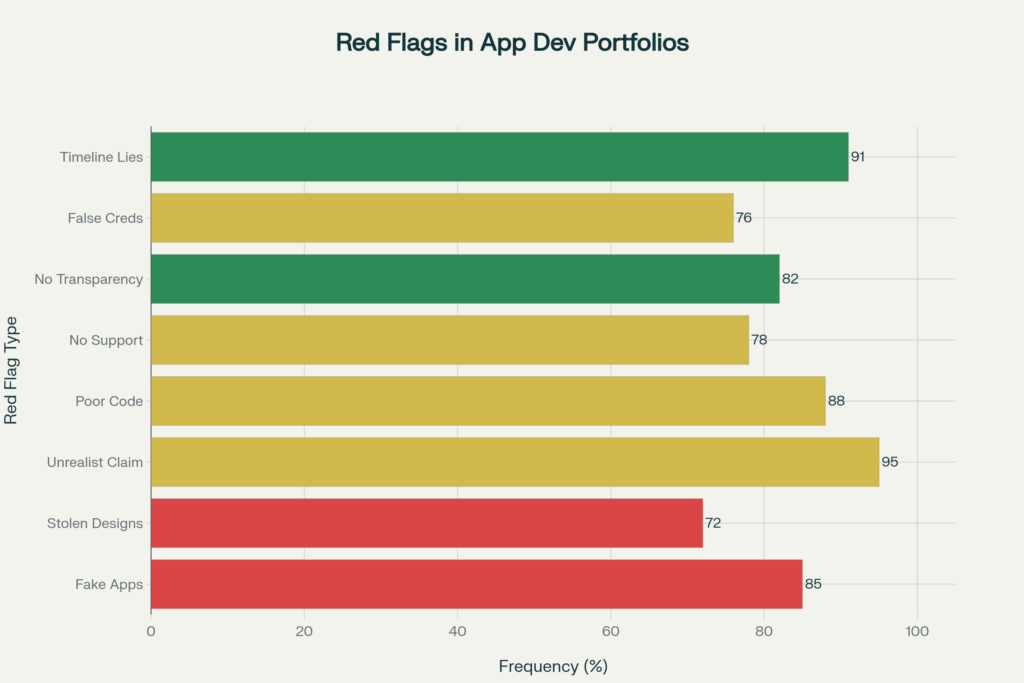
Typical Red Flags in Indian App Development Portfolios
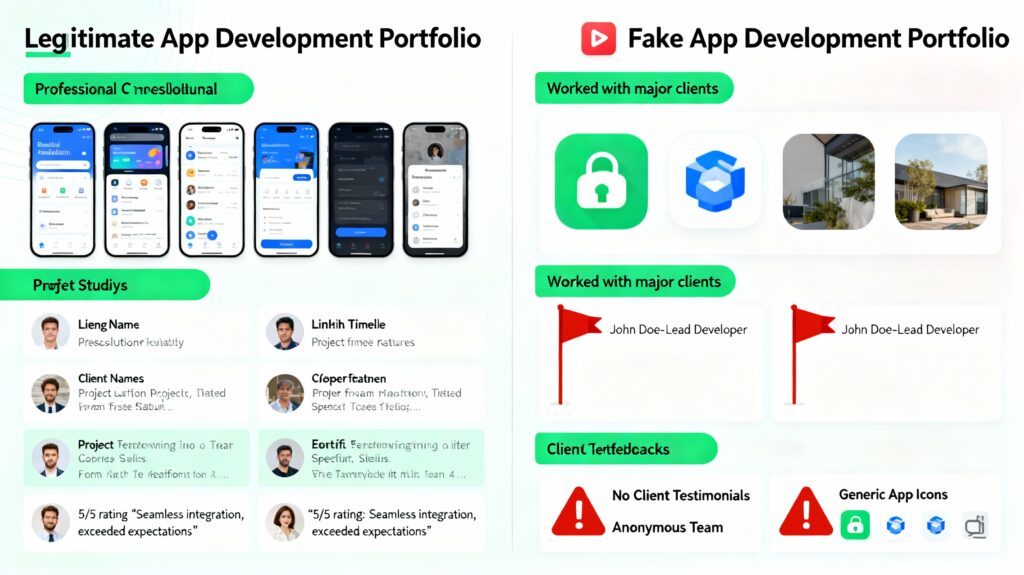
Legitimate vs.Fraudulent Portfolio Comparison
A good portfolio covers a range of industries, project types, and technologies. Yet, appraisal is not as easy as tallying different apps.
Agencies that have worked on healthcare apps, fintech applications, e-commerce platforms, and educational software have had to solve all manner of problems and have learned to creatively solve diverse problems. Healthcare apps need HIPAA compliance expertise. Fintech apps need to be PCI-DSS compliant and integrate secure payments. E-commerce apps need a good inventory management and order tracking system. One agency to go head-to-head with all these disparate compliance and architectural challenges and come out on top shows flexibility and depth.
A good consideration for a medium-sized agency would be a minimum of 2-3 apps from the healthcare, fintech, or other regulated industries, apps built using different technologies, apps of different complexity (from simple utility apps to complex enterprise systems), and apps from different app categories (B2B, B2C, marketplaces, utility tools).
Relevance surely matters above and beyond diversity. If the team is accustomed to designing dating apps and social networking tools, and your project is to build a fintech app, they might not have the necessary expertise. Make a list of the technical requirements of your project, then check out the portfolio of the agency to find out if they have implemented similar features.
A great design portfolio app with many downloads can hide a very poor codebase. The quality of code dictates whether an app will be maintainable for years or whether it will turn into an unmaintainable disaster requiring costly rewrites within a year.
When code quality is low (also known as “ high technical debt”), later work costs exponentially more. A feature that should take two weeks to build takes four weeks, because the developers have to read and maybe even refactor the existing codebase first. It’s more difficult to fix bugs because the code is hard to read. Performance problems persist because the architecture makes optimization difficult.
The best method to gauge the quality of code is to ask for access to the source code repository (GitHub, GitLab, or similar) for portfolio apps. Most good developers are happy to share code because they’re proud of it. If you see a developer who refuses to share code or says “the client won’t let us”, alarm bells should be ringing.
When reviewing code, check for the following: naming conventions consistency, code structure, internal documentation (comments) for complex logic, test coverage (automated tests that confirm the code is functioning as expected), and whether the code is modular. Bad signs in code are: obscure variable names, no documentation, spaghettified code, no or very minimal tests, and huge bulk code.
If you don’t know how to code, hire a freelance developer ($50-150) to audit portfolio code and tell you how it looks. A 1-hour code review adds that color of whether technical standards are high or low.
Technical debt is analogous to financial debt in the technical world. When the development team takes shortcuts and uses quick fixes to speed up the development process, they are producing code that will be efficient in the short run but will cause increasing costs when they try to maintain it in the long run. High-technical-debt code might work well in the first 6 months, but then the velocity of development falls as bugs overwhelm.
Indicators of high technical debt are: outdated versions of libraries, no or very little test coverage, crazy patterns in the code, and code that is overly complex. When inspecting portfolio apps, take a look at the code last updated. Many small updates suggest active maintenance and refactoring; complete silence may indicate either completion or abandonment.
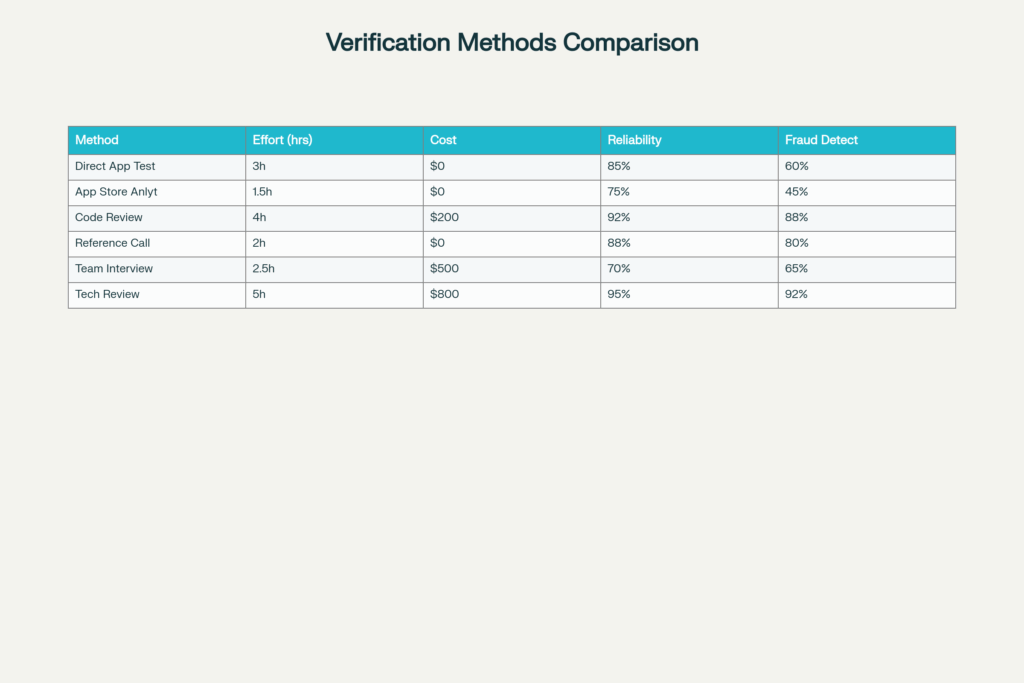
Comparison of App Developer Claims Verification Techniques
App Store statistics give us empirical data on an app’s success or failure. Not a vague statement about “quality” or “sophistication,” but rather app store numbers you can crunch.
When looking at a portfolio app in the app store, consider: Total downloads (50,000+ indicates the app has gained some traction in the market), average rating (4.0+ stars means there’s at least some level of satisfaction), number of ratings (more ratings means more users), update frequency (being updated regularly means it’s supported actively), and release date (older apps that are still gathering ratings means they’ve been holding up over time).
An app with 100,000 downloads, 4.5 stars from 5,000 reviews, and a monthly update is pretty much smash-proof evidence of quality and market success. An app with 1,000 downloads, 3.2 stars from 20 reviews, and updates that stopped 12 months ago signals that there may be problems with the quality or support.
Most app developers monitor analytics such as DAU (daily active users), MAU (monthly active users), user retention rates, and acquisition channels. Q&A such as “How many active users does this app have?” can be informative.
If a developer purports that an app has “thousands of active users” but it only has 200 total reviews ever, that simply doesn’t add up. The flow of reviews – recent versus old, positive or negative, specifically praising the app or simply vague comments – tells a tale of genuine user experience.
Fake reviews have patterns that can be highlighted. Authentic reviews often talk about features, contain meatier information, are written based on a real use-case scenario, and include a rating spread. Fake positive reviews are generic, vague, and don’t include specific details, are overly positive or negative without an explanation, or are clustered in short time spans.
When reading app reviews, you should always filter by “most recent,” so you get a feel for what the current status of that app is, not what it used to be. If you see recent negative reviews complaining about crashes or bad features, it means there are quality issues right now; if you see recent positive reviews, it means the app is being actively maintained at the present time.
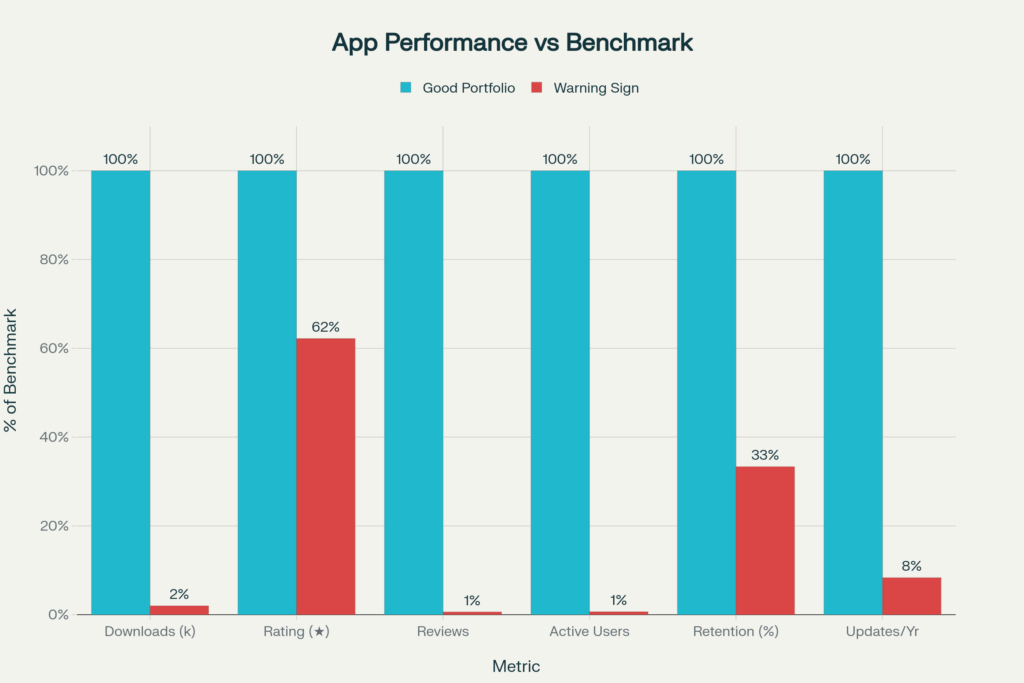
Portfolio Evaluation Based on App Store Performance Benchmarks
Transparency requires that the review of portfolios go beyond the surface, examining in detail several projects. The process, known as a “deep dive,” is the agency explaining how they developed particular apps, what obstacles they ran into, and how they addressed issues.
When the agency walks you through a particular portfolio app, ask questions such as: Tell me about the project from start to finish — what was the timeline?” “What were the biggest technical challenges?” “How did you do payment processing?” “Did you encounter any security or regulatory obligations?” “How are you tracking app performance after it’s launched?” “How many developers worked on this?”
Those are just a few of the objectives these questions meet. First, it lets you know if they genuinely built the app or are regurgitating marketing copy. Someone who has built an app can talk about how the app is implemented; one who has not either can’t talk about implementation or will give very vague answers. Second, it unveils how much technical depth they have.
Listen carefully to the explanation of the technical decisions. Are they swimming in the right pool of technical talk? Can they tell you why they went with one technology over another? A developer with a strong technical background who can explain why they made certain implementation decisions. A developer who answers fuzzily is a fuzzy developer, knowledge-wise.
Also, assess their mindset when faced with the obstacles. All big projects have challenges. Did they take a practical approach to the obstacles and deal with them? Did they warn the client about challenges? Challenge-recognizing and explaining agencies are mature ones.
An important but rarely asked question is: “What happened to this app after it launched?” Did the agency continue to offer support? Were they watching the performance and correcting issues? Apps stayed live in the app stores with updates and consistent user engagement, which I took to mean the agency stayed in touch and provided ongoing support. Apps that fell silent post-launch suggest that the agency thought its work was done once the development was complete.
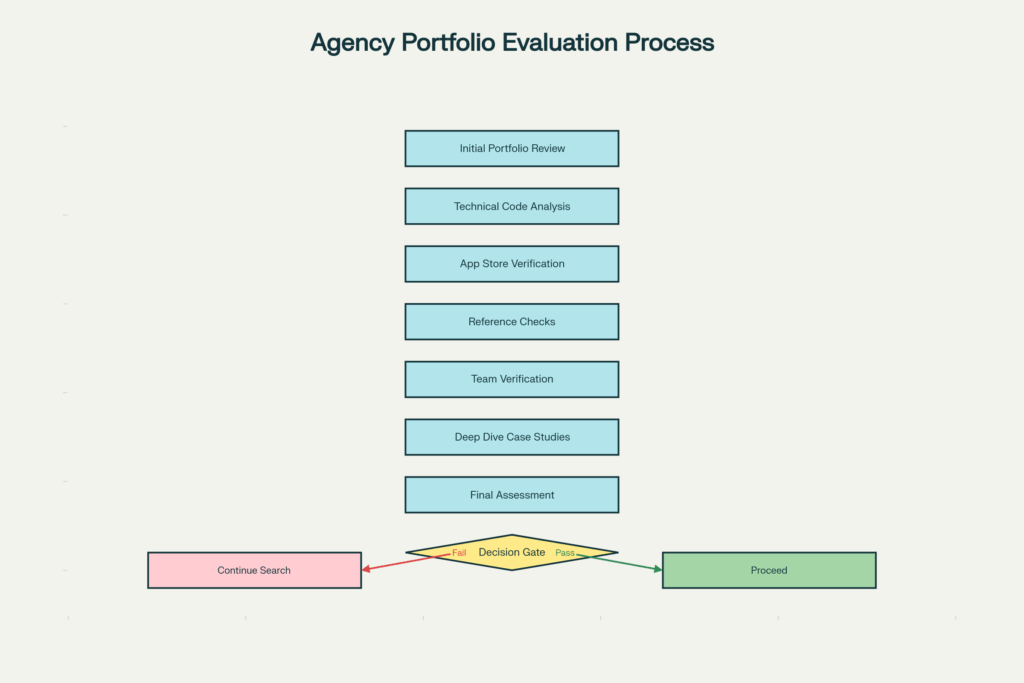
Flowchart for the Portfolio Evaluation Process
References from prior clients are the best validation of an agency’s assertions. Still, the usefulness of a reference call is completely dependent on asking the correct questions and speaking to the appropriate people.
Agencies usually give references of their happiest clients. But even those with a bias are often willing to tell you when they’re broken. To counteract bias, ask for a full list of clients for the last 3-5 years, not just the 2-3 people the agency wants you to talk to. Pose the question directly to the agency: “Can you also give me the contact details of clients you no longer collaborate with?” Real agencies will do this; dishonest ones will have excuses.
When you’re doing reference calls, ask open-ended questions that will get you more detailed answers. Bad reference questions like “Did you like working with the agency?” lead to yes/no answers. The more useful such questions as “Can you walk me through your experience with this agency from start to finish? What went well? What could have been better?” lead to particular stories.
Questions to ask to expose the truth include: “Did they come in on budget and on time, or was there an overrun?” “How was the communication — were you getting updates?” “How did they handle things if you had a big issue halfway through your project?” “Would you hire them again?” They inspire you to share specific stories and real experiences rather than generic praise.
Some reference call patterns signal trouble: references that appear to have been coached or give eerily similar responses to different questions, references that are actually employees of the company, references that seem to have forgotten details a client would clearly remember, or references who will not discuss specific technical issues or challenges.
On the other hand, references who are open about the good and the bad can identify specific examples of challenges and solutions, talk about their current relationship with the firm, and recommend the firm even after acknowledging areas of weakness, and are more believable.
Above and beyond the calls, research your references on your own. If the reference works at a recognizable company, you can confirm they work there. If references say the scope of the project was $500,000+ but hide their details when you ask, the numbers may be inflated. You can’t always verify a reference independently, but when you can, it’s a great boost to the reference.
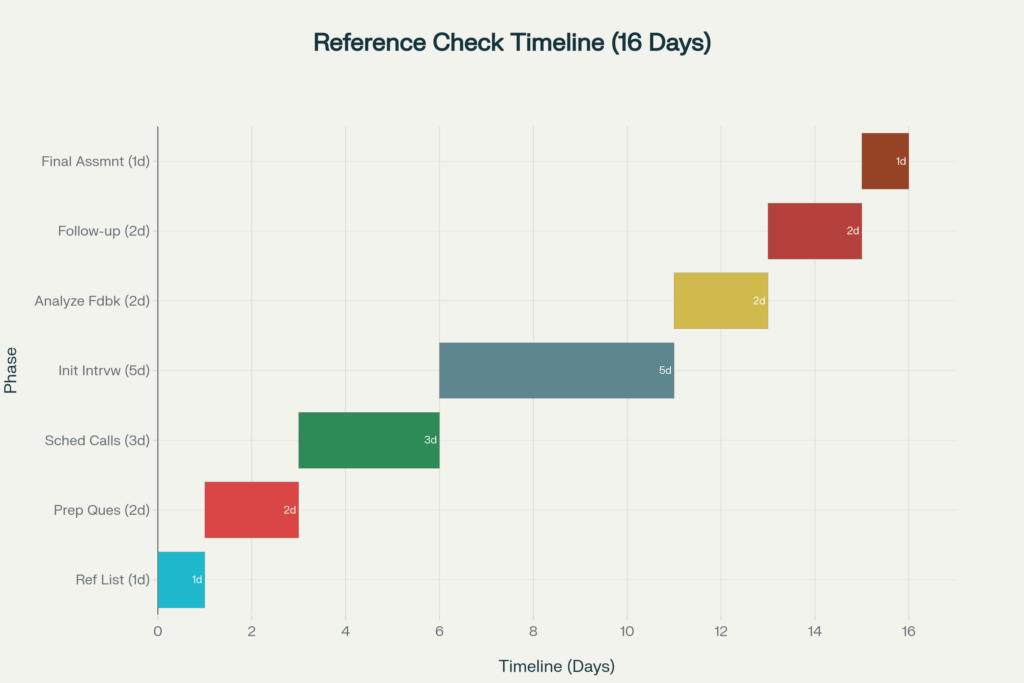
Timeline and Procedure for Reference Checking
An agency’s work is only as good as the team that produced it. However, a lot of agencies showcase work developed by teams that are no longer at the company, was done by subcontractors, or was done by employees who have left.
Question the agency itself: “What is the team that would be working on my project?” Then fire some critical follow-ups: “How long have these team members been with the agency?” “Have they worked on similar projects?” “What is your team turnover rate?” ” In case someone leaves in the middle of my project, what is the contingency plan?”
Team stability is important because knowledge transfer takes time. If the original portfolio app-building team has entirely turned over, you’re not judging the capabilities of the team now. Stability and Continuity An agency that has retained its principal development team for a period of 3 to 5 years affirms its stability in the market and the continuity of its services.
Some app developer relevant certifications are the AWS Certified Solutions Architect (for backend development), Google Cloud Certified (for cloud infrastructure), Apple Developer certification (official iOS development training), Android Development Fundamentals certification, and various security certifications like Certified Ethical Hacker (CEH).
Certifications don’t mean everything—there are plenty of great developers who aren’t certified in anything—but the fact that they have them is proof that they received at least some formal education. You can check certifications in official certifying body databases. If an agency asserts that some of their staff are certified, request proof and verify yourself.
Enquire with the agency on the team members’ individual contributions within portfolio projects. They should be able to tell you exactly who worked on each project and what role they played. This includes the areas of responsibility for each person. If the agency is unable to deliver on that detail, or if they start to hedge about who actually worked on projects, that is cause for concern.
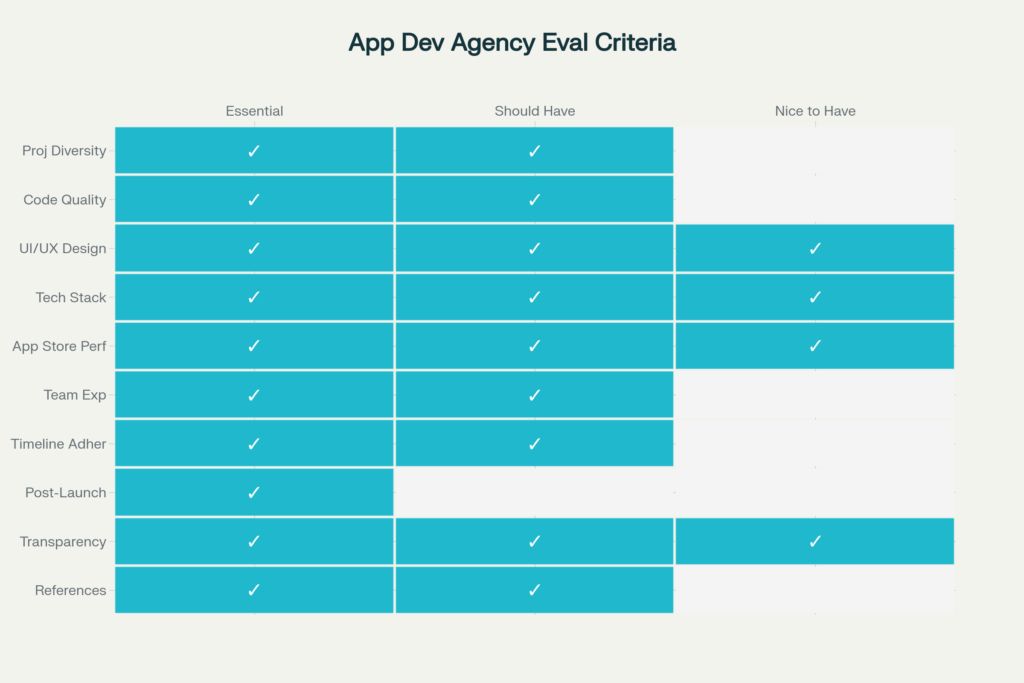
Checklist of Portfolio Evaluation Standards for App Development Firms
GitHub analysis is an objective demonstration of technical ability. When an agency shares its code repositories, you can inspect the quality of the code, the commit history, and the development practices right from your browser.
When examining a code repository that an agency says they developed, look for: The commit history (are commits consistent and frequent, or infrequent with long periods of silence?), the contributors (does the commit history indicate a single developer, or multiple developers?), branch structure (Do they have a professional branching model?), code structure (Is the code well structured?), test coverage (does it have automated tests?), and documentation (README, documentation, etc).
A well-maintained repository has regular commit activity by a handful of developers, well-organized code, tests, and decent documentation. A badly-maintained repository has infrequent commits, a single contributor (potentially indicating outsourcing despite a team product), messy code, and negligible documentation.
One of the more sophisticated verifications is to actually build the app from the source code on GitHub, and confirm it matches the app store version. This is called “reproducible builds.” In theory, if you compile precisely the same source code the agency has posted on GitHub, you should end up with the very same app binary as the one in the app store.
If the code on GitHub is different than the› app in the app store (or vice versa), then the company either isn’t really using their open source code in production (their real code is proprietary), or they are misrepresenting whose code it is.
If the agency or its developers are contributors to open-source projects, that is a proof point for technical enablement. You can also check the quality of their code by looking at their public GitHub contributions. Open source contributors, Developers who actively contribute to open-source projects, indicate that they care about code quality and are active in the wider developer community.
This is not required – many great developers work on client projects rather than open-source – but it’s a good signal to have.
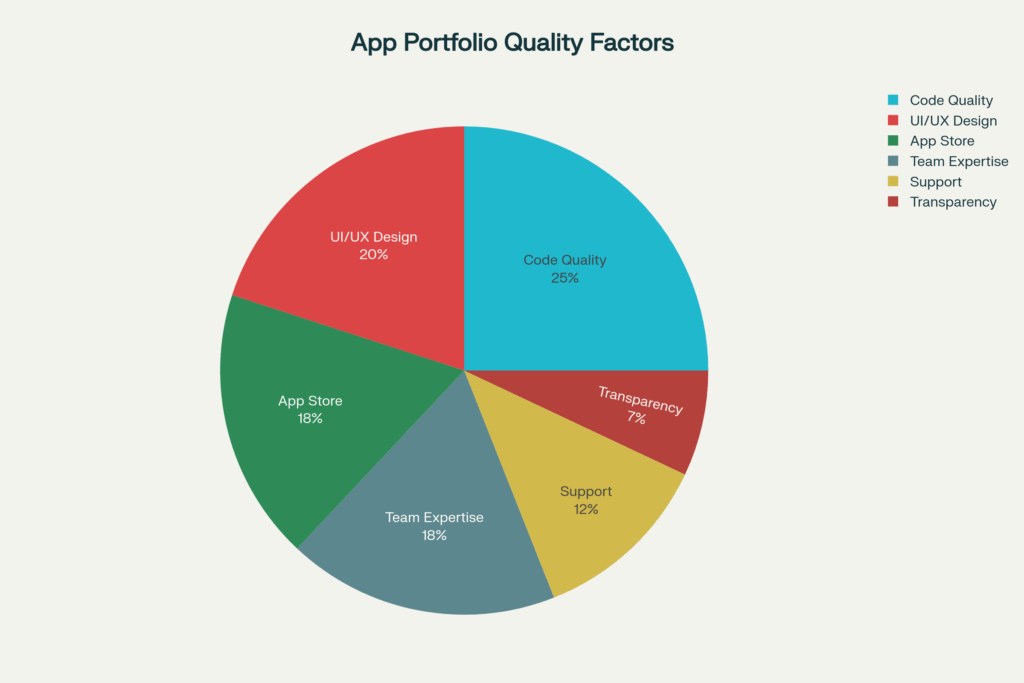
Distribution of Portfolio Evaluation Factor Weights
Outside of subjective quality assessments, there are several measurable results that indicate whether an agency makes apps that find real-world success.
The most objective measures are the app store performance indicators: number of downloads, ratings, volume of reviews, retention rate, and frequency of updates. Apps that garner tens of thousands of downloads and keep 4+ star ratings for years suggest the agency makes great products. Apps that get some initial downloads, then plateau or decline, or have poor ratings, can mean the app isn’t that great.
The number of reviews is correlated to the size and activity of the user base. An app with 5,000 reviews is likely to have tens of thousands of active users who took the time to give feedback. An app with 50 reviews has at best a few hundred users. Within the portfolio apps comparison, apps with many more reviews and with a higher rating demonstrate even stronger success.
Although detailed retention data isn’t always visible, you can get a sense of retention from patterns of reviews. If an app has a steady stream of recent reviews over the course of years, it means people are still using it. If reviews were numerous early on, but then stopped, users abandoned the app. Robust applications demonstrate sustained reviewing activity across months and years.
Apps with regular updates (monthly or more often) show that the agency is continuing to support and evolve the products based on user feedback. Apps not updated for years signify either stability (sometimes appropriate) or abandonment (bad signal). For your portfolio, regular updates and a recent positive review mean active support.
If you’re able to get an idea of how long certain apps took to build (either by asking during reference calls or portfolio deep dives), this gives you a sense of realistic timelines. For an agency to show advanced, complex apps with 50+ features that ‘only’ took 8 weeks to build with 2 developers, the timeline is just laughable. Realistic timelines consistent with the complexity of the project are a sign of a realistically planned project.
Applying all these methods of evaluation in a systematic manner results in a structured evaluation. Instead of asking questions at random, use this systematic sequence.
Browse the agency’s website and portfolio samples. Look for a range of projects, well-designed work, a variety of different industries represented, and some complexity. Make a list of 10-15 portfolio apps that interest you.
For each app in Stage 1, look it up in the app store. Take note of the rating, number of reviews, number of downloads, how often it’s updated, and the sentiment of recent reviews. Delete apps that you don’t use. Remove any apps that have an ongoing negative recent review score. You should now have a shortlist of 5–8 apps.
Request access to the GitHub repositories of your shortlist of apps. If it isn’t the case, it’s a red flag. Check code quality, commit history, test coverage, and documentation. If you’re not technical, hire a freelance developer to review the code.
Book a call with the agency and go in-depth through 2-3 of your shortlisted apps. Inquire about timeline, technical challenges, team size, and post-launch support. Record or write in detail.
Ask for a list of clients who had similar engagements. Request information on both current and former clients of the agency. Conduct 3-4 reference calls. Take notes and look for consistencies.
Ask for the specifics on the team that would be working on your project. Verify credentials if you can. Inquire about team stability and continuity. Check LinkedIn profiles to make sure they really work for the agency.
Synthesize all information from stages 1-6. Rate the agency on the following key metrics: technical quality, team capability, transparency, and reliability. Compare with other agencies. Make your decision.
There are certain fraud trends that keep appearing in the Indian app development space. Recognizing these trends makes it easier to identify and avoid them.
Usual scenario: 50-100% of payment is demanded upfront, before work starts, then they either deliver nothing or deliver crapwork. When confronted, they say “the work is ongoing” and keep asking for more money for “unforeseen expenses.” Eventually, they vanish or state they are unable to refund.
Defense: Do not pay more than 20-30% upfront. Structure the payments–say, 30% upfront, 40% at 50% done, 20% at 90% done, and 10% on launch. Use an escrow that holds the payment until milestones are verified. Have a clear contract defining what “completion means” for each milestone.
A few agencies will give you the portfolio of one agency during sales, then a completely different team is assigned to actually build your app. The sales team displays impressive apps and promises the “same team” will work on your project, but when development begins, you get junior developers or contractors.
Defense: Get names and numbers of team members, in writing, in your contract. Have the contract state explicitly that they’ll be working on your project. Request to meet or have long, detailed video chats with the real developers before you sign. Ask for LinkedIn profiles of the team members and check if they actually work for the agency.
Agencies offer app prices that are insanely low, which, upon reading, they claim to include “extensive features”. Once you’re under contract, they’ll say features are “outside the original scope,” and they’ll hit you with more fees.
Defense: Make up a (very) detailed spec document, down to all the features, integrations, and requirements. Have the agency give you a detailed quote based on this spec. Add in the contract that any changes to the requirements will be documented and quoted (separately) before implementation.
Certain agencies take your money, start the work, and then progressively retreat into a black hole. Communication slows. Progress stops. Eventually, all communication ceases, and the agency is unreachable.
Defense: Specify your communication expectations in your contract (daily or weekly updates on your progress, a particular response time for questions). Use collaboration tools that track communications. Schedule regular check-in calls. When communication gets difficult, treat that as a breach of contract. Have a contract clause that lets you stop work and get a refund if the communication standards aren’t met.
Tight portfolio scrutiny is a hard commitment, but the cost pales in comparison with the price tag for getting the wrong agency. Following this framework, a full assessment takes 10-20 hours for a mid-size application—a fraction of the 4 to 6 month development timeframe and significant capital you’ll be investing.
The important thing is that a systematic evaluation be applied–rather than a “gut” feel. By fact-checking assertions with tangible facts, assessing code quality above simply how lovely it looks, conducting real reference discussions, and asking firms to walk you through their work in depth, you can make sure you are hiring a genuine, proficient accomplice as opposed to a shining con mime.
Keep in mind – real agencies are fine with being grilled. They’re proud of their work and willing to make code, detailed portfolio explanations, and real references available. If an agency gets on the defensive when you ask specific questions, says you’re requesting too much information, or is otherwise unable to substantiate its claims, know that these are the kinds of warning signs that should get them disqualified from your list of contenders.
Following this review process, you will be able to select an agency that can deliver the app you have imagined, on time and on budget, and continue to support it over time. This is the bedrock of a fruitful app development working relationship with Indian firms.