Many of the agency portfolios feature some stunning visuals.
But it’s rare to find one that truly showcases the impact made after a project’s launch.
This article aims to be different.
Here’s a detailed breakdown of 10 actual web development projects we accomplished in 2025 (with some client names kept confidential for NDA reasons). For each project, we’ll discuss the client’s needs, what issues they faced before launching, the technology stack we used, the size of our team, the duration of the project, and the tangible results we achieved.
If you’re comparing web development portfolios from Indian agencies, this is the level of detail you should expect. And if you’re a founder or product owner assessing projects from Indian web development companies, the critical question to ask is not just “Can they create a great UI?” but rather, “Can they positively influence a business metric?”
That’s the standard we’re applying here.
The project selection is purposeful. It covers sectors like healthcare, logistics, fintech, eCommerce, SaaS, and education. It also includes projects that cater to the Middle East market (Saudi Arabia, the UAE, and Oman), as many of our 2025 builds involve significant operational complexities, compliance issues, and multilingual/enterprise requirements.
All the performance figures provided below are rounded for confidentiality, but they’re grounded in actual delivery results tracked via analytics, client systems, or operational reports during the handover and post-launch review phases.
When it comes to a portfolio write-up, a serious buyer typically looks for five key things.
First, they seek context. They want to understand the challenges the client was aiming to tackle.
Next, they look for technical credibility. They’re interested in the tech stack, the architecture choices made, and the complexity of integrations.
Thirdly, they want to see delivery evidence. This means they’re keen to know if the company can accurately estimate the project’s scope, assemble the right team, and meet deadlines.
They also want to see business outcomes. Buyers appreciate numbers and concrete results over fluffy descriptions.
Lastly, they value pattern recognition. They want insight into whether the company can solve various problems across different domains, rather than just showcasing one standout project.
And that’s the way this article is organized.
This project originated from a rapidly expanding healthcare group in Saudi Arabia with multiple facilities. They faced challenges as their front-desk teams were overloaded, appointment booking was partly manual, and patients were experiencing inconsistencies based on the branch they contacted. Appointments were being made through a mix of phone calls, WhatsApp, and various hospital systems, which complicated the patient journey.
The client wasn’t just looking for “a website”; they needed a comprehensive web platform to serve as a patient-facing access point and an operational connector across departments.
We developed a responsive web portal to facilitate patient discovery, doctor searches, time-slot booking, and appointment routing by branch. Additionally, an internal web dashboard was created for scheduling staff and coordinating admin teams. The system encompassed features like department filtering, detailed doctor profiles, slot management, lead-to-appointment workflow oversight, and a reporting layer to track appointment sources. Importantly, since this was catered for the Middle East market, we prioritized building support for both Arabic and English content and layout from the outset, rather than viewing localization as an afterthought.
For the tech stack, we used React for the frontend, Node.js (NestJS) for backend services, PostgreSQL for transactional data, Redis for queue/caching needs, and AWS for deployment. We ensured integration with the client’s existing Health Information System (HIS) environment by utilizing controlled APIs and middleware adapters, accommodating the hospital’s legacy systems that couldn’t be replaced immediately. Moreover, we implemented role-based access control for reception/admin users and established audit logs to track scheduling changes.
Our team comprised 1 product manager/business analyst, 1 UI/UX designer, 2 frontend developers, 2 backend developers, 1 QA engineer, and 1 part-time DevOps engineer during deployment and stabilization. The core delivery timeline lasted 14 weeks, followed by a 4-week hypercare phase that included weekly release enhancements.
The measurable results were significant within the first 90 days post-branch rollout. Online appointment requests surged by about 2.4 times compared to the previous baseline. The volume of manual booking calls at the front desk dropped by approximately 31% in the branches that fully adopted the system. Additionally, the no-response lead rate from web/WhatsApp inquiries decreased by roughly 46% because requests were organized into a structured queue instead of getting lost in informal communication channels. The client’s marketing team also gained new insights into source-level visibility, allowing them to make more informed decisions about their digital advertising expenditures.
This project highlights why healthcare web development in 2025 focuses more on workflow orchestration rather than just creating brochure websites.
This project focused on the healthcare market in the Middle East and leaned more towards product engineering than traditional web development. The client wanted to create a secure internal web interface for clinicians and care teams to utilize an AI-assisted diagnostic support workflow within a controlled hospital environment. The key challenge went beyond just UI; it involved building trust, ensuring traceability, and establishing safe usage practices.
Before this project, the client’s teams were testing AI outputs using various disconnected tools. There wasn’t an organized way to capture prompts, inputs, clinical context, confidence bands, escalation notes, or follow-up actions. This led to governance risks and made it difficult to ascertain whether the system was enhancing clinical workflows or merely generating noise.
We developed a secure web application designed as a guided diagnostic-assist workspace instead of a regular chatbot. The interface included case intake forms, structured symptom capture, clinician notes, generated differential suggestions, escalation pathways, and review states. Our main design philosophy was not about achieving “maximum automation” but rather ensuring “human-in-the-loop clarity.” Every output needed to be reviewable, attributable, and simple to reject or escalate.
The technology stack comprised React + TypeScript for the frontend, Python (FastAPI) for orchestration and integration with the inference service, Node.js services for user/session management and audit trail workflows, PostgreSQL for structured records, and deployment in a containerized private cloud environment. Given the healthcare context, implementing access controls and logging was crucial. We also developed an admin web console for monitoring usage and managing roles.
The project team included one domain-facing product consultant, one technical architect, two frontend developers, two backend developers (split between Python and Node.js), one QA engineer, and one DevOps/security engineer. The project unfolded in a phased release model over 16 weeks, culminating in an MVP and a controlled department rollout.
In the early stages of deployment, the measurable outcome was not “revenue” but rather improvements in operational efficiency and documentation quality. The average time taken for junior staff to prepare cases in the pilot workflow decreased by about 28%. Documentation completeness, assessed against the client’s internal review checklist, improved by approximately 35% thanks to the structured intake UI that enforced required fields and standardization. Additionally, senior clinician review turnaround times increased by around 22% for selected use cases because the cases were presented to them in a cleaner and more consistent format.
This project was significant as it demonstrated that a web platform in healthcare could add real value, even if the AI component was just one aspect of the system. The interface design, workflow rules, and auditability were the key factors behind the successful adoption.
This project was one of the most complex ones we’ve tackled in 2025 because the challenges were not obvious to outsiders. Our client was a medical manufacturing and distribution business operating within the Saudi healthcare supply chain, handling a high volume of interactions. Their teams were spending a significant amount of time downloading data from a government procurement portal through repetitive user interface processes. They then had to manually clean files, address unit-of-measure discrepancies, and reconcile everything with internal records and downstream documents.
The client’s issue wasn’t just about needing a website redesign; the real concern was that essential staff were doing work that was better suited for machines. Every delay in reconciliation poses risks for invoicing, delivery tracking, and managing exceptions.
To solve this, we created an internal web-based operations dashboard and workflow system that automated portal downloads, normalized local data, mapped unit-of-measure differences, provided reconciliation views, and managed exception queues. With automation handling repetitive data retrieval, the web app offered easy visibility, control, logs, and a way for staff to review mismatches. We designed the automation engine and web layer separately so that the client could upgrade each part on its own.
Our tech stack included React for the dashboard’s frontend, Node.js for the backend services managing workflow and state, and Python for automation tasks and data processing. We used PostgreSQL for the normalized records and reconciliation logs, along with a queue-based architecture for scheduled operations. We also created admin tools for unit-of-measure mapping updates, issue tracking, and audit history. The user interface was specifically designed for operational staff, focusing on speed and clarity over flashy components.
Our delivery team comprised a product manager, a solutions architect, a frontend developer, two backend and automation engineers, a QA engineer, and a data validation specialist during the pilot mapping setup. We delivered the first usable phase in 10 weeks, and additional reconciliation rules were implemented in the following six weeks.
The results were impressive. Manual time spent on regular portal downloads and initial data preparations saw a reduction of about 70%. The reconciliation cycle time for the pilot dataset shifted from same-day processing to a much more reliable near-real-time batch workflow, cutting the average turnaround time by roughly 58%. After we introduced mapping governance and validation rules, the error rates from manual unit-of-measure handling dropped by around 40%. The client also noticed improved accountability, as exception tickets could now be assigned and tracked within a single system.
This project is exactly the kind of opportunity that many companies overlook when they browse an Indian web development company’s project page. The interface might seem straightforward, but the operational benefits are enormous.
This project aimed to enhance logistics operations in the Gulf region by improving route coordination and communication among drivers across different branches. Previously, branch teams relied on spreadsheets, phone calls, and messaging apps to manage dispatch updates, resulting in an unclear operational picture that led to delays, redundant follow-ups, and unnecessary customer issues.
Initially, the client requested “route planning software,” but through our discovery process, it became evident that they actually needed a comprehensive web platform for command-and-control, which included route assignment, dispatch visibility, branch status tracking, and communication workflows.
We developed a web application featuring role-based dashboards tailored for dispatch managers, branch operators, and supervisors. Key modules encompassed route creation and assignment, load-level status updates, branch queues, driver communication logging, issue flags, and ETA tracking inputs. While the product also offered a map-integrated interface for visualizing routes, the true value came from better workflow organization and centralization rather than just mapping alone.
The tech stack included React and TypeScript for the frontend, Node.js for backend APIs, PostgreSQL for the database, WebSocket for real-time status updates on dispatch screens, and cloud deployment with distinct staging and production environments. We also integrated third-party map APIs and created a lightweight mobile-responsive web interface for drivers to acknowledge status updates, as the client preferred not to implement a native app in the first phase.
Our team consisted of a product manager, a UX designer, two frontend developers, two backend developers, one QA engineer, and one shared DevOps engineer. We successfully delivered the MVP in 12 weeks, followed by an additional 5 weeks of improvements after piloting with a branch.
The project yielded impressive operational improvements. The average dispatch coordination time per route batch decreased by about 37%. The reliance on phone calls for routine status updates was cut by approximately 44% in the pilot branches. Missed internal handoffs between branches and dispatch teams were reduced by around 33%. Furthermore, the client saw a boost in on-time dispatch readiness in the morning by about 18%, as route and load assignment data became available more promptly.
This project exemplifies how a logistics web platform can deliver significant value by focusing on solving key operational bottlenecks first, rather than attempting to address every fleet-related issue in the initial version.
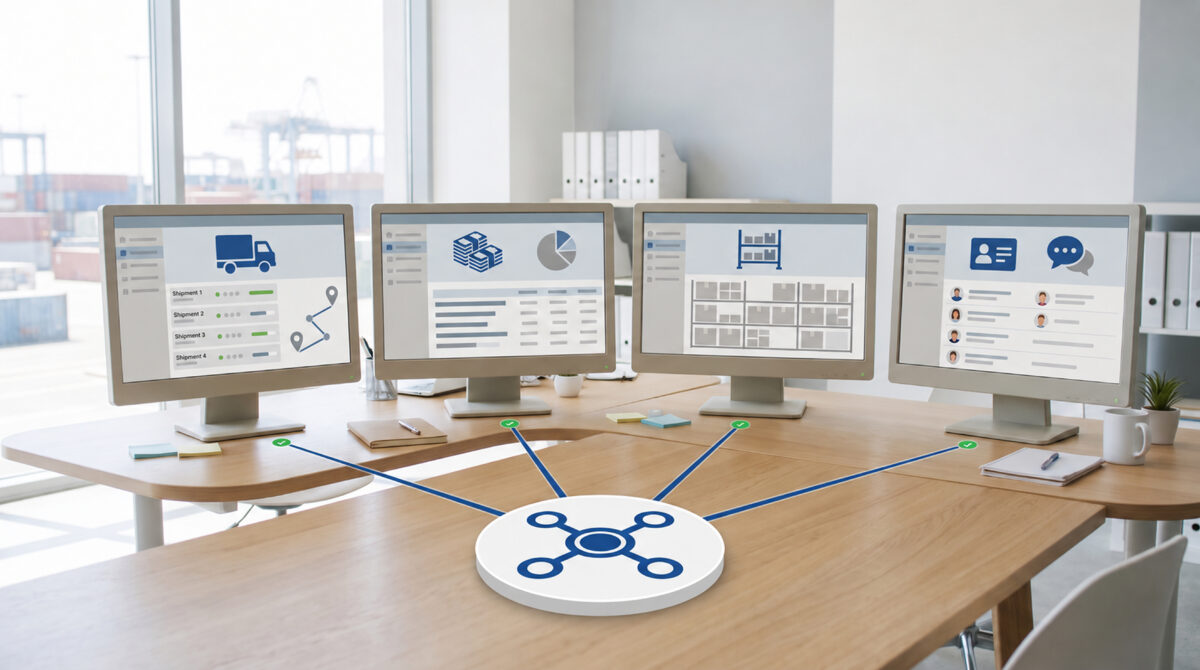
This project fell into the logistics and courier category and aimed to modernize a company that already had operational software but lacked a cohesive and user-friendly web control tower for various user groups. Their teams were using fragmented tools for dispatch, customer service, and shipment tracking. Because the web experience didn’t provide enough context about shipments, customers frequently reached out to support for help.
The client had a dual objective. They needed to boost internal efficiency and enhance the shipment experience for customers. If we only addressed one aspect, the support burden would persist.
We redesigned the internal operations web portal and the customer tracking processes with a more modular architecture. Internal users received dashboards that showcased shipment exceptions, delivery statuses, route-level insights, and serviceability checks. Customers enjoyed smoother tracking flows, improved visibility on milestones, and more actionable updates instead of generic “in transit” messages. Additionally, we enhanced the admin experience for service mapping and operational rule updates so the client’s team wouldn’t have to rely on developers for every configuration change.
For the tech stack, we chose Angular for the internal dashboard modules to align with the client’s team’s existing skills, React for the new customer-facing tracking interface, Laravel for some legacy-compatible service modules, and Node.js for creating new APIs and managing events. We also implemented a hybrid MySQL/PostgreSQL transition and used cloud-hosted services with queued background jobs for synchronous processing. This project was heavily focused on migration, meaning technical success relied on a staged replacement approach rather than a complete overhaul.
The team consisted of 1 technical project manager, 1 architect, 2 frontend developers (split between Angular and React), 2 backend developers, 1 QA automation engineer, and 1 manual QA/support engineer during the crucial cutover weeks. The timeline spanned 18 weeks due to the phased migration and integration complexities.
The results were evident in the support and operations metrics. The number of “where is my shipment?” support tickets dropped by around 29% after implementing the new tracking milestones. Furthermore, internal exception resolution times improved by approximately 34% because the operations teams now had a unified queue and filtered views. The client also noted a quicker onboarding process for new customer service staff since the workflow became simpler and less reliant on internal knowledge.
For those interested in software development results from India, these outcomes often represent what truly counts: reduced support tickets, faster resolution times, and less reliance on a handful of senior team members.
This Middle East project is a clear example of the importance of having region-specific expertise. Our client, a distribution business in Saudi Arabia, was struggling with a mix of spreadsheets, uncoordinated accounting practices, and incomplete software tools. They really needed a centralized web-based ERP system that covered sales, inventory, purchasing, invoicing, and operational reporting. However, the main challenge was ensuring compliance and alignment with local processes rather than just having generic ERP features.
The client had previously attempted to use simpler tools, but those just didn’t align with their actual branch operations and Arabic business workflows. Unfortunately, teams resorted to manual processes, which defeated the purpose of streamlining.
We stepped in with a tailored, custom web-based ERP module set that truly fits the client’s operating flow. Our project addressed various aspects, such as sales order management, tracking inventory movements, handling purchase workflows, invoicing, managing basic receivables, establishing role-based approval paths, and creating reporting dashboards. A crucial area we focused on was structuring invoice and transaction data to support local compliance workflows and future integrations. We also developed bilingual interfaces and print/document workflows that were practical for everyday use, rather than just for demonstrations.
For this project, we used a tech stack that included Laravel for the backend, Vue.js for the frontend, along with MySQL, Redis, and containerized deployment on cloud infrastructure, featuring both staging and production pipelines. Laravel was an excellent choice here due to the client’s needs for quick implementation of business rules and admin-heavy workflows. We created configurable master data and approval policies to minimize the need for hardcoded changes later on.
Our team consisted of 1 business analyst (providing Arabic workflow support through client-side coordinators), 1 solution architect, 2 backend developers, 2 frontend developers, 1 QA engineer, and 1 part-time DevOps engineer. The project was delivered in phases over 20 weeks, with the first operations-ready modules going live in just 11 weeks and additional modules being rolled out in a controlled manner.
The results were impressive, showcasing significant operational and financial process improvements. The average time for preparing and approving invoices dropped by approximately 52% for the workflows transitioned into the new system. Additionally, inventory discrepancy follow-ups (due to late or inconsistent updates) were reduced by around 31% in the pilot branches. The effort required for month-end reporting preparation also saw a significant decrease, with finance and operations teams reporting about 40% less manual consolidation time.
This project truly distinguishes our web development portfolio in India because it highlights our product engineering capabilities within the Saudi market, moving beyond just generic offshore coding.
This project originated from a fintech team that had escalated its business growth faster than its internal software could keep up with. They were juggling multiple tools for tasks like merchant onboarding, case tracking, collections status, and assessing team performance. As a result, managers had to export CSV files daily just to get an understanding of ongoing operations. Although the software was in place, any decision-making still relied heavily on manual reporting.
The client was looking for a web platform that could unify their fragmented workflows into one streamlined operational system, complete with role-based dashboards tailored for operations, managers, and leadership. The main hurdles were ensuring speed and reliability, as fintech teams can’t afford to pause while the system is being revamped.
We developed a web-based dashboard platform for merchants and operations, which featured modules for onboarding pipeline visibility, tracking case statuses, updates on collections workflows, agent assignment queues, performance metrics, and exception flags. Additionally, we implemented a reporting layer with filters, significantly reducing the need for repeated CSV exports. Security and permissions were key concerns since various teams needed different levels of visibility.
The technology stack included a React + TypeScript frontend, a Node.js (NestJS) backend, PostgreSQL, Redis, and AWS infrastructure. We also incorporated event-based updates for crucial workflow changes and designed the backend with modular services so the client could easily expand to include partner-facing modules later on. Moreover, we added activity logging and established a clear permissions matrix to meet audit requirements.
The development team comprised 1 product manager, 1 UX designer, 2 frontend developers, 2 backend developers, 1 QA engineer, and 1 DevOps engineer who collaborated through various sprints. Our first production release was completed in 9 weeks, followed by another 7 weeks of iterative releases focusing on enhancing dashboard depth and refining workflows.
The results were impressive—a reduction of approximately 63% in the time spent generating daily operational reports. Team leaders transitioned from manually aggregating spreadsheets to utilizing live dashboard views. The turnaround time for merchant onboarding (for those workflows integrated into the platform) improved by about 27%, thanks to clearer assignment and status visibility. Management reviews were faster and more data-driven, a significant win acknowledged by the client.
This project serves as a great example of an ‘internal web app’ that makes a notable impact on revenue operations, even if the end product remains unseen by the public.
This project involved developing an e-commerce website for a retail brand that had outgrown its old platform. The brand was facing challenges with performance, SEO stability, and content updates. The client was worried that switching platforms might negatively impact their rankings and revenue in the short term, but sticking with the old system was already hurting their conversions because of slow-loading pages and inconsistent checkout experiences on mobile devices.
The real challenge for the client wasn’t just about design; it was about minimizing business risk during the migration.
We decided to tackle this by approaching it as a phased rebuild of the web product rather than just focusing on visual redesign. We identified high-value pages, noted technical SEO dependencies, structured the URLs, established schema, and outlined content workflows before we began recreating the front-end experience. We introduced a headless architecture with a performance-first frontend, enhanced rendering for category and product pages, and streamlined the checkout process. Additionally, we created a user-friendly content/update workflow, allowing the marketing team to launch campaigns without being held up by developers.
The technology stack included a React (Next.js) frontend, a Node.js API layer, integration with a commerce backend, PostgreSQL for business logic and content metadata, and deployment across Vercel/AWS hybrid services, depending on the module. We also put in place caching, image optimization, and SSR/ISR strategies tailored for SEO-sensitive pages. Quality assurance covered cross-device checkout flows and monitored page speed both before and after the launch.
The team consisted of 1 eCommerce project manager, 1 UX designer, 2 frontend developers, 2 backend/integration developers, 1 QA engineer, and 1 SEO-focused technical analyst during planning and launch week. The timeline spanned 16 weeks from discovery to full implementation, with pre-launch validation staged appropriately.
The results were impressive from a commercial perspective. Mobile page load times improved significantly (by about 45–60%, depending on the page type), and the client experienced a double-digit increase in mobile conversion rates after stabilization, landing at an impressive +18% compared to their pre-migration figures. Organic sessions rebounded rapidly following the launch and rose by around 22% over the next few months, thanks to better indexability and enhanced page performance. Additionally, checkout abandonment dropped approximately 14% following the UX and performance improvements.
When companies look for Indian web development company projects, they’re often interested in seeing results like these: it’s not just about saying “we built an eCommerce site,” but emphasizing that “we transformed a revenue engine without damaging SEO.”
This education project was designed for a learning business that needed a scalable web platform to offer recorded classes, live sessions, track student progress, and manage instructor/admin operations. They had great content and audience demand, but their delivery was scattered across various video links, payment tools, messaging groups, and manual student support tasks.
The client was looking for a proper product—not just a patchwork course page.
So, we developed a comprehensive web platform that includes student login, course access, video streaming, live class scheduling, batch management, progress indicators, instructor controls, and admin dashboards for enrollments and content updates. Since the platform was aimed at learners in India and GCC regions, we optimized it for mobile web use, streamlined navigation, and provided time-zone-aware scheduling displays. Additionally, we incorporated content access controls and course entitlement logic to minimize manual support tasks.
The tech stack featured a React frontend, Node.js backend APIs, and Laravel for certain admin and content workflows—tailored to the client’s team familiarity and the speed of development. We used MySQL/PostgreSQL depending on the module, integrated cloud video delivery, and set up payment gateways. We also added analytics events to help the client gain insights into content engagement and dropout points.
The team that brought this to life consisted of a product manager, a UI/UX designer, two frontend developers, two backend developers, a QA engineer, and a DevOps engineer during the release and scaling preparations. The delivery took about 15 weeks for the production launch, with a subsequent phase focused on enhancing analytics and community features.
The results were quickly noticeable in operations and learner behavior. The enrollment-to-access activation time decreased from a manual same-day process to nearly instant automated access for most users. Student support tickets regarding course access saw a reduction of about 48%. Additionally, the average completion rate for key modules improved by approximately 26% after we enhanced the content structure and progress UI. The client also noticed a stronger conversion rate from trial/lead pages to paid enrollments after we streamlined the funnel into a single platform, reflecting a 19% increase during the measured campaign period.
This project is a standout addition to our portfolio as it effectively blends web app engineering, content delivery, payment systems, role management, and learner analytics into one cohesive system.
This project was all about creating a SaaS-style internal platform that focuses on lead intake, qualification, and making sales workflows more visible. The client received inbound leads through various channels like web forms, ads, and messaging platforms. Their issue wasn’t about having too few leads, but rather the inconsistency in the quality of responses and a lack of visibility into what happened once a lead came in.
Some leads were contacted quickly, while others were left waiting too long. The notes on qualifications were all over the place, and handoffs to sales weren’t smooth. Leadership couldn’t get a clear picture of where leads were falling through the cracks.
To tackle these challenges, we developed a web-based sales operations console that gathered everything: lead capture, qualification workflows, status changes, notes, SLA tracking, and performance visibility by team. The system was crafted to mix human effort with automation, featuring rule-based routing, response templates, follow-up reminders, and integrations with messaging platforms and CRM sync. Since the client served markets in both India and the Middle East, we included multilingual templates and specific fields for regional leads.
The tech stack consisted of a React + TypeScript frontend, Node.js for the backend services, PostgreSQL for the database, Redis for automation jobs, and a cloud deployment complete with monitoring and logging. We established a permissions model for Sales Development Representatives (SDRs), team leads, and management, along with reporting dashboards that zeroed in on response times, the quality of qualifications, and movement through conversion stages. The user interface was designed for speed, as the client’s inside-sales team had to handle a high volume of leads.
Our team included 1 product manager, 1 UX designer, 2 frontend developers, 2 backend developers, 1 QA engineer, and 1 DevOps engineer. We managed to roll out the first version in just 8 weeks, followed by another 6 weeks of refining workflows after gathering insights from real usage.
The results were quite impressive! The median first-response time dropped by around 61% since leads were now properly routed and queued. The lead-to-qualified conversion rate saw an increase of approximately 23% in the first full quarter after launch, thanks to quicker responses and a more consistent qualification process. Management’s time spent on reporting significantly decreased because the funnel views were now live, rather than being cobbled together from various tools. The client also noticed fewer leads slipping through the cracks due to follow-up gaps.
This kind of web application is essential for many businesses before they think about getting “more marketing.” By optimizing funnel operations, they can often generate more revenue from the same number of leads.
When you take a look at these 10 projects, one thing really stands out.
Clients are shifting their focus from buying “pages” to investing in comprehensive systems.
Even if a project is labeled web development, the real work often encompasses workflow design, permissions, integrations, reporting, data modeling, QA, deployment, and post-launch optimization. This is why many traditional web agencies find it challenging when projects become operationally intensive. They can design interfaces, but they aren’t equipped to create essential business systems.
These 10 projects also reveal another trend: the biggest successes often arise from minimizing friction within operations, rather than just enhancing the appearance of the front end. In several instances mentioned above, the measurable results included faster processing times, fewer support tickets, better visibility, or quicker response times. These are valuable outcomes because they build momentum over time.
For businesses considering a web development portfolio in India, this is what’s important. Understanding systems is the key. You want to ensure the team knows how to manage systems, not just focus on screens.
Many portfolio pages from Indian agencies tend to be quite generic, typically featuring a handful of healthcare screens, a few dashboards, some eCommerce pages, and then calling it a day.
Projects in the Middle East really change the game, as they often demand a higher level of delivery maturity.
It’s not just about building features; it involves managing bilingual user experiences, adapting to local business workflows, handling compliance-sensitive data structures, navigating approval-heavy processes, and applying region-specific business logic. Particularly in the fields of healthcare and distribution, the software must align with the way people genuinely work in places like Saudi Arabia, the UAE, or Oman. A technically sound system can still fall short if it doesn’t fit into actual operations.
That’s why the projects from Saudi Arabia and the UAE/Oman highlighted in this list are so significant. They demonstrate not just coding skills, but also the ability to adapt. For many clients, that adaptability is often a greater indicator of value than a polished user interface (UI) mockup.
Many blog articles talk about timelines and team sizes, but often overlook the true reason behind project success or failure.
And that reason is scope discipline.
In 2025, the projects that achieved the best results weren’t necessarily the ones with the largest budgets. They were the projects where we clearly defined what needed to be accomplished in the first phase, what could be postponed, and what would be customizable rather than hardcoded. This made a significant difference. It led to better estimations, fewer revisions, and enabled clients to launch usable systems more quickly.
For almost every successful project mentioned, we followed a similar practical approach. We took the time to map out the current workflow, pinpoint the actual bottleneck, and created the minimum operationally complete version. From there, we iterated based on usage data.
That’s how you achieve measurable outcomes in just 8–20 weeks instead of dragging through endless development.
Because this article emphasizes outcomes, it’s important to state this clearly.
Not all results carry the same weight.
When a portfolio claims “increased traffic by 200%,” you should inquire about what else changed besides the website. Was there an uptick in a paid campaign? Was tracking improved? Was it simply a seasonal increase? Was the baseline set too low? Reputable agencies should feel at ease addressing these questions.
The more valuable results you should focus on are typically operational and funnel-based metrics that are more closely related to the system: reduced processing time, boosted conversion rates following UX improvements, fewer support tickets, quicker response times, diminished manual effort, higher completion rates, and better turnaround times. These metrics tend to be stronger indicators of the actual value of the software.
When you assess the software development results from firms in India to publish, look for this sort of transparency and depth. It reveals a great deal about their working methods.
A strong web development portfolio should demonstrate more than just aesthetic preferences.
It needs to showcase a wide range of problem-solving abilities across various industries. It should highlight reliability in delivery and versatility in technology. It must illustrate how the team can navigate real-world operational challenges, such as compliance requirements, integration processes, multilingual interfaces, and phased rollouts. Most importantly, it should reveal tangible business results.
This is exactly what we set out to demonstrate through these 10 projects.
If you’re in the process of comparing vendors and looking for terms like “web development portfolio India,” “Indian web development company projects,” or “software development results India,” use this article as your reference point. Make sure to ask each shortlisted company to describe their projects with this level of detail.
The capable ones will certainly be able to do so.
The rest will just continue to show screenshots.