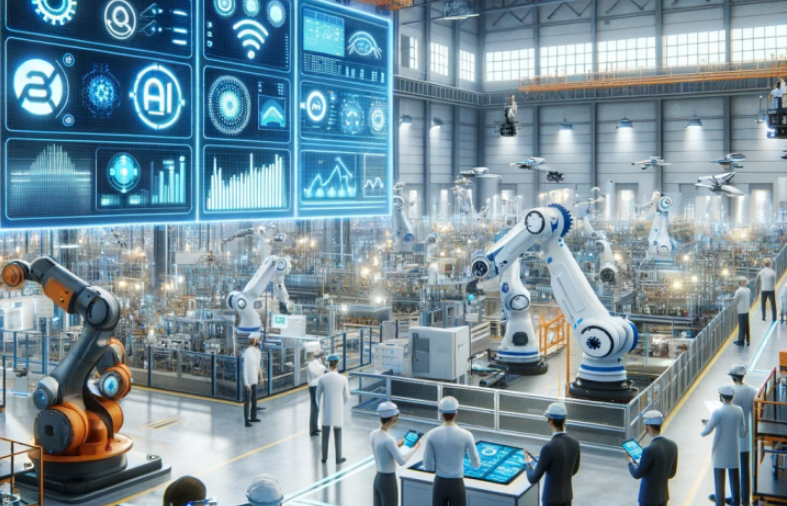
Industry 4.0 is not just “a factory with dashboards.” It is a factory that can sense itself, comprehend itself, and adapt—safely—when the environment changes.
It seems like an abstraction until you apply it to the real problems every plant faces: unexpected downtime, scrap and rework, schedule chaos, energy spikes, labor shortages, late materials, machine leaks, quality defects, and a seemingly endless flow of “exceptions” that are really just normal. AI is helpful in Industry 4.0 if it makes better decisions that can be quantitatively measured in the flow of work that people are doing.
An easy way to keep this honest is to think of Industry 4.0 AI as three layers that have to operate in unison. First, reliable operational data with shared meaning, not just raw signals. Second, AI models that predict uncertainty (risk, time, quality drift, energy peaks). Third, optimization and execution systems that convert predictions into actions under constraints (schedules, maintenance windows, routing materials, inspection plans). When one layer is weak, AI turns into noise.
To make this practical, this guide delves into ten AI application patterns that recur over and over again in successful Industry 4.0 programs. For each, you will learn what it is, why it works, at least one real factory case study, and the implementation aspects that count in production.
Before you “do AI,” you need a factory data system your operators trust. Not a data lake that’s always behind. Not a dashboard that displays a number nobody can agree on. You want a platform that transforms OT signals into meaningful events, contextualizes them to production, and securely delivers them to analytics and AI applications without compromising control reliability.
In Industry 4.0, this usually implies an edge layer near the machines, a secure integration layer that normalizes and time-synchronizes data, and a semantic model that enables interpretation for system-to-system data. Standards are necessary because no factory can afford to have every integration be a custom one. OPC UA is also a de facto interoperability standard for the secure and reliable exchange of industrial automation data, and has been standardized as IEC 62541. The ISA-95 (IEC 62264) suite is intended to organize the information flow between the systems of a business and the control/execution systems of manufacturing. RAMI 4.0 is a reference architecture model that allows participants to talk about the same layers and lifecycle concepts in the realisation of Industrie 4.0.
Le Vaudreuil site description Schneider Electric’s Le Vaudreuil site provides a good example of “one unified control center” mentality: a multilevel maze of operational data is aggregated in a single control center monitoring assets, energy, and processes on a real-time basis, and the site claims energy/carbon and material waste reductions since the launch of its digitalization program. This is not just about “having dashboards.” It’s creating a common operational nervous system that enables decisions at a team level.
Siemens’ Electronics Works Amberg is another such “data foundation” example, with quantifiable claims such as high levels of automation and such extremely high quality rates, that are supported by Siemens product sheets and backgrounders that detail the scale and performance of the factory. A plant doesn’t run on that without intact product data, process data, machine data, and quality systems.
The first “engineering decision” is when to compute. Industry 4.0 factories are adopting edge computing in greater numbers, as OT environments prioritize low latency, deterministic behavior, and resilience in the face of network outages. When the network is down, they say, manufacturing ought still to run and local decisions ought still to be made. Your edge layer- This is also the stage where you can decimate those high-frequency signals into events, so you aren’t streaming raw noise out there.
The second option is the semantic alignment. You can’t train stable models or compare across lines without a shared understanding of what a “job start,” “good part,” “scrap,” “downtime reason,” and “changeover” are. That’s what, for example, standards like ISO 22400 are for, for manufacturing KPIs, which provide consistent definitions and properties for KPIs used in manufacturing operations management. When plants bypass semantic alignment, every AI use case is a contest of semantics.
The third choice is about governance. A factory data foundation has to enable traceability: whenever you calculate a KPI or pull a trigger on an AI action, you have to be able to say what signals and events led up to that. Industry 4.0 plants that are successful at scaling AI generally treat data lineage and auditability as first-class requirements, not as “nice to have later.”
Predictive maintenance answers one question: “Is the risk of failure for an asset increasing to the point where it is likely to fail in the near future?” Prescriptive maintenance addresses the second question: “Based on the risk, what is the optimal maintenance action and when should it be performed so the plant experiences the least loss in value?”
Industry 4.0 plants view maintenance AI as an operational loop, rather than a model. You identify risk from condition signals and contextual information. The insight is routed into the CMMS/EAM workflow. You select an intervention window that takes production constraints into account. And then you learn from the outcomes, and you refresh the model.
Schneider Electric has also demonstrated the use of its predictive maintenance solutions within the broader EcoStruxure framework, including a case study on Senseye PdM utilized to help maintain plant and asset uptime as part of Schneider’s IoT architecture solution. In the spare parts/break-fix world, Siemens has also publicly added a new flavor of Industrial Copilot—expanding it into a generative AI-powered maintenance offering that helps support various stages of the maintenance cycle and brings more predictive maintenance tooling. The implication for practice is that major industrial suppliers are not representing maintenance as “alerts,” but as a lifecycle workflow from detection to planning to execution and learning.
The predominant mode of failure is poor labeling and weak maintenance coding. When your WOs do not consistently record failure modes, your supervised models learn confusion. Industry 4.0 maintenance systems frequently begin with anomaly detection since it is effective even when labels are few, and eventually progress to supervised RUL or failure-mode classifiers as data quality improves.
The next trap is a lack of production context. A bearing that appears “dangerous” might be ok until the next scheduled shutdown based on load, production priority, and availability of the parts. This is why prescriptive maintenance requires planning constraints and parts availability in the loop. In practice, the best solutions combine asset risk signals with maintenance planning calendars and production schedules — employing what is known as “freeze windows” to prevent plans from constantly churning.
Another thing that is typically overlooked is drift. A retrofitted machine, a new material, or a process change can change “normal.” So maintenance AI needs watching on input distributions and alert rates. Plants that mature predictive maintenance cultivate an “alert quality” feedback loop: each alert results in an inspection outcome, and that outcome becomes training feedback.
Quality AI in Industry 4.0 has two roles. First is to identify defects more quickly and reliably than humans or rule-based vision solutions could. Secondly, to ease the burden of quality by allowing human resources to focus where it should be focused.
That includes old-fashioned computer vision inspection, but also acoustic inspection (the machine “listens”) and new methods where AI creates a customized inspection plan for each unit based on what occurred during production.
BMW’s Plant Regensburg has publicly disclosed the details of a pilot termed “GenAI4Q,” which involves an AI system that creates a tailored inspection catalog for each car after scrutinizing vehicle configuration information and production data in real time, and then offers a prioritized inspection plan via a smartphone app. This is a very “Industry 4.0” prototype: AI does not substitute inspections; it enhances inspections to be smarter and more context-based.
BMW also runs a dedicated Vision and Sound Analytics Service on AWS, billed as one that ingests image and audio files in high volumes and enables petabyte-scale data processing for AI research and development. That’s not “marketing fluff.” It signals an architectural reality that advanced quality AI usually will need an internal data platform that can hold, index, and serve multimodal production evidence at scale.
Bosch has many real-world examples of AI for manufacturing quality, such as using AI to lighten the load for human visual inspectors by pre-screening what they must look at, and using noise analysis, where a microphone “hears” a tool and AI tells if it’s OK or not OK, to reliably inspect massive quantities. These are valuable because they represent three levels of maturity: assisting humans, surfacing earlier detection, and scale inspection with common rules.
The first engineering decision is at what point inference runs. In-line inspection is often required to be low-latency. That brings inference to the edge, near the camera or sensor. The data platform then stores only what is needed – defect images, borderline cases, and samples for drift monitoring, since saving every frame is costly and often unnecessary.
The second decision is what you do with false rejects. In a factory, too many false rejects can clog the line and breed mistrust. Good rollouts typically start in “shadow mode,” with the model running silently alongside humans and comparing, then move to “assist mode,” where the model prioritizes human review on what to look at, and finally to “gate mode,” where it can automatically block at high confidence and trigger an automatic reject at high confidence.
The third choice is the governance of the labeling. Labels of quality are not necessarily binary. Many defects are borderline; what is acceptable depends on customer necessity. Industry 4.0 plants rolling out quality AI write detailed labeling protocols, establish escalation paths for ambiguous cases, and consider label drift as a real operational risk.
A test just tells you that a failure occurs. Predictive quality aims to prevent it before it occurs by identifying process drifts that are indicative of future defects.
In terms of Industry 4.0, this is moving from end-of-line detection to “quality built in.” The model discovers patterns of sensor readings, machine parameters, and sequence events prior to quality deviations, and unveils potential contributing factors to quality deviations.
Bosch, for example, explicitly mentions employing AI to assist with root-cause analysis by analyzing massive amounts of MES data to generate ranked lists of possible causes sorted by probability to help teams determine “why rejects occur at the end of production.” Bosch also outlines an outlier detection approach in a wafer fab (Dresden) to identify outliers early and preserve process stability, presenting it as “continuously improving quality and shortening customer tests that consume a lot of time.” These illustrations matter precisely because they reflect the truth that predictive quality is much more powerful as a “decision support” and drift detection “system” than as a naive classifier.
The only necessary thing is traceability: you have to relate every quality result to the specific process context. Which means genealogy: material lot, machine, recipe version, tool ID, operator shift, environmental conditions, and measurement context. If you can’t do that, your model will produce correlations that look interesting, but you can’t do anything about them.
The next condition is causal humility. There are lots of correlated variables in manufacturing data. A silly model can latch onto a proxy that is totally unrelated to the real cause. Plants that are successful in predictive quality either perform controlled experiments or adopt domain constraints so that the model’s “top factors” are believable and actionable by process engineers.
The final requirement is integration with process control. Predictive quality analysis is not “a dashboard.” It is an alerting system that initiates investigations, holds, recipe changes, or tool inspections, and it has to monitor if those interventions actually decreased the risk of defects.
Planning AI for Industry 4.0 is not intended to produce “the perfect schedule.” It’s about producing a realistic schedule that obeys real constraints and keeping it stable enough for the floor to run it.
It combines constraint-based optimization with predictive models that quantify cycle time variability, impact of changeover, and risk of delay. AI is important because factories exist in uncertainty: a given job doesn’t always take the same amount of time, and the same line doesn’t always perform the same way.
Bosch offers a quite uncommon, straight account of AI for production scheduling in very high automation in wafer fabs, reporting that AI moves wafers through as many as 1,000 processing steps, considers material availability, and in many cases makes sequencing decisions on its own to maximize capacity utilization. Whether your factory is a wafer fab or not, the lesson is this: when complexity and route steps get high, manual scheduling becomes the bottleneck.
Also, Siemens’ Amberg plant is reported to have a very high percentage of automation and very high quality production, and Siemens references the plant scale, percentage of automation, and quality rate as a mature “digital enterprise” planning and execution based rather than ad-hoc scheduling.
It’s when Scheduling AI goes about its business and ignores the invisible constraints. Tooling, qualification rules, sequence-dependent changeovers, labor skills, maintenance windows, quality holds, batch sizes, and work-in-process (WIP) limits are all constraints in real factories. People lose trust in the schedule if it keeps crashing against constraints.
Mature systems treat constraints as declarative configuration and not hard-coded logic. They also have ‘freeze horizons’ and stability penalties to keep the schedule from churning. That stability isn’t a luxury; it’s a prerequisite for trust.
And finally, the KPI layer matters. Without unified KPIs, you can’t demonstrate that scheduling AI helps. The KPIs applied in manufacturing OPM are explicitly defined in ISO 22400, together with their behavior and usage. Scale planning AI plants monitor schedule compliance, throughput, and cycle time, WIP, changeover losses, and the true cost of expedite and rework.
A digital twin is a dynamic representation of a product, process, or resource that remains linked to real-world operations. Twins are useful in Industry 4.0 when they decrease the cost and hazard of change.
You perform virtual what-if analyses, validate newly configured systems, simulate bottlenecks, and even run real-time optimization as the model is calibrated using a digital twin.
General principles and requirements of the digital twin are described in the ISO 23247 series for a digital twin framework for manufacturing, published by the ISO. NIST released a white paper characterizing ISO 23247 as a generic framework that may be specialized for specific manufacturing paradigms such as discrete, batch, or continuous. This matters because “digital twin” isn’t just a vendor phrase anymore; it’s starting to be standardized, which can keep plants from going down dead-end architecture paths.
At the factory end, Siemens has for some time pointed to its Amberg facility as a digital factory exemplar, and related Siemens literature depicts how high automation and end-to-end data enable digital enterprise practices. NavVis also released a case study on work with Siemens Amberg to deliver a fully immersive digital twin of an indoor space, which can be seen as a practical twin category: facility-level spatial twins supporting planning, layout, and operations.
The largest mode of failure is the creation of a beauty twin that is not calibrated. A twin that assumes perfect uptime, perfect labor, and fixed cycle times will generate plans that don’t work. It must learn distributions: downtime patterns, cycle time variability, defect/rework loops, and material arrival variability .
The second failure mode is to account for the twin as “one model”. In reality, factories operate several twins: asset twins to maintain, process twins for cycle behavior, line twins for throughput, and facility twins for flows. The integration between them is the “digital thread,” which links lifecycle information from design to operation. You’re not trying to simulate everything; you’re simulating what drives decisions.
Industry 4.0 factories are increasingly automating their internal logistics, as it is in the material flow that time vanishes. They spend hours moving pallets, staging parts, hunting down missing items, and managing exceptions.
Two things related to AI are relevant here. It enables robots to be more capable (perception, grasping, navigation). And it also makes orchestration more intelligent (which robot moves what, when, along which path, with which priority).
Le Vaudreuil is said to employ driverless cars and collaborative robots on its daily production flow, and the site’s integrated control room offers real-time visibility and notifications. This is a standard Industry 4.0 recipe: intralogistics automation combined with centralized operational intelligence.
Amazon’s “Vulcan” robot is a good example of what “physical AI” is turning into: Amazon touts Vulcan as a robot with a sense of touch based on breakthroughs in robotics and physical AI, which can manipulate items more safely and efficiently. Additional technical context is provided by Amazon Science, with force/torque sensing and motion planning to deal with contact with random items. Even if you’re not building an Amazon-sized warehouse, the lesson matters for factories: robotics capability is increasingly defined by AI perception and control, rather than just mechanical automation.
Robotics projects tend to skid to a halt when they automate motion, but fail to automate orchestration. A fleet of AMRs can cause congestion if you don’t control traffic and priorities. A picking robot may improve throughput but result in a packing bottleneck downstream. Driverless transport can cut labor yet increase exception handling if inventory accuracy is poor.
Successful Industry 4.0 deployments are those where robotics is integrated with WMS/MES such that the tasks being performed by robots arise from genuine needs in production, and where robot telemetry is operational data: you are tracking cycle time, queue depth, congestion, and intervention rates. The “robot” is not the answer; the answer is the system that makes robots dependable and useful.
Energy is wasted in factories because the systems of utilities are complex, and production changes. AI contributes to forecasting energy consumption, identifying unusual consumption, and scheduling energy-intensive processes in within constraints.
Bosch presents an AI-driven energy management system at its Changsha plant that forecasts energy use for production lines and considers demand forecasts, production schedules, weather, temperature, and humidity. The system reports that energy use is being lowered along with electricity consumption and CO₂ emissions. Schneider Electric’s site in Le Vaudreuil is said to have cut its energy and carbon consumption by 25% and its materials waste by 17% since the launch of its digitisation journey, which is part of its wider Industry 4.0 transformation and integrated operational visibility.
There is value in these because they tie AI to operational levers as opposed to fuzzy sustainability assertions. They also illustrate that energy AI is frequently a problem of planning, where you must align production schedules with the availability and cost of energy.
Energy AI breaks down when process quality is compromised. A plant cannot “optimize energy” by drifting outside of validated process windows. So good implementations define safe operating envelopes and optimize within them.
The other big pitfall is measurement dishonesty. Energy savings need to be normalized by throughput and product mix. Otherwise, the “savings” may be a result of producing less. Energy per unit, peak demand charges, and the time correlation between energy consumption patterns and production events are all monitored in Industry 4.0 energy systems.
Industry 4.0 plants are connected plants, and connected plants have connected risks. Now the sources of disruption include supplier instability, logistics volatility, energy constraints, and cyberattacks on OT and industrial IoT.
Risk monitoring AI is valuable when it makes one less “surprised.” It does so by constantly observing signals, identifying anomalies, and tying those anomalies into business: which orders, lines, and products are at risk, and how much time has left until pain strikes.
The World Economic Forum conversation on lighthouse factories explicitly states that digitized manufacturing demands regulation in terms of data formats and cybersecurity, and it depicts operational resilience and sustainability as priority level one, along with productivity. That’s not theory. That is what many manufacturers discovered after a host of global shocks: visibility and early warning are now competitive capabilities.
And on the cybersecurity front, NIST SP 800-82 Rev. 3 (“Guide to Industrial Control Systems (ICS) Security”), addresses securing OT while meeting performance, reliability, and safety considerations. ISA/IEC 62443 specifies the requirements and defines the processes to establish and maintain an electronically secure IACS that operates between IT and OT, as well as process safety and cybersecurity. Furthermore, GOVERN is given an increased prominence in NIST CSF 2.0, and Cybersecurity Supply Chain Risk Management is now explicitly called out as part of the GOVERN function in NIST CSF 2.0.
Risk tracking breaks down when it turns into alert spam. Impact-based prioritization is the only path that will hold us sustainable. A risk event is significant if it disrupts your critical flows and you do not have a buffer. So risk monitoring has to link into your operational graph: your suppliers, your parts, your inventory, your production schedules, your orders.
In OT security, AI is frequently applied for anomaly detection on network and asset behavior; however, it needs to be created to assist incident workflows. Plants must be able to say: what changed, where, and what are we going to do to contain it. This is why the guidance for OT security highlights technical controls and operational processes, and not just products.
Generative AI in Industry 4.0 only becomes valuable if it reduces the “cognitive and documentation load” without inventing facts or changing the behavior of control in an unsafe way.
In a factory, there’s endless knowledge work to be done — writing maintenance instructions, summarizing alarms and logs, drafting shift handovers, formulating troubleshooting steps, searching through manuals, generating inspection checklists, and even helping automation engineers with code and configuration.
Siemens touts its Industrial Copilot as a generative AI solution for industrial use cases across the value chain, and Siemens has publicly discussed capabilities such as enabling automation engineering work. Siemens also revealed a pivot toward AI agents that can collaborate across its Industrial Copilot ecosystem, outlining an orchestrator architecture that moves away from “assistant” toward more autonomous process execution. Siemens’ generative AI solution focused on maintenance provides a further indication: Copilot templates applied to the maintenance lifecycle, integrated with predictive maintenance tools.
BMW’s example from GenAI4Q is also relevant here, as it not only leverages AI to generate customized inspection catalogs by vehicle but also is part of a smartphone workflow for inspectors, demonstrating how “AI guidance” can reduce cognitive load by removing the decision maker from having to make the final decision.
Industrial copilots go wrong when they hallucinate or when they have too much power. In the industrial world, an inaccurate direction can cause downtime or safety incidents. So copilots should be grounded: they fetch from sanctioned sources (manuals, SOPs, CMMS history, vetted knowledge bases), cite sources directly in the UI, and keep humans in the loop for high-risk actions.
When you link copilots to tools—such as issuing work orders, modifying parameters, or producing PLC code—you need to establish rigorous permissioning, audit logs, and change control. In industrial operations, “who changed what, when, and why” is non-negotiable. It’s operational safety.
The most predictable path to full maturity is one of staged autonomy. Begin with summarization and drafting. Take advantage of guided workflows that suggest what to do. And then think about limited autonomous execution for low-risk, reversible activities, well-bounded and monitored.
Scalable Industry 4.0 solutions have a few non-negotiable engineering disciplines in common.
They homogenize meaning. You can have a stream of sensor data and still fail if you don’t define what a job, a unit, a defect, a downtime event, and a changeover are across systems. This is what makes standards and reference models matter: OPC UA for interoperable industrial data exchange, ISA-95 for enterprise-to-control integration, RAMI 4.0 for architectural alignment, ISO 22400 for KPI definitions, and ISO 23247 for digital twin framing.
They construct closed loops. All AI outputs must correspond to an action, and all actions must generate feedback data. Predictive maintenance alerts have to yield inspection results. Review results must be generated by quality flags. Execution results should be produced by the schedule suggestions. If your system can’t learn from the real world, it will drift and become untrusted
Reliability is considered a feature by them. OT environments are subject to different constraints than web applications. Systems must be able to cope with process crashes, network partitions, and deterministic control requirements. That often means edge computing and a salt and pepper separation between control networks and analytics networks.
So they treat cybersecurity as part of design; they don’t treat it as an add-on. Industry 4.0 brings more connectivity, which brings a greater attack surface. OT security guidance exists because the performance and safety requirements shift the security playbook. NIST SP 800-82 Rev. 3 and ISA/IEC 62443 are not “compliance checkboxes.” They reflect the reality of working to protect OT networks and industrial control systems. Supply chain risk governance is made explicit in NIST CSF 2.0, which is increasingly relevant as factories rely on vendors, cloud services, and connected devices.
They are outcome measurements, not measures of model accuracy. A plant doesn’t purchase “AI.” It results in less downtime, less scrap, more throughput, better energy per unit, better schedule conformance, and less risk. This is why scalable AI plants are built on standardized KPIs and uniform measurements.