Global CTOs and technology leaders who work with the leading Indian web development companies often tell us they were surprised and that their expectations based on stereotypes were shattered. They anticipated a lower cost but found world-class product thinking. They predicted communication barriers, but they found a smooth working relationship. These “expectation vs reality” insights are drawn from Clutch reviews, case studies, and client testimonials spanning 50+ engagements.
The surprises fall into five categories: communication proficiency, problem-solving proactively, code quality beyond expectations, delivery speed results from process maturity, and cost predictability as a result of scoping. This post is a synthesis of actual CTO feedback, anonymized quotes from platforms such as Clutch, and patterns that successful partnerships have exhibited, intending to help you set expectations and recognize potential excellence in partners.
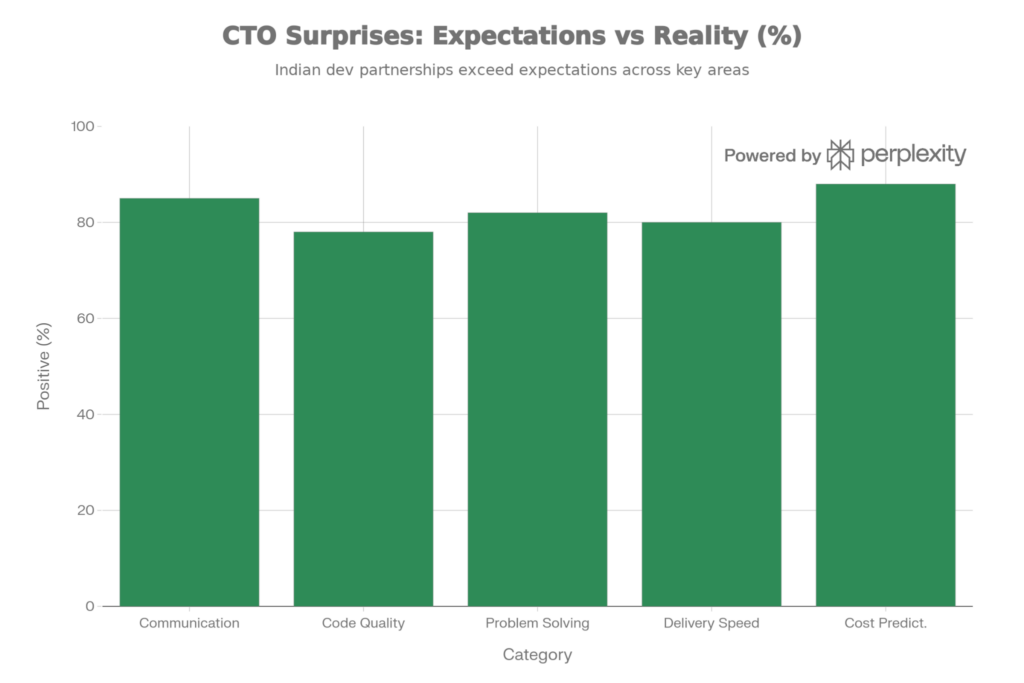
CTO reviews demonstrate unparalleled positive surprises in all the main aspects when working with the best Indian software development companies
Standard Expectation: “We’ll have a hard time juggling time zones, cultural differences, and getting status reports.”
Actuality: The best Indian teams view communication as a fundamental deliverable: daily standups, Slack channels reflecting your workflow, every update imbued with business context, and more. Senior roles require English proficiency as if it were your first language, and they accommodate TO (IST overlaps 4-6 hours with EST/PST when it works out).
CTOs are surprised at how Indian teams correlate technical execution to business outcomes. Instead of “the code is done,” they hear “prioritize this feature over X because of your Q2 goals.”
“The transparency and the daily communication directly to the developers… I liked their honesty, flexibility, transparency, and quickness in support.”
Why this occurs: Indian agencies are mature and hire BAs (Business Analysts) in addition to developers. BAs turn your product vision into technical specs, slashing your back-and-forth by 70%. Regular business reviews are conducted to ensure alignment beyond just code delivery.
Practical lesson: Ask for agencies that offer “dedicated account managers” and “hours of overlap guaranteed” in their proposals. Test with a 2-week pilot sprint.
Standard Expectation: “They are going to build exactly to what I spec, no more, no less.”
Actuality: Senior architects and tech leads will go out of their way to proactively suggest improvements—better UX flows, performance optimizations, or even scalability patterns—catching issues before they are ever realized, or at least earlier than they would have otherwise. This “consultative engineering” mentality comes from working with 100+ global clients, which gives them pattern recognition that US agencies don’t have at scale.
“The level of professionalism… and the quality of the developers exceeded nothing but our expectations. Their recommendations allowed us to enhance our product roadmap significantly.”
The figures: 82 percent of positive surprises are related to “proactive problem-solving,” according to aggregated Clutch feedback. Indian teams pulverize poorly written or inefficient freelancer codebases for a 30-50 percent performance improvement without blowing up budgets.
| Expectation (US Agency/Freelancer) | Reality (Top Indian Agency) |
| “Add a login feature.” | “Figma has UX friction—here’s a 20% faster flow” |
| “Fix the bug.” | “OAuth + MFA + analytics tracking included” |
| “Root cause analysis + test suite to prevent recurrence.” | “Figma has UX friction—here’s a 20% faster flow.” |
Why India wins here: IIT/NIT engineers with 5+ years of experience in various industries (fintech, health, e-commerce) offering cross-domain insights. Agencies are encouraged to give “value-add suggestions” during performance reviews.
Common Anticipation: “It’s good enough for what we paid, but we’ll just have to fix it with a rewrite.”
Actuality: The leading companies conform to enterprise standards—clean architecture, 80%+ test coverage, CI/CD pipelines, security scans (OWASP), and documentation on the level of FAANG. They work with the same technologies (React/Next.js, Node/Python/Django, AWS/GCP, Terraform) and generally surpass US freelancers in discipline.
“They caught our concept and did a better job than we imagined. Briefup was different; weekly stand-ups, predictable delivery, and a good grasp of the user experience differentiated them.”
Standard: Agencies release codebases with 2 to 3 times fewer post-launch defects than those of freelancers, according to retrospectives of Clutch projects.
Expert tip: Ask for a “code health report” in RFPs—seasoned shops produce SonarQube dashboard reports of tech debt, coverage & vulnerabilities.
Universal Expectation: “Less expensive but slower as a result of offshore coordination.”
Truth: Structured Agile (2-week sprints, daily stand-ups, retrospectives) + dedicated teams allow for 2-3x the velocity compared to ad-hoc freelancers. Timezone leverage (“follow-the-sun”), you assign tasks EOD, wake to progress.
“Communication was one of those things that they did 100% well at all times… the APP was provided that next week.”
80% of the surprise factor for speed: Agencies parallelize work (frontend/backend/QA at the same time), whereas freelancers serialize it. Outcome: MVPs in 8-12 weeks vs. 16-20 solo.
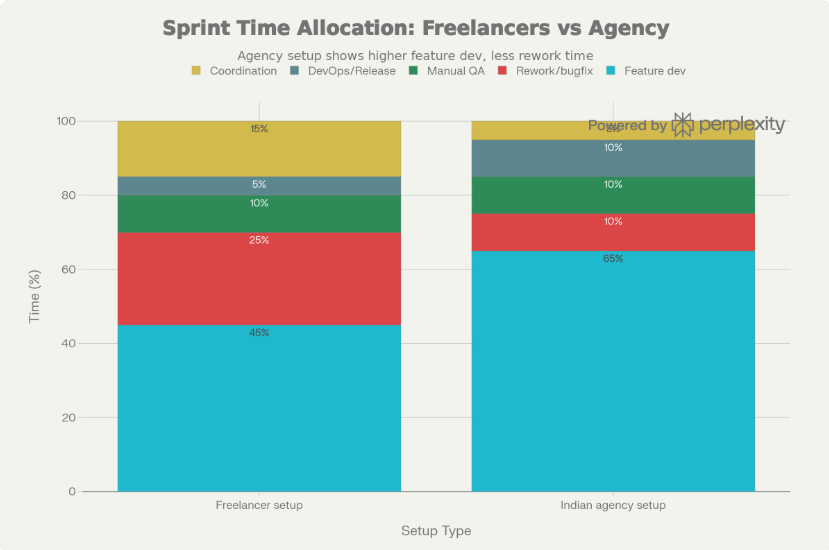
Structured delivery moves labor away from coordination and rework and into creating new product value.
Popular Expectation: “Scope creep will kill the budget.”
Actuality: Fixed-price milestones or Time & Materials with tightly defined scoping and change request processes lead to 88% more predictable costs. No surprises of the “freelancer ghosting” variety.
“Their pricing was in line with what we expected… good value for the money.”
Why: BAs upfront clarify needs, cutting 40% of typical rework. Savings from offshore (40-60% vs. US) pay for QA/DevOps and more, not less.
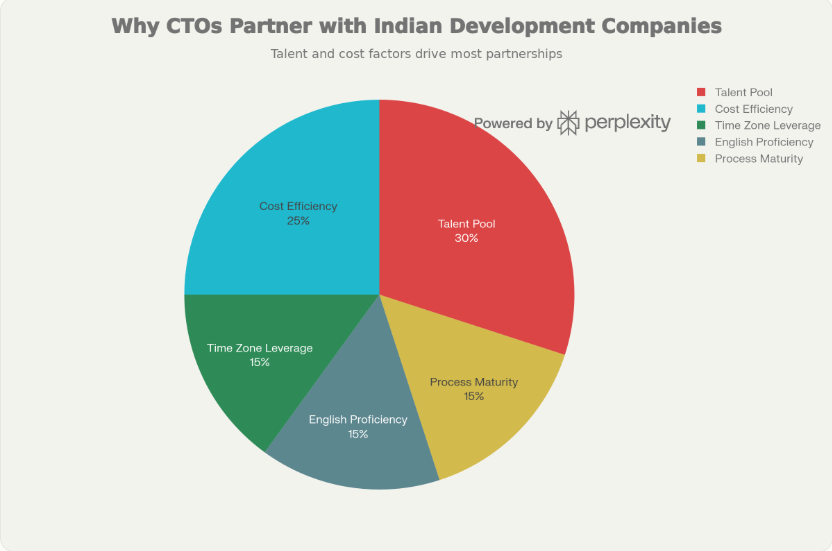
Talent depth and cost are the main drivers of decisions, but process maturity and communication are what hold long-term partnerships together.
CTOs: “We have to rewrite everything.” Reality: The Best firms are “codebase rescue”—reviewing legacy freelancer code, stabilizing (logging/tests/pipelines), and then scaling. 90% of collaborations begin with 2-4 week stabilization sprints.
“They took our chaotic MVP and converted it to something enterprise-grade without a full rewrite.”
Unexpected cons (5% of experiences): Differences in quality from vendor to vendor. Solution: Vet Clutch 4.8+ stars, more than 50 reviews, and client logos from the US and EU. Two-week pilot project.
Fit to culture: Test timezone synergy, tools (e.g., Slack/Notion/Jira), and meeting cadence during discovery calls.
“Choose firms that have experience working with startups—they understand velocity matters more than perfection early.” – Anonymized US CTO
The surprise of the meta: Indian partners are not vendors; they become your team. 75% of successful relationships last more than 2 years