For the past 20 years or so, “outsourcing to India” was synonymous with Bangalore. The city’s meteoric rise in fame led to it being called “India’s Silicon Valley” and garnering corporate attention in the form of Fortune 500 Global Capability Centers (GCCs) and hyper-growth startups.
However, the story is changing in 2025. The same elements that propelled Bangalore’s ascendancy—density, competition, and rapid growth—have created a breaking point marked by soaring costs of doing business and a “revolving door” talent crisis.
Enter Kerala. In particular, the twin tech corridors of Technopark (Thiruvananthapuram) and Infopark (Kochi).
This is not simply a narrative about “lower rates.” It’s a story about stability, predictability, and value. For the CTOs and product heads, Kerala has become the ‘Goldilocks Zone’ for Indian tech—large enough to provide world-class infrastructure and depth of talent, yet small enough to hold on to the loyalty and focus the overheated metros have lost.
If you have recently run a remote team in Bangalore or Hyderabad, you know the drill: You hire a Senior Architect. After three months, they get poached by a VC-backed unicorn with a 40% bump. You start the hiring process again. The project comes to a halt.
Data backs up this frustration. In India’s Tier-1 cities, the average tenure of a software engineer has fallen to 1.4 years. In contrast, the retention rates in the tech parks of Kerala are far better.
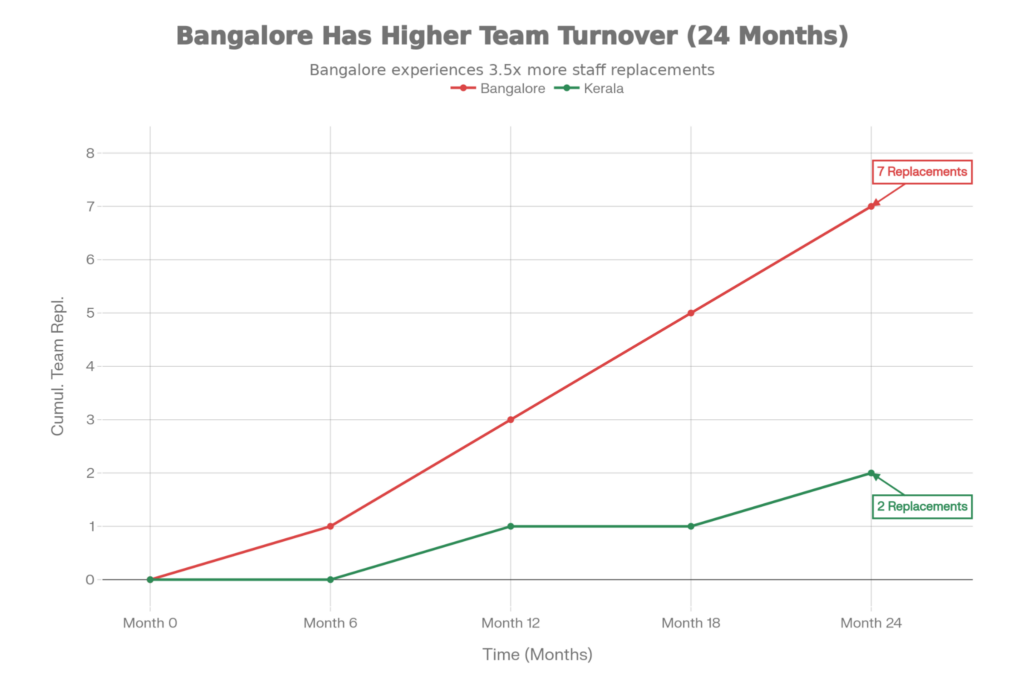
The ‘Revolving Door’ Risk: Attrition-related project disruption over 24 months
As the above chart shows, your team could turn over 7 times on a 24-month project in Bangalore. Each turnover incurs a “knowledge transfer” tax—the weeks lost while a new developer gets up to speed on your codebase. In Kerala, the curve is flat. You will probably end the project with more or less the same core team that began it. This continuity has been the single best predictor of the quality of software for many years.
There is a misconception that “Tier-2″ equals ”Lower Skill.” The reality is that the price difference is dictated by the macroeconomic factors rather than the micro-competence.
The city of Bangalore is one of the most expensive places to live in India. Rent in tech corridors like Whitefield has multiplied by 98 percent compared to Trivandrum. A Bangalore developer needs to be paid 50-60% more than a Keralite to keep up his standard of living.
Bangalore-based agencies pass this overhead to you. Kerala agencies need not.
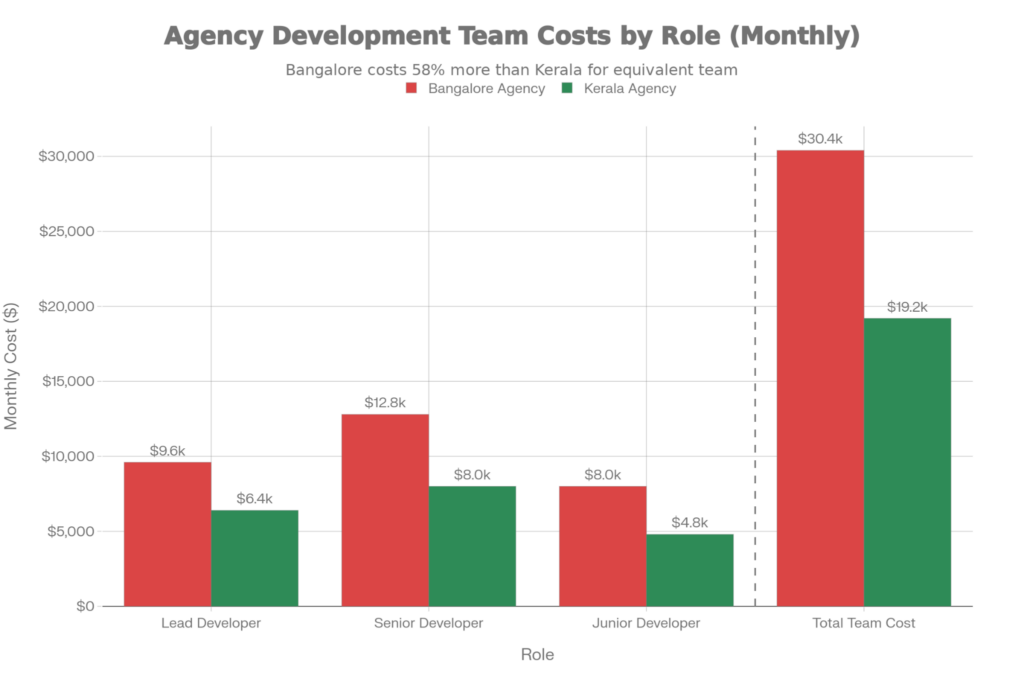
Comparison of Client “Burn Rate”: Monthly Expenses for a Five-Person Team
For a typical 5-person team (1 Lead, 2 Seniors, 2 Juniors), the monthly “burn rate” in Kerala is around $11,000 less than in Bangalore.
Over a year, that’s a saving of $134,400—which could be spent on hiring two more AI researchers or doubling your marketing budget. Significantly, you are not being charged for superior code from Bangalore; you are being charged for the developer’s higher rent and longer commute.
One frequent concern among foreign customers is, “If the talent is so strong, why aren’t they in Bangalore?”
The answer is in the Paradox of Disposable Income.
Most senior developers (10+ years experience) move back to Kerala after spending their 20s in Bangalore. They come back for the quality of life—less traffic, cleaner air, and being near family—but they don’t want to give up their financial savings.
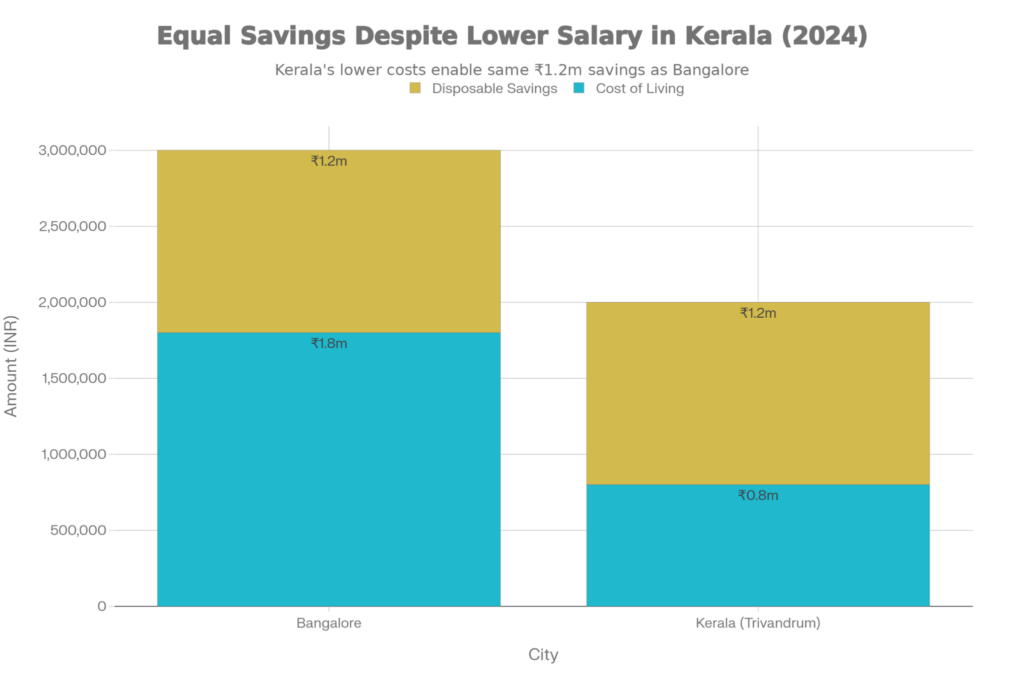
The Developer’s Wallet: Why Lower Pay Doesn’t Equate to Lower Quality in Kerala
As shown above, a developer making ₹30 Lakhs (36k) in Bangalore often ends up saving less than a developer making ₹20 Lakhs (24k) in Kerala.
This economic reality draws a particular talent pool: Senior, experienced professionals seeking stability. These are exactly the engineering talents you want to be running your critical infrastructure—not the “job hoppers” looking for their next 10% raise.
Kerala is not an ordinary Indian state. It ranks #1 consistently in the Human Development Index (HDI) and has the highest literacy rate in India (94%).
There are two ways in which this affects our daily stand-up meetings:
Let’s forget the image of the freelancer working out of a coffee shop. Trivandrum-based Technopark is the largest IT Park in Asia by built-up area and the place for 450+ companies, including Nissan, Allianz, Oracle, and a myriad of specialized SMEs. Infopark Kochi is also a hub for SaaS and AI innovation.
Kerala is not a place for all. If you require a team of 500 developers to begin work tomorrow in a colossal BPO venture, the sheer scale of Bangalore or NCR might be called for.
Kerala, however, is the Sweet Spot for:
In the changing dynamics of Indian IT, the smart money does not seem to be blindly following the herd to Bangalore. It is also making its green, sustainable, and highly literate Kerala tech hubs home.